GUIDE

The Tummy Time Guide

When to start, how long by age, positions that work, and what to do when your baby absolutely hates it.

Tummy time is one of those things that sounds simple until you try it and your baby screams like you've betrayed them. It matters more than you'd think for motor development — and there are ways to make it less miserable for everyone.

Why Tummy Time Actually Matters

  • Builds neck, shoulder, and arm strength needed for holding their head up, rolling, and eventually crawling
  • Strengthens core muscles that support sitting, standing, and walking
  • Prevents flat spots on the back of the head (positional plagiocephaly) from too much time on their back
  • Develops hand-eye coordination and visual tracking as baby learns to look around from a new angle
  • Promotes sensory development — new perspective, new textures against their hands and body
  • Builds the foundation for fine motor skills like reaching, grasping, and eventually writing
  • Supports healthy hip development and reduces risk of torticollis (tight neck muscles)

The AAP recommends tummy time from day one for all full-term babies. Tummy time directly supports every major motor milestone your baby will hit in the first year.

How Much Tummy Time by Age
Newborn (0–2 weeks)
Session Length1–2 min, 2–3x/day
Total Daily3–5 min
Best PositionOn your chest or lap
Milestone to Watch ForBriefly lifts or turns head
2–6 weeks
Session Length1–3 min, 3–4x/day
Total Daily5–10 min
Best PositionChest, lap, or floor
Milestone to Watch ForLifts head 45 degrees briefly
6 weeks – 3 months
Session Length3–5 min, 3–5x/day
Total Daily15–30 min
Best PositionFloor with support if needed
Milestone to Watch ForLifts head 45–90 degrees, pushes up on forearms
3–4 months
Session Length5–10 min, 4–5x/day
Total Daily30–60 min
Best PositionFloor, no support needed
Milestone to Watch ForHolds head at 90 degrees, pushes up on extended arms
4–6 months
Session Length10–20 min sessions
Total Daily60+ min
Best PositionFloor, reaching for toys
Milestone to Watch ForRolls tummy to back, pivots in a circle, reaches with one arm
6+ months
Session LengthAs tolerated
Total DailyAs much as they want
Best PositionFree play on the floor
Milestone to Watch ForRocking on hands and knees, army crawling, full crawling
These are guidelines, not requirements. Any tummy time is better than no tummy time. Build up gradually and follow your baby's lead.

6 Tummy Time Positions to Try

Floor time isn't the only option. Here are 6 ways to get tummy time in — some don't even require a floor.

Chest-to-Chest (Newborn Favorite)

0+ weeks
Lie back at a slight recline and place baby tummy-down on your chest. This is the gentlest introduction to tummy time — your baby gets the developmental benefits while also getting skin-to-skin contact and your heartbeat.
Tips
  • Great for the first few weeks when floor time feels too intense
  • Works well right after a feeding (slightly reclined helps with reflux)
  • Talk or sing to encourage them to lift their head to see your face
  • Counts as tummy time even though it doesn't look like it

Lap Tummy Time

0+ weeks
Place baby face-down across your lap. One hand on their back for security. You can gently pat or rub their back. This gives them the tummy-down position with the comfort of your body underneath.
Tips
  • Great transition between chest time and floor time
  • Can be combined with burping — they're already in position
  • Gently rock your legs side to side for a soothing motion
  • Easy to do anywhere — no floor space needed

Floor Time (Classic)

2+ weeks
Place baby tummy-down on a firm, flat surface with a play mat or blanket. Get down at their level so they can see your face. This is the gold standard for building strength.
Tips
  • Start after the 2-week mark when baby has a bit more strength
  • A rolled-up receiving blanket or small towel under the chest can help in the beginning
  • Place a mirror in front of them — babies love looking at faces, even their own
  • Colorful toys at eye level encourage head-lifting and reaching

Football Hold (On-the-Go)

0+ weeks
Hold baby face-down along your forearm, with their head near your elbow and legs straddling your hand. Support their chest with your palm. Walk around the house — the movement and new view can be soothing.
Tips
  • Great for fussy babies who won't tolerate floor time yet
  • The slight pressure on their belly can help with gas
  • Walk around and narrate what you see — language development bonus
  • Counts as tummy time even though baby isn't on the ground

Tummy Time on a Boppy or Rolled Towel

2+ weeks
Place a firm nursing pillow or tightly rolled towel under baby's chest and armpits, so their arms are forward and head is slightly elevated. This reduces the 'face-plant' feeling that many babies hate.
Tips
  • The elevation makes it easier for them to lift their head — builds confidence
  • Arms should be in front of the support, not tucked under their body
  • Remove the support as they get stronger to increase the challenge
  • Never leave baby unattended on a pillow or prop

Side-Lying Play

0+ weeks
Place baby on their side (supported by a rolled blanket behind their back) and play with toys in front of them. This builds the same muscles as tummy time with less gravity working against them.
Tips
  • Good for babies who absolutely refuse tummy-down positions
  • Alternate sides to work both sides of the body evenly
  • Builds the core strength needed for rolling
  • A stepping stone to traditional tummy time — not a permanent replacement
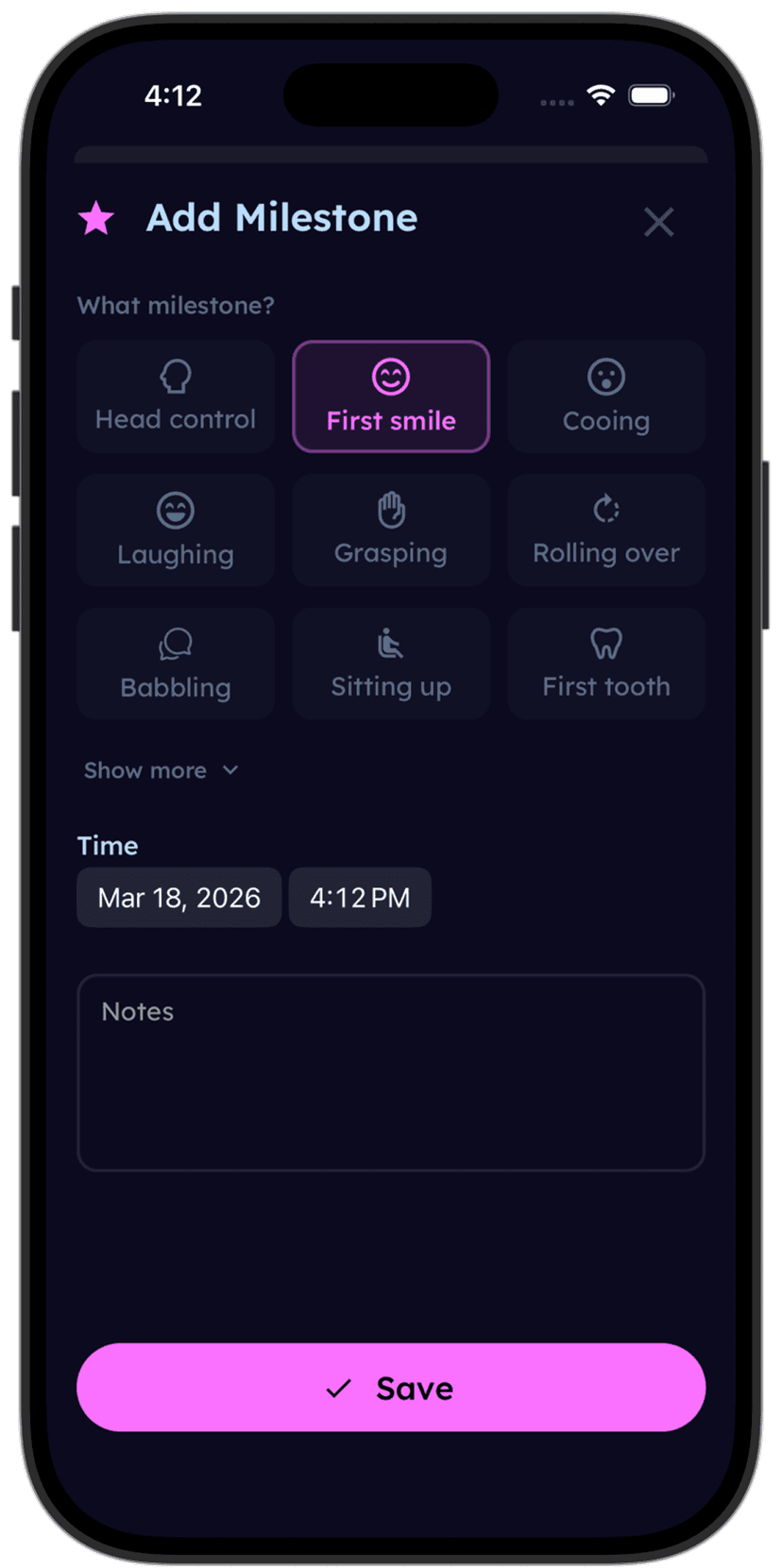
tinylog milestone tracking showing developmental progress

tinylog tracks tummy time and milestones together.

Log tummy time sessions with one tap and record milestones as they happen — first head lift, first roll, first push-up. See your baby's progress over time.

Download on the App StoreGet It On Google Play

What to Do When Baby Hates Tummy Time

If your baby screams the second they're placed face-down, you're not alone. Here's how to make it work anyway.

Start ridiculously small

Even 30 seconds counts. One minute counts. The goal is to build positive associations, not hit a time target. If they last 90 seconds before fussing, that's a successful session. You can always add more time later.

Timing matters more than you think

Try tummy time when your baby is well-rested and fed (but not immediately after — wait 15–20 minutes after a feed to avoid spit-up). Right after a diaper change is often a sweet spot. Never during a tired or hungry meltdown.

Get on the floor with them

Your face is the most interesting thing in your baby's world. Get down at their eye level, talk to them, make silly faces. Suddenly tummy time is face-time-with-my-favorite-person time.

Use distractions strategically

High-contrast cards or books propped up at eye level, a small mirror, a crinkly toy, or even your phone playing a video of themselves — anything that captures their attention long enough to forget they're doing tummy time.

Try a different position

Floor tummy time isn't the only option. Chest time, lap time, football hold, or a Boppy pillow all count. If they hate the floor, work up to it gradually over weeks.

Normalize the fussing

Some fussing is okay — it's hard work and they're letting you know. There's a difference between 'this is hard and I don't love it' fussing and 'I'm in distress' crying. Learn your baby's signals and honor the real distress, but know that mild protest is normal.


When to Talk to Your Pediatrician

  • Baby consistently cannot lift their head at all by 2 months of age
  • Strong head tilt to one side every time (may indicate torticollis — very treatable)
  • Doesn't push up on forearms by 4 months despite regular tummy time
  • One side of the body seems significantly weaker than the other
  • Baby seems to be in pain (not just fussing) during tummy time
  • No interest in reaching for objects by 4–5 months
  • Persistent flat spot on the head that isn't improving with repositioning

Most of these are easily addressed with early intervention — physical therapy, repositioning techniques, or simple exercises your pediatrician can show you. Earlier is always better.

Related Guides

Sources

American Academy of Pediatrics. (2022). Back to Sleep, Tummy to Play.
Pathways.org. (2023). Tummy Time for Babies: When to Start and How to Do It.
Dudek-Shriber, L., & Zelazny, S. (2007). The Effects of Prone Positioning on Motor Development. Journal of Perinatology.
Kuo, Y. L., et al. (2008). Developmental Changes in Prone Positional Play. Developmental Medicine & Child Neurology.
Pin, T., et al. (2007). The Relationships of Prone and Supine Sleep Position to Motor Milestones. Pediatrics.
Get this guide in your inbox.
We'll send you the full tummy time guide with age-by-age milestones and position ideas you can reference anytime.
Track milestones as they happen.
Download ${appName} free — log tummy time sessions and developmental milestones so you never forget when your baby first rolled over.
Download on the App StoreGet It On Google Play