
The 6-week growth spurt plus peak fussiness is brutal
They hit at the same time. More eating, more crying, less sleeping. It's temporary, but 'temporary' feels like a lie when you're in the middle of it. It typically lasts a few days.
GUIDE
Published on
This is the hardest week — and the social smile is about to change everything.
Fussiness peaks now, sleep deprivation is cumulative, and you're deep in the trenches. But somewhere around this week, your baby is going to smile at you on purpose. And it will change how you feel about all of it.
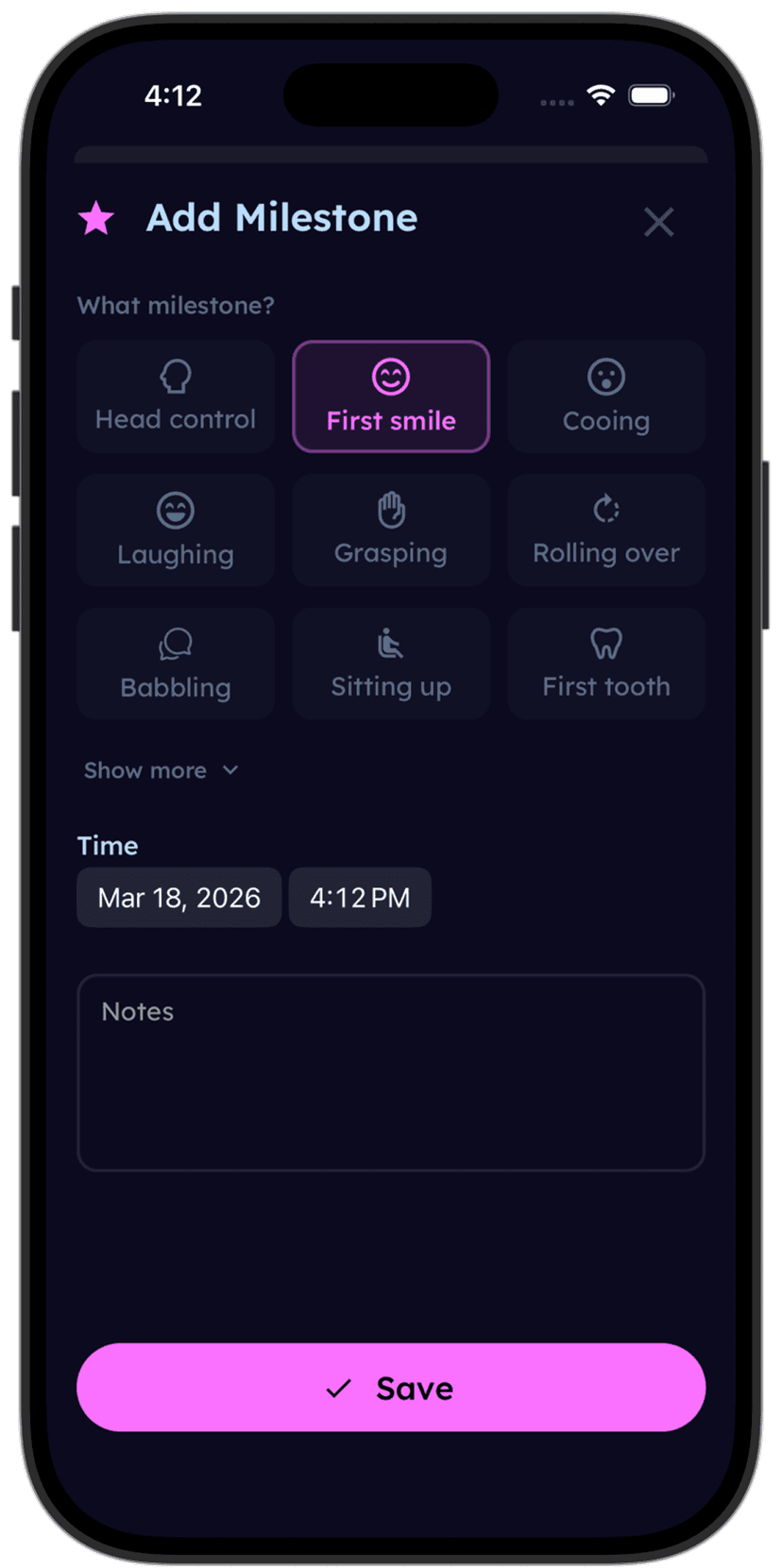
Log milestones as they happen
Your six-week-old is noticeably stronger. Head control has improved — during tummy time, many babies can now lift their head to 45 degrees and hold it for several seconds. Some manage brief moments at 90 degrees. Pathways.org recommends tummy time multiple times per day for gradually increasing durations. If your baby screams during tummy time, try shorter sessions — even one minute counts.
Leg movements are becoming more vigorous. Arm movements are evolving — the tight newborn fists are starting to open more frequently, and you might see batting at objects. The WHO Motor Development Study emphasizes that the sequence of development is more consistent than the timing.
Every baby is different. If your baby isn't doing all of these yet, that's within the normal range.
At six weeks, the cognitive leaps are becoming visible. Alert periods are longer — some babies have stretches of 20–30 minutes of calm observation. Visual tracking is improving significantly. Early pattern recognition is developing — your baby is starting to recognize routines.
The social smile is the big event. According to Zero to Three, it typically arrives between 6–8 weeks and marks a fundamental shift in social development. It means your baby can recognize familiar faces, has positive emotional responses to social interaction, and can express those responses voluntarily. You'll know it when you see it — their eyes crinkle, their mouth spreads into a grin, and your heart explodes.
Cooing is taking off — breathy vowel sounds that are often conversational. Your baby makes a sound, pauses, and waits. If you respond, they coo again. This "serve and return" is one of the most important interactions in infant development. According to the CDC, these exchanges build the foundation for language and social skills.
Feeding at six weeks often involves another growth spurt — more frequent feeding and, for breastfeeding parents, more anxiety about supply. The pattern: baby eats more for a few days, supply adjusts, things settle. Many breastfeeding relationships start to feel more established around now.
Sleep may be showing signs of improvement. The circadian rhythm is starting to develop — some babies are producing first longer nighttime stretches (4–6 hours). If your baby gives you a 4-hour stretch, that counts as "sleeping through the night" in pediatric terms. (Yes, really.)
Tinylog's sleep tracking shows patterns over time, so you can see whether those nighttime stretches are actually getting longer — even when it doesn't feel like it at 2 AM.


They hit at the same time. More eating, more crying, less sleeping. It's temporary, but 'temporary' feels like a lie when you're in the middle of it. It typically lasts a few days.
Don't just go through the motions. If you're struggling with your mood — depression, anxiety, intrusive thoughts, or feeling disconnected — tell your provider. The 6-week visit exists partly to catch postpartum mood disorders.
The car seat, the stroller, being put down, bath time — six-week-olds are more aware and more opinionated. It's not defiance; it's increasing awareness.
The AAP's Bright Futures guidelines include developmental screening at well-child visits, but you don't have to wait for a scheduled appointment.