
Baby acne is peaking right about now
Many babies develop acne around 2–4 weeks. It's caused by maternal hormones still in your baby's system and clears up on its own. Don't pick at it, don't put products on it.
GUIDE
Published on
The fog is starting to lift. Your baby is more alert, more engaged, and more here.
At one month, something shifts. You're reading your baby slightly better, they're starting to interact, and the chaos is beginning to have a shape.
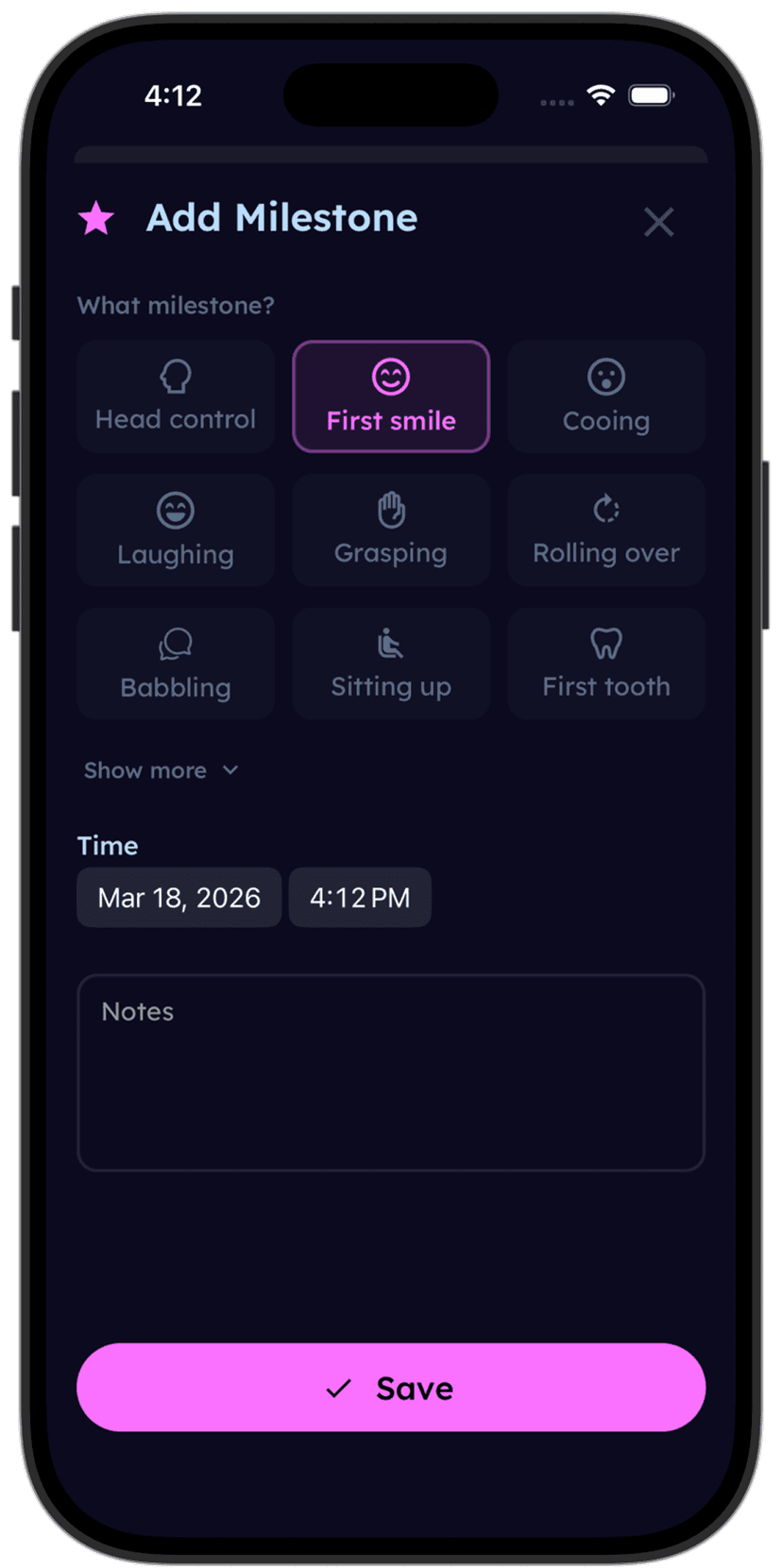
Log milestones as they happen
At one month, your baby's body is getting stronger in ways you can actually see. Head control is improving — during tummy time, many one-month-olds can briefly lift their head at a 45-degree angle. Their fists are starting to open more frequently. According to Pathways.org, these early movements are building the neural connections for coordinated reaching, grabbing, and rolling.
The WHO Motor Development Study places early head-lifting in the first month as part of the expected sequence, with significant variation between babies. Weight gain is a big marker — most babies gain about 5–7 ounces per week.
These are ranges, not deadlines. Your baby is on their own timeline.
Your one-month-old's brain continues its extraordinary growth. Attention spans are growing — you'll notice longer periods of quiet alertness. Your baby now clearly prefers human faces to objects, your face to strangers' faces, and your voice to other voices. Habituation (tuning out repeated stimuli) is developing — why a constant noise stops bothering them but a new sound gets attention.
Cooing may emerge this month — vowel-like sounds ("ooh," "aah") as your baby discovers their vocal cords. According to the CDC, making sounds other than crying is expected by 2 months. Eye contact is getting more sustained. According to Zero to Three, this face-studying is critical social learning. The social smile is approaching (6–8 weeks). Attachment is deepening: your baby calms faster in your arms than anyone else's.
Most one-month-olds eat every 2–3 hours, with 8–12 feedings per day. Feeding sessions may be getting slightly more efficient. Evening cluster feeding is often still happening — this is normal and usually tapers off in the coming weeks.
Sleep is still fragmented but may show the earliest signs of a pattern. Some one-month-olds start producing one slightly longer stretch at night (3–5 hours). The circadian rhythm usually clicks around 6–8 weeks. Total sleep is around 14–17 hours per day.
Having a few weeks of logged data can reveal trends that are invisible day-to-day. Tinylog's trend views are built for exactly this kind of pattern recognition.


Many babies develop acne around 2–4 weeks. It's caused by maternal hormones still in your baby's system and clears up on its own. Don't pick at it, don't put products on it.
Around this age, many babies who slept fairly well start protesting being put down. It's not a regression — it's increasing awareness. They've figured out that being held is better. Frustrating, but normal.
Your one-month-old is already noticeably different from the newborn you brought home. That can bring unexpected feelings of loss alongside the excitement. Parenthood is like that — you miss stages before you've finished them.
If something feels off, call. 'I just feel like something isn't right' is a perfectly valid reason to pick up the phone.
Development at 3 Weeks — What you just came through
Development at 6 Weeks — The changes coming in the next few weeks
Tummy Time — Building the foundation for rolling and sitting