GUIDE

Baby Ear Infections

Ear infections are the most common reason babies get antibiotics — but they don't always need them.

Ear pulling alone does not diagnose an ear infection. Here is what actually points to one, when your pediatrician might recommend waiting before prescribing antibiotics, and what it means if your baby keeps getting them.

What an Ear Infection Actually Looks Like

Ear infections are the most common bacterial infection in children and the single most common reason babies end up on antibiotics. By age three, roughly 80 percent of children will have had at least one. If your baby is between six and eighteen months old and attends daycare, the odds approach near certainty.

Here is what is happening inside: your baby's eustachian tubes — the tiny passages that connect the middle ear to the back of the throat — are short, horizontal, and narrow. In adults, these tubes angle downward, allowing fluid to drain easily. In babies, they are nearly level, which means fluid gets trapped easily. When a cold causes congestion and swelling, those little tubes can block completely. Fluid builds up behind the eardrum. Bacteria or viruses that were lurking in the nasopharynx move in. Pressure builds. The eardrum becomes red and bulging. And your baby, who cannot tell you "my ear hurts," starts screaming.

The classic presentation is a baby who seemed to have a normal cold for a few days, then suddenly gets worse — a new fever spike, more crying, especially at night or when lying down. Sleep falls apart. Feeding may decline because sucking and swallowing change pressure in the ear, causing pain. You might notice your baby pulling or batting at one ear, though many babies do this when teething or tired, so ear pulling alone is not diagnostic.

The only way to confirm an ear infection is for your pediatrician or provider to look at the eardrum directly with an otoscope. A healthy eardrum is translucent and slightly pearly. An infected one is red, opaque, and bulging outward under pressure. This distinction matters because it determines whether your baby actually needs antibiotics or whether something else is going on.


Common Signs of an Ear Infection in Babies

  • Increased fussiness, especially when lying down or during nighttime
  • Tugging or pulling at one or both ears (not always reliable on its own)
  • Difficulty sleeping or frequent waking — lying flat increases ear pressure
  • Fever — can range from low-grade to 104°F, though not always present
  • Decreased appetite or refusing to nurse/bottle feed — sucking and swallowing changes ear pressure
  • Fluid or pus draining from the ear (this means the eardrum has ruptured, which actually relieves pressure and pain)
  • Not responding to quiet sounds or seeming to not hear you (fluid muffles sound)
  • Crying more than usual with no other obvious cause
  • Balance problems or unusual clumsiness in older babies who are walking

No single sign confirms an ear infection on its own. The combination of symptoms — especially fever plus disrupted sleep plus feeding difficulty after a cold — is what raises suspicion. Only an otoscope exam can confirm the diagnosis.

AOM vs. OME: Two Types of Ear Problems

Not all ear issues are infections. Understanding the difference between the two main types helps you make sense of what your pediatrician tells you.

Acute otitis media (AOM) is a true ear infection. There is fluid in the middle ear, and it is actively infected. This is what causes pain, fever, and misery. The eardrum looks red and bulging. This is the condition that may or may not need antibiotics.

Otitis media with effusion (OME) is fluid behind the eardrum without active infection. There is no fever, no redness, and usually no pain. Your baby may not even seem sick. OME often develops after an ear infection as leftover fluid that has not drained yet, or it can occur after a cold without ever becoming a true infection. The main concern with OME is hearing — fluid behind the eardrum muffles sound, like listening to the world with earplugs. If it persists for months during a critical language development window, it can affect speech.

OME is extremely common. After a single ear infection, fluid can linger for weeks or even months. Your pediatrician will often recheck ears at a follow-up visit to see if the fluid has cleared. In most cases, it resolves on its own within three months. If it does not, and hearing appears affected, that is when ear tubes enter the conversation.

AOM (Ear Infection) vs. OME (Fluid Without Infection)
Cause
AOM (Acute Otitis Media)Bacterial or viral infection in the middle ear
OME (Otitis Media with Effusion)Fluid trapped behind eardrum without active infection
Pain
AOM (Acute Otitis Media)Usually significant — baby is clearly uncomfortable
OME (Otitis Media with Effusion)Usually none or very mild
Fever
AOM (Acute Otitis Media)Common, sometimes high
OME (Otitis Media with Effusion)Absent
Eardrum appearance
AOM (Acute Otitis Media)Red, bulging, inflamed
OME (Otitis Media with Effusion)Retracted or neutral, fluid visible behind it
Hearing affected
AOM (Acute Otitis Media)Often yes, temporarily
OME (Otitis Media with Effusion)Often yes — sounds are muffled
Treatment
AOM (Acute Otitis Media)Antibiotics (sometimes), pain management
OME (Otitis Media with Effusion)Watchful waiting — most resolves in 3 months
Duration
AOM (Acute Otitis Media)Acute episode, resolves in days with or without antibiotics
OME (Otitis Media with Effusion)Can persist weeks to months
Follow-up needed
AOM (Acute Otitis Media)Recheck if symptoms persist beyond 48-72 hours
OME (Otitis Media with Effusion)Recheck at 3 months; audiology if hearing concerns
Your pediatrician determines which type is present by examining the eardrum. The distinction matters because the treatment approach is very different.

Do Antibiotics Always Help? The Watchful Waiting Approach

This surprises many parents: antibiotics are not always the right first step for ear infections. The American Academy of Pediatrics updated its guidelines to include a "watchful waiting" option for certain ear infections, and the reason is straightforward — about 80 percent of ear infections resolve on their own within two to three days, and overusing antibiotics contributes to resistance and disrupts your baby's gut microbiome.

Watchful waiting means managing pain for 48 to 72 hours and seeing if the infection clears without antibiotics. Your pediatrician may give you a "safety-net" prescription to fill only if symptoms are not improving after two to three days. This is not the same as ignoring the problem. It is structured observation with a clear plan to escalate if needed.

However, watchful waiting is not appropriate for every situation. Babies under six months should receive antibiotics immediately — they are at higher risk, and the research supporting watchful waiting was primarily conducted in older children. Children with bilateral infections (both ears) between six and twenty-three months, children with severe symptoms (high fever, significant pain, toxic appearance), and children with complicating factors like immune problems or craniofacial abnormalities should also receive prompt treatment.

When antibiotics are prescribed, amoxicillin is the first-line choice for most ear infections. The standard course is ten days for children under two years and five to seven days for older children. Finish the entire course even if your baby seems better after a few days — stopping early increases the risk of treatment failure and resistant bacteria.

When to Use Antibiotics vs. Watchful Waiting
Baby under 6 months with suspected ear infection
Recommended ActionAntibiotics recommended immediately
WhyYoung infants are at higher risk for complications and cannot reliably communicate pain level
Baby 6-23 months, one ear affected, mild symptoms, temp under 102.2°F
Recommended ActionWatchful waiting is an option
WhyAAP guidelines support observation for 48-72 hours with pain management and a safety-net antibiotic prescription
Baby 6-23 months, both ears affected
Recommended ActionAntibiotics recommended
WhyBilateral infections in this age group are more likely to need treatment
Child 24+ months, one ear, mild symptoms
Recommended ActionWatchful waiting is an option
WhyOlder children have lower complication risk and can communicate symptoms better
Any age, high fever (102.2°F+), severe ear pain, toxic-appearing
Recommended ActionAntibiotics recommended immediately
WhySevere symptoms warrant prompt treatment
Any age, ruptured eardrum with drainage
Recommended ActionAntibiotics recommended
WhyDrainage confirms infection; antibiotic ear drops may also be prescribed
Immunocompromised child or child with craniofacial abnormalities
Recommended ActionAntibiotics recommended
WhyHigher risk for complications — lower threshold for treatment
Watchful waiting is a valid, evidence-based approach — not neglect. It always includes pain management, close monitoring, and a clear plan to start antibiotics if improvement does not occur within 48-72 hours.
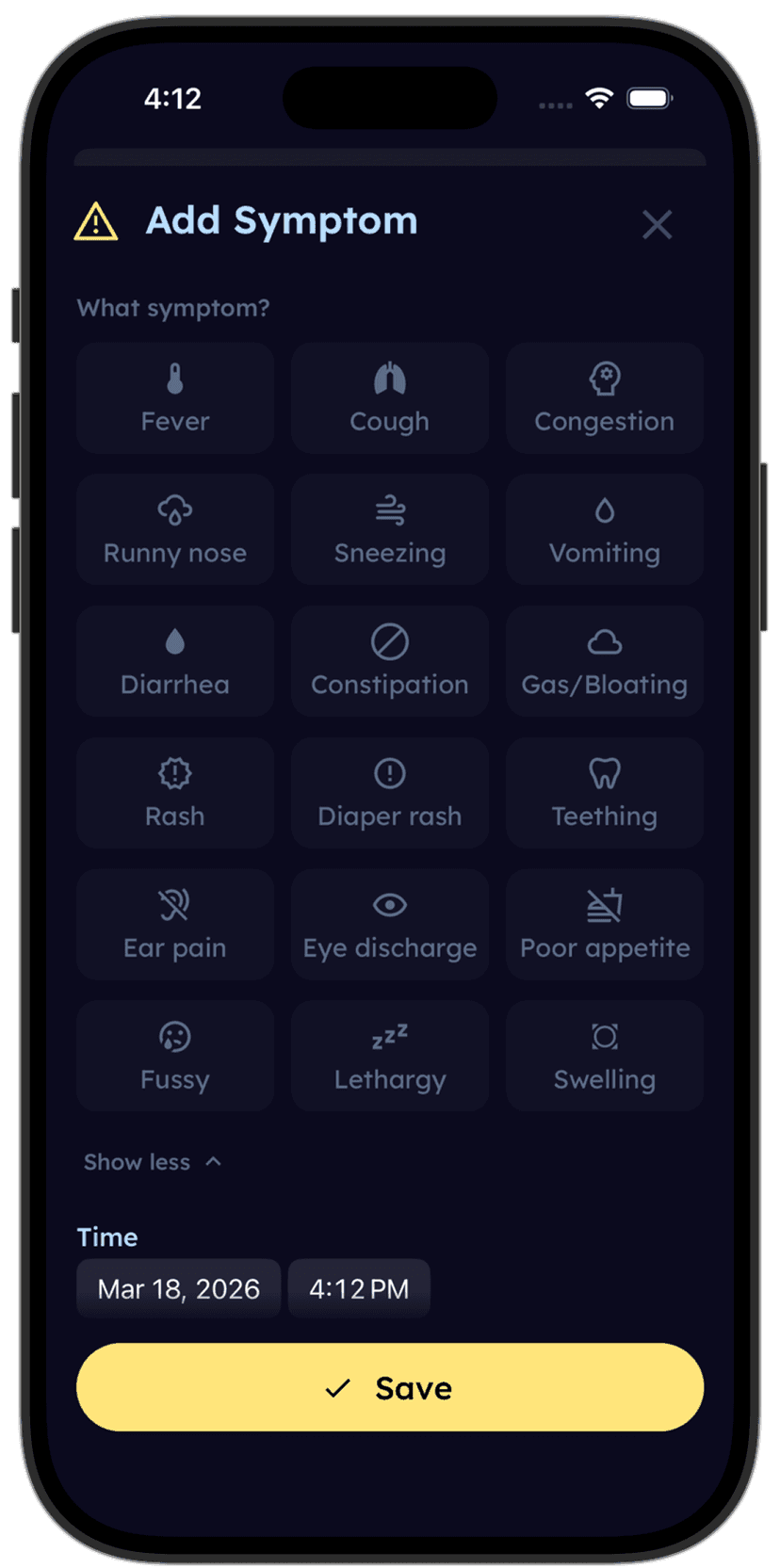
tinylog symptom tracking screen showing fever log entries during an ear infection

Track fevers and symptoms during ear infections.

When your baby has an ear infection, your pediatrician will want to know how high the fever has been, how long it has lasted, and whether symptoms are improving. Log temperatures and symptom notes in tinylog so you have an accurate timeline — not a 3 AM guess — when you call the doctor's office.

Download on the App StoreGet It On Google Play

When to Call Your Pediatrician, When to Go to the ER, When to Call 911

Most ear infections are manageable with a pediatrician visit and either watchful waiting or a course of antibiotics. But some situations demand faster action.

Call your pediatrician if your baby has symptoms consistent with an ear infection — fever plus ear pain, disrupted sleep, feeding changes after a cold. You need that otoscope exam to confirm what is going on. Also call if symptoms are not improving 48 to 72 hours into watchful waiting, if your baby has had three or more ear infections in six months, or if you notice hearing concerns.

Go to the ER if your baby under three months has a fever over 100.4 degrees Fahrenheit (any cause). Also go if your baby has a fever over 104 degrees Fahrenheit, if there is redness or swelling behind the ear (possible mastoiditis — an infection of the bone behind the ear that needs urgent treatment), if your baby has a stiff neck, or if your baby is lethargic and difficult to arouse.

Call 911 if your baby is not breathing normally, is unresponsive, or is having a seizure. Febrile seizures can occasionally accompany the fever from an ear infection.

Action Guide: When to Seek Help
Baby is fussy, pulling ears, but no fever, eating and sleeping okay
Recommended ActionMonitor at home
DetailsEar pulling alone is not diagnostic. Could be teething, curiosity, or habit. Watch for additional symptoms over 24-48 hours.
Fever, ear pain, disrupted sleep, decreased appetite
Recommended ActionCall pediatrician
DetailsLikely needs an exam. Your provider will check the eardrum with an otoscope to confirm infection.
Symptoms worsening after 48-72 hours of watchful waiting
Recommended ActionCall pediatrician — fill the safety-net prescription
DetailsIf symptoms are not improving, it is time for antibiotics. Most pediatricians provide a prescription to fill if watchful waiting does not work.
Fluid or pus draining from the ear
Recommended ActionCall pediatrician same day
DetailsThis means the eardrum has ruptured. This actually reduces pain, but the infection needs treatment. Keep the ear clean and dry.
Fever over 104°F, stiff neck, baby is lethargic or inconsolable
Recommended ActionGo to ER
DetailsThese may signal a complication beyond a simple ear infection — such as mastoiditis or meningitis. Seek immediate evaluation.
Baby under 3 months with fever over 100.4°F
Recommended ActionGo to ER
DetailsAny fever in a baby under 3 months requires urgent evaluation, regardless of suspected cause.
When in doubt, call your pediatrician. They would always rather hear from a cautious parent than miss a complication.

Recurrent Ear Infections and Ear Tubes

Some babies seem to get one ear infection after another. If this is your child, you are understandably exhausted and wondering when it ends.

Recurrent ear infections are defined as three or more episodes in six months, or four or more in twelve months, with at least one occurring recently. If your baby meets this threshold, your pediatrician may refer you to a pediatric ENT (otolaryngologist) to discuss tympanostomy tubes — commonly called ear tubes.

Ear tubes are tiny cylinders, usually made of plastic or metal, that are surgically placed in the eardrum. The procedure takes about ten to fifteen minutes under general anesthesia, and most children go home within an hour. The tubes create a small opening that allows air into the middle ear and fluid to drain out, bypassing those dysfunctional eustachian tubes.

The results are often dramatic. Children with recurrent infections typically have far fewer episodes with tubes in place. If infections do occur, they can often be treated with antibiotic ear drops rather than oral antibiotics. The tubes usually stay in place for six to eighteen months and then fall out on their own as the eardrum heals. A small percentage of children need a second set.

Ear tubes are one of the most common childhood surgical procedures. They are safe and well-studied. Complications are rare and usually minor — persistent drainage or early tube extrusion are the most common. The vast majority of parents report significant improvement in their child's quality of life, sleep, and behavior after tube placement.

What This ISN'T: Ear Infection vs. Other Conditions

Babies pull their ears for many reasons, and not all ear pain is an ear infection. Here is how to think through the common look-alikes.

Conditions That Mimic Ear Infections
Teething
Key DifferenceEar pulling WITH drooling, gnawing on objects, possible low-grade fever (under 100.4°F), gum swelling. No true ear pain when lying down. Teething does not cause fevers above 100.4°F.
Swimmer's ear (otitis externa)
Key DifferenceOuter ear canal infection — pain when you gently tug the outer ear or press on the tragus (the little flap in front of the ear canal). The earlobe area may be red or swollen. More common after water exposure. Different location than middle ear infection.
Referred pain from a sore throat
Key DifferenceThroat and ear share nerve pathways. Baby with a cold or sore throat may seem to have ear pain even though the ears are fine. Pediatrician can distinguish by examining the eardrum.
Foreign object in the ear
Key DifferenceToddlers sometimes put small objects in their ears. May cause pain, drainage, or foul smell. Only on one side. Requires provider to look inside.
Jaw or tooth pain
Key DifferenceErupting molars can cause pain that radiates toward the ear. More common in toddlers. No fever, no eardrum changes on exam.
The definitive distinction requires your provider to look at the eardrum. If you are unsure, an office visit is the right call.

What This Looks Like in Real Life

It is Tuesday night. Your ten-month-old has had a runny nose and mild cough for three days — standard daycare cold. She has been handling it fine, eating normally, sleeping okay. Then at 2 AM, she wakes up screaming. Not the "I'm hungry" cry or the "I lost my pacifier" cry. This is the "something is really wrong" cry. She is burning up — the thermometer reads 102.8 degrees Fahrenheit. You pick her up and she calms slightly but starts screaming again when you try to lay her back down. She keeps batting at her right ear.

You give infant acetaminophen for the fever and pain. It takes about 30 minutes, but she calms down enough to doze off on your chest while you sit in the recliner. You do not sleep. By morning, the fever has come down to 100.1 degrees Fahrenheit but spikes again when the acetaminophen wears off. She refuses to nurse on the right side — the one she was pulling at.

You call the pediatrician's office at 8 AM. They get you in at 10. The pediatrician looks in both ears. The right eardrum is angry red and bulging. The left one has some fluid behind it but is not infected. Diagnosis: acute otitis media, right ear, with effusion in the left. Because she is ten months old and it is one-sided with a moderate fever, the pediatrician offers you a choice: watchful waiting with a safety-net prescription, or start antibiotics now. You ask a few questions and decide to watch for 48 hours since she is keeping fluids down and the acetaminophen is managing her pain.

By Thursday morning, her fever has broken and she slept through the night. You never fill the prescription. At the two-week recheck, the right ear has cleared. The left still has fluid, which the pediatrician says may take another month or two to resolve. You keep watching. It does.

That is what a typical ear infection looks like — an escalation of a cold, a rough night or two, and a resolution that feels both too slow and surprisingly fast.

Prevention Tips

Breastfeed if you can

Breastfeeding for at least six months is associated with lower rates of ear infections. Breast milk contains antibodies that help protect against the bacteria and viruses that cause ear infections. Even partial breastfeeding offers some benefit compared to exclusive formula feeding.

Keep vaccines current

The pneumococcal conjugate vaccine (PCV13 or PCV15) targets Streptococcus pneumoniae, one of the most common bacteria behind ear infections. The annual flu vaccine also helps — influenza often precedes ear infections by causing congestion and eustachian tube swelling. Both of these vaccines have measurably reduced ear infection rates since their introduction.

Feed upright, not lying flat

When a baby drinks a bottle while lying completely flat, milk can flow toward the eustachian tubes and pool in the middle ear space. Hold your baby at least semi-upright during bottle feeds. Never prop a bottle in the crib. This does not apply to breastfeeding, as the sucking mechanics are different.

Reduce pacifier use after 6 months

Some studies show a link between prolonged pacifier use and increased ear infection risk, possibly because the sucking motion affects eustachian tube function. If your baby is prone to ear infections, consider weaning the pacifier after six months, especially during daytime hours.

Avoid secondhand smoke

Exposure to tobacco smoke significantly increases the risk of ear infections in children. Smoke irritates the eustachian tube lining and impairs the immune system's ability to clear infections. If anyone in the household smokes, keep it entirely outside and away from the baby.

tinylog health log showing tracked ear infection episodes over several months

Recurring ear infections? Track every episode.

If your baby gets frequent ear infections, having a log of every episode — dates, fevers, antibiotics prescribed — is invaluable when talking to a pediatric ENT about ear tubes. tinylog makes it easy to build that record over time so nothing gets lost.

Download on the App StoreGet It On Google Play

Related Guides

Sources

  • American Academy of Pediatrics. (2013, reaffirmed 2022). Clinical Practice Guideline: The Diagnosis and Management of Acute Otitis Media. Pediatrics, 131(3), e964-e999.
  • Rosenfeld, R. M., et al. (2016). Clinical Practice Guideline: Otitis Media with Effusion (Update). Otolaryngology—Head and Neck Surgery, 154(1_suppl), S1-S41.
  • Lieberthal, A. S., et al. (2013). The Diagnosis and Management of Acute Otitis Media. Pediatrics, 131(3), e964-e999.
  • Rovers, M. M., et al. (2004). Antibiotics for Acute Otitis Media: A Meta-Analysis with Individual Patient Data. The Lancet, 368(9545), 1429-1435.
  • National Institute on Deafness and Other Communication Disorders. (2024). Ear Infections in Children. NIDCD.NIH.gov.

Medical Disclaimer

This guide is for informational purposes only and is NOT a substitute for professional medical advice. When in doubt, always call your pediatrician. If your baby is under 3 months with a fever, having difficulty breathing, showing signs of dehydration, or seems seriously unwell, seek immediate medical attention.

Get this guide in your inbox.
We'll email you this guide so you have the symptom checklist and action steps ready when you need them.
Track symptoms so you can give your pediatrician the full picture.
Download tinylog free — log symptoms, fevers, and sleep with a single tap.
Download on the App StoreGet It On Google Play