GUIDE

Baby's First Cold

Every baby gets their first cold — usually between 2 and 6 months. It sounds worse than it is, and most colds resolve on their own in 7-10 days.

A congested, sneezy baby is stressful. But knowing what is normal, what actually helps, and what requires a call to the pediatrician makes the difference between a manageable week and a panicked one.

Your Baby's First Cold: What Is Actually Happening

Every baby gets their first cold. It is not a question of whether but when. For most babies, it happens somewhere between two and six months of age — around the time maternal antibodies from pregnancy begin to wane, or when exposure increases through older siblings, daycare, or simply being out in the world. Babies can catch six to eight colds per year in their first two years, and if they are in group childcare, that number can climb higher.

Colds are caused by viruses — over 200 different viruses, with rhinovirus being the most common culprit. They spread through respiratory droplets and contaminated surfaces. When someone with a cold sneezes near your baby or your baby puts a virus-laden toy in their mouth, the virus enters through the nose or eyes and starts replicating.

What follows is predictable: the nasal passages swell, mucus production ramps up, and your baby starts sneezing, sniffling, and sounding congested. They may develop a mild cough as mucus drips down the back of the throat (postnasal drip). They might run a low-grade fever for the first day or two. Their appetite may dip because it is difficult to suck and swallow when you cannot breathe through your nose. Sleep will likely suffer.

Here is the reassuring part: colds are self-limiting. Your baby's immune system will clear the virus. There is no medication that cures a cold — not antibiotics, not over-the-counter cold medicines, nothing. What you can do is manage symptoms to keep your baby comfortable while their body does the work. That is the entire strategy, and it is enough.

Cold Symptoms: What to Expect and When
Runny nose (clear mucus initially, may turn yellow/green)
When It PeaksStarts day 1-2, peaks day 3-5, can linger 10-14 days
Important NotesYellow/green mucus is NORMAL — it does not mean bacterial infection
Sneezing
When It PeaksMost frequent in first few days
Important NotesBabies sneeze to clear nasal passages — it is their primary defense against congestion
Mild cough
When It PeaksMay develop day 2-3, can linger 1-2 weeks
Important NotesUsually from postnasal drip. Worse at night and when lying down.
Slightly decreased appetite
When It PeaksDuring peak congestion days 3-5
Important NotesHard to eat when you cannot breathe through your nose. Shorter, more frequent feeds may help.
Fussiness and disrupted sleep
When It PeaksWorst during peak congestion
Important NotesBaby is uncomfortable, not dangerously ill. Expect more night waking.
Low-grade fever (under 101°F)
When It PeaksFirst 2-3 days, if present at all
Important NotesNot all colds cause fever. Fever is the body fighting the virus.
Mild red or watery eyes
When It PeaksVariable
Important NotesCommon with colds. Different from bacterial conjunctivitis (thick yellow/green discharge, eyes crusted shut).
Most cold symptoms peak around days 3-5 and then gradually improve. The entire illness usually resolves in 7-10 days, though a lingering cough or runny nose can persist up to 2 weeks.

What You CAN Do: Safe Cold Remedies for Babies

You cannot cure a cold, but you can make your baby significantly more comfortable. These are the evidence-based, pediatrician-approved interventions.

Saline drops + gentle suction

This is your most effective tool. Put 2-3 drops of saline solution into each nostril, wait 30-60 seconds for the mucus to loosen, then gently suction with a bulb syringe or NoseFrida. Do this before feeds and before sleep for maximum benefit. Your baby will hate it. It will help anyway. Do not suction more than 3-4 times per day — the nasal passages can become irritated and swollen from over-suctioning, making congestion worse.

Cool-mist humidifier

Run a cool-mist humidifier in your baby's room during sleep. Moist air helps thin mucus and soothe irritated nasal passages. Clean the humidifier daily to prevent mold and bacteria buildup — a dirty humidifier can make things worse. Use cool mist, not warm — warm mist humidifiers pose a burn risk and offer no additional benefit for colds.

Elevate the mattress slightly

Place a thin, rolled towel or crib wedge UNDER the crib mattress to create a very gentle incline (about 30 degrees). This helps mucus drain rather than pooling in the back of the throat. Never put pillows, blankets, or loose items in the crib — safe sleep guidelines still apply during illness.

Keep feeding

Congested babies have trouble feeding because they cannot breathe through their nose while sucking. Suction the nose before each feed. Offer shorter, more frequent feeds rather than trying to get a full feed when your baby is struggling. Breastfed babies may nurse more frequently for comfort and hydration. Formula-fed babies may take smaller bottles more often. Hydration is the priority.

Steam from a shower

Run a hot shower in the bathroom with the door closed for a few minutes, then sit in the steamy room with your baby for 10-15 minutes. The warm, moist air can help loosen congestion. Do not bring your baby directly into the shower. This is a temporary measure but can provide noticeable relief before bedtime.

Gentle nose wipes

The constant runny nose will irritate the skin around your baby's nostrils. Apply a thin layer of petroleum jelly (Vaseline) or a gentle balm around the nostrils to protect the skin. Use soft tissues or a damp washcloth to wipe — rough or frequent wiping worsens the irritation.

What You CANNOT Give: Off-Limits for Babies

  • Over-the-counter cough and cold medications — NOT safe for children under 2 (FDA). This includes decongestants, antihistamines, cough suppressants, and expectorants.
  • Honey — NOT safe for babies under 12 months due to the risk of infant botulism. This includes honey-based cough remedies.
  • Vapor rubs containing camphor or menthol on the chest of babies under 2 — can cause breathing difficulty in young infants. Some pediatricians allow a small amount of infant-specific vapor rub (like Vicks BabyRub) on the feet with socks over it, but check with your provider.
  • Aspirin — NEVER give aspirin to children or teenagers. Associated with Reye's syndrome, a rare but life-threatening condition.
  • Antibiotics (unless prescribed for a confirmed bacterial complication) — colds are caused by viruses, and antibiotics do not treat viruses. Taking unnecessary antibiotics promotes resistance and disrupts gut health.
  • Nasal decongestant sprays (like Afrin) — not approved for infants. Can cause rebound congestion and other side effects.

The FDA advisory against OTC cold medications for children under 2 is not a suggestion — it is based on reports of serious adverse events and deaths. These medications do not work in young children and carry real risks. Stick to saline, suction, humidity, and fluids.

Age-Specific Concerns: When Age Changes the Equation

A cold in a six-month-old and a cold in a six-week-old are very different situations. Your baby's age changes the risk profile and the threshold for seeking medical care.

Cold Management by Age
Under 3 months
Level of ConcernAny cold symptoms warrant a call to your pediatrician
Key DetailsYoung infants have immature immune systems. What looks like a cold could be something more serious. Fever over 100.4°F in this age group is ALWAYS an ER visit, regardless of other symptoms. Even without fever, your pediatrician should know your young infant is sick.
3-6 months
Level of ConcernMonitor closely, call pediatrician for fever over 101°F or breathing difficulty
Key DetailsMost colds in this age range are manageable at home, but babies this age still have limited ability to fight infections. Call your pediatrician if fever exceeds 101°F, if your baby is not eating well, or if breathing seems labored.
6-12 months
Level of ConcernMost colds are manageable at home with supportive care
Key DetailsBy this age, your baby's immune system is more mature. Ibuprofen is now an option for fever (in addition to acetaminophen). Continue normal feeding and hydration. Call your pediatrician if symptoms worsen after day 5, if fever lasts more than 3 days, or if a secondary infection develops (ear infection, pneumonia).
12-24 months
Level of ConcernColds are frequent (6-8 per year is normal), especially in daycare
Key DetailsToddlers in group care can seem perpetually congested during fall and winter. This is normal and actually builds immune strength. Honey is now safe for cough (1/2 to 1 teaspoon for ages 1-5). Continue monitoring for complications but expect many routine colds.
The under-3-months rule is absolute: any fever over 100.4°F in this age group is an ER visit. For older babies, use the symptom severity and your instincts to guide decisions.
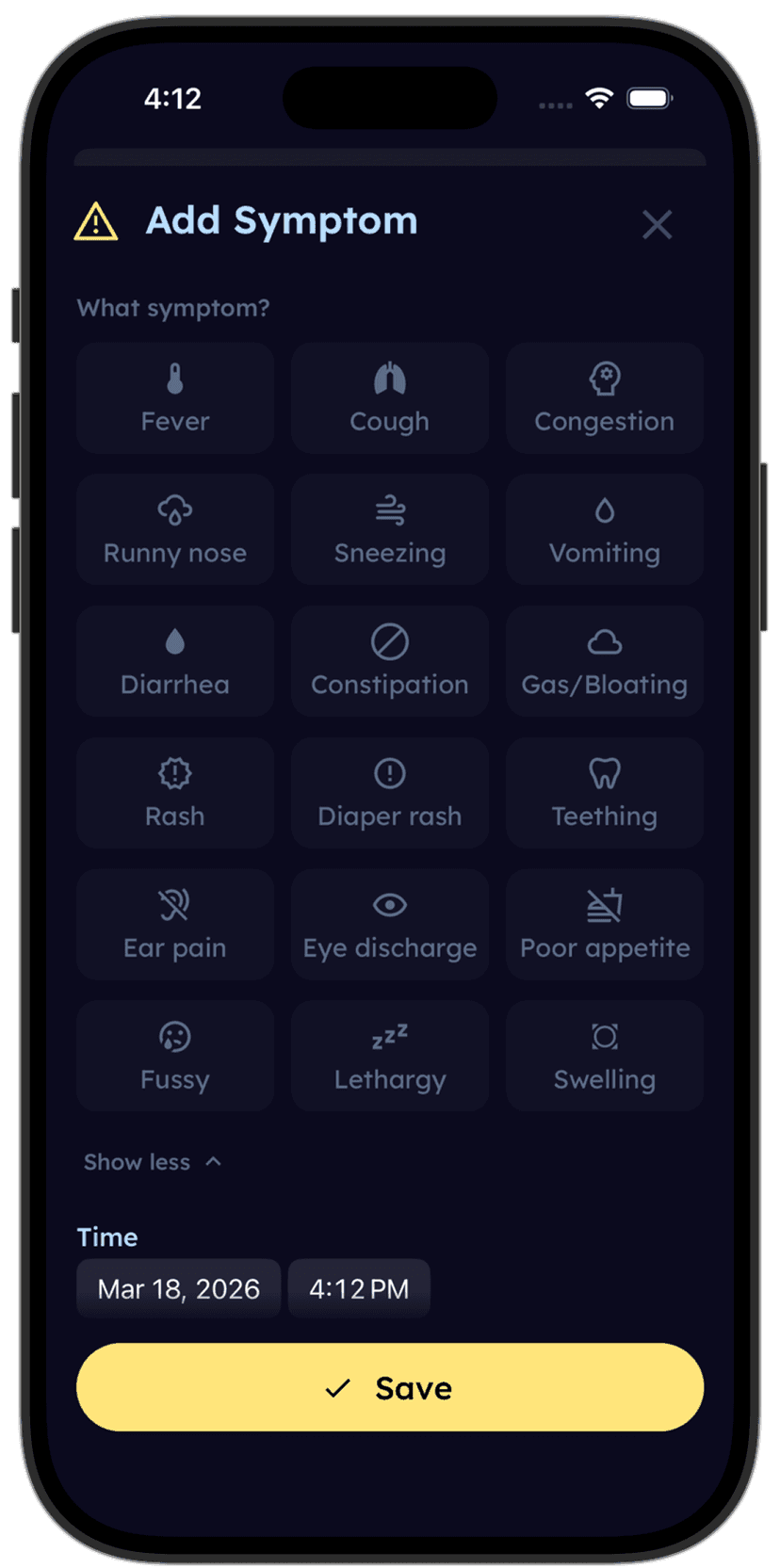
tinylog symptom tracking screen showing daily cold symptom entries for a baby

First cold? Track symptoms so you know the trajectory.

During your baby's first cold, you are constantly asking: is this getting better or worse? When you log symptoms in tinylog — temperature, feeding amounts, congestion severity, sleep disruptions — you can look back over 2-3 days and see whether the trend is improving or worsening. That data turns anxious guessing into informed decisions.

Download on the App StoreGet It On Google Play

The Yellow/Green Mucus Myth

This deserves its own section because it is one of the most persistent misconceptions in pediatrics: yellow or green mucus does NOT mean your baby has a bacterial infection that needs antibiotics.

Here is what actually happens. When your baby's immune system fights a cold virus, white blood cells rush to the nasal passages. These white blood cells contain an enzyme called myeloperoxidase, which has a greenish color. As mucus sits in the nasal passages and these cells accumulate, the mucus turns from clear to white to yellow to green. This is a sign that the immune system is working, not a sign that bacteria have moved in.

Mucus color follows a predictable arc during a cold: clear at the start, then white or yellowish at the peak, then green, then gradually back to clear as the cold resolves. This is the same arc whether the cold is viral or bacterial. The color alone tells you nothing about whether antibiotics are needed.

What DOES suggest a possible bacterial complication is the pattern: if your baby seemed to be getting better and then suddenly gets worse (a "double-worsening"), if a new high fever appears after several days of improvement, or if thick green discharge persists beyond ten to fourteen days without any improvement — these patterns may indicate a secondary bacterial sinus infection and warrant a call to your pediatrician. But green mucus on day four of a cold? That is just a cold being a cold.

Breathing Red Flags — Know These Signs

  • Breathing rate over 60 breaths per minute in a baby under 2 months, or over 50 in a baby 2-12 months
  • Rib retractions — you can see the outline of the ribs or the skin pulling in between the ribs with each breath
  • Nasal flaring — nostrils widen noticeably with each breath
  • Head bobbing — baby's head nods forward with each breath (a sign of using neck muscles to breathe)
  • Grunting at the end of each breath
  • Skin around the lips or fingernails turning blue or gray (cyanosis) — call 911
  • Wheezing — a high-pitched whistling sound, especially when breathing out
  • Belly breathing — the abdomen rises and falls exaggeratedly with each breath while the chest stays still
  • Pauses in breathing lasting more than 10-15 seconds (apnea)

Most colds stay in the nose and throat. But some viruses (particularly RSV) can move into the lower airways. If your baby's breathing looks like work — not just noisy from congestion — seek medical attention promptly.

When to Call Your Pediatrician, When to Go to the ER, When to Call 911

The vast majority of baby colds are managed entirely at home. But certain situations require medical input.

Call your pediatrician if your baby is under three months and has any cold symptoms (even without fever). Also call if fever lasts more than three days, if symptoms are worsening after day five to seven, if your baby is refusing to eat, if there are fewer wet diapers than usual, or if a new fever develops after an initial improvement.

Go to the ER if your baby under three months has a fever over 100.4 degrees Fahrenheit. Also go if you see signs of labored breathing — rib retractions, nasal flaring, grunting, head bobbing, or breathing rate above 60 per minute in a young infant. These may indicate RSV bronchiolitis, pneumonia, or another lower respiratory infection that needs medical evaluation and possible oxygen support.

Call 911 if your baby's lips or skin turn blue or gray (cyanosis), if they stop breathing for more than fifteen seconds, if they become unresponsive, or if breathing difficulty is severe and worsening rapidly.

Action Guide: When to Seek Help
Runny nose, sneezing, mild fussiness in a baby over 3 months, no fever
Recommended ActionManage at home
DetailsSaline and suction, humidifier, continue feeding. Monitor for worsening. This is a typical cold.
Cold symptoms with low-grade fever (under 101°F) in a baby over 3 months
Recommended ActionManage at home
DetailsAcetaminophen for comfort if needed. Push fluids. Watch for progression.
Any cold symptoms in a baby under 3 months
Recommended ActionCall pediatrician
DetailsYoung infants need provider awareness of illness. They will guide you on what to watch for.
Fever over 100.4°F in a baby under 3 months
Recommended ActionGo to ER
DetailsAny fever in this age group is treated as potentially serious until proven otherwise, regardless of other symptoms.
Fever over 101°F lasting more than 3 days in older babies
Recommended ActionCall pediatrician
DetailsPersistent fever may indicate a secondary bacterial infection (ear infection, pneumonia) developing on top of the cold.
Signs of labored breathing — retractions, nasal flaring, grunting, fast breathing rate
Recommended ActionGo to ER or call 911
DetailsBreathing difficulty can indicate RSV bronchiolitis, pneumonia, or other conditions requiring medical intervention.
Baby refusing all feeds or showing dehydration signs (fewer wet diapers, dry mouth, no tears)
Recommended ActionCall pediatrician same day
DetailsA congested baby who cannot eat needs evaluation. Dehydration risk increases when intake drops.
Symptoms worsening after day 5-7 rather than improving
Recommended ActionCall pediatrician
DetailsColds should gradually improve. Worsening suggests a secondary infection may have developed.
Colds are overwhelmingly manageable at home. But the complications that can develop from a cold — ear infections, bronchiolitis, pneumonia — do sometimes need medical intervention. Watch the trajectory, not just the moment.

What This ISN'T: Cold vs. Other Respiratory Illnesses

A cold is usually straightforward, but several other illnesses start with cold-like symptoms before becoming something more significant.

Common Cold vs. Conditions That Start Similarly
Allergies
Key DifferenceAllergies cause persistent clear runny nose, sneezing, and itchy/watery eyes WITHOUT fever. Symptoms come and go with allergen exposure rather than following a 7-10 day cold arc. Allergies are uncommon in babies under 12 months but can appear in the second year. No cough unless asthma is also present.
RSV (respiratory syncytial virus)
Key DifferenceRSV starts like a cold but can progress to bronchiolitis — wheezing, labored breathing, and difficulty feeding. Most concerning in babies under 6 months and premature infants. If your baby's cold seems to be moving into the chest (wheezing, fast breathing, rib retractions), RSV should be considered. Seek medical evaluation promptly.
Flu (influenza)
Key DifferenceThe flu hits harder and faster than a cold. Higher fever (often 102-104°F), more significant body aches and lethargy, and a more sudden onset. Babies with the flu are noticeably more ill than babies with a cold. Antiviral medication (oseltamivir) can be given to infants if started within 48 hours of symptom onset.
Croup
Key DifferenceCroup is characterized by a distinctive barking, seal-like cough and sometimes a harsh sound when breathing in (stridor). The cough is very different from a typical cold cough. Worse at night. Most common in children 6 months to 3 years. Cool night air or steam may help.
Pertussis (whooping cough)
Key DifferenceStarts like a mild cold for 1-2 weeks, then develops into severe coughing fits that can end with a 'whoop' sound (though infants may not whoop — they may just stop breathing briefly). Coughing episodes can cause vomiting. Very dangerous in young infants. Vaccination (DTaP) is the primary prevention.
If your baby's cold is not following the typical 'peak at day 3-5, then improve' trajectory — or if breathing becomes labored — consider whether something else may be going on and call your pediatrician.

What This Looks Like in Real Life

Your four-month-old has been in daycare for three weeks. On Wednesday, you notice a little clear discharge from her nose when you pick her up. By Thursday morning, she is sneezing frequently and the runny nose is constant. She nurses fine at her morning feed but is fussier than usual at daycare. Thursday night, she wakes up twice — not screaming, just restless and congested. You can hear the mucus rattling when she breathes.

Friday, you try saline drops for the first time. She screams like you are committing a crime. You suction with the bulb syringe and a startling amount of mucus comes out. She nurses better immediately afterward. You feel like a hero and a villain simultaneously. Her temperature is 99.8 degrees Fahrenheit — barely elevated. She is fussy but consolable. You set up the cool-mist humidifier in her room.

Saturday and Sunday are the worst. The congestion peaks. She sounds terrible — snorty, rattly, mouth-breathing. She takes shorter feeds more frequently. Sleep is a mess for everyone. You check the thermometer repeatedly — it hovers around 100 to 100.5 degrees Fahrenheit. You give acetaminophen at bedtime to help with comfort. You suction before every feed and before every sleep. She hates it every time. It helps every time.

Monday, you notice a small improvement. The mucus is thicker and yellowish-green, which panics you until you remember that this is normal. She is eating more. By Wednesday — one week in — she sounds noticeably less congested. By the following weekend, the runny nose is mostly gone, though a little cough lingers for a few more days. She is back to sleeping through the night by day ten.

That was her first cold. It will not be her last. But now you know the drill: saline, suction, humidifier, patience. And you know what to actually worry about versus what is just uncomfortable.


tinylog symptom and feeding log showing cold symptom progression over one week

Is this cold getting better or worse? Your log has the answer.

When your baby is on day five of a cold and you cannot remember whether yesterday was better or worse, your symptom log in tinylog gives you the answer. Track congestion, feeding, temperature, and sleep — the trend line over several days is more useful than any single data point.

Download on the App StoreGet It On Google Play

Related Guides

Sources

  • American Academy of Pediatrics. (2024). Colds in Children. HealthyChildren.org.
  • U.S. Food and Drug Administration. (2023). Should You Give Kids Medicine for Coughs and Colds? FDA.gov.
  • Centers for Disease Control and Prevention. (2024). Common Cold. CDC.gov.
  • Ralston, S. L., et al. (2014). Clinical Practice Guideline: The Diagnosis, Management, and Prevention of Bronchiolitis. Pediatrics, 134(5), e1474-e1502.
  • Turner, R. B. (2010). Epidemiology, Pathogenesis, and Treatment of the Common Cold. Annals of Allergy, Asthma and Immunology, 78(6), 531-540.

Medical Disclaimer

This guide is for informational purposes only and is NOT a substitute for professional medical advice. When in doubt, always call your pediatrician. If your baby is under 3 months with a fever, having difficulty breathing, showing signs of dehydration, or seems seriously unwell, seek immediate medical attention.

Get this guide in your inbox.
We'll email you this guide so you have the symptom checklist, safe remedies, and red flags ready when your baby catches their first cold.
Track symptoms so you know if things are improving or getting worse.
Download tinylog free — log symptoms, fevers, and feeds with a single tap.
Download on the App StoreGet It On Google Play