GUIDE

RSV in Babies

Nearly every child gets RSV by age 2 — but in young infants, it can turn serious fast.

RSV usually looks like a common cold. For most older babies and toddlers, that is exactly what it is. But for babies under 6 months, premature infants, and those with heart or lung conditions, RSV can progress to bronchiolitis and breathing difficulty. The danger window is days 3 through 5. Here is how to monitor it and when to act.

What RSV Actually Is — And Why Parents Hear About It So Much

Respiratory syncytial virus — RSV — is one of those diagnoses that sounds terrifying the first time you hear it. But here is the reality: nearly every child on the planet gets RSV by the time they turn two. For most of them, it looks and feels like a common cold. Runny nose, cough, maybe a low-grade fever, a cranky few days, and then it resolves.

The reason RSV gets so much attention is not because it is rare. It is because in certain babies, it can become serious — and the line between "bad cold" and "needs a hospital" is not always obvious to parents who are seeing it for the first time. The babies who are most vulnerable are premature infants, babies under six months old, and babies with underlying heart or lung conditions. For these groups, RSV can cause bronchiolitis — inflammation of the small airways in the lungs — which leads to wheezing, breathing difficulty, and sometimes hospitalization.

RSV season in the United States typically runs from fall through early spring, with peak activity between December and February, though this has shifted somewhat since the COVID-19 pandemic. The virus spreads through respiratory droplets (coughing, sneezing) and by touching contaminated surfaces. It is highly contagious — which is why it tears through daycares and families with older siblings who bring it home from school.

The good news is that there is now a preventive option. Nirsevimab (Beyfortus) is a monoclonal antibody — not a vaccine, but a single injection that gives babies passive immunity for about five months. The CDC recommends it for all infants under eight months entering their first RSV season. If your baby was born before or during RSV season, talk to your pediatrician about it.

How RSV Progresses: The Timeline You Need to Know

Understanding the typical RSV timeline is essential, because the most dangerous thing about RSV is the way it sneaks up on you. Day one looks like a cold. Day two still looks like a cold. Then on day three or four, your baby is suddenly breathing harder, wheezing, and you are wondering how it escalated so fast.

The answer is anatomy. RSV infects the cells lining the airways. In older children and adults, the airways are wide enough that the swelling and mucus are an annoyance. In a baby, the airways are tiny — some are the diameter of a pencil. Even a small amount of inflammation and mucus can significantly obstruct airflow. That is why the same virus that gives a four-year-old a runny nose can put a four-month-old in the hospital.

RSV starts in the upper airways — the nose and throat — which is why the first symptoms are indistinguishable from a cold. Over the next few days, it can migrate to the lower airways — the bronchioles in the lungs. This is when wheezing, rapid breathing, and retractions appear. The peak of symptoms is typically days three through five. After that, most babies slowly improve, though the cough can linger for two to four weeks.

The critical thing to understand is this: if your baby is going to need medical intervention, it will almost certainly happen during that day three to five window. This is when you need to be watching most carefully.

RSV Symptom Timeline
Days 1-2
What You'll SeeRunny nose, sneezing, mild cough, possible low-grade fever, slight fussiness
Level of ConcernLow — looks like a typical cold
Days 3-5 (peak danger)
What You'll SeeCough worsens, wheezing may appear, breathing may become faster or labored, decreased appetite, possible fever spike
Level of ConcernHighest — this is when lower airway involvement develops
Days 5-7
What You'll SeeSymptoms begin to plateau or slowly improve, cough persists, appetite gradually returns
Level of ConcernModerate — still monitor breathing closely
Days 7-14
What You'll SeeGradual improvement, lingering cough and congestion, energy returning
Level of ConcernLower — but watch for secondary bacterial infection (new fever after improvement)
Weeks 2-4
What You'll SeeResidual cough that slowly resolves
Level of ConcernLow — lingering cough is common and expected
This is a typical progression. Not every baby follows this exact pattern. Some plateau early and never develop lower airway symptoms. Others worsen faster, especially premature or very young infants.

Breathing Warning Signs — Memorize These

  • Respiratory rate above 60 breaths per minute in an infant (count for a full 60 seconds while baby is calm)
  • Nasal flaring — nostrils widen visibly with each breath
  • Chest retractions — skin pulls in between the ribs, below the ribcage, or at the notch above the sternum with each breath
  • Grunting — a short sound at the end of each exhale, the body's attempt to keep airways open
  • Head bobbing — baby's head bobs forward with each breath (sign of using accessory muscles)
  • Blue or gray tint to lips, tongue, or fingernail beds (cyanosis) — call 911
  • Pauses in breathing lasting more than 10 seconds (apnea) — call 911
  • Unable to feed because breathing is too fast or labored
  • Unusually sleepy, limp, or difficult to arouse

If you see any of these signs, do not wait to see if they improve. Nasal flaring, retractions, and grunting mean your baby is working hard to breathe. Blue lips or breathing pauses mean call 911.

Who Is Most at Risk — Age-Specific Guidance

Not all babies face the same risk from RSV. Age is the single biggest factor, followed by prematurity and underlying medical conditions. A full-term, otherwise healthy nine-month-old with RSV is in a very different situation than a six-week-old born at 28 weeks.

Babies under 28 days (newborns): RSV in a newborn is always taken seriously. Their immune systems are extremely immature, and their airways are at their smallest. Newborns with RSV are also at higher risk for apnea — episodes where they simply stop breathing for several seconds. Any respiratory illness in a newborn warrants immediate contact with your pediatrician.

Babies 1-3 months: Still very high risk. The airways are small, the immune system is still developing, and these babies have limited reserves. A baby in this age range with RSV symptoms — even if they currently look like "just a cold" — should be evaluated by a pediatrician. The threshold for hospital monitoring is low in this group.

Babies 3-6 months: High risk, especially if premature. These babies can often be managed at home if they are feeding well and breathing comfortably, but they need close monitoring during the peak days. Any sign of breathing difficulty or significant feeding decline warrants a call.

Babies 6-24 months: Moderate risk. Most healthy babies in this age range handle RSV like a bad cold. Wheezing may develop but often remains mild. The main concerns are hydration (they may eat less) and breathing. Keep watching, but odds are in your favor.

Toddlers over 24 months: Low risk. RSV at this age is typically just another cold. Unless your child has underlying lung or heart disease or is immunocompromised, standard cold care is usually sufficient.

RSV Risk by Group
Premature infants (born before 29 weeks)
Risk LevelHighest risk — lungs are underdeveloped, smaller airways are more easily obstructed
What to DoDiscuss nirsevimab (Beyfortus) with your pediatrician before RSV season. Low threshold for ER evaluation.
Babies under 3 months
Risk LevelVery high — immature immune system, small airways, higher risk of apnea (breathing pauses)
What to DoAny RSV symptoms warrant a same-day call to your pediatrician. ER if breathing changes.
Babies 3-6 months
Risk LevelHigh — airways still small, immune system still developing
What to DoMonitor closely during days 3-5. Call pediatrician if breathing changes or feeding drops significantly.
Babies with congenital heart disease
Risk LevelHigh — heart may struggle to compensate for respiratory distress
What to DoConsult your cardiologist and pediatrician at first sign of respiratory illness.
Babies with chronic lung disease (BPD)
Risk LevelHigh — already compromised lung function
What to DoShould receive nirsevimab. Very low threshold for medical evaluation during any respiratory illness.
Immunocompromised infants
Risk LevelHigh — unable to fight infection effectively
What to DoContact your specialist team early. Do not wait for symptoms to worsen.
Babies 6-24 months (otherwise healthy)
Risk LevelModerate — most will have a bad cold that resolves
What to DoMonitor breathing and hydration. Call pediatrician if concerning symptoms develop.
Toddlers over 24 months (otherwise healthy)
Risk LevelLow — usually just a cold
What to DoStandard cold care. Seek help only if breathing difficulty develops.
Risk level refers to the chance of RSV progressing to bronchiolitis or requiring hospitalization. Even in low-risk groups, always monitor breathing and hydration.

When to Call Your Pediatrician, Go to the ER, or Call 911

This is the section you may need at 2 AM, so it is designed to be scanned quickly.

Call your pediatrician if your baby's cough is worsening around days 3-5, if you hear wheezing, if feeding has dropped noticeably, if your baby is under 3 months with any cold symptoms, or if you are simply unsure whether what you are seeing is normal. Pediatricians would always rather take a call from a worried parent than see a baby who has been struggling at home too long.

Go to the ER if your baby's breathing rate is above 60 breaths per minute, if you see nasal flaring or chest retractions, if your baby is grunting with each breath, if they cannot feed because breathing is too difficult, or if they seem unusually limp or hard to wake. The ER can measure oxygen saturation, provide supplemental oxygen, perform suctioning, and monitor your baby's breathing.

Call 911 if your baby has blue or gray lips, tongue, or fingertips, if they are having pauses in breathing lasting more than 10 seconds, or if they become unresponsive. These are emergencies that require immediate intervention. Do not drive to the ER yourself — paramedics can provide oxygen and respiratory support en route.

Action Guide: RSV Decision Framework
Runny nose and mild cough, breathing normal, feeding well
Recommended ActionMonitor at home
DetailsSupportive care — suction nose, humidifier, upright positioning, frequent small feeds
Cough worsening on day 3-4, slight wheeze, still feeding adequately
Recommended ActionCall pediatrician
DetailsThey may want to see your baby to assess breathing and oxygen levels
Baby under 3 months with any RSV symptoms
Recommended ActionCall pediatrician immediately
DetailsYoung infants need close monitoring. Pediatrician may recommend in-office evaluation or ER.
Breathing rate above 60/min, nasal flaring, or chest retractions
Recommended ActionGo to ER
DetailsBaby needs oxygen saturation monitoring and professional breathing assessment
Unable to feed because breathing is too fast
Recommended ActionGo to ER
DetailsWhen a baby cannot eat because they cannot breathe well enough, they need immediate help
Blue or gray lips, tongue, or fingertips
Recommended ActionCall 911
DetailsCyanosis indicates inadequate oxygen. Do not drive to the ER — call emergency services.
Pauses in breathing lasting more than 10 seconds
Recommended ActionCall 911
DetailsApnea requires emergency intervention, especially in young infants
Baby is limp, lethargic, or very difficult to arouse
Recommended ActionCall 911
DetailsExtreme lethargy with respiratory illness indicates severe distress
When in doubt, call. No pediatrician has ever been upset by a parent calling about breathing concerns. Trust your instincts — you know your baby.
tinylog feeding and diaper tracking screen showing daily log during illness

Track feeding and breathing patterns during RSV.

When your baby has RSV, your pediatrician will ask how much they are eating, how many wet diapers they are producing, and whether symptoms are getting better or worse. Log feeds and diapers in tinylog so you have exact numbers instead of guesses. On day 4, being able to say 'she ate 6 times today versus 10 yesterday, and had 4 wet diapers instead of 7' gives your doctor the information they need to make decisions.

Download on the App StoreGet It On Google Play

What to Do Right Now: Home Management

There is no antiviral treatment for RSV. Antibiotics do not help because RSV is a virus, not a bacteria. Treatment is entirely supportive — meaning you are keeping your baby comfortable, hydrated, and breathing as well as possible while their immune system does the work. Here is how.

Suction the nose before feeding

Babies are obligate nose breathers — they cannot eat and breathe through their mouth at the same time. When the nose is clogged with mucus, feeding becomes exhausting. Use a bulb syringe or a NoseFrida to suction the nose before each feeding. A few saline drops in each nostril first can loosen thick mucus. This one intervention makes the biggest difference in keeping a congested baby fed and hydrated.

Offer small, frequent feeds

A baby with RSV may not have the stamina for a full feeding. Instead of trying to push a normal-length session, offer shorter feeds more frequently — every 1-2 hours if needed. Think of it as snacking instead of meals. The goal is total fluid intake over 24 hours, not the size of each individual feed.

Use a cool-mist humidifier

Dry air thickens mucus and irritates inflamed airways. Run a cool-mist humidifier in the room where your baby sleeps. Clean it daily to prevent mold and bacteria growth. Avoid warm-mist humidifiers for safety reasons — the hot water is a burn risk.

Keep baby upright after feeding

Mucus drains more easily when the head is elevated. Hold your baby upright for 15-20 minutes after each feeding. During supervised rest, you can hold baby on your chest in a slightly inclined position. But never prop a baby up in a crib with pillows or wedges — safe sleep guidelines still apply. Babies should always sleep on a flat, firm surface on their back.

Count breaths when you are worried

If you are concerned about your baby's breathing, count their respiratory rate. Watch their chest or belly rise and fall, and count for a full 60 seconds while they are calm (not crying or just finished feeding). Normal rates: newborn to 2 months is 30-60 breaths per minute; 2-12 months is 25-40; 1-3 years is 20-30. If the rate is above 60 in an infant, call your pediatrician or go to the ER.

Days 3-5 are the peak — plan accordingly

RSV follows a predictable pattern. It starts as a cold and gets worse before it gets better, with the peak around days 3-5. Knowing this timeline helps you plan. If your baby starts with a runny nose on Monday, days 3-5 would be Wednesday through Friday — that is when you should be most vigilant. Have your pediatrician's after-hours number ready. If the peak falls on a weekend, know where your nearest pediatric urgent care or ER is located.

What This ISN'T: RSV vs. Cold vs. Croup vs. Pneumonia

When your baby is sick and coughing, it can be hard to tell what you are dealing with. Here is how RSV compares to other common respiratory illnesses.

A common cold stays in the upper airways. The main symptoms are nasal congestion and a mild cough. Breathing remains normal. It peaks around days two to three and then gradually improves. Most colds are caused by rhinoviruses, not RSV.

RSV starts like a cold but can move into the lower airways, causing wheezing, rapid breathing, and visible breathing effort. The progression — getting worse around days three to five — is the hallmark that distinguishes it from a simple cold. You cannot diagnose RSV at home based on symptoms alone; a rapid test at the pediatrician's office or ER can confirm it.

Croup has a distinctive barking cough that sounds like a seal — once you hear it, you will not forget it. Croup affects the upper airway (the larynx and trachea) rather than the lower airways, and it causes stridor (a high-pitched sound when breathing in) rather than wheezing. It is classically worse at night and improves during the day.

Pneumonia involves infection of the lung tissue itself. It typically causes a high fever (often above 102 degrees Fahrenheit), a deep productive cough, rapid breathing, and a baby who looks and acts sicker than you would expect from a cold. Bacterial pneumonia can develop as a secondary infection after RSV or a cold, so watch for a new fever spike after your baby had been improving.

RSV vs. Cold vs. Croup vs. Pneumonia
Cough type
Common ColdMild, wet or dry cough
RSV / BronchiolitisWorsening cough, may become wheezy
CroupDistinctive barking or seal-like cough
PneumoniaDeep, wet, productive cough
Breathing
Common ColdNormal breathing
RSV / BronchiolitisMay become rapid, labored, wheezy
CroupStridor (high-pitched sound on inhale)
PneumoniaRapid, sometimes labored, may grunt
Fever
Common ColdLow-grade or none
RSV / BronchiolitisVariable — can be low or high
CroupLow-grade, usually mild
PneumoniaOften high (over 102F), persistent
Progression
Common ColdPeaks days 2-3, then improves
RSV / BronchiolitisWorsens days 3-5, then improves
CroupWorst at night, better during day
PneumoniaPersistent or worsening, does not follow cold pattern
Worst symptom
Common ColdCongestion and runny nose
RSV / BronchiolitisBreathing difficulty and wheezing
CroupBarking cough and stridor
PneumoniaHigh fever with breathing difficulty
Duration
Common Cold7-10 days
RSV / Bronchiolitis1-2 weeks (cough may linger 4 weeks)
Croup3-5 days (worst at night)
PneumoniaVaries — bacterial responds to antibiotics in 48-72 hours
Age most affected
Common ColdAny age
RSV / BronchiolitisUnder 2 years (serious in under 6 months)
Croup6 months to 3 years
PneumoniaAny age
These are general patterns — not every illness follows the textbook presentation. When you are unsure, your pediatrician can help differentiate.

What This Looks Like in Real Life

It is Tuesday and your 4-month-old, who goes to daycare, has a runny nose. You think: cold. Everyone at daycare has a cold. You suction her nose, nurse a little more often than usual, and carry on. Wednesday she starts coughing, and you notice a low-grade fever of 100.2. Still seems like a cold.

Thursday morning — day 3 — something shifts. The cough sounds tighter. You hear a faint whistle when she breathes out. She nurses for two minutes, pulls off, breathes hard, tries again, pulls off again. She is working at it. You count her breaths: 54 per minute. She is irritable and has had three wet diapers instead of her usual six by noon.

You call the pediatrician. They ask exactly those questions — how is she breathing, how is she eating, how many wet diapers. Because you have been logging in tinylog, you can give precise answers. They say to come in. At the office, her oxygen saturation is 94 percent — slightly low but not critical. The pediatrician diagnoses RSV bronchiolitis based on the exam and a rapid test, gives you clear instructions for monitoring at home, and tells you the threshold for going to the ER: oxygen levels dropping further, inability to eat, or any of the red-flag breathing signs.

Friday is the worst day. She is wheezy and cranky and eats less than half her normal amount. But her breathing rate stays around 50, you do not see retractions, and she manages to produce five wet diapers. Saturday, she turns a corner. She eats a full feed for the first time in two days. By Monday, the wheeze is almost gone, though the cough will hang around for another two weeks.

This is a typical RSV story — scary during the peak, but manageable at home with close monitoring. Not all RSV episodes go this way, which is why knowing the warning signs and acting on them is so important.


tinylog daily log showing feeding and diaper data during baby illness

Take exact data to your pediatrician visit.

When your baby is sick, your memory gets unreliable fast — sleep deprivation and worry do that. tinylog gives you a clear log of feedings, wet diapers, and diaper changes so when the pediatrician asks 'how has she been eating today?' you have a real answer, not a guess.

Download on the App StoreGet It On Google Play

Prevention: What You Can Actually Do

Nirsevimab (Beyfortus): This is the biggest advancement in RSV prevention in decades. It is a monoclonal antibody — a single injection that gives your baby passive immunity for about five months. The CDC recommends it for all infants under 8 months entering their first RSV season (October through March in most of the US). For high-risk infants aged 8-19 months entering their second season, it may also be recommended. Talk to your pediatrician — ideally before RSV season begins.

Maternal RSV vaccine (Abrysvo): This is a vaccine given to the pregnant person between 32 and 36 weeks of gestation. It stimulates antibody production that crosses the placenta, giving the baby some protection at birth. Your OB or midwife can discuss whether this is right for your pregnancy.

Basic hygiene measures: Wash hands before touching the baby. Keep sick siblings and visitors away from young infants. Avoid crowded indoor spaces during peak RSV season if your baby is very young or high-risk. Clean frequently touched surfaces. These measures do not eliminate risk, but they reduce it.

What does NOT work: There is no RSV vaccine for infants themselves (nirsevimab is a monoclonal antibody, not a vaccine). Antibiotics do not prevent or treat RSV. Over-the-counter cold medications are not safe for infants and do not help with RSV.

Related Guides

Sources

  • American Academy of Pediatrics (AAP). (2025). RSV: When It's More Than Just a Cold. HealthyChildren.org.
  • Centers for Disease Control and Prevention (CDC). (2025). RSV in Infants and Young Children. CDC.gov.
  • Ralston, S., et al. (2014). Clinical Practice Guideline: The Diagnosis, Management, and Prevention of Bronchiolitis. Pediatrics, 134(5), e1474-e1502. (AAP guideline)
  • Hammitt, L. L., et al. (2022). Nirsevimab for Prevention of RSV in Healthy Late-Preterm and Term Infants. New England Journal of Medicine, 386(9), 837-846.
  • CDC. (2025). Immunization Schedule: Nirsevimab Recommendations. CDC.gov.
  • World Health Organization. (2024). Respiratory Syncytial Virus (RSV): Key Facts. WHO.int.

Medical Disclaimer

This guide is for informational purposes only and is NOT a substitute for professional medical advice. When in doubt, always call your pediatrician. If your baby is under 3 months with a fever, having difficulty breathing, showing signs of dehydration, or seems seriously unwell, seek immediate medical attention.

Get this guide in your inbox.
We'll email you this guide so you have the symptom checklist and breathing assessment steps whenever you need them.
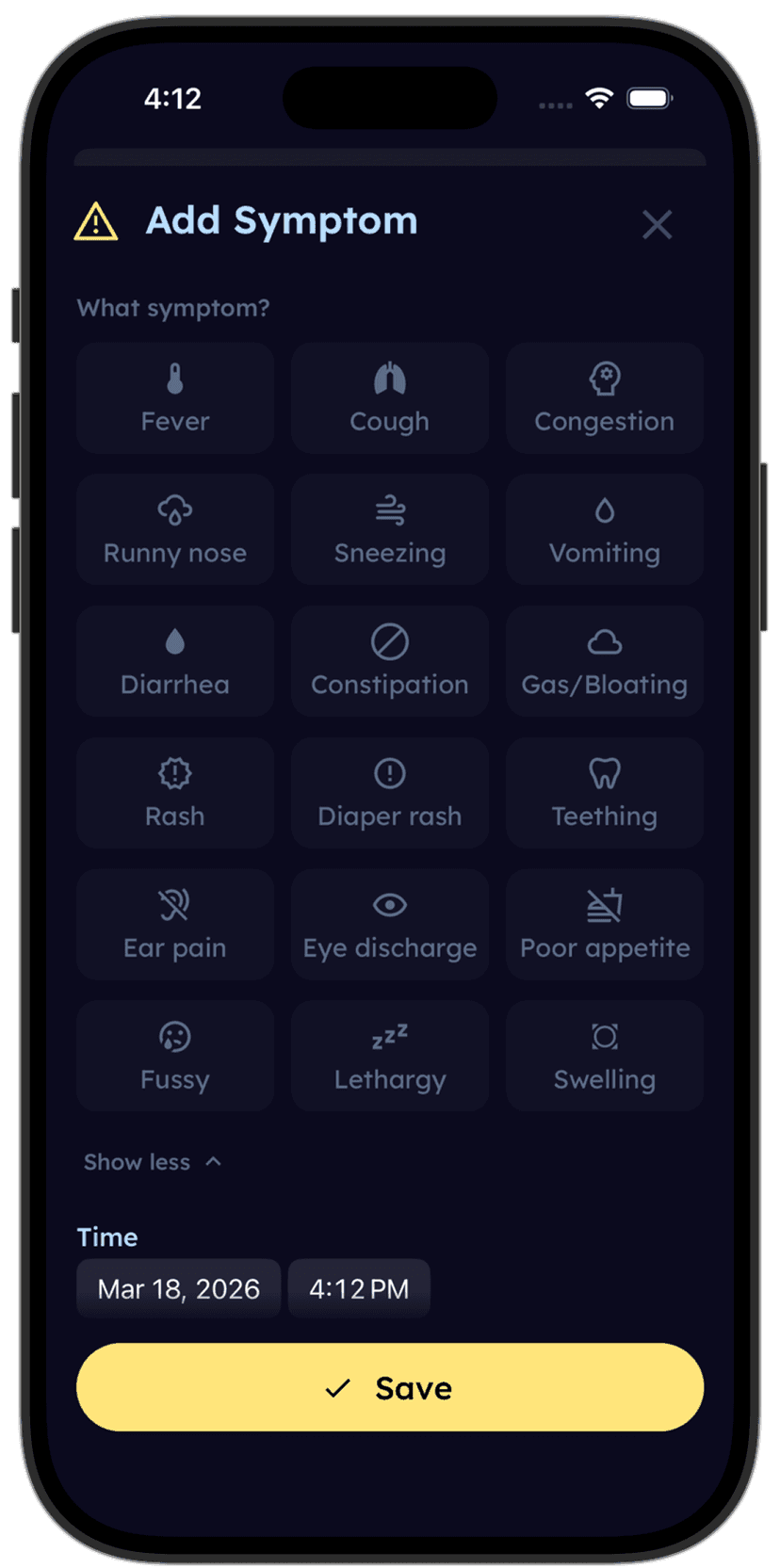
Track symptoms day by day so you can catch RSV getting worse.
Download tinylog free — log feedings, diapers, and symptoms in seconds.
Download on the App StoreGet It On Google Play