GUIDE

Croup in Babies and Toddlers

That terrifying barking cough is almost always manageable — but severe croup needs the ER.

Croup causes swelling in the upper airway, producing a distinctive seal-like bark cough and sometimes stridor — a high-pitched sound when breathing in. It is most common between 6 months and 3 years and classically worse at night. Here is how to assess severity, what to do at home, and when to head to the emergency room.

What Croup Is and Why It Sounds So Terrifying

There is a moment in parenting — often around 2 AM — when your child starts coughing and the sound that comes out is unlike anything you have heard before. It is a harsh, barking cough that sounds like a seal, or a small dog, or something that definitely should not be coming from a toddler. If you have never heard croup before, it is genuinely alarming. Your instinct will be to grab your keys and drive to the emergency room.

Before you do, take a breath. In most cases, croup sounds much worse than it is. The bark is dramatic, but the vast majority of croup cases are mild and manageable at home. Understanding what is happening inside your child's airway helps you make the right call about when to stay home and when to go.

Croup is caused by a viral infection — most commonly parainfluenza virus — that causes swelling of the larynx (voice box) and trachea (windpipe). These are the upper airways, and in a small child, they are narrow to begin with. When the lining swells even a few millimeters, it significantly restricts airflow. The barking cough is the sound of air being forced through that narrowed space. Stridor — the high-pitched, raspy sound you may hear when your child breathes in — is another result of air squeezing through the swollen airway.

Croup is most common between six months and three years of age, with a peak around two years. It is more common in boys. It typically starts with one to two days of cold symptoms (runny nose, mild cough, low-grade fever) before the characteristic barking cough appears — often suddenly, often at night.

Severity Matters: Mild vs. Moderate vs. Severe

The key to managing croup is assessing severity, and the key to assessing severity is one symptom: stridor. Stridor is the high-pitched sound your child makes when breathing in (not out — that would be wheezing). It is caused by turbulent airflow through the narrowed upper airway.

Mild croup means your child has the barking cough but no stridor at rest. They may have stridor only when they are coughing, crying, or agitated — this is still considered mild because the airway is open enough for quiet breathing. Between episodes, the child is relatively comfortable. This is where most croup cases land, and it can be managed at home.

Moderate croup means stridor is present even when the child is calm and resting — you can hear the high-pitched sound just sitting next to them. There may be mild retractions (the skin between or below the ribs pulling in with each breath). The child may be more agitated than usual. This is the threshold for medical evaluation. Your child likely needs dexamethasone (a corticosteroid that reduces airway swelling).

Severe croup means loud stridor at rest, significant retractions, and a child who is either very agitated or, more worryingly, becoming lethargic. When a child with croup goes from agitated to lethargic, that is a sign of exhaustion — they are tiring out from the effort of breathing. This needs emergency treatment.

There is one counterintuitive thing to know: if stridor suddenly becomes quieter in a child who is clearly still struggling to breathe, that is actually worse, not better. It means the airway has become so narrow that there is not enough airflow to produce the sound. This is an emergency.

Croup Severity Assessment
Mild croup
What You'll SeeBarking cough (intermittent), no stridor at rest, no retractions, child is comfortable between coughing episodes
What to DoManage at home — cool air, humidifier, calm the child, small sips of fluids
NotesMost croup falls in this category. May still sound scary.
Moderate croup
What You'll SeeStridor at rest (audible high-pitched sound when breathing in while calm), mild retractions, some agitation, barking cough more frequent
What to DoCall pediatrician or go to ER — child needs evaluation and likely dexamethasone
NotesStridor at rest is the key line between mild and moderate
Severe croup
What You'll SeeLoud stridor at rest, significant retractions (skin pulling in visibly with each breath), agitation OR lethargy, decreased air entry, difficulty speaking or crying
What to DoGo to ER immediately — child will likely need dexamethasone AND nebulized epinephrine
NotesSevere croup is uncommon but requires urgent intervention
Life-threatening croup
What You'll SeeCyanosis (blue/gray lips), extreme lethargy or altered consciousness, barely audible breath sounds (paradoxically quiet — airway too narrow for sound), drooling and unable to swallow
What to DoCall 911 — this is a medical emergency
NotesExtremely rare. If stridor becomes quiet while child is clearly struggling, airway is critically narrowed.
The critical distinction: stridor only when crying or agitated = mild. Stridor at rest = moderate or worse. When in doubt, err on the side of seeking evaluation.

Go to the ER If You See Any of These

  • Stridor audible when your child is calm and at rest — not just when coughing or crying
  • Visible chest retractions — skin pulling in between the ribs, below the ribcage, or at the neck notch with each breath
  • Child is drooling excessively or unable to swallow (rare but concerning — may suggest epiglottitis, not croup)
  • Blue or gray tint to lips or fingertips — call 911
  • Child is extremely agitated and cannot be calmed despite your best efforts
  • Child is becoming lethargic or difficult to arouse — this is worse than agitation
  • Stridor getting quieter while breathing effort stays the same or worsens — airway may be critically narrowed
  • Cool air and calm-down techniques have not improved symptoms after 15-20 minutes
  • Child is under 6 months old with croup symptoms — lower threshold for ER evaluation

Croup sounds terrifying, but most cases are mild. These warning signs help you distinguish the cases that truly need emergency care from the majority that do not.

The Middle of the Night: Your Action Plan

Croup loves the nighttime. The combination of cool air, lying down, pooling secretions, and naturally dropping cortisol levels means that croup episodes almost always peak between 10 PM and 4 AM. Your child may go to bed seeming fine — maybe a little congested — and wake up at midnight with a cough that sounds like a barking animal.

Here is what to do in the moment.

First, assess. Is there stridor? Listen carefully when your child is not actively coughing. Can you hear a high-pitched sound when they breathe in? If yes — and it persists even when they are not crying — this is moderate croup and warrants a trip to the ER. If stridor is only present during coughing or crying but disappears when they calm down, you are dealing with mild croup that can likely be managed at home.

Second, cool air. Pick your child up (upright position helps), and take them outside. If it is a cool or cold night, stand on the porch or take a short walk. Ten to fifteen minutes of cool air exposure reduces airway swelling in many children. If the weather is warm, sit in front of an open freezer or turn the air conditioning down. The goal is cool, moist air on the swollen airway.

Third, calm. Hold your child close, speak quietly, move slowly. Do not try to look down their throat. Do not do anything that will make them cry harder. A calm child breathes better. Put on a favorite show if it helps. Offer a small drink.

If symptoms improve with cool air and calming, you can return to bed — but plan to stay close. Croup can flare again the same night. If symptoms do not improve after fifteen to twenty minutes of cool air and calming, or if they worsen, head to the ER.

Middle-of-the-Night Decision Guide
Barking cough wakes child, no stridor between coughing episodes, child settles back down
What to DoTake child outside into cool night air for 10-15 minutes or sit in bathroom with cool-mist shower running. Offer a small drink. Stay calm — your calm keeps them calm.
How UrgentManage at home
Barking cough plus stridor only when crying or upset, no stridor when calm
What to DoCool air, calm the child, offer fluids. If stridor resolves when child is calm, continue monitoring closely through the night. Call pediatrician in the morning.
How UrgentMonitor closely — call pediatrician in morning
Stridor audible even when child is calm and resting, mild retractions visible
What to DoGo to the ER. Do not wait until morning. Drive with windows cracked (cool air may help en route). Stay calm — an agitated child breathes worse.
How UrgentER tonight
Severe stridor, significant retractions, child extremely agitated or unusually lethargic
What to DoGo to ER immediately or call 911 if symptoms are alarming. Child likely needs epinephrine and dexamethasone.
How UrgentER now or 911
Blue or gray lips, child struggling to breathe, barely audible sounds despite visible effort
What to DoCall 911. Do not attempt to drive. Sit child upright and keep them as calm as possible until paramedics arrive.
How UrgentCall 911
Keep your pediatrician's after-hours number in your phone. If you are unsure about severity, call — the on-call nurse or doctor can help you decide whether to go to the ER or monitor at home.
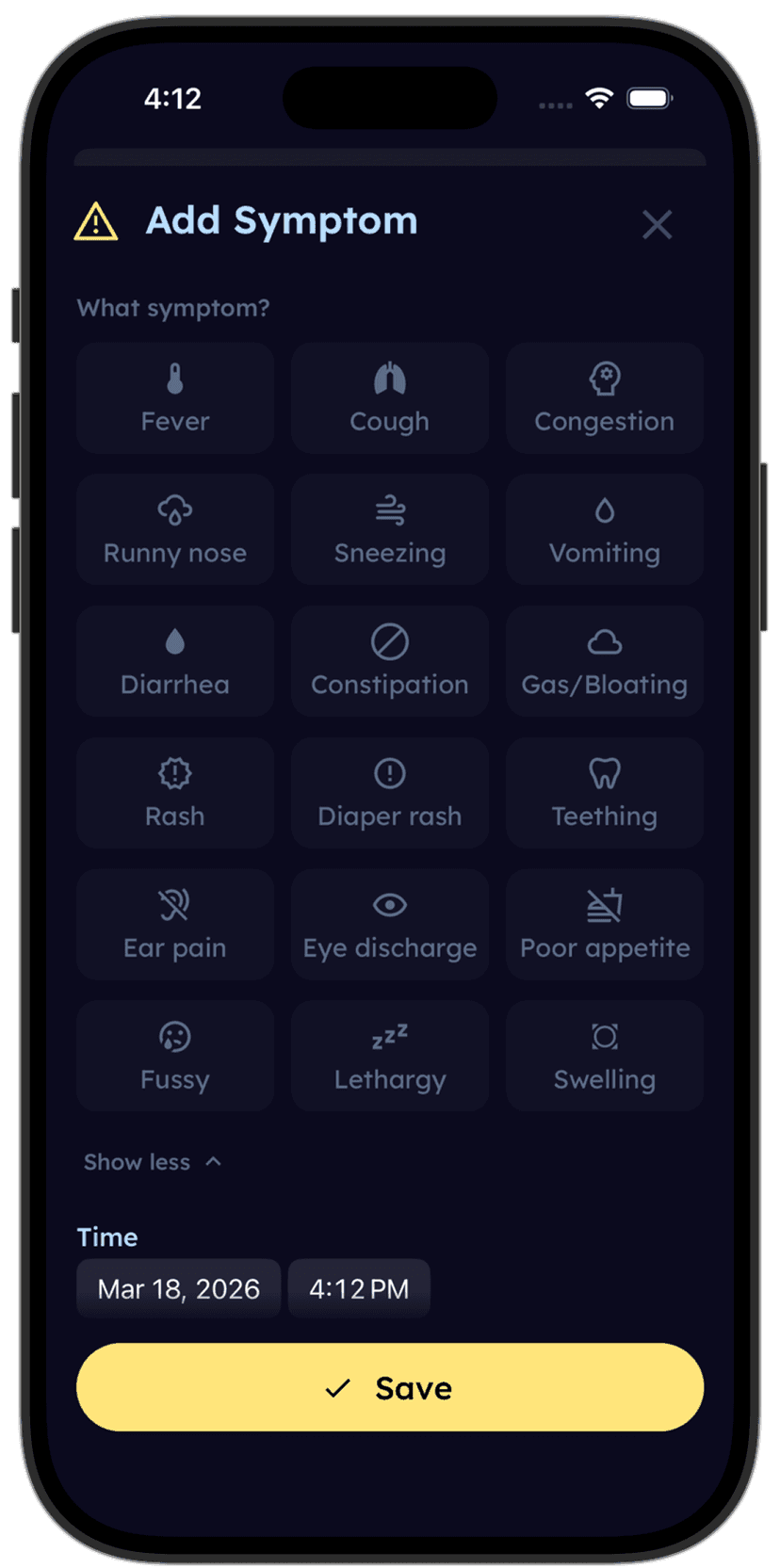
tinylog symptom tracking screen showing overnight croup notes

Log overnight symptoms so you remember the details in the morning.

At 2 AM with a croupy child, you will not remember the details by morning. A quick note in tinylog — 'woke 1:30 AM, barking cough, stridor when crying but not at rest, cool air helped after 15 min' — gives you something concrete to report to your pediatrician. It also helps you compare nights if croup continues for several days.

Download on the App StoreGet It On Google Play

What to Do Right Now: Home Management for Mild Croup

Cool night air is your best friend

This is the oldest trick in the croup playbook, and it actually works. Bundle your child up and take them outside into the cool night air for 10-15 minutes. The cold air reduces airway swelling. Many parents have had the experience of loading a croupy child into the car to drive to the ER, and by the time they arrive, the child sounds dramatically better — because the cool air during the drive did its job. If it is warm outside, try standing in front of the open freezer.

Stay calm — agitation makes it worse

This is not feel-good advice — it is medical reality. When a child with croup gets upset and cries, the increased airflow through the swollen airway causes more turbulence and more swelling. Agitation literally makes the breathing worse. So the most therapeutic thing you can do is stay calm yourself. Hold your child, speak in a soothing voice, avoid invasive or upsetting interventions (like aggressive suctioning). A calm child with croup breathes better than a panicked one.

Upright position helps

Sitting your child upright — on your lap, in your arms, propped against you — allows gravity to help keep the airway as open as possible. Lying flat can worsen symptoms because secretions pool in the narrowed airway. During the worst of a croup episode, many parents end up sleeping sitting upright with their child on their chest. It is not glamorous, but it works.

Offer small sips of fluids

Hydration helps keep secretions thin, and the act of swallowing can briefly soothe the irritated airway. Offer whatever your child will take — breast milk, formula, water, or warm clear fluids for older toddlers. Small sips are better than large amounts, especially if your child is coughing hard enough to trigger gagging. A popsicle can work wonders for toddlers — the cold soothes the throat.

Cool-mist humidifier (but steamy bathroom is debated)

A cool-mist humidifier in the bedroom adds moisture to the air and can help with symptoms. The steamy bathroom trick — running a hot shower and sitting in the steam — is a longstanding home remedy, but recent studies have not shown clear benefit. It may help, it probably will not hurt, but cool mist has more support. Either way, if it seems to comfort your child, that matters too.

Expect the second night to be rough too

Croup typically lasts three to five days, and the second night is often as bad as or worse than the first. Do not be caught off guard. If your child had a croup episode tonight, plan for a possible repeat tomorrow night. Have your pediatrician's after-hours number ready. Know the route to the nearest ER. Being prepared reduces your own anxiety, which helps you keep your child calm.

What Happens at the ER

If you do end up at the emergency room for croup, here is what to expect. The process is usually straightforward and reassuring.

The doctor will assess your child's breathing — listening to the quality of the stridor, looking for retractions, checking oxygen levels, and observing how your child looks overall. They will likely give a single dose of dexamethasone (a corticosteroid), either by mouth or, if your child is vomiting, as an injection. Dexamethasone reduces airway inflammation and is the most effective treatment for croup. It starts working within two to four hours and its effects last two to three days. Many parents notice significant improvement by the time they get home or the next morning.

If croup is moderate to severe, nebulized racemic epinephrine may also be given through a face mask. Epinephrine works fast — within minutes — by constricting blood vessels in the swollen airway tissue, temporarily reducing the swelling. The catch is that it wears off in about two hours. This is why children who receive epinephrine are observed in the ER for two to four hours — the doctors need to make sure symptoms do not return when the epinephrine effect fades (this is called "rebound").

Antibiotics are NOT given for croup because it is a viral illness. Cough medicine is not used. The treatment is specifically aimed at reducing the airway swelling.

Most children go home the same night or morning. Hospitalization is reserved for severe cases that do not respond to treatment or for very young infants.

What This ISN'T: Croup vs. Asthma vs. Foreign Body vs. Epiglottitis

Not every barking cough is croup, and not every breathing difficulty in a toddler has the same cause. Here is how to think about the main possibilities.

Croup produces a distinctive barking cough with stridor (sound on inhalation). It develops gradually after cold symptoms and is classically worse at night. The child typically looks reasonably well between episodes. It responds to cool air and steroids.

Asthma causes wheezing — a whistling sound on exhale, not inhale. The cough is tight and wheezy, not barking. Asthma can be triggered by viral illness (just like croup can follow a cold), but it can also be triggered by allergens, exercise, or cold air. Asthma is less common in children under two but not impossible. It does not cause stridor.

Foreign body aspiration is the emergency to always consider, especially in the six-month to three-year age range when children put everything in their mouths. The hallmark is sudden onset — one moment the child is fine, the next they are choking, coughing, and struggling. There is no preceding cold, no fever, no gradual onset. If your child suddenly starts coughing with no warning, especially if they were playing with small objects or eating, think foreign body. This needs emergency evaluation.

Epiglottitis is rare since the Hib (Haemophilus influenzae type b) vaccine became standard, but it is the one to never miss. Epiglottitis is a bacterial infection of the epiglottis (the flap of tissue at the base of the tongue). It causes rapid-onset high fever, sore throat, drooling (because swallowing is too painful), a muffled voice, and stridor. The child looks toxic — visibly ill, often sitting in a "tripod" position (leaning forward, neck extended). This is a true emergency. If you suspect epiglottitis, go to the ER immediately and do NOT try to look down the child's throat — this can cause complete airway obstruction.

Croup vs. Asthma vs. Foreign Body vs. Epiglottitis
Cough sound
CroupBarking, seal-like, harsh
AsthmaWheezy, tight, may be dry
Foreign BodySudden onset, choking, gagging
EpiglottitisMuffled voice, no barking cough
Breathing sound
CroupStridor (high-pitched on INHALE)
AsthmaWheezing (on EXHALE)
Foreign BodyWheezing or stridor depending on location
EpiglottitisStridor, drooling, muffled voice
Onset
CroupGradual — cold symptoms for 1-2 days then barking cough
AsthmaTriggered by allergens, exercise, cold air, or illness
Foreign BodySudden — one moment fine, next choking/coughing
EpiglottitisRapid — high fever, sore throat, drooling over hours
Fever
CroupLow-grade or none
AsthmaNo fever (unless triggered by viral illness)
Foreign BodyNo fever
EpiglottitisHigh fever, child looks toxic (extremely unwell)
Position
CroupChild may prefer sitting up
AsthmaSitting up, leaning forward
Foreign BodyVariable
EpiglottitisClassic 'tripod' position — sitting, leaning forward, neck extended, drooling
Time pattern
CroupWorse at night, better during day
AsthmaCan occur anytime, may be worse at night
Foreign BodyNo pattern — sudden event
EpiglottitisRapidly progressive, does not improve
Age
Croup6 months to 3 years most common
AsthmaAny age, but more common after 2-3 years
Foreign Body6 months to 3 years (peak mouthing/exploring age)
EpiglottitisRare since Hib vaccine — any age if unvaccinated
Response to cool air
CroupOften improves with cool air exposure
AsthmaCold air may worsen
Foreign BodyNo response
EpiglottitisNo response
If the onset was sudden with no preceding illness, think foreign body. If the child has a high fever and looks very sick with drooling, think epiglottitis. Both are emergencies.

What This Looks Like in Real Life

Your 18-month-old had a runny nose for two days — nothing dramatic, just daycare's weekly contribution to your household. You put him to bed at 7:30, and he goes down without fuss. At midnight, you are jolted awake by a sound you have never heard before. It sounds like there is a seal in the nursery. Your son is sitting up in his crib, barking out this alarming cough, and between coughs, you hear a high-pitched squeaky sound when he breathes in.

Your heart rate spikes. You pick him up and he clings to you, coughing. You listen: when he calms down on your shoulder, the squeaky sound disappears. It only comes back when he coughs or starts to cry. You remember reading that stridor at rest is the dividing line. No stridor when he is calm — that is mild croup.

You carry him to the front door, wrap a blanket around both of you, and step outside. It is 38 degrees Fahrenheit. You stand there, swaying slightly, talking to him in a low voice. Within ten minutes, the barking cough has softened. He coughs a few more times, but the bark is less dramatic. You go back inside, offer him a sippy cup of water, and he drinks. You sit in the rocking chair with him upright on your chest. He falls asleep. You do not. You log a quick note in tinylog — "midnight croup episode, stridor only when crying, cool air helped, settled by 12:30" — and sit in the chair for the rest of the night.

The next morning, he seems fine. Runny nose, a mild regular cough, but no barking. You call the pediatrician's office and report what happened. They say: mild croup, expect it to return tonight, call if stridor is present at rest. It does return — the second night is actually a little worse, with more frequent barking episodes. But each time, cool air and calm settle him. By night four, it is over.


tinylog daily log showing overnight croup symptom notes across multiple nights

Compare night to night — is the croup improving?

Croup typically lasts 3-5 nights, and it can be hard to tell if things are improving when you are sleep-deprived. Log each episode in tinylog — the time, severity, what helped, how long it took to settle. When your pediatrician asks 'is it getting better or worse?' you will have the answer.

Download on the App StoreGet It On Google Play

Related Guides

Sources

  • Smith, D. K., et al. (2018). Croup: Diagnosis and Management. American Family Physician, 97(9), 575-580.
  • Bjornson, C. L., & Johnson, D. W. (2013). Croup in Children. Canadian Medical Association Journal, 185(15), 1317-1323.
  • Petrocheilou, A., et al. (2014). Viral Croup: Diagnosis and a Treatment Algorithm. Pediatric Pulmonology, 49(5), 421-429.
  • American Academy of Pediatrics (AAP). (2024). Croup and Your Young Child. HealthyChildren.org.
  • Gates, A., et al. (2018). Glucocorticoids for Croup in Children. Cochrane Database of Systematic Reviews.
  • Cherry, J. D. (2008). Croup. New England Journal of Medicine, 358(4), 384-391.

Medical Disclaimer

This guide is for informational purposes only and is NOT a substitute for professional medical advice. When in doubt, always call your pediatrician. If your baby is under 3 months with a fever, having difficulty breathing, showing signs of dehydration, or seems seriously unwell, seek immediate medical attention.

Get this guide in your inbox.
We'll email you this guide so you have the severity assessment and action steps whenever you need them.
Track symptoms overnight so you can report clearly to your pediatrician.
Download tinylog free — log feedings, diapers, and symptoms in seconds.
Download on the App StoreGet It On Google Play