
You cannot cook it out
Cereulide is heat-stable. Boiling, microwaving, or any preparation method will not neutralize it. Once it is in the formula powder, it stays. This is why the recalls are so broad — there is no consumer workaround.
GUIDE
Published on ·Updated on
2026 has already seen the fallout from the largest formula safety events in recent history — a US botulism recall and a global contamination crisis spanning 60+ countries.
Here's what happened, what's affected, whether your formula is involved, and what you should actually do. Facts first, panic never.
Free 2-min quiz. Instant FDA recall check plus a personalized match.
“All infant formulas must meet requirements that ensure optimal nutrition for babies. If your baby's formula is sold in the U.S., it has the nutrients your baby needs.”
 Dr. Matthew Badgett, MD, Pediatrician, Cleveland Clinic
2026 has started with two of the largest infant formula safety events in recent history happening simultaneously. Both are serious. Neither should make you panic.
The first is the continuation of the ByHeart botulism recall — the first known infant botulism outbreak linked to formula in the world. All ByHeart products ever manufactured remain recalled. No new cases have been reported since December 2025. The investigation is ongoing but the immediate crisis appears to be stabilizing.
The second is a massive global cereulide contamination crisis that has triggered recalls across 60+ countries, affecting Nestlé, Danone, Lactalis, and other manufacturers. This one is primarily a European and international issue — the affected brands are not sold in US retail stores. But if you import European formula, you need to know about it.
Here's what matters for US parents: the US formula supply on store shelves (Similac, Enfamil, Gerber, Bobbie, Kendamil, Kirkland, and other FDA-regulated brands) has not been affected by the cereulide crisis. The ByHeart recall is the only active US FDA formula recall as of February 2026, and ByHeart represented approximately 1% of US formula sales — no supply shortage has occurred.
| Event | Status | Classification | Affects US? | Details |
|---|---|---|---|---|
| ByHeart Botulism Recall (ongoing) | Active — all product recalled | Class I | Yes — US FDA recall | All ByHeart Whole Nutrition Infant Formula ever produced remains recalled. 51 infants hospitalized across 19 states with infant botulism. Clostridium botulinum confirmed in finished product and organic whole milk powder ingredient. FDA issued warning letters to Walmart, Target, Kroger, and Albertsons for failing to remove product from shelves. As of Jan 23, 2026 CDC update: no new cases since Dec 1, 2025. No deaths reported. |
| Global Cereulide Crisis (Nestlé, Danone, Lactalis) | Active — recalls in 60+ countries | Varies by country | No — primarily EU/international brands | Cereulide toxin contamination traced to a single Chinese ARA oil supplier (Cabio Biotech). Nestlé recalled 800+ products from 10+ factories across 60+ countries. Danone recalled Aptamil and Cow & Gate products. Lactalis recalled in 18 countries. Affected brands (SMA, NAN, BEBA, Aptamil, Cow & Gate) are not sold in US retail. UK reported 36 clinical cases. French prosecutors investigating 5 companies. Deaths of 2–3 infants under investigation in France (no causal link established). Estimated $1.3B financial exposure for Nestlé. |
| Kendamil Recall (Canada) | Active — CFIA recall | N/A (Canadian, not FDA) | No — Canadian recall only (Costco Canada) | Canadian Food Inspection Agency recalled Kendamil Whole Milk Infant Formula sold at Costco Canada for potential cereulide toxin. Two lot codes affected. Same root cause as global cereulide crisis — contaminated ARA oil from the same Chinese supplier. No illnesses reported. No US FDA recall issued for Kendamil. |
| FDA Retailer Warning Letters | Enforcement action | N/A | Yes — US enforcement | FDA sent formal warning letters to Walmart, Target, Kroger, and Albertsons in December 2025 for failing to remove recalled ByHeart formula from shelves. FDA investigators found recalled product in 175+ locations across 36 states, in some cases for over 3 weeks after the recall. Recalled product was found for sale as recently as January 18, 2026. |
The ByHeart infant botulism outbreak was the defining formula safety event of late 2025, and its aftermath has carried into 2026. Here is where things stand.
The CDC's most recent update (January 23, 2026) shows the case count holding steady at 51 hospitalized infants across 19 states. No new cases have been reported since December 1, 2025. No deaths have been attributed to the outbreak.
The root cause has been identified: Clostridium botulinum was confirmed in finished product samples and traced via genetic sequencing to organic whole milk powder — an ingredient sourced from a supplier that does not supply other formula manufacturers. ByHeart has paused all production, marketing, and influencer partnerships.
The most troubling part of the ByHeart story in 2026 is not the contamination itself — it's the retail response. The FDA found recalled ByHeart formula still on store shelves in 175+ locations across 36 states, in some cases for over three weeks after the recall was announced. Recalled product was found for sale as recently as January 18, 2026 — more than two months after the public warning. The FDA issued formal warning letters to Walmart, Target, Kroger, and Albertsons.
If you have any ByHeart formula at home — any lot number, any product — do not use it. The entire brand's production history is recalled.
| Item | Details |
|---|---|
| Total cases | 51 infants hospitalized across 19 states (AZ, CA, ID, IL, KY, MA, ME, MI, MN, NC, NJ, OH, OR, PA, RI, TX, VA, WA, WI) |
| Deaths | Zero deaths reported as of February 2026 |
| Last new case | December 1, 2025 — no new cases reported since (per Jan 23, 2026 CDC update) |
| Recall scope | All ByHeart Whole Nutrition Infant Formula ever produced — cans and single-serve packs — since the brand launched in March 2022 |
| Root cause | Clostridium botulinum confirmed in 6 of 36 finished product samples. Genetic sequencing matched contamination to organic whole milk powder from a ByHeart supplier. The supplier does not supply other formula manufacturers. |
| Production status | ByHeart has paused all production, marketing, advertising, and influencer partnerships |
| Retailer enforcement | FDA issued warning letters to Walmart, Target, Kroger, and Albertsons. Recalled product found on shelves in 175+ locations across 36 states. Product found for sale as recently as January 18, 2026. |
| Congressional scrutiny | Senator Cassidy wrote to ByHeart citing FDA inspection reports of 'numerous safety deficiencies' in manufacturing facilities |
This is the biggest infant formula safety event of 2026 by geographic scope — and it's one that most US parents haven't heard about, because it primarily affects brands sold outside the United States.
In late November 2025, Nestlé detected cereulide — a heat-stable toxin produced by Bacillus cereus bacteria — during routine testing at its factory in the Netherlands. By January 2026, the recall had expanded to 60+ countries and 800+ products. Austria's Health Ministry called it the largest recall in Nestlé's history.
Then it spread beyond Nestlé. Danone, Lactalis, and smaller brands all issued recalls after confirming they had sourced the same contaminated ingredient: arachidonic acid (ARA) oil from a single Chinese supplier, Cabio Biotech. ARA is added to formula for brain and eye development. Lab analysis revealed the contamination dates back to at least October 2024 and persisted throughout 2025.
The affected brands — SMA, NAN, BEBA, Aptamil, Cow & Gate — are not sold in US retail stores. They are regulated by European and international food safety authorities, not the FDA. No US FDA recall has been issued for these products.
But this matters for US parents in two specific scenarios. First, if you import European formula (HiPP, Aptamil, Holle, or others), you should check whether your products are affected — you are outside the FDA recall system and responsible for monitoring European safety alerts yourself. Second, Kendamil — a UK brand that is sold in the US — was recalled in Canada for the same cereulide contamination. No US FDA recall has been issued for Kendamil, but the situation is evolving.
| Date | What Happened |
|---|---|
| Late Nov 2025 | Nestlé detects low levels of cereulide during routine checks at its Nunspeet, Netherlands factory after installing new production equipment |
| Dec 10, 2025 | Nestlé informs Dutch food safety authorities and the European Commission. Initial voluntary recall issued. |
| Jan 5, 2026 | Nestlé begins public voluntary recall across multiple countries after extensive lab analysis (Dec 23, 2025 – Jan 3, 2026) |
| Jan 12, 2026 | Recall expands to 50+ countries. Austrian Health Ministry calls it the largest recall in Nestlé's history — 800+ products from 10+ factories |
| Jan–Feb 2026 | Danone, Lactalis, and smaller brands (Babybio, La Marque en Moins) issue precautionary recalls after confirming they sourced ARA oil from the same Chinese supplier (Cabio Biotech) |
| Feb 2, 2026 | EFSA proposes first-ever safety threshold for cereulide in infant formula (0.014 μg/kg bodyweight). Prior to this date, no generally accepted limit existed. |
| Feb 13, 2026 | Seven EU countries (Austria, Belgium, Denmark, France, Luxembourg, Spain, UK) report infants with gastrointestinal symptoms under investigation |
| Feb 16, 2026 | French prosecutors open criminal investigations into five formula companies |
| Feb 22, 2026 | Canada's CFIA recalls Kendamil infant formula sold at Costco Canada for cereulide — same ARA oil supplier as the global crisis |
| Feb 23, 2026 | Nestlé reports CHF 185 million ($210M) financial hit. Analysts estimate up to $1.3 billion total exposure. Both Nestlé and Danone warn of Q1 earnings impact. |
Cereulide is different from the contamination events US parents are used to hearing about. Cronobacter and Salmonella — the bacteria behind previous major US formula recalls — can be managed through proper preparation (using hot water, cleaning bottles). Cereulide cannot.
Cereulide is heat-stable. Boiling, microwaving, or any preparation method will not neutralize it. Once it is in the formula powder, it stays. This is why the recalls are so broad — there is no consumer workaround.
The contamination entered through ARA oil from a single Chinese supplier. Multiple formula manufacturers — Nestlé, Danone, Lactalis, Kendamil — sourced from this supplier. This is a supply chain vulnerability, not a single-factory failure.
Prior to February 2, 2026, there was no generally accepted regulatory limit for cereulide in infant formula. The European Food Safety Authority proposed the first-ever threshold only after this crisis forced the issue. That gap meant manufacturers were not testing for a risk that no one had defined.
| Fact | Details |
|---|---|
| It's a toxin, not a bacterium | Cereulide is produced by Bacillus cereus bacteria, but the toxin itself is what causes illness. It's a cyclic depsipeptide — a small, extremely stable molecule. |
| It cannot be destroyed by cooking | Unlike most food safety threats, cereulide is heat-stable. Boiling, microwaving, or any preparation method will not neutralize it. Once it's in the formula powder, it stays. |
| Symptoms are mainly gastrointestinal | Nausea and vomiting are the most common symptoms, typically beginning rapidly after ingestion. Infants under 6 months are more vulnerable because they are more sensitive to dehydration. |
| It entered through an ingredient supplier | The contamination was traced to arachidonic acid (ARA) oil from a Chinese supplier (Cabio Biotech). ARA is added to formula for brain and eye development. Lab analysis showed contamination dates back to at least October 2024. |
| There was no safety limit before this crisis | Prior to February 2, 2026, no generally accepted regulatory limit for cereulide in infant formula existed. The EFSA has now proposed a threshold of 0.014 μg/kg bodyweight. |
A significant number of US parents import European formula — brands like HiPP, Holle, Aptamil, and others — through third-party retailers and online sellers. The 2026 cereulide crisis is directly relevant to these families.
The cereulide crisis has underscored a real risk of using formula outside your country's regulatory system: when a recall happens, the safety net you're relying on is not designed to catch you.
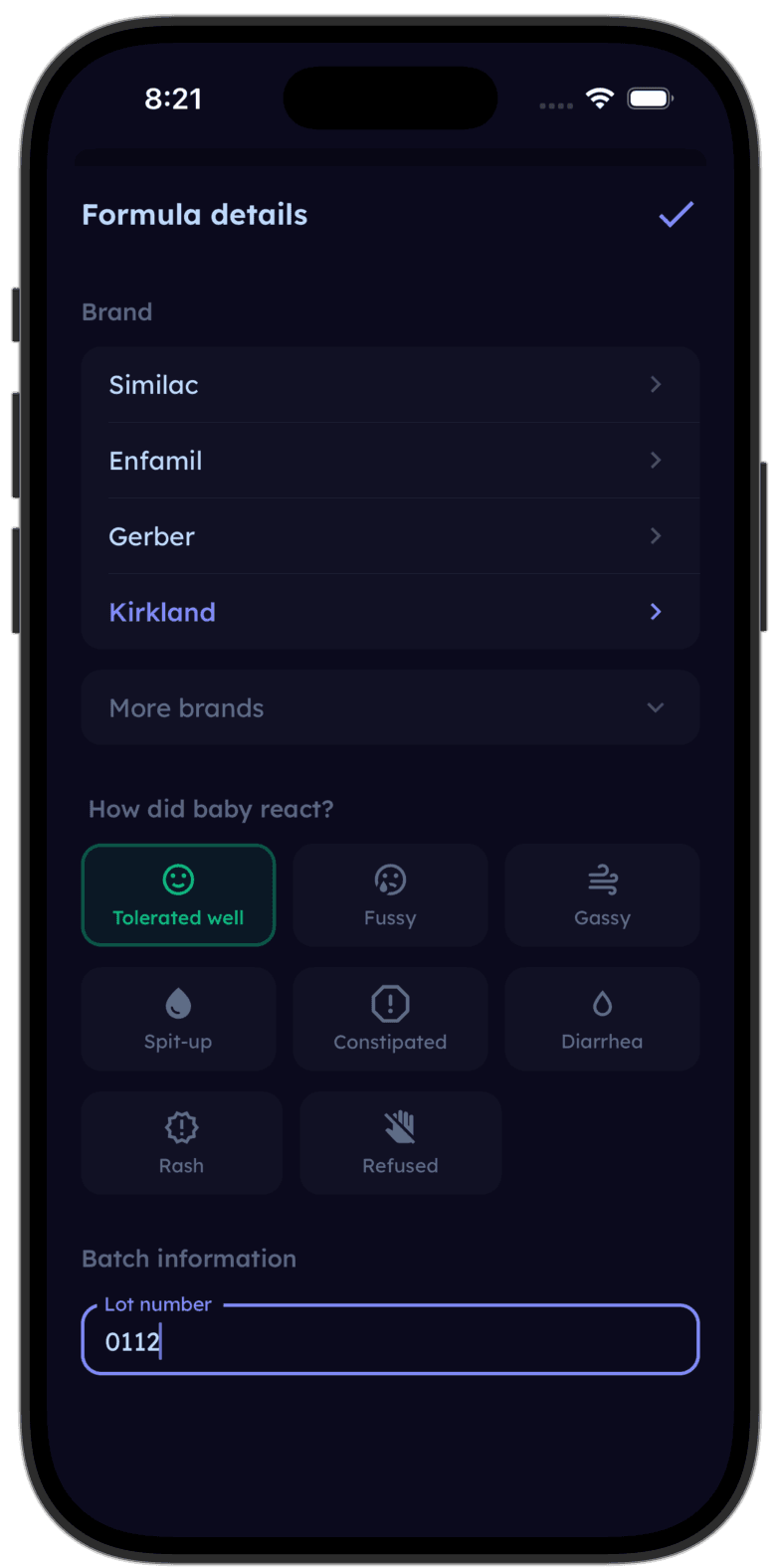
Log the formula brand and lot number with each new can in Tinylog. Your feeding history is saved automatically. If ByHeart, a cereulide-affected import, or anything else comes up in the news, you can cross-reference in seconds — not after a panicked scroll through receipts.


You do not need to be afraid of the formula on your shelf. But you do need to be informed. Here is the short list.
The US formula supply in stores is safe. These actions are about staying informed and having a system — not about living in fear.
Two unprecedented events happening at the same time feels alarming. But understanding what each one actually means — and whether it affects your formula — makes a meaningful difference.
When in doubt, call. Your pediatrician would rather hear from you and reassure you than have you worry in silence.
2026 has been an unprecedented year for formula safety — and it's only February. The ByHeart botulism recall was the first of its kind in formula history. The global cereulide crisis is one of the largest formula safety events ever by geographic scope. Both trace back to ingredient suppliers, not to the formula manufacturers' own factories — a pattern that is forcing the entire industry to rethink how it manages supply chain risk.
For US parents using FDA-regulated formula from US stores: your supply is not affected by the cereulide crisis. The only active US FDA formula recall is ByHeart, which represented about 1% of the market. There is no formula shortage.
For parents importing European formula: this is a direct and ongoing concern. Check your products, check the lot numbers, and understand that you are responsible for monitoring safety alerts from the relevant European authorities.
Your job as a parent is not to be scared of formula. It is to know where to check, to keep your lot numbers accessible, and to have a system in place so that when a recall is announced, you can verify in five minutes whether it affects your family. That's it. That's the whole thing.
Log what you're feeding your baby. Sign up for FDA email alerts. And move on — because the US formula supply on store shelves is safe, and millions of feedings are happening without incident every single day.
For the full history of every major formula recall in the US, see our complete formula recall history. For a brand-by-brand breakdown of recall records, see our formula recall safety scorecard. For step-by-step instructions on checking recalls, see our how to check for recalls guide.
How to Check for Recalls — A step-by-step guide
Formula Recalls History — A complete history
Formula Safety Scorecard — Every major brand rated
This guide is for informational purposes only and is not a substitute for professional medical advice. Recall data is based on publicly available FDA, CDC, EFSA, CFIA, and manufacturer records as of February 26, 2026 and may not reflect the most current information. Always check the FDA recall database and relevant international food safety authorities directly for current recalls. If you have concerns about your baby's formula or health, please consult your pediatrician.