
GUIDE
How to Check if Your Formula Has Been Recalled
Published on ·Updated on
Find the lot number on your can, check the FDA recall database, and sign up for free recall alerts. It takes about five minutes.
Formula recalls are rare, but they happen. When one does, the news cycle makes it sound like every can on every shelf is dangerous. It's not. Here's how to check yours quickly and calmly.
Free 2-min quiz. Instant FDA recall check plus a personalized match.
“All infant formulas must meet requirements that ensure optimal nutrition for babies. If your baby's formula is sold in the U.S., it has the nutrients your baby needs.”
 Dr. Matthew Badgett, MD, Pediatrician, Cleveland Clinic
Why You Should Know How to Check
Formula recalls happen. Not often — but when they do, the information spreads unevenly. You might see a scary headline on social media before you see the actual details from the FDA. Or you might miss the news entirely because you were up all night with a teething baby.
Having a simple, repeatable process to check your formula means you don't have to rely on algorithms or word of mouth. You can verify for yourself in under five minutes whether the cans in your pantry are affected — our formula recall search pulls from the FDA, UK FSA, and Canadian CFIA databases so you can check by brand, keyword, or lot number in one place.
If you want context on what past recalls have looked like and why they happened, our formula recall history guide covers the major ones.
| Container Type | Where to Look |
|---|---|
| Metal can (powder) | Stamped on the bottom of the can and/or printed on the label near the expiration date |
| Plastic tub (powder) | Printed on the bottom of the tub or on the label near the UPC code |
| Ready-to-feed bottle | Printed on the bottom of the bottle or on the neck label |
| Liquid carton/tetra pack | Printed on the top or side panel near the expiration date |
| Single-serve packet | Printed on the back of each individual packet and on the outer box |
| Sample cans from pediatrician | Same locations as retail cans — bottom and label. These are recalled too if the lot matches. |
The Five-Step Recall Check
When you hear about a recall — or just want to verify that your current supply is fine — here's the process.
| Step | Where to Check | Details |
|---|---|---|
| Step 1: Find Your Lot Number | Bottom of the can (stamped into metal), side label near expiration date, or bottom of liquid bottles | The lot number is a code like 'SH23FEB2025' or 'C26EVFV.' It identifies the exact production batch. Write it down or take a photo. You need this number to cross-reference against any recall. |
| Step 2: Search the Recall Database | tinylog.app/tools/formula-recall-search | Use our free search tool to check the FDA, UK FSA, and Canadian CFIA databases in one place. Search by brand, keyword, or your lot number. If your lot number is not listed, your formula is not part of the recall. You can also search the FDA database directly at fda.gov/safety/recalls-market-withdrawals-safety-alerts. |
| Step 3: Check the Manufacturer's Website | Brand-specific recall pages (see list below) | Manufacturers often post recall information before it appears on the FDA site. Many have lot number lookup tools where you can enter your code directly and get a yes/no answer. |
| Step 4: Sign Up for Recall Alerts | tinylog.app/tools/formula-recall-alerts | Our free recall alerts tool monitors the FDA, UK FSA, and Canadian CFIA databases daily and emails you when your selected formula brands are recalled. You can also add lot numbers for more precise matching. This way you hear about recalls within 24 hours, not from a friend's social media post three days later. |
| Step 5: Check CPSC for Non-Food Safety Issues | cpsc.gov/Recalls | The Consumer Product Safety Commission handles recalls for things like bottle defects, packaging issues, and contamination from non-food sources. It's a different database than the FDA's and worth bookmarking. |
| Brand | URL | Notes |
|---|---|---|
| Similac (Abbott) | similac.com/recall | Has a lot number lookup tool. Also covers Alimentum, EleCare, and other Abbott formula brands. |
| Enfamil (Reckitt/Mead Johnson) | enfamil.com/contact-us | Product quality inquiries. Check under safety notices or contact their consumer line. |
| Gerber Good Start (Nestle) | gerber.com/contact-us | Nestle's recall page covers all Gerber formula products. |
| Kirkland (Costco) | costco.com/product-recalls.html | Costco manages recalls for Kirkland brand formula. Also check with the actual manufacturer (Perrigo). |
| Store Brands (Perrigo) | perrigosafety.com | Perrigo manufactures most store-brand formulas (Target, Walmart, CVS). Their recall page covers all of them. |
| Bobbie | bobbie.com | Check their website or email support. Smaller brand with direct-to-consumer communication. |
| ByHeart | byheart.com | Direct-to-consumer brand. Check their website or contact customer support for safety notices. |
What to Do if Your Formula IS Recalled
- Stop using the formula immediately — do not feed it to your baby, even if you've been using it without issues
- Do not throw it away yet — you may need the packaging for the refund process
- Contact the manufacturer's recall hotline for a full refund or replacement
- If your baby consumed the recalled formula and has symptoms (vomiting, diarrhea, fever, lethargy), call your pediatrician immediately
- Report adverse events to FDA MedWatch at fda.gov/medwatch or call 1-800-FDA-1088
- Switch to a different lot number of the same brand (if available and not recalled) or a comparable formula
- Check with your pediatrician if you need help choosing a replacement formula
Most manufacturers process recall refunds quickly. Keep the receipt if you have it, but most will accept the product even without one.
What the Marketing Doesn't Tell You
Formula companies are not incentivized to make recall information easy to find. Their websites are designed to sell product, not to highlight safety issues. Most major brands bury their recall pages deep in the site navigation, and some don't have a dedicated recall page at all — you have to go through general customer service.
The FDA database is more reliable but less user-friendly. It's designed for regulatory compliance, not for a parent who needs a quick answer at 11 PM.
This is why your best move is proactive: sign up for free recall alerts now, before there's a recall. Our tool monitors the FDA, UK FSA, and Canadian CFIA databases daily and emails you when your selected brands are recalled. And keep a record of the formula you're using — brand, product name, and lot number. If you're already logging feeds in Tinylog, adding the lot number to your notes gives you a searchable record you can pull up instantly if a recall is announced.
What NOT to Do (Stay Calm)
- A recall does not mean every can of that brand is dangerous — it applies to specific lot numbers only
- Most recalls are precautionary, initiated before any illnesses are reported
- If your baby has been drinking the recalled formula and is showing no symptoms, they are very likely fine — but stop using it going forward
- Don't stockpile formula from other brands in a panic — this contributes to shortages
- Don't assume homemade formula or imported formula is safer — these carry their own significant risks
Recalls sound terrifying. Most of the time, they are caught before harm occurs. Your job is to check your lot number, follow the instructions, and move on.
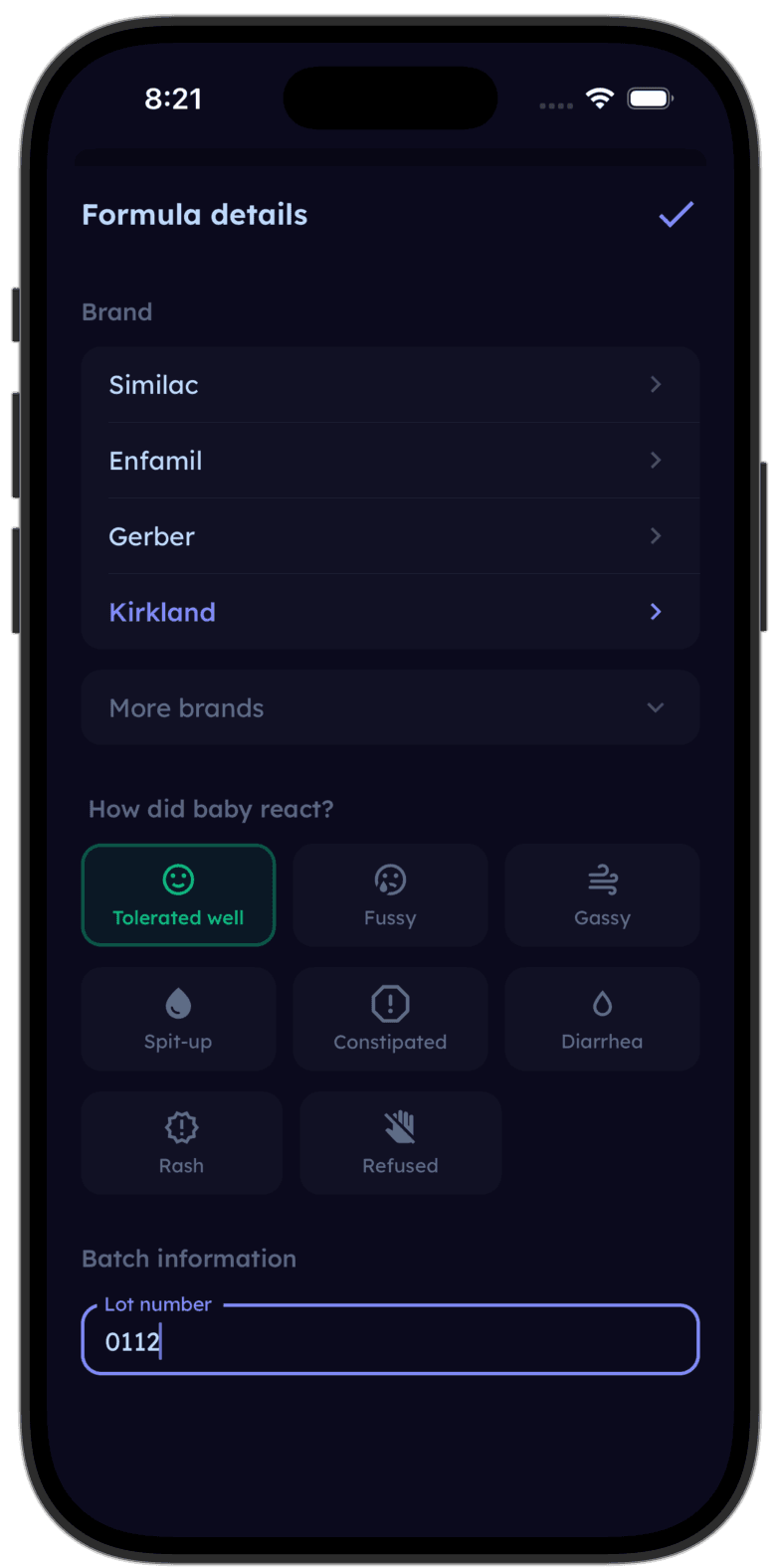
Set up your recall-ready system before you need it — it takes less than a minute.
Log the formula brand and lot number when you open a new can in Tinylog. From then on, every feed is recorded automatically. When a recall is announced, open the app and check — instead of digging through the recycling bin for a can you threw away two weeks ago.


When to Talk to Your Pediatrician
Most recalls do not require a doctor visit. But contact your pediatrician if:
- Your baby consumed recalled formula and is showing any symptoms — vomiting, diarrhea, fever, unusual fussiness, or lethargy
- You need help choosing a replacement formula, especially if your baby is on a specialty formula (hypoallergenic, amino acid-based, or for a specific medical condition)
- Your baby has a health condition that makes them higher-risk for contamination-related illness (premature birth, immunocompromised, under 2 months old)
- You're unsure whether your baby's current symptoms are related to a recalled product
Your pediatrician can help you assess risk and choose an appropriate alternative. For more on what makes some babies higher-risk, see our Cronobacter and formula safety guide.
Building a Simple Recall-Ready System
You don't need to be anxious about this. You just need a system. Here's one that takes about 30 seconds per can:
- When you open a new container of formula, take a photo of the lot number (bottom of the can) and the label.
- Store the photo in a dedicated album on your phone, or note the lot number in your feeding log.
- Sign up for free recall alerts — you'll get an email when your brands are recalled.
- When a recall is announced, pull up your lot numbers and cross-reference. Done.
Most parents go through an entire year of formula feeding without ever encountering a recall. But the ones who have a system in place handle it calmly instead of scrambling — because checking a lot number takes five minutes when you already have the number. Without it, you're searching through receipts, emailing retailers, or just hoping the can isn't in recycling yet.
Set up the system now. Sign up for free recall alerts. Log your lot number when you open a can. Done.
For a broader understanding of how formula quality and safety varies across brands, check out our formula scorecard guide.
Related Guides
-
2026 Formula Recalls — What parents need to know right now
-
Formula Safety Scorecard — Every major brand rated
Sources
- U.S. Food & Drug Administration (FDA) — Recalls, Market Withdrawals, & Safety Alerts: fda.gov/safety/recalls-market-withdrawals-safety-alerts
- FDA MedWatch — Safety Reporting Portal: fda.gov/medwatch
- Consumer Product Safety Commission (CPSC) — Recall Database: cpsc.gov/Recalls
- FDA — Infant Formula Guidance Documents and Regulatory Actions
- CDC — Cronobacter Infection and Infant Formula, 2023 update
This guide is for informational purposes only and is not a substitute for professional medical advice. If you have concerns about your baby's formula or health, please consult your pediatrician.
Frequently asked questions
- Where do I find the lot number on baby formula?
- The lot number is typically stamped on the bottom of the can or printed on the label near the expiration date. It's a combination of letters and numbers. For liquid formula, check the bottom of the bottle or the side of the carton. For single-serve packets, it's usually on the back of the packet.
- How do I check if my formula has been recalled?
- Go to the FDA's recall database at fda.gov/safety/recalls-market-withdrawals-safety-alerts. You can search by brand name, product name, or lot number. You can also check the manufacturer's website directly — all major brands have dedicated recall or safety pages.
- What should I do if my formula is on a recall list?
- Stop using it immediately. Do not feed it to your baby. Contact the manufacturer for a refund or replacement — most have dedicated recall hotlines. If your baby consumed the recalled formula and is showing symptoms, contact your pediatrician right away and report to FDA MedWatch.
- How can I get notified about future formula recalls?
- Use our free formula recall alerts tool to get automatic email notifications when your specific formula brands are recalled. It monitors the FDA, UK FSA, and Canadian CFIA databases daily so you hear about recalls within 24 hours — not days later through social media.
- Are all products from a recalled brand unsafe?
- No. A recall typically applies to specific lot numbers, produced during a specific time period, at a specific facility. Other products from the same brand with different lot numbers are generally unaffected. Always check the exact lot numbers listed in the recall notice.