
GUIDE
Bobbie vs. Happy Baby Organic
Published on ·Updated on
Both are USDA Organic and use lactose as the primary carbohydrate. Bobbie costs 50–60% more. The main differences are DHA sourcing, fat blend, and business model.
Happy Baby Organic and Bobbie represent the budget and premium ends of the organic formula market. Both meet FDA and USDA Organic standards. The question is whether Bobbie's cleaner processing and ingredient sourcing justifies a $60–80/month premium over Happy Baby.
Log formula and bottles
“All infant formulas must meet requirements that ensure optimal nutrition for babies. If your baby's formula is sold in the U.S., it has the nutrients your baby needs.”
 Dr. Matthew Badgett, MD, Pediatrician, Cleveland Clinic
The Honest Starting Point
Bobbie and Happy Baby Organic are both USDA Organic infant formulas that meet identical FDA nutritional requirements. They use the same protein base (organic skim milk + whey). They both prioritize lactose as the primary carbohydrate. And they both avoid the conventional corn syrup solids found in many mainstream formulas.
The difference is price — and what that price buys you. Bobbie costs roughly 50–60% more per ounce. That premium pays for hexane-free DHA extraction, a palm-oil-free fat blend, and a direct-to-consumer business model that emphasizes transparency. Happy Baby delivers solid organic nutrition at a price closer to conventional formula.
The real question: does your baby care about DHA extraction methods? No. But you might, and that is a valid choice — as long as you understand what the premium actually buys.
For a broader look at all organic options, see our best organic baby formula rankings.
| Feature | Bobbie | Happy Baby Organic | What It Means |
|---|---|---|---|
| Organic certification | USDA Organic | USDA Organic | Both are certified organic. Same standard. |
| Protein source | Organic nonfat milk, organic whey protein concentrate | Organic nonfat milk, organic whey protein concentrate | Same protein approach |
| Carbohydrate source | Organic lactose (sole carbohydrate) | Organic lactose (primary), some formulations include organic glucose syrup solids | Bobbie uses only lactose. Happy Baby primarily uses lactose but may include secondary carbohydrates. |
| Fat source | Organic high oleic sunflower, organic coconut, organic soy oils (no palm oil) | Organic palm olein, organic soy, organic coconut, organic high oleic sunflower oils | Bobbie avoids palm oil. Happy Baby uses organic palm olein. |
| DHA source | Water-extracted algal oil (no hexane) | Algal oil (standard extraction) | Bobbie uses hexane-free DHA extraction. This is a meaningful processing difference. |
| Prebiotics | Not added | Organic galactooligosaccharides (GOS) | Happy Baby includes a prebiotic. Bobbie does not. |
| Price per oz (powder) | ~$1.80–$2.10/oz prepared | ~$1.10–$1.30/oz prepared | Happy Baby costs roughly 40–50% less per ounce |
| Availability | Subscription via bobbie.com, limited retail | Walmart, Target, Amazon, most grocery stores | Happy Baby is far easier to buy in stores. Bobbie requires planning ahead. |
The Ingredient Differences That Actually Matter
There are three real differences between these formulas worth understanding.
DHA extraction: hexane-free vs. standard
Bobbie uses water-extracted algal DHA, avoiding hexane — a chemical solvent commonly used in DHA extraction. This is Bobbie's most distinctive ingredient claim. Happy Baby uses algal DHA with standard extraction methods. While trace hexane residues in infant formula are well below FDA safety thresholds, some parents prefer to avoid it entirely.
Fat source: palm oil vs. no palm oil
Bobbie does not use palm oil. Happy Baby uses organic palm olein. Some research suggests palm olein may reduce calcium absorption slightly and lead to firmer stools. However, no major pediatric organization has recommended against palm oil in infant formula. If your baby tends toward constipation, this difference may be worth considering.
Prebiotics
Happy Baby includes organic galactooligosaccharides (GOS), a prebiotic that supports gut bacteria development. Bobbie does not add prebiotics. Research on prebiotic supplementation in formula is promising but limited for long-term outcomes.
What the Marketing Doesn't Tell You
Both brands market themselves as "better" than conventional formula. Here is the honest context.
Happy Baby Organic's pricing makes organic formula accessible to more families. At $1.10–$1.30/oz, it costs only marginally more than conventional Enfamil or Similac. This makes the organic choice a genuine option rather than a luxury.
Bobbie's premium pricing reflects real ingredient and processing choices (hexane-free DHA, no palm oil) as well as a direct-to-consumer business model with higher customer acquisition costs. Both are legitimate cost drivers, but the $60–80/month premium over Happy Baby does not buy fundamentally different nutrition — it buys specific ingredient processing choices.
Neither formula will produce meaningfully different developmental outcomes in a healthy, full-term baby compared to the other — or compared to conventional formula. The AAP does not recommend organic formula over conventional, and does not distinguish between organic brands.
| Product | Typical Price | Cost Per Oz (Prepared) | Monthly Estimate |
|---|---|---|---|
| Bobbie Organic Infant Formula (powder, 14.1 oz) | $28–$32 | ~$1.90/oz prepared | ~$200–$240/month |
| Happy Baby Organic Stage 1 (powder, 21 oz) | $22–$28 | ~$1.20/oz prepared | ~$130–$160/month |
| Annual savings choosing Happy Baby | — | ~$0.70/oz saved | ~$840–$960/year saved |
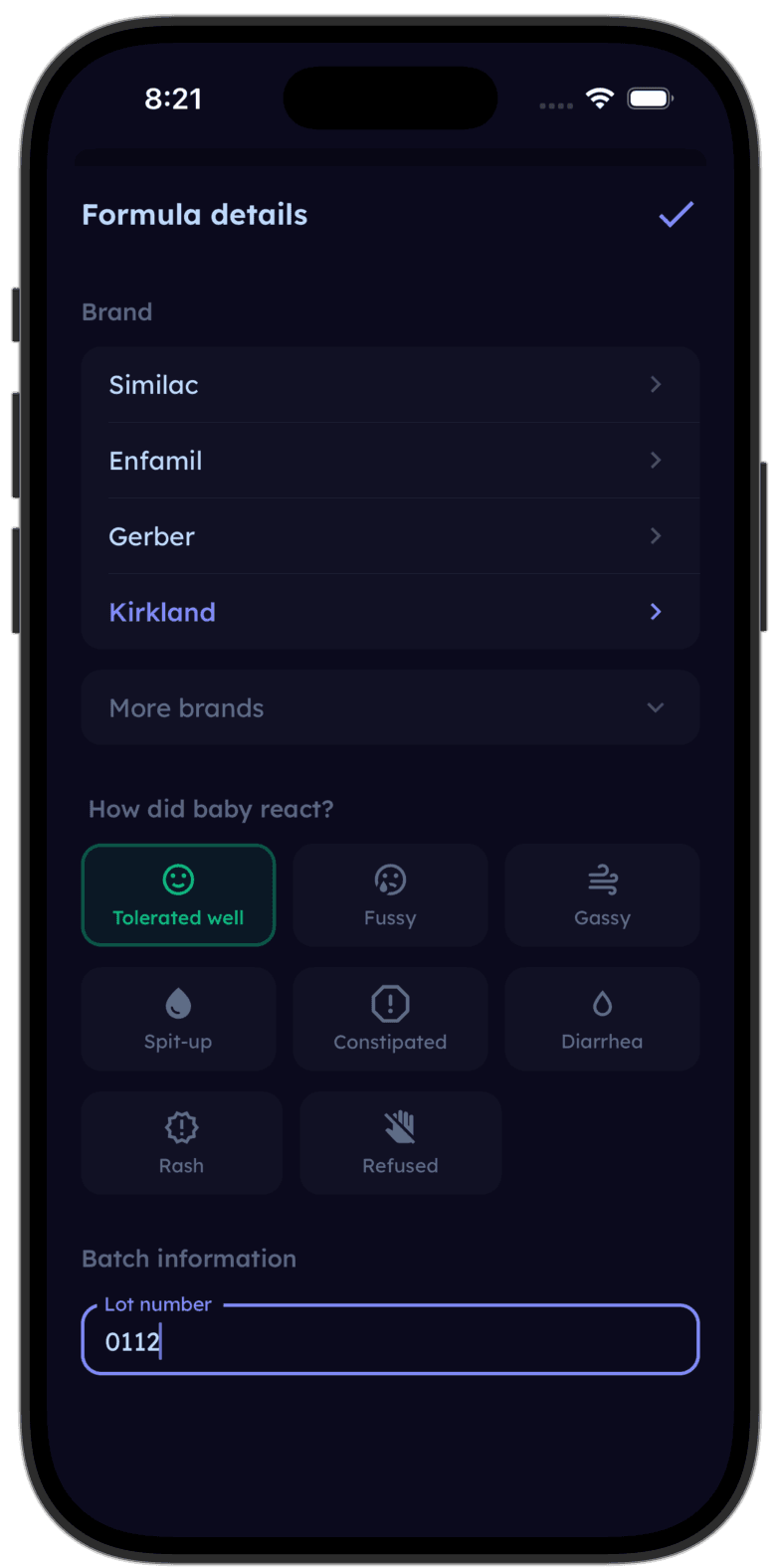
Tinylog tracks formula intake so you can spot what's working.
Log each bottle in seconds — see daily totals, track which formula your baby is on, and have real data ready for your pediatrician. Especially useful during formula transitions.


Taste, Mixing, and Practical Differences
Taste: Both formulas taste mild and are generally well-accepted. Neither has the slightly bitter taste that hydrolyzed-protein formulas sometimes have.
Mixing: Both dissolve well in room-temperature water. No significant differences in clumping or texture.
Availability: This is Happy Baby's biggest practical advantage. You can buy it at Target, Walmart, Amazon, and most grocery stores — including at 2 AM if you run out. Bobbie is subscription-based through bobbie.com with limited retail availability. Running out of Bobbie requires planning ahead.
Packaging: Happy Baby comes in larger containers (21 oz) available at most stores. Bobbie comes in smaller cans (14.1 oz), which means you go through them faster and rely on subscription delivery.
When to Talk to Your Pediatrician
Switching between organic formulas does not require a pediatrician visit for most healthy babies. However, contact your doctor if your baby shows signs of formula intolerance after switching.
Signs to Discuss With Your Pediatrician
- Your baby is consistently refusing feeds or eating significantly less than expected
- Persistent vomiting (not just spit-up) after most feedings
- Blood or mucus in stools
- Significant fussiness that does not improve after 1–2 weeks on a new formula
- Poor weight gain or weight loss
- Signs of allergic reaction: hives, facial swelling, wheezing, or difficulty breathing (seek immediate care)
Most formula discomfort (mild gas, occasional spit-up) is normal and does not require a formula change. Give any new formula at least 1–2 weeks before deciding it is not working.
The Bottom Line
Both Bobbie and Happy Baby Organic are good formulas. Both are USDA Organic. Both use lactose as the primary carbohydrate. Both meet every FDA requirement.
Choose Bobbie if: hexane-free DHA and a palm-oil-free fat blend matter to you, the subscription model works for your family, and the $60–80/month premium fits your budget.
Choose Happy Baby Organic if: you want organic formula at the most accessible price point, you like being able to buy formula at any store, and you prioritize prebiotics (GOS) in the formula.
Either works well if: your baby is healthy, full-term, and growing normally. The organic certification ensures no synthetic pesticides, no GMOs, and no growth hormones regardless of which brand you choose.
If you are switching formulas, tracking feeds and symptoms for 1–2 weeks gives you real data. Tinylog logs feeds, diapers, and fussiness so you can spot what is working.
Related Guides
-
Best Organic Formulas — Honest, evidence-based rankings
-
Bobbie vs. Kendamil — Two premium formulas compared
-
Earth's Best vs. Happy Baby — Budget organic head-to-head
-
Organic vs. Conventional — Does organic formula actually matter?
Sources
- U.S. Food and Drug Administration. "21 CFR Part 107 — Infant Formula." Code of Federal Regulations.
- American Academy of Pediatrics. "Choosing an Infant Formula." HealthyChildren.org, 2024.
- USDA. "National Organic Program Standards." usda.gov, 2024.
- Alarcon PA, et al. "Effect of individual fatty acids on calcium absorption in infant formulas." Food and Nutrition Research, 2017.
- Vandenplas Y, et al. "Prebiotics in infant formula." Gut Microbes, 2015.
- U.S. FDA. "Infant Formula Guidance Documents and Regulatory Information." fda.gov, 2023.
This guide is for informational purposes only and is not a substitute for professional medical advice. Formula recommendations should be discussed with your pediatrician, especially for babies with allergies, reflux, or other medical conditions.
Frequently asked questions
- Is Bobbie worth the extra cost over Happy Baby Organic?
- That depends on what you value. Both are USDA Organic and meet identical FDA nutritional requirements. Bobbie uses water-extracted DHA (no hexane), avoids palm oil, and uses lactose as the sole carbohydrate. Happy Baby Organic also uses lactose as the primary carbohydrate but includes some organic glucose syrup solids in certain formulations and uses standard DHA extraction. If hexane-free DHA and a palm-oil-free fat blend matter to you and the cost is manageable, Bobbie delivers on those claims. If budget matters more, Happy Baby Organic provides solid organic nutrition at a significantly lower price.
- Is Happy Baby Organic a good formula?
- Yes. Happy Baby Organic is USDA Organic, meets all FDA nutritional requirements under 21 CFR 107, and uses organic lactose as a primary carbohydrate source. It is one of the most affordable organic formulas available at roughly $1.10–$1.30/oz prepared. It includes DHA, prebiotics, and the standard vitamin and mineral profile required by the FDA.
- Does Bobbie use corn syrup solids?
- No. Bobbie uses organic lactose as the sole carbohydrate source. Happy Baby Organic also uses organic lactose as the primary carbohydrate, though some formulations include organic glucose syrup solids as a secondary carbohydrate. Neither uses conventional corn syrup solids.
- Can I switch between Bobbie and Happy Baby?
- Yes. You can switch between formulas. Most babies adjust within a few days. You can transition gradually by mixing the two if you prefer. Give any new formula at least 1–2 weeks before deciding it is not working, and track feeds and symptoms so you have data.
- Which organic formula is cheapest?
- Happy Baby Organic and Earth's Best Organic are typically the most affordable at $1.10–$1.30/oz prepared. Bobbie is one of the most expensive at $1.80–$2.10/oz. For a full price comparison, see our best organic baby formula guide.