GUIDE

Does Teething Cause Fever?

No. Teething may cause a very slight temperature elevation, but it does NOT cause true fever (100.4°F / 38°C or higher).

This is one of the most persistent myths in parenting. Multiple well-designed studies have looked at this question carefully, and the answer is consistent: teething does not cause fever. Here is what actually happens and why the myth is so hard to shake.

The Short Answer

No. Teething does not cause fever. This has been studied repeatedly in well-designed, prospective studies, and the conclusion is consistent: while teething may cause a very slight elevation in body temperature — by a fraction of a degree — it does not cause true fever, defined as a temperature of 100.4°F (38°C) or higher.

This is not a minority opinion or a controversial finding. It is the conclusion of every major study that has investigated the question using objective temperature measurements rather than parent reports. The systematic review by Massignan et al. (2016), which analyzed 16 studies across multiple countries, found the same thing: fever is not a symptom of teething.

If your baby has a fever and also happens to be teething, the fever is being caused by something else — most commonly a viral infection. The tooth is coincidental, and the fever needs its own evaluation.

What the Research Actually Found
Macknin et al. (2000)
DesignProspective study of 125 infants
FindingNo significant association between teething and fever (≥100.4°F / 38°C). Found slight temperature elevation on the day of eruption (average 0.12°C increase), well below the fever threshold.
Published InPediatrics
Wake et al. (2000)
DesignCohort study of 21 infants with daily temperature recordings
FindingNo significant increase in temperature associated with teething. Parents reported fever as a teething symptom, but objective measurements did not confirm it.
Published InPediatrics
Ramos-Jorge et al. (2011)
DesignProspective longitudinal study of 47 infants
FindingSlight increase in body temperature on the day of tooth eruption and the day before, but temperatures did not reach the fever threshold.
Published InPediatrics
Massignan et al. (2016)
DesignSystematic review and meta-analysis of 16 studies
FindingTemperature increase associated with teething was small and did not reach the level of fever (≥38°C / 100.4°F). Concluded that fever is NOT a symptom of teething.
Published InPediatrics
Every major study that has objectively measured temperature during teething has reached the same conclusion: teething does not cause fever. The slight temperature elevation observed is well below the clinical threshold for fever.

Why This Myth Is So Persistent

The teething-fever myth has persisted for centuries — literally. Medical texts from the 1800s attributed all manner of infant illness and even death to teething. The myth survives today for several compelling reasons:

The timing overlap is perfect. Babies start teething between 4 and 12 months. This is the exact same period when maternal antibodies from pregnancy decline, babies begin putting everything in their mouths (dramatically increasing pathogen exposure), and many enter group childcare. The result is a spike in viral infections that coincides precisely with active teething. When a baby develops a fever at 7 months while also cutting a tooth, the association seems obvious — even though it is a coincidence.

Confirmation bias is powerful. Parents who believe teething causes fever notice every fever that occurs during teething and remember it as confirmation. They do not notice the many teething episodes that occur without fever, or the fevers that occur when no tooth is erupting.

The myth is culturally reinforced. Grandparents, friends, and even some healthcare providers repeat the association. A parent who takes their feverish baby to the doctor and hears "it's probably just teething" goes home believing that teething caused the fever. This perpetuates the cycle.

Correlation feels like causation. The human brain is wired to find patterns and assign causes to effects. When two things happen at the same time — teething and fever — it takes deliberate effort to consider that they might be unrelated.


What Actually Happens to Temperature During Teething

The research does show a very small temperature increase associated with teething — but it is important to understand how small. In the Macknin et al. (2000) study, the average temperature increase on the day of tooth eruption was 0.12°C (about 0.2°F). That is a change so slight that most parents would not even detect it with a thermometer.

This small increase is thought to be a localized inflammatory response as the tooth pushes through the gum tissue. Inflammation naturally produces a minor temperature elevation. But the key point is that this elevation remains well within the normal body temperature range — it does not come anywhere close to the threshold for fever.

To put this in practical terms: if your baby's baseline temperature is 98.6°F and they are actively teething, you might see 98.8°F or 99.0°F. That is the range of what teething does to temperature. If the thermometer reads 100.4°F or higher, you are looking at a different cause entirely.

Fever Action Guide by Age
Under 3 months
Temperature100.4°F (38°C) or higher
What to DoCall pediatrician or go to ER immediately
NotesAny fever in this age group is taken very seriously regardless of other symptoms
3-6 months
Temperature100.4°F (38°C) or higher
What to DoCall pediatrician
NotesPrompt evaluation recommended. Low threshold for same-day visit.
6-24 months
Temperature100.4-102°F
What to DoMonitor closely; call if lasting 24+ hours or worsening
NotesManage with acetaminophen or ibuprofen. Watch for other concerning symptoms.
6-24 months
TemperatureOver 102°F
What to DoCall pediatrician
NotesHigher fevers warrant evaluation to identify the cause.
Any age
TemperatureOver 104°F (40°C)
What to DoSeek immediate medical attention
NotesVery high fevers always need prompt evaluation.
Any age
TemperatureFever lasting more than 3 days
What to DoSee pediatrician
NotesPersistent fever suggests an infection that may need treatment.
These guidelines apply regardless of whether your baby is teething. Fever always warrants appropriate evaluation and management based on age and severity.
tinylog tracking screen showing health data and milestones

Log temperature spikes alongside tooth eruptions — the data tells the real story.

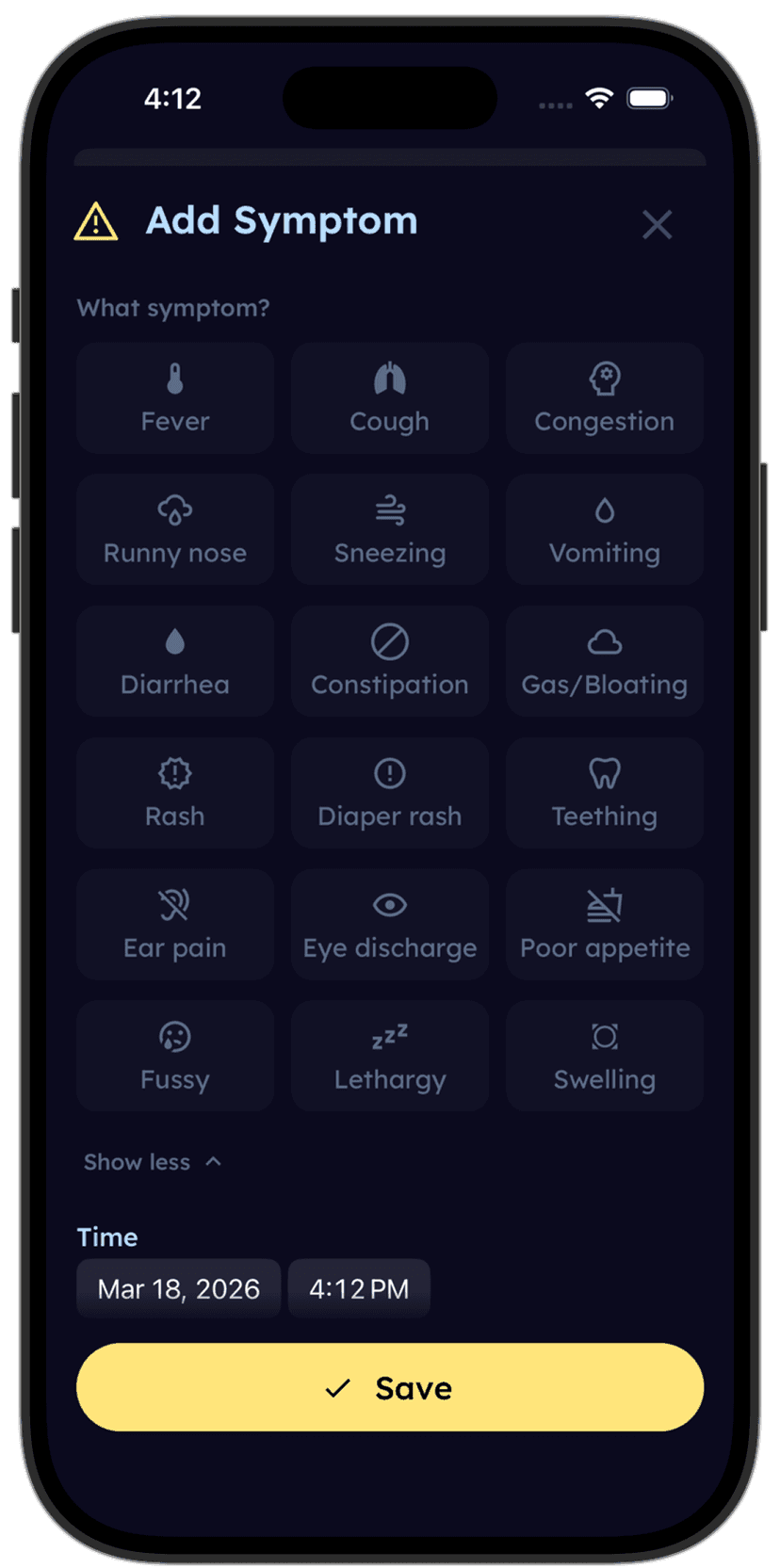
If you are tracking symptoms in tinylog, you can look back and see whether fever episodes actually correlate with tooth eruptions — or whether they line up with daycare sick days and sibling illnesses instead. Data beats guessing.

Download on the App StoreGet It On Google Play

What to Do When Your Baby Has a Fever During Teething

When your baby has a genuine fever (100.4°F or higher) and also happens to be teething, the approach is straightforward: treat the fever as you would any fever, because it is not being caused by the tooth.

For babies under 3 months: Any fever of 100.4°F or higher is a medical situation. Call your pediatrician immediately or go to the emergency department. Young infants have immature immune systems, and fever at this age can indicate serious infection. Do not wait, and do not dismiss it as teething.

For babies 3 months and older: Manage the fever with appropriate doses of acetaminophen (any age) or ibuprofen (6 months and older). Keep your baby hydrated. Monitor for additional symptoms like respiratory distress, persistent vomiting, signs of dehydration, or unusual lethargy. Call your pediatrician if the fever lasts more than 24 to 48 hours or if your baby seems significantly unwell.

For the teething component: Continue to manage gum discomfort with evidence-based remedies — cold teething rings, chilled washcloths, and gentle gum pressure. The teething may be making your baby extra miserable on top of whatever illness is causing the fever, and addressing the gum pain can help with overall comfort.

What Your Pediatrician Wants You to Know

Fever is never "just teething." This is the single most important message. A fever over 100.4°F has a cause — and that cause is not a tooth. Your pediatrician would rather evaluate a fever that turns out to be a mild virus than miss an infection because it was attributed to teething.

The studies are clear. This is not a gray area in pediatric medicine. Prospective, controlled studies with objective temperature measurements have consistently shown that teething does not cause fever. Any provider who dismisses a genuine fever as teething is not reflecting the current evidence.

It is okay to give fever medicine. Acetaminophen and ibuprofen are safe and effective for managing fever in babies when dosed appropriately by weight. You do not need to let your baby suffer through a fever. Managing their comfort is good parenting.

Call early, call often. No pediatrician has ever been annoyed by a parent who called about a fever. The call takes two minutes and can give you either peace of mind or a plan of action. Both are better than worry.

Practical Tips

A real fever always has a real cause

This is the most important takeaway. When your baby has a temperature of 100.4°F or higher, there is an infection somewhere — even if you can also see a tooth coming in. The tooth may be adding to your baby's misery, but it is not causing the fever. Identifying and addressing the actual infection is what matters.

Do not second-guess yourself into inaction

The teething-fever myth can make parents doubt their instincts. You notice a fever, you think about calling the doctor, but then you see a swollen gum and think 'oh, it is probably just teething.' Do not let that happen. Call anyway. The worst case is that the doctor confirms it is a viral illness and gives you a management plan. The best case is catching something that needs treatment.

A slight temperature elevation is not the same as fever

Research does suggest that body temperature can increase slightly — by a fraction of a degree — around the day of tooth eruption. This is thought to be a minor inflammatory response. But this elevation stays well below 100.4°F. If you take your baby's temperature and it is 99.5°F during active teething, that is consistent with what the research shows. If it is 101°F, that is not teething.

The myth persists because the timing is perfect

The reason 'teething fever' is so widely believed is not that it is true — it is that the timing of teething and the timing of frequent viral infections overlap so precisely that the association seems obvious. Babies who are teething are also babies who are catching every virus at daycare. The fever is from the virus. The tooth is coincidental.

Related Guides

Sources

  • Macknin, M. L., et al. (2000). Symptoms associated with infant teething: a prospective study. Pediatrics, 105(4), 747-752.
  • Wake, M., et al. (2000). Teething and tooth eruption in infants: A cohort study. Pediatrics, 106(6), 1374-1379.
  • Ramos-Jorge, J., et al. (2011). Prospective longitudinal study of signs and symptoms associated with primary tooth eruption. Pediatrics, 128(3), 471-476.
  • Massignan, C., et al. (2016). Signs and symptoms of primary tooth eruption: A meta-analysis. Pediatrics, 137(3), e20153501.
  • American Academy of Pediatrics (AAP). Fever and your baby. HealthyChildren.org.

Medical Disclaimer

This guide is for informational purposes only and is not a substitute for professional medical advice. If your baby has a fever of 100.4°F (38°C) or higher, is refusing to eat, or seems unusually unwell, contact your pediatrician — these symptoms are not typical of teething alone.

Get this guide in your inbox.
We'll email you this evidence-based guide so you can reference it when your baby has a fever during teething.
Track temperature alongside milestones — see the real picture.
Download tinylog free — log symptoms and teeth in seconds.
Download on the App StoreGet It On Google Play