GUIDE

Teething vs. Sick

Teething causes gum pain, drooling, and fussiness. It does NOT cause high fever, diarrhea, vomiting, or rash. If your baby has those symptoms, they are sick.

Teething is the most over-attributed cause of baby symptoms. This guide helps you tell the difference — because getting it right could matter a lot.

Why Getting This Right Matters

Teething is the most over-attributed cause of symptoms in babies. In a study by Wake et al. (2000), parents attributed an average of 2 to 4 symptoms to teething, while the actual data showed that very few symptoms were reliably associated with tooth eruption. Fever, diarrhea, and rash — the symptoms parents most commonly attribute to teething — are precisely the ones that research does NOT support as teething symptoms.

This matters because dismissing illness as teething can delay treatment. A baby with a 102°F fever has an infection, not "bad teething." A baby with persistent diarrhea needs monitoring for dehydration, not a teething ring. And a baby who is unusually lethargic or inconsolable needs evaluation, not reassurance that "molars are the worst."

On the flip side, attributing every fussy day to illness is not helpful either. Babies who are genuinely just teething do not need a doctor visit for each tooth. The goal is to tell the difference — and the symptoms, when you know what to look for, usually make the answer clear.

Teething vs. Illness: Side-by-Side
Temperature
TeethingNormal or slightly elevated (below 100.4°F / 38°C)
IllnessOften elevated — fever of 100.4°F or higher is common with infections
Fussiness
TeethingIntermittent — baby has happy periods between fussy episodes
IllnessMore persistent, progressively worsening. Baby may seem unusually listless.
Appetite
TeethingMay briefly decrease around eruption but baby continues to eat
IllnessOften significantly reduced. May refuse feeds entirely.
Drooling
TeethingOften significantly increased
IllnessNot a typical feature of illness
Congestion / runny nose
TeethingNot caused by teething
IllnessCommon with upper respiratory infections
Cough
TeethingNot caused by teething
IllnessCommon with respiratory infections. May persist for days.
Diarrhea / vomiting
TeethingNot caused by teething
IllnessCommon with gastroenteritis and many other infections
Rash
TeethingDrool rash only (around mouth, chin, neck)
IllnessCan appear anywhere on the body. May accompany fever.
Gum changes
TeethingSwollen, red, or visible bump where tooth is emerging
IllnessGums typically normal (unless it is an oral infection like thrush)
Symptom trajectory
TeethingPeaks around day of eruption, then improves
IllnessOften worsens over 2-3 days before improving
Duration
TeethingSymptoms for each tooth last a few days to a week
IllnessVaries — colds last 7-10 days, stomach bugs 3-7 days
The most reliable differentiators are fever (teething = no true fever), gum changes (teething = visible gum swelling), and additional symptoms (illness = congestion, cough, diarrhea, vomiting).

The Overlap Problem

Here is what makes this genuinely tricky: babies can be teething and sick at the same time. A 9-month-old can be cutting their upper incisors while also fighting off a rhinovirus from daycare. The teething makes their gums hurt. The virus gives them a fever and runny nose. Everything is happening at once, and it all looks like one big miserable mess.

The way to handle this is to address each symptom on its own merits. The gum swelling and desire to chew are teething — manage with cold items and counter-pressure. The fever and congestion are illness — monitor temperature, watch for signs that need medical attention, and manage comfort. Do not let the presence of a visible tooth make you ignore the fever, and do not let the presence of a fever make you ignore the teething discomfort.

Common Overlap Scenarios
Baby has a tooth coming in + runny nose + low fever
Likely ExplanationThe tooth is causing gum discomfort. The runny nose and fever are from a cold. Both are happening at the same time.
What to DoTreat the teething with cold items and pressure. Manage the cold symptoms. Call your pediatrician if fever exceeds 100.4°F in young babies or if symptoms worsen.
Baby is pulling ears + fussy + no fever + gums look swollen
Likely ExplanationLikely teething — pain from upper teeth or molars can radiate to the ear area.
What to DoOffer teething remedies. Monitor for fever development, which would suggest an ear infection.
Baby has diarrhea + is teething + low fever
Likely ExplanationThe diarrhea and fever are likely from a stomach virus. The teething is coincidental.
What to DoManage the gastroenteritis (fluids, monitoring for dehydration). Do not dismiss the diarrhea as 'teething diarrhea.'
Baby is inconsolable + high fever + visible tooth erupting
Likely ExplanationThe tooth is real, but the high fever and inconsolable crying suggest illness, not teething.
What to DoSee your pediatrician. The tooth explains some discomfort, but high fever and inconsolable behavior go beyond what teething causes.
When in doubt, call your pediatrician. They can help sort out which symptoms need attention and which are just teething.

Call Your Pediatrician if You See These

  • Any fever (100.4°F / 38°C or higher) in a baby under 3 months — this is always urgent
  • Fever above 104°F (40°C) at any age
  • Fever lasting more than 3 days in older babies
  • Difficulty breathing, rapid breathing, or retractions (ribs visible with each breath)
  • Refusal to eat for more than 24 hours
  • Signs of dehydration: fewer wet diapers, no tears, dry mouth, sunken fontanelle
  • Unusual lethargy — baby is difficult to rouse or seems limp
  • Persistent vomiting — cannot keep fluids down
  • Rash that does not blanch (does not turn white when pressed)
  • Your instinct says something is wrong — trust it

None of these symptoms are caused by teething. Every one of them warrants medical evaluation. If you are unsure whether something is 'just teething,' that uncertainty is itself a reason to call.

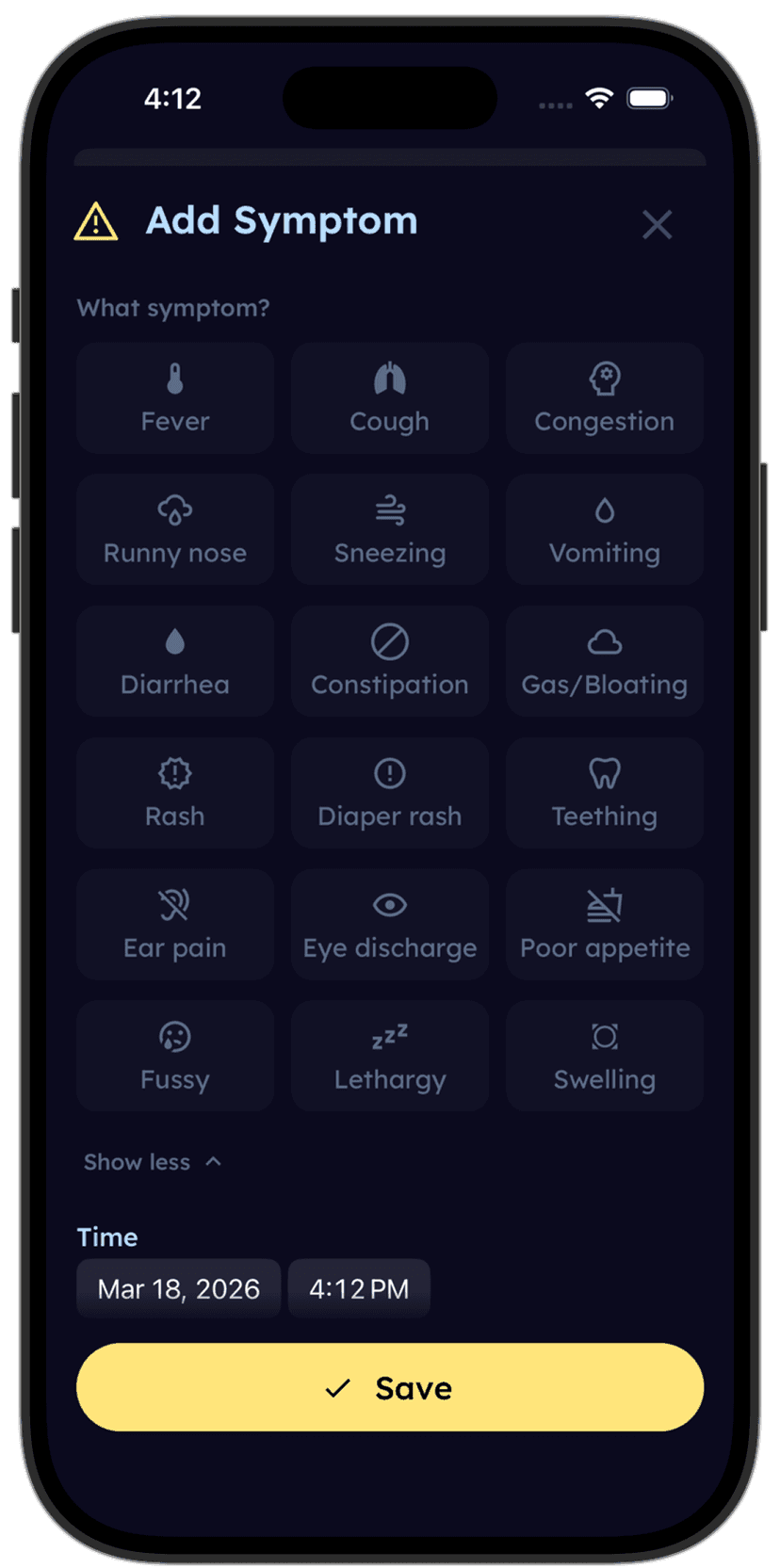
tinylog tracking screen showing symptom and feeding data

A symptom log tells the story your memory cannot.

When you call the pediatrician, they will ask: How long has the fever been going on? When did the fussiness start? Is the baby eating? How many wet diapers? A few days of data in tinylog gives you clear, accurate answers instead of guesses.

Download on the App StoreGet It On Google Play

What Your Pediatrician Wants You to Know

Teething is not a diagnosis of exclusion for fever. When a baby has a fever, the reflex to say "must be teething" is understandable but potentially dangerous. Fever always deserves its own evaluation, especially in young infants.

It is better to over-call than under-call. Pediatricians would rather see a baby with "just teething" than miss a baby with an evolving infection. If you are unsure, call. If the answer is teething, great — you wasted a phone call and gained peace of mind. If the answer is something else, you caught it early.

Teething does not explain multi-system symptoms. A baby with a fever, runny nose, and diarrhea does not have "really bad teething." They have an illness affecting multiple systems, and they need evaluation. Teething affects the gums. That is it.

Trust the parent who says "something is off." Research consistently shows that parents who know their babies well are accurate assessors of when their child is genuinely ill. If your gut says this is more than teething, act on that instinct.


Practical Tips

The 100.4°F rule

This number is your bright line. Teething does not cause a temperature of 100.4°F (38°C) or higher. Period. Multiple well-designed studies have confirmed this. If your baby's temperature is at or above this threshold, they have something else going on — even if you can see a tooth coming in. Do not dismiss a real fever as teething.

Watch the trajectory

Teething symptoms tend to stay roughly the same intensity or improve after the tooth breaks through. Illness symptoms typically worsen over several days. If your baby is getting progressively more miserable — more feverish, less interested in eating, more lethargic — that trajectory points to illness, not teething.

A sick baby looks sick

With experience, most parents develop an intuition for when their baby is genuinely ill versus temporarily uncomfortable. A teething baby is fussy but can often be distracted, comforted, or cheered up. A sick baby may be listless, clingy in a different way, less responsive, or simply 'off.' If your gut says your baby is sick, trust it.

You do not have to choose one explanation

Babies can be teething and sick at the same time. In fact, given how often babies are teething and how often they catch viruses, overlap is very common. Acknowledging the teething does not mean ignoring the illness. Treat both. Comfort the gums and see the doctor about the fever.

Related Guides

Sources

  • Macknin, M. L., et al. (2000). Symptoms associated with infant teething: a prospective study. Pediatrics, 105(4), 747-752.
  • Wake, M., et al. (2000). Teething and tooth eruption in infants: A cohort study. Pediatrics, 106(6), 1374-1379.
  • Massignan, C., et al. (2016). Signs and symptoms of primary tooth eruption: A meta-analysis. Pediatrics, 137(3), e20153501.
  • American Academy of Pediatrics (AAP). Fever and your baby. HealthyChildren.org.
  • Ramos-Jorge, J., et al. (2011). Prospective longitudinal study of signs and symptoms associated with primary tooth eruption. Pediatrics, 128(3), 471-476.

Medical Disclaimer

This guide is for informational purposes only and is not a substitute for professional medical advice. If your baby has a fever of 100.4°F (38°C) or higher, is refusing to eat, or seems unusually unwell, contact your pediatrician — these symptoms are not typical of teething alone.

Get this guide in your inbox.
We'll email you this guide so you can reference the comparison at 2 AM when you need it most.
Track symptoms so you know what is changing and when.
Download tinylog free — log everything with a single tap.
Download on the App StoreGet It On Google Play