GUIDE

Eczema Herpeticum

Eczema herpeticum is a herpes virus superinfection of eczema skin. It is a medical emergency that requires hospital treatment.

If your baby has eczema and you are seeing clusters of small, painful, punched-out blisters or erosions — especially after exposure to someone with a cold sore — stop reading and go to the ER. This is not a bad flare. This is a viral infection spreading across your baby's damaged skin barrier, and it needs IV antiviral medication now. If you are here to learn and prepare, keep reading.

What Eczema Herpeticum Is — and Why It Is an Emergency

Here is the short version: your baby has eczema, which means their skin barrier is broken. The herpes simplex virus (HSV) — the same virus that causes cold sores — gets onto that broken skin and goes wild. Instead of a single cold sore on a lip, the virus spreads across the eczema-damaged areas, causing a widespread, painful, potentially life-threatening infection.

This is called eczema herpeticum, and it is one of the few true dermatologic emergencies in pediatrics.

In a person with a healthy skin barrier, HSV stays contained — one cold sore, maybe a cluster of blisters, limited to a small area. The intact skin acts as a wall the virus cannot cross. But eczema skin has no wall. The barrier is full of gaps, and HSV exploits every single one. It spreads rapidly across eczematous areas, creating dozens or hundreds of lesions in hours to days.

The danger is not just the skin infection. HSV can disseminate — spreading from the skin to the eyes (risking permanent vision loss), to the brain (herpes encephalitis), or to internal organs. In young infants especially, disseminated HSV can be fatal. This is why eczema herpeticum is treated with IV antiviral medication in a hospital, not with a topical cream at home.

The most common way a baby gets eczema herpeticum: someone with a cold sore kisses them.

How to Recognize Eczema Herpeticum

Eczema herpeticum looks different from an eczema flare — but if you have never seen it before, the difference might not be obvious until you know what to look for.

What eczema herpeticum looks like:

  • Clusters of small (1-3 mm), uniform, dome-shaped vesicles (fluid-filled blisters) on areas of active eczema
  • Or — more commonly by the time parents notice — punched-out erosions where the vesicles have already ruptured. These look like tiny round craters in the skin, as if someone pressed a pencil eraser into the surface
  • The lesions are grouped together in clusters, not scattered randomly
  • They often start on the face (especially around the mouth and cheeks — where babies get kissed and where eczema is common in infants) and spread outward
  • The affected skin is painful to touch, not just itchy

What makes it different from a regular flare:

  • Pain, not just itch. Your baby cries when the area is touched, not just when they scratch it
  • Fever. Eczema flares do not cause fever on their own
  • The lesions look uniform and punched-out — different from the rough, patchy dryness of eczema
  • It is getting worse fast — visibly spreading over hours, not slowly worsening over days
  • Your baby seems sick — not just uncomfortable, but genuinely unwell. Lethargic, irritable, not feeding well

If you are looking at your baby's skin and thinking "this does not look like the usual flare" — trust that instinct.

Eczema Flare vs. Eczema Herpeticum vs. Impetigo
Cause
Eczema FlareSkin barrier dysfunction triggered by irritants, allergens, dryness, or illness
Eczema HerpeticumHerpes simplex virus (HSV-1 or HSV-2) infecting eczema-damaged skin
ImpetigoStaphylococcus aureus or Group A Strep bacteria entering broken skin
What it looks like
Eczema FlareDry, red, rough, scaly patches. May be weepy during bad flares. Same pattern your baby usually gets, just worse.
Eczema HerpeticumClusters of small, uniform, punched-out erosions or tiny dome-shaped vesicles. Often described as looking like someone pressed a hole punch into the skin.
ImpetigoHoney-colored crusted sores. May start as fluid-filled blisters that rupture and form golden-yellow crusts.
Pain vs. itch
Eczema FlarePrimarily itchy. Baby scratches and rubs.
Eczema HerpeticumPrimarily painful. Baby cries and pulls away when the area is touched.
ImpetigoMildly itchy or painless. Usually does not seem to bother the baby much.
Fever
Eczema FlareNo fever (unless a separate illness is triggering the flare)
Eczema HerpeticumFever is common — often 101-104°F. Baby looks and acts sick.
ImpetigoUsually no fever unless the infection is extensive or has spread deeper.
How fast it spreads
Eczema FlareGradual worsening over days
Eczema HerpeticumRapid spread over hours to days. New clusters keep appearing.
ImpetigoModerate spread over days. New sores appear where baby scratches.
Location
Eczema FlareSame areas that always flare — cheeks, creases, etc.
Eczema HerpeticumOften starts on the face or areas of active eczema, then spreads. Can become widespread.
ImpetigoTypically around the mouth and nose, but can appear anywhere.
Treatment
Eczema FlareMoisturizer, topical steroids, trigger avoidance
Eczema HerpeticumIV acyclovir in hospital. STOP topical steroids immediately.
ImpetigoTopical or oral antibiotics
Urgency
Eczema FlareManage at home. See pediatrician if not improving.
Eczema HerpeticumEmergency. Go to the ER now.
ImpetigoSee pediatrician within 24 hours. Not an emergency unless spreading rapidly.
The critical distinction: eczema flares are itchy and dry. Eczema herpeticum is painful and blistered. If your baby's 'bad flare' involves painful vesicles and fever, get to the ER.

Emergency Signs — Go to the ER Now

  • Clusters of small, painful, punched-out erosions or dome-shaped blisters on eczematous skin — this is the hallmark sign
  • Rapid worsening that looks different from your baby's usual eczema flares — the lesions are more uniform, more painful, and spreading faster
  • Fever (especially over 101°F) combined with new skin lesions on eczema patches
  • Baby is in obvious pain when the skin is touched — crying, pulling away — rather than just itchy
  • Vesicles or erosions near or around the eyes — herpes keratitis can cause permanent vision loss and is its own emergency
  • Baby is lethargic, inconsolable, or refusing to feed alongside the skin changes
  • Known recent exposure to someone with a cold sore plus any new unusual skin changes

Do not wait for a pediatrician appointment. Do not wait until morning. Eczema herpeticum is treated in the emergency room with IV antiviral medication. Time matters — the sooner treatment starts, the better the outcome.

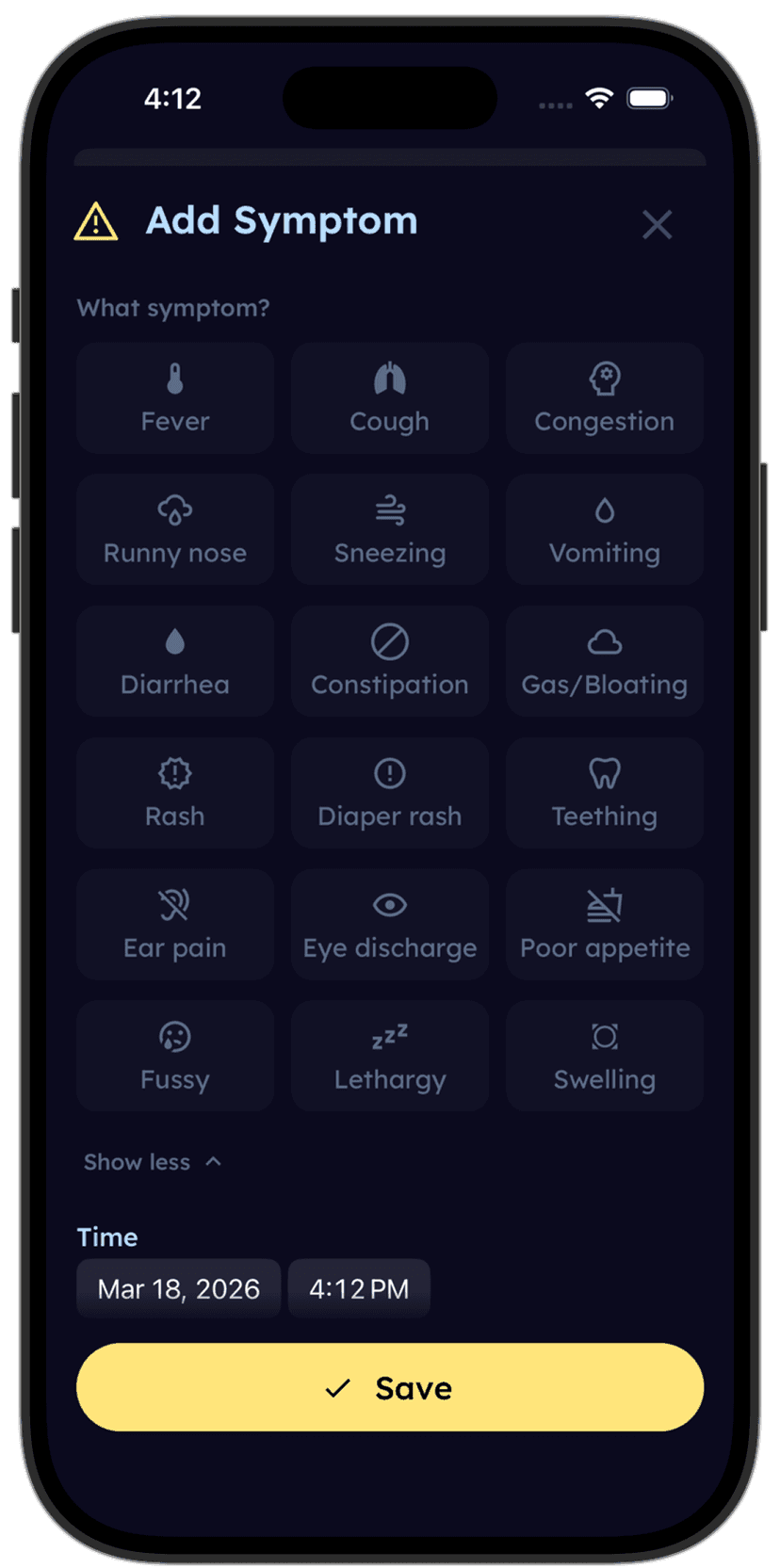
tinylog symptom tracking screen showing eczema flare log entries

Know what your baby's normal eczema looks like.

The easiest way to spot something abnormal is to know what normal looks like for your baby. Log eczema flares in tinylog — severity, location, what the skin looks like — so you have a baseline. When something changes, you will notice it faster and describe it more clearly to the ER team.

Download on the App StoreGet It On Google Play

How Eczema Herpeticum Happens

The virus behind eczema herpeticum is herpes simplex virus, usually HSV-1 (oral herpes, the cold sore virus), though HSV-2 (genital herpes) can also cause it. The transmission route is almost always direct skin-to-skin contact with someone who has an active herpes outbreak — or who is about to have one.

The most common scenario: A well-meaning family member who has a cold sore (or is in the prodromal stage — that tingling feeling before a sore appears) kisses the baby. The virus lands on the baby's eczema-affected skin. Within 2-7 days, eczema herpeticum develops.

Why eczema skin is so vulnerable: Healthy skin has multiple layers of defense against viral invasion — an intact stratum corneum, antimicrobial peptides, tight junctions between cells. Eczema disrupts all of these. The skin barrier is literally full of microscopic holes. HSV, which normally struggles to get past intact skin, finds an open highway. It infects the keratinocytes (skin cells), replicates rapidly, and spreads laterally across the damaged areas.

Risk factors that make eczema herpeticum more likely:

  • Severe or widespread eczema (more compromised skin surface = more entry points)
  • Early onset eczema (before age 2)
  • High total IgE levels (a marker of atopic disease severity)
  • History of food allergies alongside eczema
  • Eczema that is actively flaring at the time of HSV exposure

The bottom line: any baby with eczema who is exposed to HSV is at risk. The worse the eczema, the higher the risk — but even mild eczema can develop eczema herpeticum if the exposure is there.

What Happens at the Hospital

If your baby is diagnosed with eczema herpeticum, they will be admitted to the hospital. This is not outpatient treatment — it requires IV medication and monitoring. Here is what to expect so you are not blindsided.

Hospital Treatment Timeline
ER evaluation
What HappensThe medical team will examine the skin lesions and likely perform a viral swab (HSV PCR or direct fluorescent antibody test) to confirm the diagnosis. They will check for eye involvement and systemic signs.
WhenFirst 1-2 hours
IV acyclovir started
What HappensAcyclovir is the antiviral medication that fights HSV. It is given intravenously (through an IV line) because the infection needs aggressive systemic treatment, not just topical cream. The dose is based on your baby's weight.
WhenAs soon as diagnosis is suspected — they do not wait for test results to confirm
Topical steroids stopped
What HappensIf your baby was using topical corticosteroids for eczema, these will be stopped immediately. Steroids suppress the local immune response, which is exactly the opposite of what you want when fighting a viral infection.
WhenImmediately
Monitoring and supportive care
What HappensYour baby will be monitored for complications — especially eye involvement and signs of disseminated infection (HSV spreading to the brain, liver, or other organs). Pain management, hydration, and fever control.
WhenThroughout hospital stay
Transition to oral acyclovir
What HappensOnce the lesions stop spreading and begin to crust over, and your baby is feeding and stable, the team will switch from IV to oral acyclovir to complete the treatment course.
WhenUsually after 3-5 days of IV treatment
Discharge and follow-up
What HappensYou will go home with oral acyclovir to complete the course (typically 10-14 days total antiviral treatment). Follow-up with your pediatrician and dermatologist to restart eczema management carefully — without topical steroids initially.
WhenHospital stay is typically 5-7 days total
Treatment is started based on clinical suspicion — doctors do not wait for lab confirmation before giving IV acyclovir. If it looks like eczema herpeticum, treatment begins immediately.

Prevention: The Rules That Matter

Eczema herpeticum is preventable. Not 100% of the time — you cannot control every exposure — but the vast majority of cases come from a known, avoidable transmission route: direct contact with someone shedding HSV, usually through kissing.

These rules are not suggestions. For a baby with eczema, they are as important as any other safety measure you take.

Prevention Rules for Families With an Eczema Baby
No kissing the baby if you have a cold sore — period
Why It MattersThis is the single most important prevention rule. HSV-1 is most commonly transmitted by kissing. If you have an active cold sore, or feel the tingling that means one is coming, do not kiss your baby anywhere — not on the lips, not on the cheeks, not on the hands. The virus sheds from the moment you feel the tingle until the sore is completely healed.
Tell your family and visitors the rule
Why It MattersThis is the hard conversation. Grandparents, aunts, uncles, friends — anyone who gets cold sores needs to know they cannot kiss your baby when they have one (or feel one coming). People will think you are overreacting. You are not. Show them this guide if you need backup.
Know that HSV sheds before the sore appears
Why It MattersThe virus becomes contagious during the prodromal phase — the tingling, burning, or itching sensation that precedes a visible cold sore by 1-2 days. If someone says 'I think I might be getting a cold sore,' they are already contagious.
Wash hands before touching the baby's skin
Why It MattersIf you have a cold sore, wash your hands thoroughly and frequently. HSV can transfer from your lip to your fingers to your baby's skin. Do not touch your cold sore and then touch your baby.
Do not share items that touch mouths
Why It MattersUtensils, cups, pacifiers, towels, washcloths — anything that contacts the mouth of someone with HSV can transfer the virus. Use separate items during an outbreak.
Keep eczema well-managed
Why It MattersThe better your baby's eczema is controlled, the stronger their skin barrier, and the harder it is for HSV to establish infection. Consistent moisturizing is not just about comfort — it is about defense.
Have an action plan if there is a known exposure
Why It MattersIf your baby with eczema was kissed by someone who later realized they had a cold sore, call your pediatrician. They may recommend watchful waiting with clear instructions on what to look for, or in some cases, prophylactic antiviral medication.
Most adults with HSV-1 were infected as children and may not even remember getting cold sores. Ask directly: 'Do you ever get cold sores?' If the answer is yes, the no-kissing rule applies whenever they have symptoms.
tinylog symptom log showing exposure event and eczema tracking

Log cold sore exposures alongside eczema flares.

If your baby was around someone with a cold sore, log it in tinylog right away. If something unusual shows up on the skin 2-7 days later, you will have the exposure date documented — which helps the ER team act faster and confirms the diagnosis.

Download on the App StoreGet It On Google Play

After the First Episode: Preventing Recurrence

HSV is a lifelong virus. Once your baby is infected, the virus retreats into nerve ganglia and stays dormant — potentially reactivating later, especially when the immune system is stressed or the skin barrier is compromised during eczema flares.

Recurrences of eczema herpeticum do happen, but they tend to be milder than the first episode and can often be treated with oral antiviral medication at home if caught early. The key is having a plan.

Recurrence Action Plan
Learn your baby's warning signs
DetailsThe first episode teaches you what eczema herpeticum looks like on your child's skin. Take photos (with your doctor's guidance) so you have a reference for comparison. Recurrences often start in the same location.
Get a standing prescription for oral acyclovir
DetailsMany pediatricians will provide a prescription for oral valacyclovir or acyclovir that you can fill and keep on hand. At the first sign of recurrence, you can start treatment immediately rather than waiting for an appointment.
Start treatment at the first sign — do not wait
DetailsIf you see vesicles or punched-out erosions forming on eczematous skin, start oral acyclovir and call your pediatrician. Early treatment of recurrences can prevent hospitalization.
Be extra vigilant during eczema flares
DetailsRecurrences are more likely when eczema is actively flaring because the skin barrier is at its weakest. During a bad flare, be extra cautious about HSV exposure and watch the skin more closely for herpetiform changes.
Children with a history of eczema herpeticum should be seen by a pediatric dermatologist regularly. Managing eczema aggressively reduces the risk of recurrence by keeping the skin barrier as strong as possible.

Tips From Parents Who Have Been Through This

The difference between scary and dangerous

A bad eczema flare looks scary but is not dangerous. Eczema herpeticum looks different — and it is dangerous. The key distinction is pain versus itch, and uniform punched-out lesions versus the rough, patchy dryness of eczema. Trust your gut. If the skin looks like something you have never seen before on your baby — not just 'worse eczema' but genuinely different — get it evaluated urgently.

Take photos of normal flares

This sounds strange, but take photos of what your baby's typical eczema flare looks like. Store them on your phone. When something new and alarming shows up on the skin, you can compare it to what you know is 'just eczema.' If the new lesions look fundamentally different — especially if they are painful vesicles instead of itchy dry patches — that comparison helps you make the call to go to the ER.

Do not apply steroid cream to suspected eczema herpeticum

This is critical. If you suspect eczema herpeticum, do not put topical steroids on the lesions. Your instinct will be to treat what looks like a bad eczema flare with the prescription cream — but if it is actually HSV, steroids suppress the immune response and help the virus spread faster. When in doubt, skip the steroid and go get evaluated.

The cold sore conversation is not optional

Telling your family 'do not kiss my baby if you have a cold sore' is awkward. It might hurt feelings. Grandma might roll her eyes and say she has had cold sores her whole life and all her kids turned out fine. But her kids probably did not have eczema, and the combination of HSV plus eczema is what makes this dangerous. Have the conversation. Be direct. You are protecting your child from a preventable emergency.

HSV is incredibly common — that is part of the problem

About 50-80% of American adults carry HSV-1 (oral herpes). Most were infected in childhood and many do not even know they carry it. Cold sores are so common that people treat them as trivial. For a healthy adult, they are trivial. For a baby with eczema, they are a potential medical emergency. The mismatch between how common HSV is and how dangerous it can be in eczema babies is exactly why awareness matters.

Eye involvement is its own emergency within the emergency

If eczema herpeticum lesions are on or near the eyelids, or your baby's eye appears red, swollen, or weepy, make sure the ER team knows immediately. Herpes keratitis — HSV infection of the cornea — can cause permanent scarring and vision loss. An ophthalmology consultation in the ER is standard when lesions are near the eyes.

What This Looks Like in Real Life

Your eight-month-old has had eczema since she was three months old. Cheeks, creases, the usual. You have a good routine — daily baths, CeraVe cream within three minutes, occasional hydrocortisone when it flares. It is under control. Not gone, but managed.

Your mother-in-law comes to visit. She kisses the baby on the cheek — both cheeks, multiple times, because she missed her. You did not notice the small sore in the corner of her lip. She did not think anything of it — she gets cold sores all the time.

Four days later, your baby's left cheek — her worst eczema side — looks wrong. Not the usual dry, rough patches. There are clusters of tiny blisters you have never seen before. Some have already broken open, leaving small, round, raw spots that look like they were stamped into the skin. Your baby screams when you try to put moisturizer on. She has a fever of 102.

You almost reach for the hydrocortisone, because your brain says "bad eczema flare." But something stops you. This does not look like eczema. It looks different. It hurts her instead of itching. She has a fever, which eczema does not cause.

You go to the ER. The doctor takes one look and says "eczema herpeticum." Your baby is admitted, an IV is placed, and acyclovir is started within the hour. Over the next three days, the lesions stop spreading. By day five, they are crusting over. By day seven, you go home with oral acyclovir and a follow-up plan.

The conversation with your mother-in-law is hard. But now everyone in the family knows the rule: no kissing the baby during a cold sore. Not negotiable. Not ever.

Your baby recovers fully. You go back to your eczema routine, without steroids at first, then reintroduce them carefully under your dermatologist's guidance. You keep oral acyclovir in the medicine cabinet for the future, just in case. You take photos of what normal eczema looks like on your daughter's skin, so you will spot the difference instantly if it ever happens again.

You know what to look for now. That is the whole point of this guide.

Related Guides

  • Baby Rash Types — Visual guide to every rash your baby might get
  • Baby Eczema — Understanding the underlying condition that makes eczema herpeticum possible
  • Impetigo — Bacterial skin infection that can look like eczema herpeticum
  • Chickenpox — Blistering rash that can be confused with eczema herpeticum

Sources

  • Aronson, P. L., et al. (2021). Eczema Herpeticum in Children: Clinical Features and Factors Predictive of Hospitalization. Journal of Pediatrics, 199, 119-127.
  • Wollenberg, A., et al. (2017). ETFAD/EADV Eczema task force consensus on diagnosis and treatment of eczema herpeticum. Journal of the European Academy of Dermatology and Venereology, 31(4), 586-592.
  • American Academy of Pediatrics (AAP). (2024). Eczema and Skin Infections. HealthyChildren.org.
  • National Eczema Association. (2024). Eczema Herpeticum. NationalEczema.org.
  • Leung, D. Y. M. (2013). Why is eczema herpeticum unexpectedly rare? Antiviral Research, 98(2), 153-157.
  • Olsen, J. R., et al. (2016). Risk factors for eczema herpeticum: A systematic review and meta-analysis. British Journal of Dermatology, 175(5), 1062-1065.
  • Beck, L. A., et al. (2009). Phenotype of atopic dermatitis subjects with a history of eczema herpeticum. Journal of Allergy and Clinical Immunology, 124(2), 260-269.

Medical Disclaimer

This guide is for informational purposes only and is NOT a substitute for professional medical advice. Eczema herpeticum is a medical emergency. If you suspect your baby has eczema herpeticum — clusters of painful blisters on eczema skin, especially with fever — go to the emergency room immediately. Do not wait for a pediatrician appointment. Do not apply topical steroids. Get emergency medical care now.

Get this guide in your inbox.
We'll email you this guide so you have the emergency signs, the comparison chart, and the prevention rules ready when you need them.
Know what your baby's normal eczema looks like — so you can spot when something changes.
Download tinylog free — log eczema flares and symptoms so you have a baseline when it matters most.
Download on the App StoreGet It On Google Play