
GUIDE
Elvie Double Electric vs. Motif Luna
Published on
The Elvie is a hands-free wearable that disappears inside your bra. The Motif Luna is a traditional tabletop pump with hospital-grade suction at half the price. Your pick depends on whether you value portability or raw pumping power.
These two pumps sit at opposite ends of the electric breast pump spectrum. The Elvie Double Electric is a wearable, app-connected pump designed for mobility. The Motif Luna is a corded, closed-system workhorse built for output. Both are popular, both are insurance-eligible, and both get the job done — just in very different ways.
Log sessions, output, and feeding patterns
Two Very Different Approaches to the Same Job
The Elvie Double Electric and the Motif Luna are both popular double electric breast pumps, but they solve the pumping problem in completely different ways. The Elvie tucks inside your bra and lets you walk around, cook dinner, or hop on a video call while pumping. The Motif Luna plants you in a chair with a cord in the wall and rewards you with strong, consistent suction.
Neither is objectively better. They are built for different lifestyles and different priorities. This guide breaks down every meaningful difference so you can pick the one that actually fits your day.
If you are still building your registry or exploring feeding options, our baby feeding chart covers how much milk your baby needs at every age.
| Feature | Elvie Double Electric | Motif Luna | What It Means |
|---|---|---|---|
| Pump type | Wearable, in-bra | Traditional tabletop, corded | Totally different form factors. Your daily routine determines which style works better. |
| Hands-free | Fully hands-free — sits inside bra | Requires a pumping bra or hand-holding flanges | Elvie wins on true hands-free convenience. Luna needs a pumping bra to go hands-free. |
| Max suction | ~200 mmHg | ~250 mmHg (hospital-grade range) | Luna pulls harder. If you need strong suction to trigger letdown, that matters. |
| Noise level | ~25–30 dB (nearly silent) | ~45–50 dB (quiet conversation) | Elvie is dramatically quieter. Pump during calls or beside a sleeping baby without worry. |
| Closed system | Yes | Yes | Tie. Both prevent milk from entering the motor, making them safe to share or resell. |
| App connectivity | Yes — Bluetooth app tracks volume and session history | No app | Elvie's app auto-logs output per session. Luna users log manually or with a separate tracker. |
| Bottle capacity | 5 oz per side | Uses standard wide-neck bottles (varies) | 5 oz can be limiting for high-output pumpers. Luna adapts to whatever bottles you already own. |
| Number of suction modes | 7 intensity levels, stimulation + expression | 10 intensity levels, stimulation + expression | Luna offers more fine-tuning. Most users settle on 2–3 favorite settings anyway. |
| Power source | Rechargeable battery (up to 2.5 hrs) | AC adapter (wall outlet required) | Elvie goes anywhere. Luna needs a plug, keeping you tethered to one spot. |
| Weight | ~5.5 oz per hub (worn in bra) | ~2.2 lbs (sits on table) | Elvie barely registers in your bra. Luna stays on the desk. |
| Replacement parts | Proprietary — Elvie-only parts | Standard flanges — widely compatible | Luna parts are cheaper and easier to find. Elvie locks you into their ecosystem. |
Portability vs. Power: The Core Trade-Off
This is the decision that everything else flows from.
The Elvie Double Electric is a wearable pump. Each breast gets its own self-contained hub that drops into your bra. There are no external tubes, no dangling cords, and no obvious "I am pumping right now" signals. You charge the hubs via USB, slip them in, and go about your business. The companion app tracks output automatically over Bluetooth.
The Motif Luna is a traditional tabletop pump. It plugs into the wall, connects to flanges via tubing, and sits on whatever surface is nearby. It draws more power from the outlet than a battery can deliver, which translates into stronger and more consistent suction across a session.
Here is the honest trade-off: the Elvie gives you freedom of movement at the cost of suction ceiling and bottle capacity. The Luna gives you raw pumping performance at the cost of being anchored to one spot. Knowing which constraint bothers you more is the fastest way to pick your pump.
Suction and Output: What the Numbers Actually Mean
The Motif Luna tops out around 250 mmHg of suction. The Elvie reaches roughly 200 mmHg. On paper, that is a meaningful gap — 250 mmHg puts the Luna in hospital-grade territory.
In practice, most pumping parents do not use maximum suction. The sweet spot for comfortable, effective pumping is typically between 150–200 mmHg. At those levels, both pumps perform well. But if you are someone who responds to higher suction — maybe you have a slower letdown reflex or you are trying to build supply — that extra headroom on the Luna can make a real difference.
One thing worth noting: the Elvie's 5 oz bottle capacity per side means you may need to stop and empty mid-session if you are a high-output pumper. The Luna uses standard wide-neck bottles, so you can attach larger bottles if needed. It is a small thing until the day it is not.
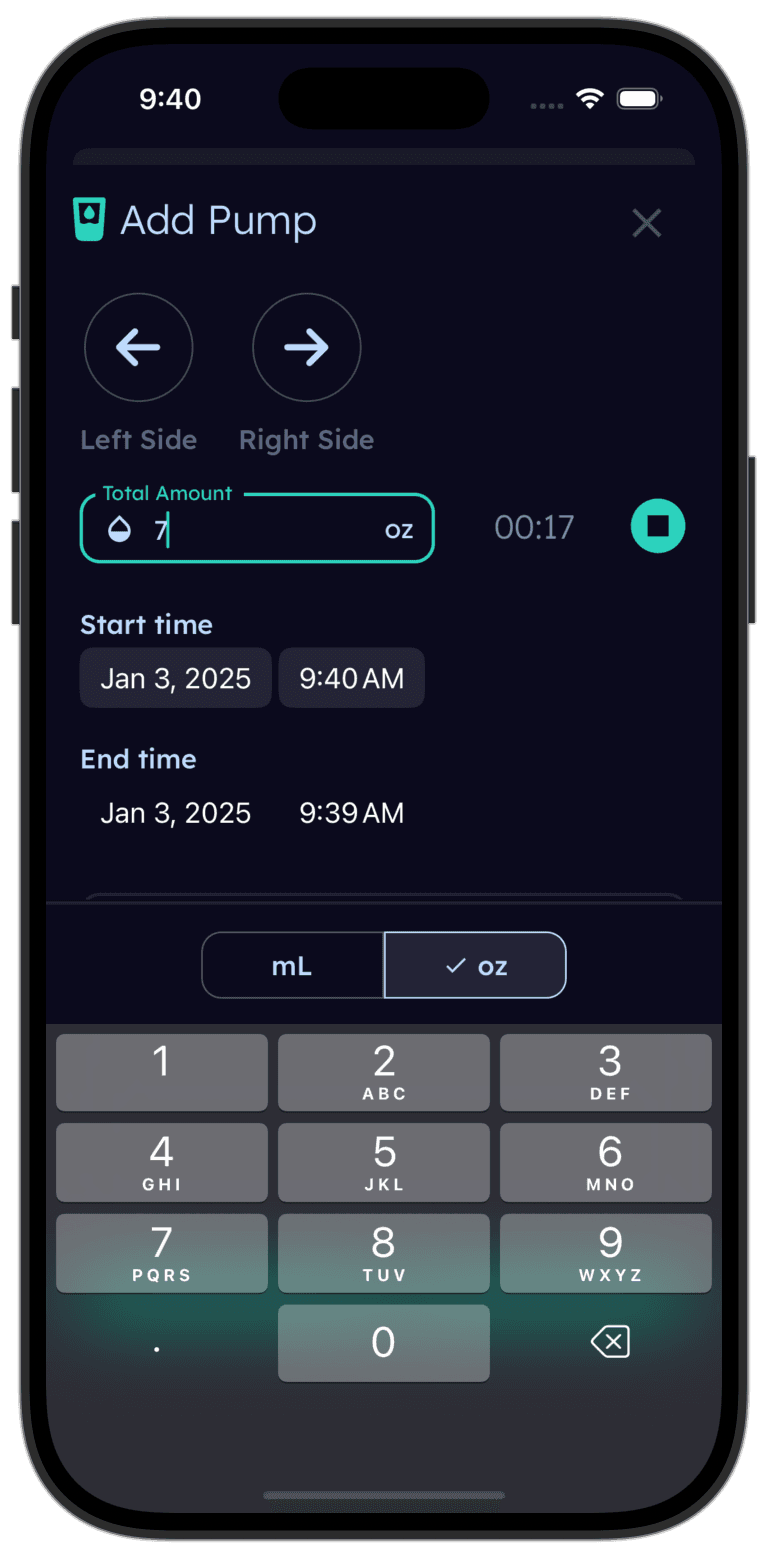
Tinylog tracks pumping sessions so you can protect your supply.
Log pump output, session duration, and feeding patterns. See trends over days and weeks. Bring the data to your lactation consultant.


Noise: A Bigger Deal Than You Expect
Before you have a baby, you do not think much about how loud a breast pump is. After you have a baby, you think about it constantly.
The Elvie runs at roughly 25–30 dB. That is quieter than a whisper. You can pump during a meeting, in a shared office, or next to a sleeping newborn without anyone noticing.
The Motif Luna sits around 45–50 dB. That is the volume of a quiet conversation — noticeable in a silent room but not disruptive. It is quieter than many competing tabletop pumps, but it is not stealth-level.
If noise matters to your daily routine, the Elvie wins this category by a wide margin.
Parts, Maintenance, and the Long Game
Breast pump parts wear out. Valves, membranes, and flanges need regular replacement to maintain suction and hygiene. This is where the ongoing cost difference shows up.
Motif Luna uses standard-size flanges and widely available replacement parts. You can grab compatible valves and membranes from Amazon, Target, or most baby stores. Third-party options are cheap and plentiful.
Elvie uses proprietary parts. Shields, valves, and seals must come from Elvie or authorized retailers. They cost more and are harder to find on short notice. If a valve tears at 11 PM, you are not running to a 24-hour store to replace it.
Over a year of pumping, parts costs add up. Budget an extra $50–$100 for the Elvie ecosystem compared to the Luna.
| Product | Typical Price | Cost Per Diaper | Monthly Estimate |
|---|---|---|---|
| Elvie Double Electric Wearable Pump | $280–$350 | N/A | ~$8–$15 (replacement shields and valves) |
| Motif Luna Double Electric | $60–$90 | N/A | ~$5–$10 (replacement valves and membranes) |
| Elvie via insurance (with upgrade fee) | $0–$80 out of pocket | N/A | ~$8–$15 (replacement parts) |
| Motif Luna via insurance | $0 out of pocket (most plans) | N/A | ~$5–$10 (replacement parts) |
Insurance Coverage: Both Are Eligible, but Read the Fine Print
Under the Affordable Care Act, most insurance plans cover a breast pump at no cost. The catch is that plans typically cover up to a certain dollar amount, and the Elvie often exceeds that cap.
The Motif Luna is fully covered by most insurance plans with zero out-of-pocket cost. It falls well within the standard coverage allowance, and DME suppliers like Aeroflow and Edgepark stock it widely.
The Elvie Double Electric is covered as a base, but many plans require an upgrade fee ranging from $0 to $80 depending on your insurer and supplier. Some plans cover it fully — it is worth checking before you assume you will owe money.
Either way, start the insurance process early. It can take a few weeks for approval and shipping, and you want your pump ready before your due date.
Choose the Elvie Double Electric If
- You pump at work, on the go, or in situations where discretion matters
- You want a truly hands-free pump that fits inside a regular nursing bra
- Quiet operation is non-negotiable — sleeping baby, conference calls, shared spaces
- You like app-based tracking and automatic session logging
- You are willing to pay more upfront for convenience and portability
- Your output is moderate (under 5 oz per side per session)
Choose the Motif Luna If
- You mostly pump at home and can sit near an outlet
- You want the strongest suction available outside of a hospital rental
- Budget matters — you want a fully insurance-covered pump with cheap replacement parts
- You prefer using standard bottles and flanges you already own
- You are a high-output pumper who needs more than 5 oz of bottle capacity per side
Where to Buy
If portability and discretion are your top priorities, the Elvie Double Electric Wearable Pump (~$280–$350 retail, often $0–$80 through insurance) lets you pump anywhere without tubes, cords, or anyone knowing. The app-based tracking is a nice bonus for data-minded parents.
If you want strong suction, affordable parts, and a pump that is fully covered by insurance, the Motif Luna Double Electric (~$60–$90 retail, typically $0 through insurance) is hard to beat on value. It performs near hospital-grade levels and works with standard bottles and flanges you probably already have.
Our honest take: if you can swing it financially, some parents buy both — the Luna for home sessions where output matters most, and the Elvie for work or on-the-go pumping. But if you are picking just one, match it to where and how you pump most often.
Tinylog earns a small commission on purchases made through these links, at no cost to you.
Tip: check promo.new before purchasing. It's hit or miss depending on the product, but when it hits, you'll be glad you checked.
The Bottom Line
The Elvie Double Electric and the Motif Luna are both solid pumps that serve different needs.
Elvie Double Electric wins on portability, noise, hands-free convenience, and app-connected tracking. It is the pump for parents who need to move while pumping.
Motif Luna wins on suction strength, bottle compatibility, part availability, and price. It is the pump for parents who want maximum output from a dedicated pumping spot.
For most families, the deciding factor comes down to one question: do you need to pump on the move, or are you mostly pumping at home? Answer that honestly and the right pump picks itself.
If you are tracking pump sessions and feeding volumes — which is especially helpful in the early weeks when you are building supply — Tinylog makes it simple to log output and spot trends over time.
Related Guides
- Baby Feeding Chart — How much your baby should eat by age
- Breastfeeding Basics — Latching, positioning, and common challenges
- Baby Constipation — What's normal and when to worry
- 1-Month-Old Sleep Schedule — What to expect in the newborn haze
Sources
- Elvie.com. "Elvie Breast Pump — Product Specifications." 2026.
- Motifmedical.com. "Motif Luna Double Electric Breast Pump — Product Information." 2026.
- Aeroflow Breastpumps. "Insurance-Covered Breast Pumps — How It Works." aeroflowbreastpumps.com, 2026.
- Wirecutter. "The Best Breast Pumps." nytimes.com/wirecutter, 2026.
- Babylist. "Best Breast Pumps of 2026." babylist.com.
- Exclusive Pumping. "Elvie Breast Pump Review." exclusivepumping.com, 2025.
- Healthline Parenthood. "Best Wearable Breast Pumps." healthline.com, 2026.
This guide is for informational purposes only. Breast pump choice is a personal decision based on your body, schedule, and feeding goals. If you are experiencing supply issues or pain while pumping, consult a board-certified lactation consultant.
Frequently asked questions
- Is the Elvie Double Electric worth the higher price?
- It depends on your lifestyle. If you pump at work, commute, or need to move around while pumping, the hands-free wearable design can be life-changing. If you mostly pump at home and want maximum suction, the Motif Luna delivers comparable output for significantly less money.
- Does insurance cover the Elvie or the Motif Luna?
- Most insurance plans cover both pumps under the Affordable Care Act breast pump benefit. The Elvie may require an upgrade fee depending on your plan since it costs more than the typical insurance allowance. The Motif Luna is fully covered by most plans with no out-of-pocket cost.
- Which pump has stronger suction?
- The Motif Luna maxes out at around 250 mmHg, which is near hospital-grade territory. The Elvie Double Electric reaches roughly 200 mmHg. For most people this difference is not noticeable, but if you respond better to strong suction, the Luna has the edge.
- Can I use the Elvie pump while lying down?
- You should not lie flat while using the Elvie. The milk collects in a container inside the bra cup, and lying down can cause spills or inaccurate volume readings. Sitting upright or slightly reclined works fine.
- How loud is the Motif Luna compared to the Elvie?
- The Motif Luna runs around 45–50 dB, which is comparable to a quiet conversation. The Elvie is nearly silent at roughly 25–30 dB. If you need to pump during meetings or next to a sleeping baby, the Elvie is noticeably quieter.
- Are replacement parts easy to find for both pumps?
- Motif Luna parts are widely available on Amazon, Target, and most baby retailers. Standard-size flanges from other brands also fit. Elvie parts are proprietary and must be purchased from Elvie directly or select retailers, which can be pricier and harder to find in a pinch.