


GUIDE

1 Month Old Sleep Schedule

At one month, you might see the faintest glimmer of a pattern — or you might not. Both are completely normal.

Your baby is starting to have slightly longer alert periods and may be giving you one marginally longer sleep stretch at night. Here's what to expect and what to stop worrying about.

One Month In: What's Changing and What's Not

You've survived the first month. That alone deserves acknowledgment — the first few weeks of a baby's life are some of the most intense, sleep-deprived days most parents will ever experience. At one month, you're still in the thick of the newborn fog, but there are subtle shifts happening.

Your baby is starting to have slightly longer alert periods during the day. They might track your face across the room, offer a fleeting social smile (the real ones usually arrive by the end of this month or early next month), and seem more aware of their surroundings. These emerging alert periods are exciting but also mean your baby is taking in more stimulation — which can make them harder to settle by evening.

Sleep-wise, one month looks a lot like the newborn period: no real schedule, feeding around the clock, and sleep in short bursts. But the day/night confusion that plagued the first 2 to 3 weeks is usually starting to resolve. You might notice your baby's longest sleep stretch (still only 3 to 4 hours) happens at night rather than during the day. That's circadian rhythm development in its earliest form — and it's real progress, even if 3 hours doesn't feel like much.

1 Month Old Sleep at a Glance
Total sleep (24 hrs)
14–17 hours
Nighttime sleep
8–10 hours (in 2–4 hr stretches)
Number of naps
4–6 (irregular)
Nap duration
30 minutes to 2 hours
Wake windows
45–75 minutes
These are research-based ranges. Your baby might sleep more or less and be perfectly healthy — go by their mood and weight gain, not just numbers.

Sample 1 Month Old Schedule

This is what a day might look like — not what it has to look like. Follow your baby's cues, not the clock.

A rough daily flow

  1. Wake + feed
  2. Back to sleep (nap 1)
  3. Wake + feed
  4. Nap 2
  5. Wake + feed
  6. Nap 3
  7. Wake + feed
  8. Nap 4
  9. Wake + feed
  10. Nap 5 (short)
  11. Cluster feeding + fussy period (normal)
  12. Final feed + down for the night

Your baby's schedule may shift by an hour or more in either direction — and it might look different every day. At one month, consistency means following the same general pattern (eat, short alert time, sleep), not hitting specific clock times. The wake windows matter more than anything else.

Wake Windows at 1 Month

Your baby can handle about 45 to 75 minutes of awake time — slightly longer than a newborn, but still very short. This includes feeding, which can take 20 to 40 minutes, so the actual "play time" window may be as short as 10 to 15 minutes.

The first wake window of the day is typically the shortest — your baby might eat and be ready to sleep again within 30 to 45 minutes. As the day progresses, wake windows may stretch slightly toward 60 to 75 minutes, though by evening (when overstimulation accumulates), your baby may need shorter windows again.

Signs the wake window is too long: fussiness that doesn't respond to feeding, frantic movements, arching back, inconsolable crying. Signs it's too short: baby takes a long time to fall asleep, or wakes after just 10 minutes and seems alert. At one month, erring on the side of shorter wake windows is almost always the safer bet.

Naps at 1 Month

Your baby will take 4 to 6 naps (or sleep periods) during the day, ranging from 30 minutes to 2 hours. There's no pattern to which nap will be long and which will be short — it changes daily. One day you'll get a glorious 2-hour nap in the morning; the next day, every nap is 30 minutes. This is normal.

Contact napping (sleeping on you) is still completely fine and normal at this age. Your baby's nervous system is immature and being held helps them regulate. If you want to practice putting them in the bassinet, great — but don't stress if it doesn't work consistently yet. Many babies don't nap independently until 3 to 4 months.

The last nap of the day often becomes a battle as evening fussiness sets in. It's okay if this nap is short, happens in your arms, or doesn't happen at all — a slightly earlier "bedtime" can compensate.

Nighttime Sleep at 1 Month

Nighttime sleep totals about 8 to 10 hours, broken into 2 to 4 hour stretches by feeds. Breastfed babies typically still eat every 2 to 3 hours overnight; formula-fed babies may go 3 to 4 hours. Both patterns are normal and expected — your baby's stomach is still very small.

The good news: by 1 month, most babies are starting to reserve their longest single sleep stretch for nighttime. This might be 3 to 4 hours instead of 2 to 3 — a small but meaningful improvement. This stretch usually happens in the first part of the night, so going to bed when your baby does (even if that's 10 PM) means you'll get the longest stretch too.

The "bedtime" for a 1-month-old is usually late — 9 to 11 PM is typical. Don't try to force an early bedtime yet. Your baby's circadian rhythm is still developing, and a natural shift toward an earlier bedtime usually happens around 2 to 3 months.

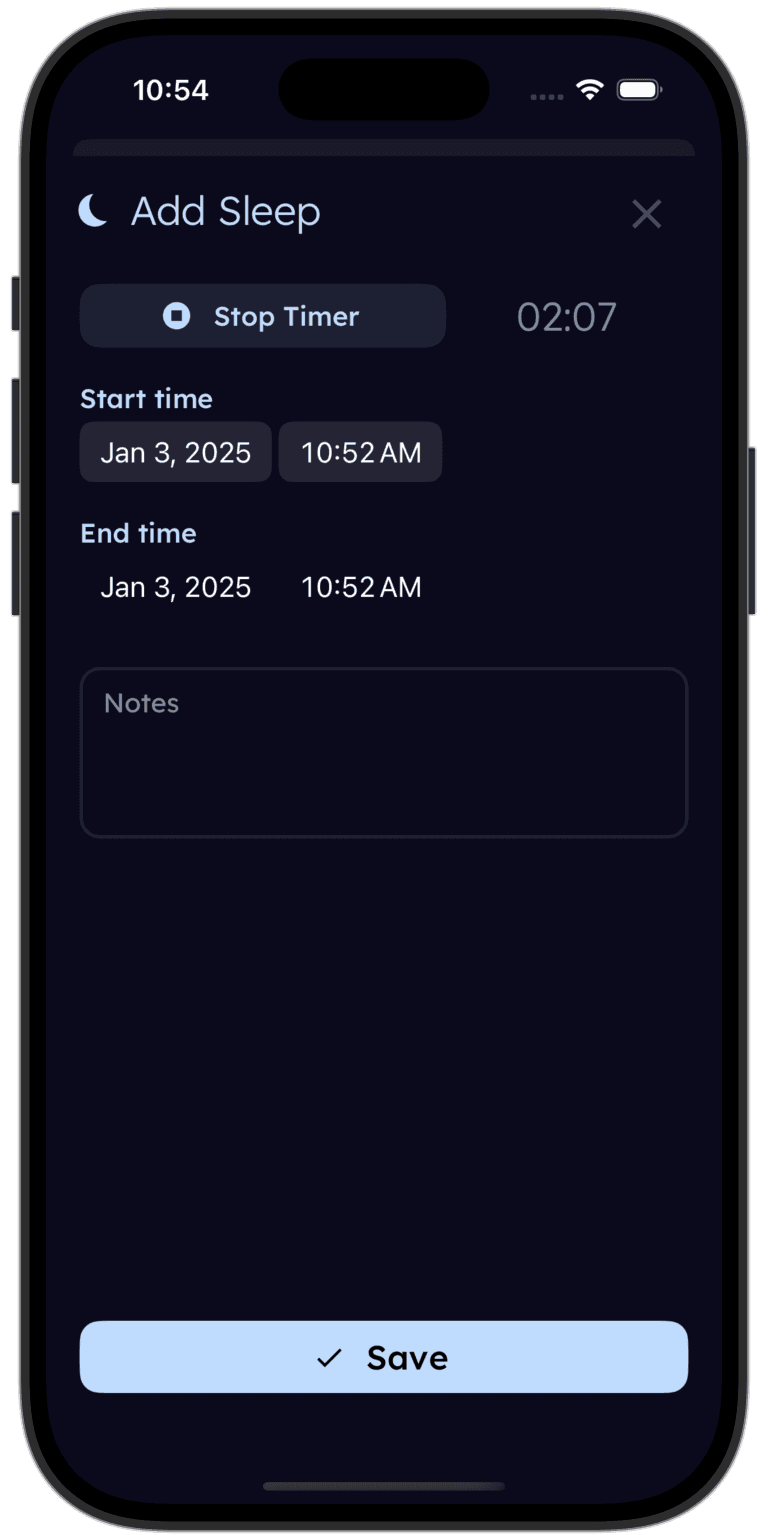
tinylog showing 1 month old sleep and feeding log

You're too tired to remember — let the app do it.

At 1 month, every day feels the same. Logging feeds and sleep with a single tap lets you look back and spot the patterns you can't see in real time — like that slightly longer night stretch getting a little longer each week.

Download on the App StoreGet It On Google Play

What's Happening Developmentally

Your 1-month-old is waking up to the world — literally. They can now focus on objects 8 to 12 inches away (conveniently, the distance to your face while feeding), they're starting to track moving objects briefly, and they may be offering their first social smile. These new capabilities mean more stimulation during awake periods, which is wonderful for development but can make settling for sleep slightly harder.

The startle (Moro) reflex is still strong and can disrupt sleep — arms fling out, baby startles awake, crying follows. Swaddling remains your best tool for managing this. Make sure the swaddle is snug around the arms but allows plenty of room for the hips to move freely.

Digestive development is also affecting sleep. Your baby's gut microbiome is establishing itself, which means gas, discomfort, and the grunting/straining you hear during sleep are all common. These usually peak around 4 to 6 weeks and gradually improve. Bicycle legs and gentle belly massage can help with gas discomfort.

Common Problems at 1 Month

The witching hour (evening fussiness)

Between 5 and 11 PM, your 1-month-old may become inconsolably fussy. This is the 'witching hour' and it's one of the most common — and most stressful — aspects of this age. It typically peaks around 6 to 8 weeks and then gradually improves. Cluster feeding, skin-to-skin, gentle motion (walking, bouncing, swinging), and white noise can help. This isn't colic unless it exceeds 3 hours a day for 3+ days a week — and even then, it resolves on its own.

Confusing active sleep with being awake

Your baby grunts, squirms, flails their arms, and even opens their eyes during active (REM) sleep. It looks exactly like they're waking up. But about half the time, they're actually still asleep. If you pick them up immediately, you may accidentally wake them. Try pausing for 30 to 60 seconds before responding — if they're in active sleep, they'll settle back down on their own.

Baby won't sleep unless being held or rocked

This is your baby's biology, not a behavior problem. Their vestibular system (sense of movement) is one of the most developed senses at birth — movement literally calms their nervous system. If you want to practice putting them down, try the 'jiggle and shush' method: lay them in the bassinet and gently jiggle the mattress while shushing. Gradually reduce the jiggling as they settle. But also know that contact naps are normal and fine at this age.

What No One Tells You About Sleep at 1 Month

Active sleep looks exactly like being awake

Your 1-month-old will grunt, squirm, make faces, move their arms, and even open their eyes — all while sound asleep. This is active (REM) sleep, and it makes up about 50% of their total sleep. Before you pick them up, pause. Wait 30 to 60 seconds. If they're in active sleep, they'll cycle back to quiet sleep without your help. Intervening too quickly is one of the most common reasons parents feel like their baby 'won't stay asleep.'

The fourth trimester is real — recreate the womb

The concept of the 'fourth trimester' means your baby's nervous system expected 3 more months of womb life. Swaddling (snug arms, loose hips), white noise (as loud as a shower), gentle rhythmic motion, and being held close recreate womb conditions. These aren't crutches — they're the closest thing to a sleep strategy that works at this age. Your baby will naturally outgrow the need for all of them.

When to Talk to Your Pediatrician

  • Your baby is excessively sleepy and difficult to rouse for feeds
  • They're not producing at least 6 wet diapers per day
  • Weight gain has stalled or they're losing weight at the 1-month checkup
  • You notice pauses in breathing longer than 10 seconds, or skin color changes during sleep
  • Evening fussiness exceeds 3 hours a day, 3+ days a week, for 3+ weeks (possible colic — your pediatrician can help)
  • You're struggling with your own mood, sleep, or ability to cope — postpartum depression and anxiety affect up to 1 in 5 parents

You never need a 'good enough' reason to call your pediatrician. 'Something feels off' is always enough.

Related Guides

Sources

American Academy of Pediatrics (AAP). (2022). Healthy Sleep Habits: How Many Hours Does Your Child Need?
Mindell, J. A., et al. (2016). Development of infant and toddler sleep patterns: Real-world data from a mobile application. Journal of Sleep Research, 25(5), 508–516.
Galland, B. C., et al. (2012). Normal sleep patterns in infants and children: A systematic review of observational studies. Sleep Medicine Reviews, 16(3), 213–222.
Baby Sleep Information Source (BASIS), Durham University. Normal Infant Sleep Development. https://www.basisonline.org.uk
Barr, R. G. (1990). The normal crying curve: what do we really know? Developmental Medicine & Child Neurology, 32(4), 356–362.

Medical Disclaimer

This guide is for informational purposes only and is not a substitute for professional medical advice. Always follow safe sleep guidelines (baby on their back, on a firm surface, in their own sleep space). Consult your pediatrician with any concerns about your baby's sleep.

Want this guide in your inbox?
We'll send you this 1-month sleep guide so you can reference it during those 3 AM feeds.
Track the patterns you can't see yet.
Download ${appName} free — log sleep and feeds with one tap and watch your baby's rhythm emerge.
Download on the App StoreGet It On Google Play