GUIDE

Newborn Sleep Schedule

There is no newborn sleep schedule — and that's completely normal.

In the first four weeks, your baby sleeps on demand, eats on demand, and doesn't know the difference between day and night. Here's what to actually expect and how to survive it.

The First Four Weeks: Survival, Not Schedules

Let's get this out of the way immediately: there is no newborn sleep schedule. Not a flexible one, not a loose one, not a "general framework." Your newborn's brain hasn't developed a circadian rhythm yet, which means they genuinely cannot tell the difference between day and night. They sleep when they're tired, eat when they're hungry, and the clock on your wall is meaningless to them.

This can feel disorienting — especially if you've read books or seen social media posts that suggest a newborn routine is possible from day one. It's not, and trying to force one will only make you feel like you're failing at something that was never achievable in the first place.

What IS happening in these first four weeks is important: your baby is adjusting to life outside the womb, their digestive system is learning to process food, and their brain is beginning the slow process of organizing sleep. By the end of the first month, you'll likely notice the faintest hints of a pattern — a slightly longer stretch at night, a predictable fussy period in the evening. That's progress, even if it doesn't feel like it.

Newborn Sleep at a Glance
Total sleep (24 hrs)
14–17 hours
Nighttime sleep
8–10 hours (in 2–4 hr stretches)
Number of naps
4–6 (irregular, on-demand)
Nap duration
30 minutes to 3 hours (unpredictable)
Wake windows
45–60 minutes
Every baby is different — these ranges come from AAP and sleep research. Your newborn might fall outside them and be perfectly healthy.

What a Newborn's Day Actually Looks Like

This isn't a schedule — it's a rhythm. Follow your baby's cues, not the clock.

A typical newborn day (if 'typical' is even a word that applies)

  1. Feed every 2–3 hours (breast) or 3–4 hours (formula)
  2. Watch for sleepy cues, then help baby sleep
  3. Anywhere they'll sleep — arms, chest, swing, bassinet
  4. Frequent evening feeds (5–10 PM) are common and normal
  5. Feed, change, back to sleep — keep it dark and boring
  6. A 'bedtime' of 9–11 PM is completely typical

There are no fixed times here on purpose. Your newborn's day is driven by hunger and sleepiness, not by hours. The only rhythm that matters right now is: feed, brief awake period, sleep, repeat. Wake windows are 45 to 60 minutes — and that includes feeding time, so the actual "alert and looking around" window is very short.

Wake Windows: The Only Thing That Matters Right Now

A newborn's wake window is 45 to 60 minutes. That's it. And that includes feeding, diaper changes, and any stimulation. By the time you've fed, burped, and changed your baby, their wake window may already be closing.

Sleepy cues at this age are subtle: a yawn, looking away from you, jerky arm movements, fussing. By the time they're crying, they're already overtired — and an overtired newborn is harder to settle, not easier. Watch for the early cues and start your wind-down routine at the first sign.

The first wake window of the day is often the shortest — sometimes just 30 to 45 minutes. Don't worry if your baby wakes up, eats, and is ready to sleep again almost immediately. That's normal.

Naps in the Newborn Period

Calling them "naps" is generous — newborn sleep is just sleep, happening in short bursts throughout the day and night. Your baby will take 4 to 6 sleep periods during daytime hours, ranging from 30 minutes to 3 hours. There's no predicting which one you'll get.

Location doesn't matter at this age from a habit perspective. Your chest, a swing, a car seat (while supervised), a bassinet — wherever your baby will actually sleep is the right place. You are not creating bad habits by letting your newborn sleep on you. You are keeping a tiny human alive and comfortable. That's the whole job right now.

If you want to practice putting your baby down drowsy (not fully asleep), you can start experimenting — but don't stress if it doesn't work. Most newborns need significant help falling asleep, and that's developmentally appropriate.

Nighttime Sleep: What 'Night' Means to a Newborn

For the first 2 to 3 weeks, your newborn doesn't distinguish between day and night. Night sleep happens in 2 to 4 hour stretches, broken by feeds. Breastfed babies typically eat every 2 to 3 hours; formula-fed babies every 3 to 4 hours. Night feeds are essential — your baby's stomach is tiny and they need the calories.

Around 3 to 4 weeks, you may notice the faintest preference for sleeping slightly longer at night than during the day. This is the very beginning of circadian rhythm development — melatonin production usually kicks in around 6 to 8 weeks, which is when night sleep starts to consolidate.

In the meantime, make nights different from days: keep the room dark, use a dim light for feeds, minimize talking and stimulation, and put them right back down after feeding and changing. This won't fix day/night confusion immediately, but it gives their brain the environmental cues it needs to start organizing.

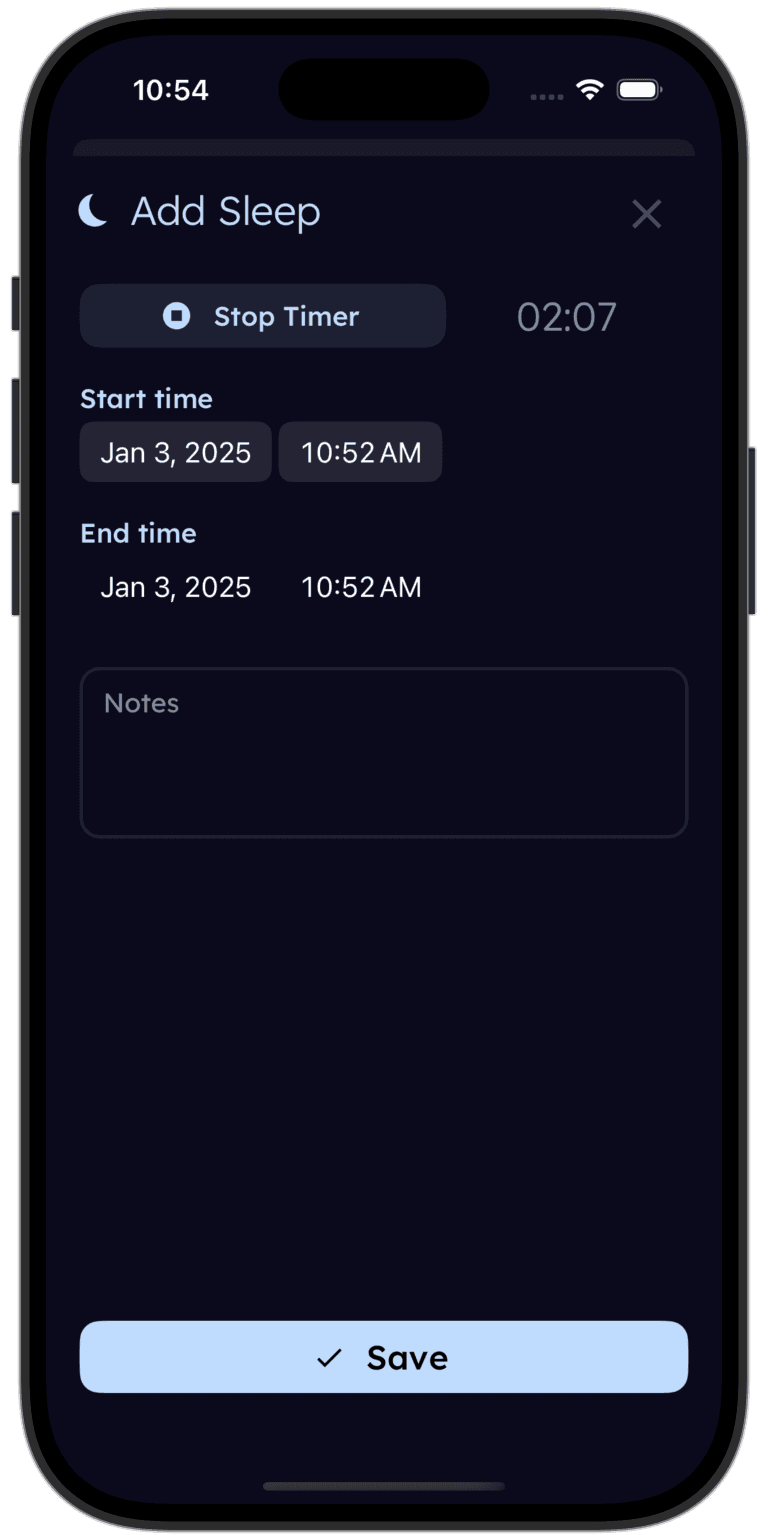
tinylog sleep tracking showing newborn sleep and feeding patterns

Patterns are hiding in the chaos — tracking reveals them.

Even in the newborn fog, logging feeds and sleep with a single tap helps you see emerging rhythms. When your pediatrician asks 'how's sleep going?' you'll have real data instead of 'I honestly have no idea.'

Download on the App StoreGet It On Google Play

What's Happening Developmentally

Your newborn's brain is doing extraordinary work in the first four weeks, but almost none of it is visible. They're processing sensory information for the first time — light, sound, touch, temperature, gravity. Their nervous system is immature, which is why they startle easily (the Moro reflex), have jerky movements, and need help regulating their body temperature and state.

Sleep is where most of the brain's development work happens. About 50% of a newborn's sleep is active (REM) sleep, compared to about 20-25% for adults. During REM sleep, the brain is building neural connections at an incredible rate. This is why newborns sleep so much — their brain literally needs it for construction.

The startle reflex can disrupt sleep significantly. A tight swaddle (arms in, hips loose) mimics the snug feeling of the womb and dampens the reflex. Most newborns sleep noticeably better when swaddled. Just make sure to stop swaddling when your baby shows the first signs of rolling, which can happen as early as 2 months.


Common Problems in the Newborn Period

Day/night confusion

Your newborn doesn't know that 2 PM and 2 AM are supposed to feel different. For the first 2 to 3 weeks, this is normal. Help them sort it out: keep days bright and social (open blinds, talk normally, go outside), and keep nights dark and boring (dim lights, whisper, minimal stimulation during feeds and changes). Most babies figure it out by 3 to 4 weeks.

Only sleeping when held

This is biologically normal, not a bad habit. Your newborn's nervous system is immature and contact helps them regulate. If you need hands-free time, try a tight swaddle, white noise at a consistent volume, and a warm (not hot) bassinet. But if your baby sleeps best on your chest, that's not something you need to fix right now — just follow safe sleep guidelines when you put them down.

Evening cluster feeding makes sleep impossible

Many newborns cluster feed between 5 and 10 PM — wanting to eat every 30 to 60 minutes. This is normal and usually helps them load up calories for a longer first sleep stretch. It's exhausting, but it's your baby's strategy for getting through the night. It usually peaks around 3 to 6 weeks and gradually eases.

What No One Tells You About Newborn Sleep

There is no such thing as a newborn sleep schedule

Anyone claiming to have a precise newborn schedule is either misremembering or selling something. Newborns are driven by hunger and sleepiness, not clocks. The best thing you can do is follow their cues — feed when hungry, sleep when tired — and stop trying to force a pattern that their brain isn't ready for yet. A pattern will emerge on its own around 6 to 8 weeks.

You cannot spoil a newborn

Holding your baby too much, responding too quickly, feeding on demand — none of these create bad habits in the first month. Research consistently shows that responsive parenting in the newborn period actually builds more secure attachment and better self-regulation later. Pick them up. Hold them. You're not making a mistake.

When to Talk to Your Pediatrician

  • Your baby is excessively sleepy and difficult to wake for feeds
  • Fewer than 6 wet diapers per day after the first week
  • Your baby hasn't regained their birth weight by 2 weeks
  • You notice pauses in breathing, gasping, or choking during sleep
  • Your baby's skin has a yellow tint (possible jaundice) — especially in the first 2 weeks
  • You're feeling overwhelmed, hopeless, or unable to cope — postpartum mood disorders are common, treatable, and not your fault

You never need a 'good enough' reason to call your pediatrician. 'I'm worried' is always sufficient. That's what they're there for.

Related Guides

Sources

American Academy of Pediatrics (AAP). (2022). Sleep-Related Infant Deaths: Updated 2022 Recommendations for Reducing Infant Deaths in the Sleep Environment. Pediatrics, 150(1).
Mindell, J. A., et al. (2016). Development of infant and toddler sleep patterns: Real-world data from a mobile application. Journal of Sleep Research, 25(5), 508–516.
Galland, B. C., et al. (2012). Normal sleep patterns in infants and children: A systematic review of observational studies. Sleep Medicine Reviews, 16(3), 213–222.
Baby Sleep Information Source (BASIS), Durham University. Normal Infant Sleep Development. https://www.basisonline.org.uk
Zero to Three. (2022). Helping Your Baby Sleep. https://www.zerotothree.org

Medical Disclaimer

This guide is for informational purposes only and is not a substitute for professional medical advice. Always follow safe sleep guidelines (baby on their back, on a firm surface, in their own sleep space). Consult your pediatrician with any concerns about your baby's sleep.

Want this guide in your inbox?
We'll send you this newborn sleep guide so you can reference it at 3 AM without unlocking your phone.
See your newborn's patterns emerge.
Download ${appName} free — log sleep and feeds with one tap, even at 2 AM.
Download on the App StoreGet It On Google Play