


GUIDE

Baby Sleep Schedule by Age

Realistic, age-by-age sleep schedules you can actually use — not rigid timetables that fall apart by 9 AM.

We break down sleep needs, sample routines, and feeding integration for every stage from newborn through toddlerhood. Use these as starting points, not scripts — your baby gets the final say.

How Much Sleep Does Your Baby Need?
0–3 months
Total Sleep14–17 hrs
Night Sleep8–10 hrs
Day Sleep5–7 hrs
Naps4–6 (irregular)
Wake Window45–90 min
4–6 months
Total Sleep12–15 hrs
Night Sleep10–11 hrs
Day Sleep2.5–4 hrs
Naps2–3
Wake Window1.5–2.75 hrs
7–9 months
Total Sleep12–15 hrs
Night Sleep10–12 hrs
Day Sleep2–3 hrs
Naps2
Wake Window2.5–3.5 hrs
10–12 months
Total Sleep12–14 hrs
Night Sleep10–12 hrs
Day Sleep2–3 hrs
Naps2
Wake Window3–4 hrs
12–18 months
Total Sleep12–14 hrs
Night Sleep10–12 hrs
Day Sleep2–3 hrs
Naps1–2
Wake Window3.5–5.5 hrs
18–24 months
Total Sleep11–14 hrs
Night Sleep10–12 hrs
Day Sleep1.5–2.5 hrs
Naps1
Wake Window5–6 hrs
24–36 months
Total Sleep11–14 hrs
Night Sleep10–12 hrs
Day Sleep1–2 hrs
Naps1 (some drop it)
Wake Window5.5–7 hrs
Ranges based on AAP and National Sleep Foundation guidelines. Your baby might fall outside these ranges and be perfectly healthy — go by mood and energy, not just numbers.

When Do Babies Get on a Schedule?

Spoiler: it takes a while. And it never looks like the internet says it should.

The truth is, newborns don't have schedules. They have patterns that you notice after the fact. A real predictable routine usually starts forming around 3–4 months when circadian rhythms kick in and wake windows become more consistent.

Before that? You're following your baby's lead — feeding on demand, watching for sleepy cues, and surviving. That's not a failure to schedule. That's responsive parenting.

By 6 months, most families settle into a recognizable rhythm with fairly consistent nap times and a predictable bedtime. By 9–12 months, you'll likely have a solid 2-nap schedule that holds most days. For a deep dive on overall sleep architecture, see our Baby Sleep Playbook. For wake window details, check out Wake Windows by Age.

Age-by-Age Sleep Schedules

Sample daily routines for every stage. Use these as templates — adjust based on your baby's wake windows and cues.

Newborn (0–3 Months)

There's no real schedule here — and that's fine. Follow your baby's lead.
Sleep needs
14–17 hours total. Night sleep is 8–10 hours (with wakes every 2–4 hours to feed). Day sleep is 5–7 hours across 4–6 naps.
Feeding integration
Breastfed: every 2–3 hours (8–12 times per day). Formula-fed: every 3–4 hours. Night feeds are essential and expected.

Sample daily schedule

  1. Feed every 2–3 hours around the clock
  2. Watch for sleepy cues, then down for a nap
  3. Anywhere they'll sleep — your chest, the swing, the car
  4. A late 'bedtime' around 9–11 PM is totally normal
Good to know
  • Day/night confusion is real — open the blinds during the day, keep nights dark and boring
  • Wake windows max out around 45–90 minutes, including feeding time
  • Don't stress about a schedule — focus on feeding well and watching sleepy cues
  • Swaddling, white noise, and gentle motion are your best friends right now
4–6 Months

A pattern is emerging. Wake windows are your scheduling superpower.
Sleep needs
12–15 hours total. Night sleep consolidates to 10–11 hours. Day sleep is 2.5–4 hours across 2–3 naps.
Feeding integration
5–6 feeds per day. Some babies start solids around 6 months (watch for readiness signs, not just age). Night feeds drop to 1–2.

Sample daily schedule

  1. Wake + feed
  2. Nap 1 (1–2 hours)
  3. Feed
  4. Nap 2 (1–2 hours)
  5. Feed
  6. Catnap (30–45 min — drop around 6 months)
  7. Feed (+ solids if started)
  8. Bedtime routine
  9. Bedtime
Good to know
  • The 4-month sleep regression may hit — it's brain development, not a setback
  • This is a great time to introduce a consistent bedtime routine if you haven't yet
  • Watch for the 3-to-2 nap transition around 6 months
  • If starting solids, offer them during a wake window — not right before sleep

7–9 Months

Two solid naps, predictable bedtime. Things are clicking.
Sleep needs
12–15 hours total. Night sleep is 10–12 hours. Day sleep is 2–3 hours across 2 naps.
Feeding integration
3 meals of solids + 4–5 milk feeds. Night feeds: 0–1. Solids are supplementing milk, not replacing it yet.

Sample daily schedule

  1. Wake + milk feed
  2. Breakfast (solids)
  3. Nap 1 (1–1.5 hours)
  4. Milk feed + lunch (solids)
  5. Nap 2 (1–2 hours)
  6. Milk feed + snack
  7. Dinner (solids)
  8. Bedtime routine + milk feed
  9. Bedtime
Good to know
  • Separation anxiety may ramp up — keep your goodbye short and calm
  • Babies learning to crawl or pull to stand may practice in the crib instead of sleeping
  • If naps are solid but night sleep suffers, check that total day sleep isn't too much
  • This is often a great age for sleep training if you haven't already

10–12 Months

Two naps, three meals, and possibly sleeping through the night.
Sleep needs
12–14 hours total. Night sleep is 10–12 hours. Day sleep is 2–3 hours across 2 naps.
Feeding integration
3 meals of solids + 3–4 milk feeds. Many babies drop all night feeds. Solids are becoming the primary nutrition source.

Sample daily schedule

  1. Wake + milk feed
  2. Breakfast
  3. Nap 1 (1–1.5 hours)
  4. Lunch + milk feed
  5. Nap 2 (1–1.5 hours)
  6. Snack + milk feed
  7. Dinner
  8. Bedtime routine + milk feed
  9. Bedtime
Good to know
  • The 12-month regression is real — resist the urge to drop to one nap (most babies aren't ready until 14–18 months)
  • Walking attempts may disrupt sleep temporarily — lots of active play during the day helps
  • If they skip a nap, move bedtime 30 minutes earlier
  • Start offering whole milk after their first birthday (discuss with your pediatrician)

12–18 Months

The 2-to-1 nap transition is the big event. Go slow.
Sleep needs
12–14 hours total. Night sleep is 10–12 hours. Day sleep is 2–3 hours across 1–2 naps.
Feeding integration
3 meals + 2 snacks + milk (whole milk or continued breastfeeding). Solids are now the main nutrition source.

Sample daily schedule

  1. Wake + milk
  2. Breakfast
  3. Snack
  4. Lunch
  5. Nap (2–3 hours)
  6. Snack + milk
  7. Dinner
  8. Bedtime routine + milk
  9. Bedtime
Good to know
  • Wait until they refuse one nap consistently for 2+ weeks before dropping to one
  • During the transition, an early bedtime (6:00–6:30 PM) will save your sanity
  • The single nap should land around 12:00–12:30 PM
  • Budget 2–4 weeks for the transition to smooth out

18–24 Months

One nap, solid routine. Welcome to the (relatively) predictable phase.
Sleep needs
11–14 hours total. Night sleep is 10–12 hours. Day sleep is 1.5–2.5 hours in a single nap.
Feeding integration
3 meals + 2 snacks. Milk is a drink alongside food, not a primary nutrition source.

Sample daily schedule

  1. Wake + milk
  2. Breakfast
  3. Snack
  4. Lunch
  5. Nap (1.5–2.5 hours)
  6. Snack
  7. Dinner
  8. Bedtime routine
  9. Bedtime
Good to know
  • Toddlers are master stallers — keep the bedtime routine predictable and firm (but loving)
  • If nap is too long or too late, it pushes bedtime — cap it at 2 hours if night sleep suffers
  • The 18-month sleep regression is often driven by language explosion and separation anxiety
  • A toddler clock ('okay to wake' light) can work wonders for early risers

24–36 Months

One nap (maybe) and a strong bedtime routine carry you through the toddler years.
Sleep needs
11–14 hours total. Night sleep is 10–12 hours. Day sleep is 1–2 hours — some toddlers drop the nap entirely by 3.
Feeding integration
3 meals + 2 snacks. Fully independent eating with family meals.

Sample daily schedule

  1. Wake
  2. Breakfast
  3. Snack
  4. Lunch
  5. Nap or quiet time (1–2 hours)
  6. Snack
  7. Dinner
  8. Bedtime routine
  9. Bedtime
Good to know
  • If they fight the nap consistently for 2+ weeks, switch to 'quiet time' in their room
  • The big bed transition usually happens between 2.5–3.5 years — don't rush it
  • Night fears and bad dreams may start — a nightlight and reassurance go a long way
  • If they drop the nap, move bedtime 30–60 minutes earlier to compensate
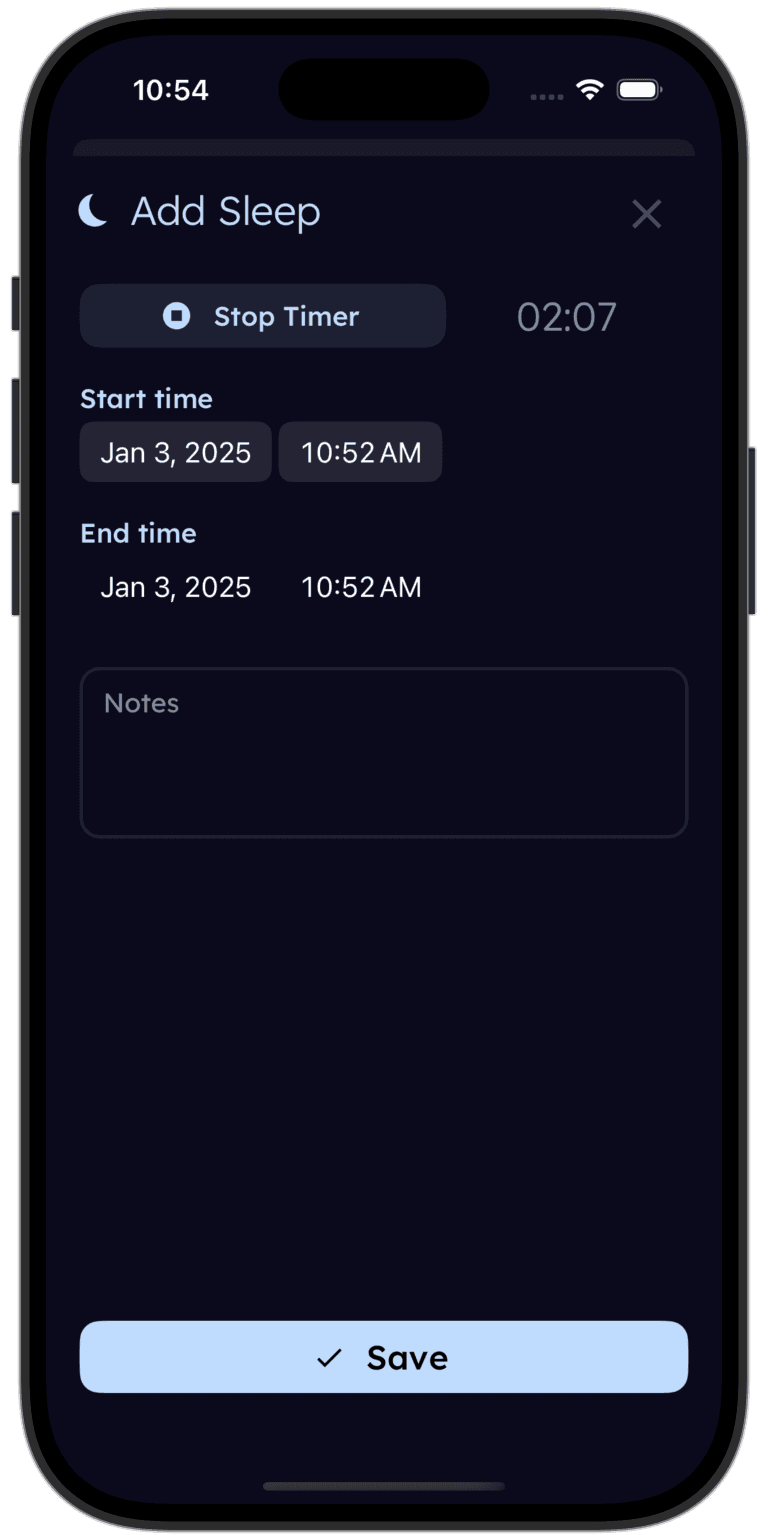
tinylog sleep tracking showing daily sleep schedule patterns

tinylog shows you the schedule your baby is already on.

Log sleep with one tap and let the data reveal your baby's natural rhythm — wake windows, nap lengths, and night sleep trends tracked automatically over time.

Download on the App StoreGet It On Google Play

How to Build YOUR Baby's Schedule

Every baby is different. Here's how to create a schedule that works for your actual kid — not the hypothetical baby on the internet.

Start with wake-up time, not bedtime

Build forward from when your baby naturally wakes. A 6:30 AM riser needs different nap timing than a 7:30 AM riser. Once you anchor the morning, everything else falls into place.

Use wake windows, not clock times

The times above are examples — what matters is the stretch of awake time between sleeps. A baby who wakes at 7:00 AM with a 2-hour wake window needs a nap at 9:00 AM, not 9:30 AM because a chart said so.

Observe before optimizing

Track your baby's sleep for a week before making changes. You might discover they already have a pattern you can build on rather than replacing.

Adjust one thing at a time

If sleep is off, change one variable (wake window, nap length, bedtime) and give it 3–5 days before assessing. Changing everything at once makes it impossible to know what worked.

Expect flexibility

Some days will be off-schedule — teething, travel, growth spurts, life. A solid routine means you have a home base to come back to, not a prison sentence.

Common Schedule Mistakes to Avoid

  • Keeping baby awake too long hoping they'll sleep better at night (overtiredness causes worse sleep, not better)
  • Letting the last nap run too late — it pushes bedtime and fragments night sleep
  • Dropping a nap too early because baby skipped it once or twice (wait for 2+ weeks of consistent refusal)
  • Putting baby to bed too late — most babies do best with a 6:30–7:30 PM bedtime after 3 months
  • Expecting the schedule to work perfectly every day — aim for 80% consistency and give yourself grace
  • Comparing your baby's schedule to another baby's — there's a huge range of normal

These are the most common issues we see from the tinylog community. Adjusting even one of these can make a noticeable difference within a few days.

Related Guides

Looking to go deeper on specific topics? These guides cover each area in detail:

Sources

American Academy of Pediatrics. (2022). Healthy Sleep Habits: How Many Hours Does Your Child Need?
National Sleep Foundation. (2023). How Much Sleep Do Babies and Kids Need?
Mindell, J. A., et al. (2016). Development of infant and toddler sleep patterns. Sleep Medicine.
Galland, B. C., et al. (2012). Normal sleep patterns in infants and children: A systematic review. Sleep Medicine Reviews.
Hirshkowitz, M., et al. (2015). National Sleep Foundation's sleep time duration recommendations. Sleep Health.
Want these schedules in your inbox?
We'll send you the complete age-by-age sleep schedule guide so you can reference it anytime — especially at 2 AM.
Stop guessing. Start tracking.
Download ${appName} free — log sleep with one tap and see your baby's actual schedule emerge from the data.
Download on the App StoreGet It On Google Play