


GUIDE

Sleep Training Methods Compared

Six approaches, honestly compared. No judgment, no agenda — just the information you need to pick what works for your family.

Sleep training is one of the most debated topics in parenting. We're not here to push a method. We're here to lay out how each one actually works, what the research says, and help you choose the one you'll stick with — because consistency matters more than method.

Is Your Baby Ready for Sleep Training?

  • Baby is at least 4 months old (adjusted age if premature)
  • Pediatrician has confirmed baby is healthy and gaining weight well
  • No active illness, teething pain, or ear infection
  • A consistent bedtime routine is in place (even a simple one)
  • You and your partner (if applicable) agree on the approach
  • You can commit to consistency for at least 1–2 weeks
  • Baby's sleep environment is safe (firm mattress, no loose bedding, dark room)

If you can check most of these, you're probably ready. If you're unsure about any, talk to your pediatrician first.

Signs You Should Wait

  • Baby is under 4 months old (their circadian rhythm isn't developed enough)
  • Baby has an active medical condition that affects sleep (reflux, ear infection, etc.)
  • You're about to travel, move, or go through a major disruption
  • You're not emotionally ready — if you can't follow through, it's better to wait
  • Baby is in the middle of a developmental leap or regression (wait until it passes)
  • You feel pressured by someone else to do it — this should be your decision

There's no rush. A few more weeks of waiting won't matter in the long run — starting when you're both ready will.

Quick Comparison: All 6 Methods at a Glance
Drowsy But Awake
CryingMinimal
SpeedOngoing
Parent InvolvementHigh
Best ForNewborns, gentle start
Pick Up / Put Down
CryingLow–Moderate
Speed1–3 weeks
Parent InvolvementVery high
Best For4–8 months, hands-on parents
Chair Method
CryingLow–Moderate
Speed2–3 weeks
Parent InvolvementModerate
Best For5+ months, gradual approach
Ferber (Graduated)
CryingModerate
Speed3–7 nights
Parent InvolvementLow
Best For5+ months, balanced approach
Full Extinction
CryingHigh (brief)
Speed3–5 nights
Parent InvolvementMinimal
Best For5+ months, fastest results
Bedtime Fading
CryingMinimal
Speed2–4 weeks
Parent InvolvementModerate
Best ForBedtime resistance
Crying level and speed are general expectations — individual results vary based on baby's temperament and consistency of application.

Sleep Training Methods: Deep Dive

Each method below includes step-by-step instructions, a realistic timeline, and what the research actually says.

Drowsy But Awake (Gentle Foundation)

0–4 months
Crying: Minimal
Timeline: Ongoing — builds a foundation
This isn't a formal sleep training method — it's a habit that sets the stage for independent sleep. You put baby down when they're sleepy but still slightly awake, so they learn to associate the crib with falling asleep.
Step-by-step protocol
  • Complete your bedtime routine (feed, book, song)
  • Watch for drowsy signs — heavy eyelids, slow blinking, relaxed body
  • Lay baby in the crib before they're fully asleep
  • Place a hand on their chest gently if they fuss
  • Use shushing or soft 'shhh' sounds to soothe
  • If they get truly upset, pick up to calm, then try again
  • Don't stress if it doesn't work every time — it's practice, not perfection
What the research says
While not a formal sleep training method, the concept is supported by sleep association research. Babies who fall asleep independently at bedtime are better at self-settling during normal nighttime arousals (Mindell et al., 2006).
Pro tip
This works best as a starting point in the early months. If it's not enough by 5–6 months, transition to a more structured method.
Pick Up / Put Down (PUPD)

4–8 months
Crying: Low to moderate
Timeline: 1–3 weeks
Baby cries, you pick them up. They calm down, you put them back. Repeat as many times as needed. The message: 'I'm always here, but sleep happens in the crib.'
Step-by-step protocol
  • Complete your bedtime routine and lay baby in the crib awake
  • If baby cries, wait 30–60 seconds to see if they self-settle
  • If crying escalates, pick baby up and hold them until they're calm (not asleep)
  • As soon as they're calm, lay them back down
  • Repeat — this can take 30+ repetitions on night 1
  • Each night, the number of pickups typically decreases
  • Stay calm and patient — your energy affects theirs
What the research says
This method is associated with Tracy Hogg's 'Baby Whisperer' approach. While less formally studied than graduated extinction, the underlying principle of responsive soothing with consistent crib-based sleep is supported by attachment theory research.
Pro tip
Works beautifully for some babies, but can overstimulate others (all that picking up and putting down gets them wound up). If it's getting worse after 3–4 nights, consider switching methods.

The Chair Method (Sleep Lady Shuffle)

5+ months
Crying: Low to moderate
Timeline: 2–3 weeks
You sit in a chair next to the crib and gradually move farther away every 2–3 nights until you're out of the room. Your presence provides comfort while baby learns to fall asleep without being held.
Step-by-step protocol
  • Night 1–3: Sit in a chair right next to the crib. You can shush, pat the mattress, or offer verbal comfort — but don't pick baby up
  • Night 4–6: Move the chair halfway between the crib and the door. Same rules — comfort with your voice, no picking up
  • Night 7–9: Move the chair to the doorway. You're still present and visible
  • Night 10–12: Sit just outside the door where baby can hear you but not see you
  • Night 13+: You should be able to leave after putting baby down. Check in verbally if needed
  • If baby stands up, lay them down once. After that, use your voice from the chair
  • Stay calm and boring — no eye contact, no playing, no picking up
What the research says
Kim West's 'Sleep Lady Shuffle' has been used successfully by thousands of families. The gradual withdrawal approach is consistent with the fading literature in behavioral sleep medicine and the broader principle of gradually reducing parental presence.
Pro tip
Some babies find your presence more frustrating than comforting — they can see you but can't understand why you won't pick them up. If your baby gets angrier with you sitting there, a check-in method might actually be easier on them.

Ferber Method (Graduated Extinction)

5+ months
Crying: Moderate
Timeline: 3–7 nights
Put baby down awake and leave. Come back at gradually increasing intervals to briefly reassure them — but don't pick them up or stay. This teaches baby that you're still there while giving them space to learn self-settling.
Step-by-step protocol
  • Complete bedtime routine and lay baby in the crib awake. Say your goodnight phrase and leave
  • Night 1: Check in at 3 minutes, then 5 minutes, then 10 minutes. Stay under 1 minute per check — reassure verbally, pat briefly, then leave
  • Night 2: Check at 5 minutes, then 10 minutes, then 12 minutes
  • Night 3: Check at 10 minutes, then 12 minutes, then 15 minutes
  • Continue increasing intervals each night
  • During check-ins: stay calm, don't pick up, don't turn on lights. Brief verbal reassurance only
  • For middle-of-the-night wakes, restart the intervals at that night's starting interval
  • Naps: use the same approach, but if baby hasn't fallen asleep after 30 minutes of trying, end the nap attempt and try again at the next wake window
What the research says
The most-studied sleep training method. Gradisar et al. (2016) in Pediatrics found graduated extinction was effective and showed no adverse effects on infant stress, parent-child attachment, or child behavior at 12-month follow-up. Multiple systematic reviews confirm safety and efficacy (Mindell et al., 2006; Meltzer & Mindell, 2014).
Pro tip
Night 2 or 3 is often the hardest — there can be an 'extinction burst' where crying temporarily increases before it gets better. This is normal and a sign the method is working. Stick with it.

Full Extinction (Cry It Out)

5+ months
Crying: High (short-term)
Timeline: 3–5 nights
Put baby down awake, say goodnight, and don't return until morning (or a scheduled feed time). The fastest method but requires the most parental resolve. Baby learns to self-settle without any external intervention.
Step-by-step protocol
  • Complete your bedtime routine and lay baby in the crib fully awake
  • Say your goodnight phrase, leave the room, and close the door
  • Do not go back in unless there's a safety concern
  • Monitor via audio or video monitor — you're not ignoring your baby, you're letting them learn
  • Night 1 may involve 45–90 minutes of crying before sleep. This is the hardest night
  • Night 2 typically sees 20–45 minutes of crying
  • By night 3–5, most babies cry less than 10 minutes or not at all
  • For middle-of-the-night wakes, apply the same approach (unless it's a planned feed time)
What the research says
Price et al. (2012) published a 5-year follow-up study in Pediatrics showing no long-term differences in emotional health, behavior, sleep quality, stress, or parent-child relationship between cry-it-out babies and controls. Cortisol studies show that while babies' cortisol is elevated during the learning phase, it returns to baseline within days and does not remain chronically elevated.
Pro tip
This is not 'ignoring your baby.' You're giving them the space to learn a skill. If you can't commit to not going in, use the Ferber method instead — inconsistently going in and out can actually prolong the process and increase total crying.

Bedtime Fading

5+ months
Crying: Minimal
Timeline: 2–4 weeks
Instead of fighting a too-early bedtime, you temporarily move bedtime later to match when baby naturally falls asleep. Then you gradually shift it earlier in 15-minute increments. This reduces bedtime resistance because baby is genuinely tired when you put them down.
Step-by-step protocol
  • Track when your baby naturally falls asleep for 3–5 nights (even if it's 9 PM)
  • Set the temporary bedtime 15 minutes before that natural sleep time
  • Complete bedtime routine and put baby down at the new time — they should fall asleep quickly
  • After 2–3 nights of easy bedtimes, move the target 15 minutes earlier
  • Continue shifting 15 minutes every 2–3 nights
  • Keep morning wake time constant throughout (don't let them sleep in to compensate)
  • Goal: reach your target bedtime (usually 7:00–7:30 PM) over 2–4 weeks
What the research says
Bedtime fading is rooted in stimulus control and sleep restriction principles from behavioral sleep medicine. Gradisar et al. (2016) included a bedtime fading group alongside graduated extinction and found both were similarly effective, with bedtime fading producing less parental stress.
Pro tip
This method works well combined with other approaches. If your baby fights bedtime but sleeps fine once asleep, fading might be all you need. If they also struggle with night wakings, pair fading with another method.
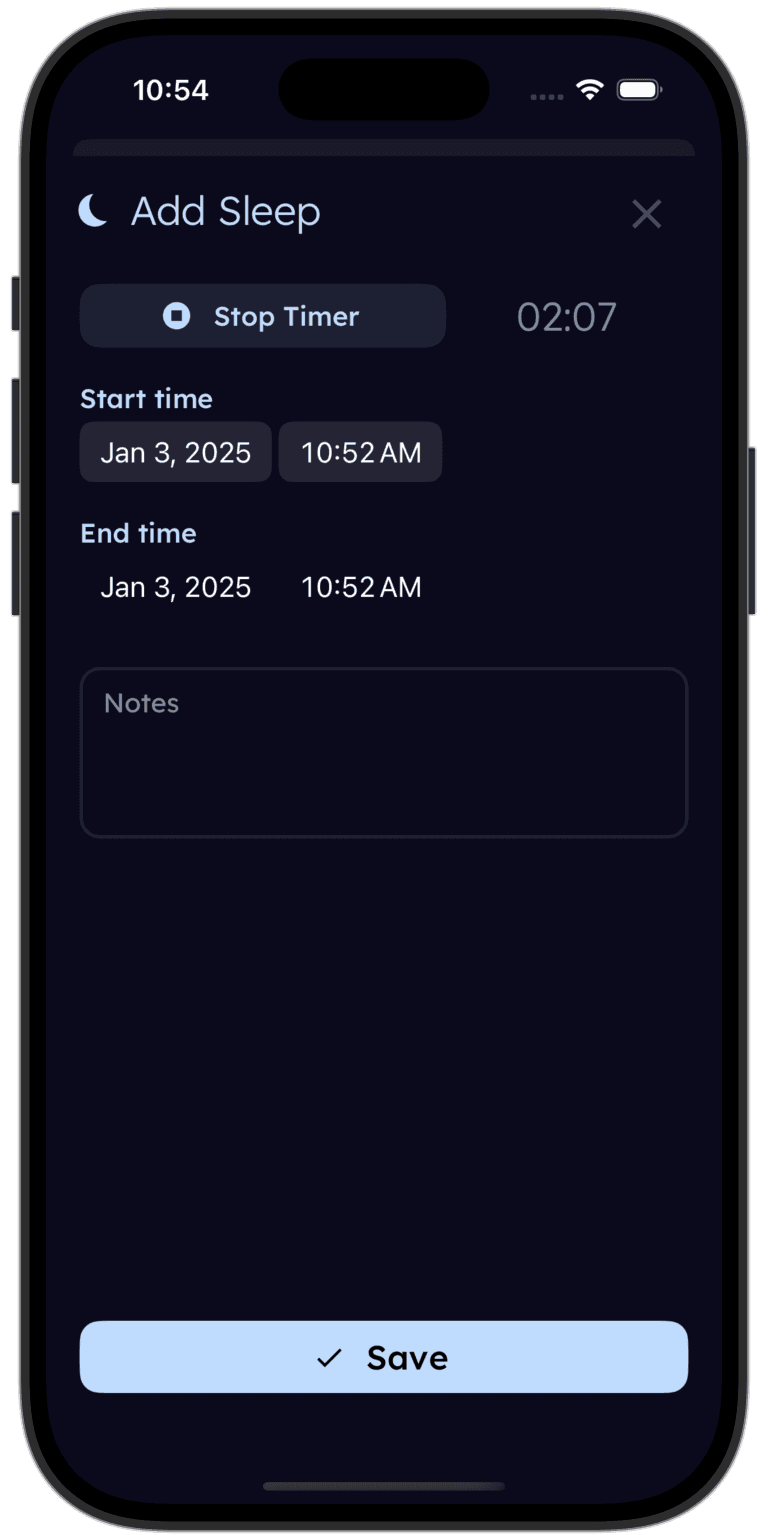
tinylog sleep tracking showing improvement over time

tinylog shows you night-by-night progress.

Log sleep through the training process and actually see the improvement in the data — fewer wake-ups, longer stretches, faster bedtimes. Evidence you can point to when you're questioning everything at 2 AM.

Download on the App StoreGet It On Google Play

How to Choose the Right Method for Your Family

Here's an honest framework for deciding.

There's no universally "best" method — but there might be a best one for your family. Ask yourself:

How much crying can you handle? Be honest. If you'll cave on night 2 of extinction, that's not a failure of character — it's useful information. Start with a gentler method and know you can always escalate later.

What's your baby's temperament? Some babies do better with a clean break (extinction methods). Others do better with parental presence (chair method). And some get more upset with check-ins because they want to be picked up (Ferber check-ins can backfire for these babies).

How much time do you have? If you need results fast — maybe you're going back to work next week — graduated or full extinction is faster. If you have time, gentler methods work just as well in the end.

What does your gut say? You know your baby. If a method feels deeply wrong to you, don't force it. Parental stress and inconsistency undermines any method. Pick something you can do wholeheartedly.

For more on what happens when training doesn't go as planned, see Sleep Regression While Sleep Training. For a gentler approach to night wakings, check out Night Wakings Without Sleep Training.

Common Sleep Training Pitfalls

  • Starting too early — wait until at least 4 months (adjusted age) and get pediatrician clearance
  • Switching methods every 2 days — pick one and commit for at least 5–7 nights before evaluating
  • Being inconsistent within a method — going in 'just this once' can reset progress and increase total crying
  • Not having both parents on the same page — discuss and agree before night 1
  • Trying to sleep train during a regression, illness, or major transition (teething, travel, new daycare)
  • Forgetting about naps — most methods work best when applied to both bedtime and naps
  • Not having a solid bedtime routine in place first — the routine is the foundation everything else builds on
  • Comparing your timeline to someone else's — your baby's temperament affects how long it takes

The #1 predictor of sleep training success isn't the method — it's consistency. Pick one approach, commit for at least a week, and resist the urge to change course at 3 AM.

Related Guides

Sources

Gradisar, M., et al. (2016). Behavioral Interventions for Infant Sleep Problems: A Randomized Controlled Trial. Pediatrics, 137(6).
Mindell, J. A., et al. (2006). Behavioral Treatment of Bedtime Problems and Night Wakings in Infants and Young Children. Sleep, 29(10).
Price, A. M., et al. (2012). Five-Year Follow-up of Harms and Benefits of Behavioral Infant Sleep Intervention. Pediatrics, 130(4).
Meltzer, L. J., & Mindell, J. A. (2014). Systematic Review and Meta-Analysis of Behavioral Interventions for Pediatric Insomnia. Journal of Pediatric Psychology, 39(8).
Hiscock, H., et al. (2007). Improving Infant Sleep and Maternal Mental Health: A Cluster Randomised Trial. Archives of Disease in Childhood, 92(11).
American Academy of Pediatrics. (2016). SIDS and Other Sleep-Related Infant Deaths: Updated 2016 Recommendations.
Want this comparison in your inbox?
We'll send you the full sleep training breakdown so you can discuss it with your partner and decide together.
Track progress so you know it's working.
Download ${appName} free — log sleep through the training process and see night-by-night improvement in the data.
Download on the App StoreGet It On Google Play