GUIDE

2 Month Old Sleep Schedule

Two months brings your baby's first real hints of a pattern — longer night stretches, more alert days, and the beginning of circadian rhythm.

Sleep is still unpredictable, but it's getting less chaotic. Here's what's changing, what's normal, and how to make the most of this transitional month.

Two Months: The Light at the End of the Newborn Tunnel

Two months brings a real shift — not a dramatic one, but a shift you can feel. Your baby is noticeably more alert, engaging with you through social smiles and cooing, and staying awake for slightly longer stretches during the day. They're starting to look like a tiny person with a personality, not just a sleeping-eating machine.

Sleep-wise, the biggest change is the beginning of circadian rhythm development. Your baby's brain is starting to produce melatonin, which means they're beginning to distinguish day from night in a real, biological way. You might notice that their longest sleep stretch (maybe 4 to 5 hours if you're lucky) is shifting to the nighttime hours. This is genuine progress.

But let's be honest: two months is also when the 6 to 8 week fussiness peak often hits full force. Evening crying, cluster feeding, and general crankiness can make this period feel harder than the newborn days, even though sleep is technically improving. If you're in the thick of it, know that this peaks and then gets better — usually significantly better by 3 months.

2 Month Old Sleep at a Glance
Total sleep (24 hrs)
14–16 hours
Nighttime sleep
8–10 hours (may get one 4–5 hr stretch)
Number of naps
4–5
Nap duration
30 minutes to 2 hours
Wake windows
60–90 minutes
These are research-based averages. Your baby might fall outside these ranges — watch their mood and growth, not just the numbers.

Sample 2 Month Old Schedule

A realistic example — your baby's day might look nothing like this, and that's fine.

What a day might look like

  1. Wake + feed
  2. Nap 1 (45 min–1.5 hrs)
  3. Wake + feed
  4. Nap 2 (45 min–1.5 hrs)
  5. Wake + feed
  6. Nap 3 (30 min–1 hr)
  7. Wake + feed
  8. Nap 4 (30–45 min)
  9. Wake + feed
  10. Catnap (20–30 min — optional)
  11. Feed + start winding down
  12. Last feed + down for the night

The wake windows matter more than the clock times. If your baby wakes at 7:30 AM instead of 6:30 AM, shift everything accordingly. At 2 months, you're still following your baby's cues — the schedule is just a rough framework.

Wake Windows at 2 Months

A 2-month-old can handle about 60 to 90 minutes of awake time between sleeps. This is slightly longer than a newborn, and you'll notice your baby can tolerate a bit more stimulation — tummy time, looking at toys, having a conversation with you (they'll coo back).

The first wake window of the day is still typically the shortest — around 60 minutes. Your baby wakes, eats, has a brief alert period, and may be ready to sleep again before you've finished your coffee. Mid-day wake windows stretch toward 75 to 90 minutes. By late afternoon, your baby may be overstimulated, and shorter wake windows often work better again.

How to tell if the wake window is too short: baby takes a long time to fall asleep, or pops awake after 5 to 10 minutes and seems alert. Too long: crying that escalates quickly, rubbing eyes, frantic movements, the "overtired scream" that's different from their normal fussing. When in doubt, go shorter.

Naps at 2 Months

Your baby will take 4 to 5 naps per day. Some babies start showing a preference for one longer nap (usually in the morning) and several shorter ones, but many are still completely unpredictable. Both patterns are normal.

Short naps (30 to 45 minutes) are biologically typical at this age. Your baby's sleep cycles are still immature, and they haven't learned to link one cycle to the next during daytime sleep. If every nap is 30 to 40 minutes, that's not a problem to solve — it's a developmental limitation that improves over the next 2 to 3 months.

Nap location at 2 months is still flexible. Bassinet, crib, your chest, a swing — whatever works. If you'd like to start practicing crib naps, the morning nap (when sleep pressure is highest) is usually the easiest one to transfer. But there's no urgency to make this shift yet.

Nighttime Sleep at 2 Months

This is where you'll see the most encouraging change. Your baby's melatonin production is beginning, and nighttime sleep is starting to consolidate. Many 2-month-olds can produce one longer stretch of 4 to 5 hours in the early part of the night, followed by 2 to 3 hour stretches for the rest.

Night feeds are still expected — typically 2 to 3 per night. Breastfed babies usually eat more frequently than formula-fed babies overnight, and both patterns are normal. These feeds serve a real nutritional purpose; your baby's stomach is still small and they're growing rapidly.

The "bedtime" is still likely late — 8 to 10 PM is common. Some families start seeing a natural shift toward 8 to 9 PM at the end of this month. If you notice your baby getting drowsy earlier in the evening, try gradually nudging bedtime earlier by 15 minutes every few days. But don't force it — the shift will happen naturally over the coming weeks.

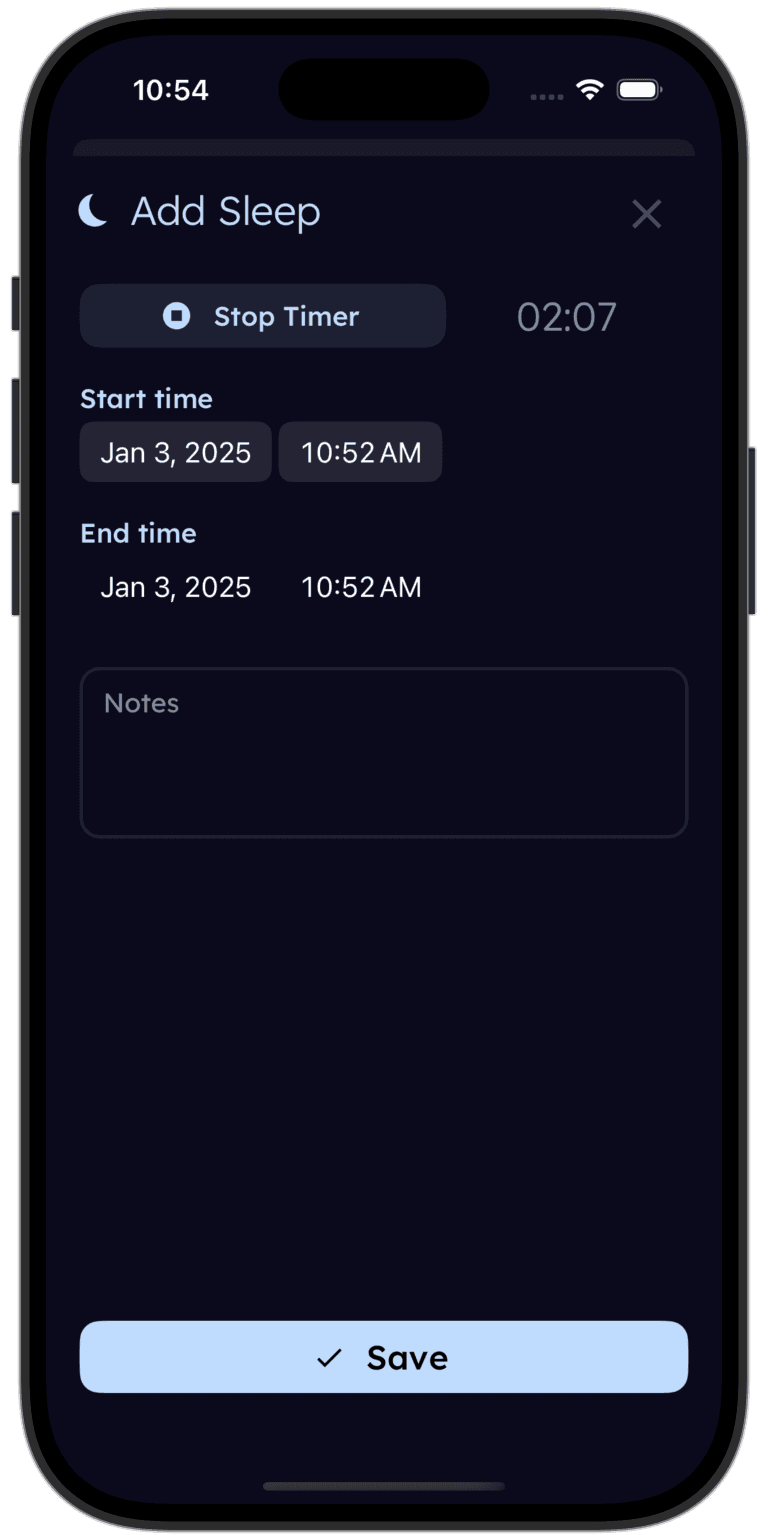
tinylog sleep tracking showing emerging 2 month old sleep patterns

The longest stretch is getting longer — can you see it?

Tracking sleep at 2 months reveals the pattern your exhausted brain can't detect: that 3-hour stretch quietly became 4 hours, and that first nap is starting to settle into a predictable time. Data shows you the progress before you feel it.

Download on the App StoreGet It On Google Play

What's Happening Developmentally

At two months, your baby's brain is undergoing a significant transformation. Social smiling appears — a real, intentional smile in response to your face, not just a reflex. They're beginning to coo and vocalize, tracking objects smoothly across their visual field, and showing a clear preference for faces and high-contrast patterns.

These cognitive advances directly impact sleep. More alertness during the day means more stimulation to process, and all that processing happens during sleep. You may notice that after a particularly stimulating morning (visitors, a new environment, lots of interaction), your baby sleeps harder — or has more difficulty settling because they're overstimulated.

The startle reflex is still present but starting to fade. Swaddling continues to help, but your baby is getting stronger and may break free more easily. This is also when some babies begin showing the earliest signs of rolling — pushing up during tummy time, arching their back, turning to one side. If you see any of these, start planning the swaddle transition. The AAP recommends stopping swaddling at the first signs of rolling.


Common Problems at 2 Months

Fighting the last nap of the day

By late afternoon, your 2-month-old has accumulated a full day of stimulation, and their immature nervous system may be overwhelmed. The last nap becomes a battle. If they won't take it, don't force it — move bedtime earlier instead. A 20-minute assisted catnap (in your arms, the swing, or while being worn) is perfectly acceptable to bridge the gap to bedtime.

The 6-week fussiness peak is hitting hard

If your baby is around 6 to 8 weeks, you may be at peak fussiness. Research by Dr. Ronald Barr shows that infant crying peaks at this age for nearly all babies, regardless of parenting approach. This isn't something you caused or can fully fix — it's a developmental phase. It will improve significantly by 3 to 4 months. In the meantime, cycle through your comfort tools: feeding, swaddling, white noise, gentle motion, pacifier. And tag in a co-parent or family member when you need a break.

Baby is escaping the swaddle

Your baby is getting stronger, and the basic swaddle wrap may not hold anymore. Try a zippered swaddle product with snug arm pockets — they're much harder to break out of. If your baby is showing any signs of rolling (pushing up during tummy time, rolling to side), it's time to start transitioning out of the swaddle even though it still helps with sleep. Safety comes first.

What No One Tells You About Sleep at 2 Months

The fussiness peak is scientifically documented — it's not you

The 6 to 8 week fussiness peak is a real, researched phenomenon documented by Dr. Ronald Barr's crying curve research. Your baby likely cries MORE at this age than at any other point in their life. It peaks and then gradually improves over the next 4 to 6 weeks. This is not caused by something you're doing wrong, and there's no feeding method, swaddle technique, or schedule that eliminates it entirely. Knowing it's temporary and universal can help you survive it.

Go to bed when your baby does — seriously

Your baby's longest sleep stretch at 2 months might be 4 to 5 hours, and it almost always happens in the first part of the night. If your baby falls asleep at 9 PM and you stay up until midnight, you'll miss the longest stretch entirely and only get the fragmented second half of the night. Going to bed when your baby does — even if it feels absurdly early — can be the difference between 4 hours of unbroken sleep and 2 hours.

When to Talk to Your Pediatrician

  • Your baby seems excessively sleepy and hard to wake for feeds
  • They're not producing at least 6 wet diapers per day
  • Weight gain has slowed significantly or stopped
  • You notice pauses in breathing, gasping, or color changes during sleep
  • Inconsolable crying that seems different from their usual fussy period — especially if accompanied by fever, vomiting, or changes in stool
  • You're feeling overwhelmed, anxious, or depressed — postpartum mood disorders are common at this stage and treatment helps

The 2-month well visit is a great time to discuss any sleep concerns. Write down your questions beforehand — sleep deprivation makes it easy to forget what you wanted to ask.

Related Guides

Sources

American Academy of Pediatrics (AAP). (2022). Healthy Sleep Habits: How Many Hours Does Your Child Need?
Mindell, J. A., et al. (2016). Development of infant and toddler sleep patterns. Journal of Sleep Research, 25(5), 508–516.
Galland, B. C., et al. (2012). Normal sleep patterns in infants and children: A systematic review. Sleep Medicine Reviews, 16(3), 213–222.
Barr, R. G. (1990). The normal crying curve: what do we really know? Developmental Medicine & Child Neurology, 32(4), 356–362.
Baby Sleep Information Source (BASIS), Durham University. Normal Infant Sleep Development. https://www.basisonline.org.uk

Medical Disclaimer

This guide is for informational purposes only and is not a substitute for professional medical advice. Always follow safe sleep guidelines (baby on their back, on a firm surface, in their own sleep space). Consult your pediatrician with any concerns about your baby's sleep.

Want this guide in your inbox?
We'll send you this guide so you can reference it during those middle-of-the-night feeds.
Spot the pattern before you feel it.
Download ${appName} free — track sleep in one tap and see your baby's emerging rhythm.
Download on the App StoreGet It On Google Play