
GUIDE
Elvie Double Electric vs. Spectra 9 Plus
Published on
Both are solid portable pumps, but they solve different problems. The Elvie is truly hands-free and fits inside your bra — perfect for pumping on the go. The Spectra 9 Plus is a more traditional portable pump with hospital-grade suction at a much lower price.
These two pumps represent opposite ends of the portable pumping spectrum. The Elvie Double Electric is a wearable, in-bra pump with app connectivity and silent operation. The Spectra 9 Plus is a lightweight, battery-powered portable pump with strong suction and a backflow protector. Your choice depends on whether you prioritize discretion or raw pumping performance.
Log sessions, output, and supply trends
Two Very Different Approaches to Portable Pumping
The Elvie Double Electric and Spectra 9 Plus are both portable breast pumps — but that is about where the similarities end. They are built around completely different ideas about what "portable" should mean.
The Elvie sits inside your bra. No tubes, no dangling bottles, no setup at your desk. You pop the cups in, press the button, and go about your life. It is the closest thing to pumping invisibly that exists right now.
The Spectra 9 Plus is a small, lightweight traditional pump. It has tubes, flanges, and bottles like any standard pump — but the unit is compact enough to toss in a bag and the battery lasts long enough to pump away from an outlet. Think of it as a hospital-grade pump that shrank.
Both can work beautifully. Which one is right for you depends on where you pump, how often, and what you are willing to spend.
For more on pumping output tracking, see our baby feeding chart.
| Feature | Elvie Double Electric | Spectra 9 Plus | What It Means |
|---|---|---|---|
| Type | Wearable, in-bra pump | Traditional portable pump | Fundamentally different form factors. Elvie is hands-free inside your bra. Spectra uses standard flanges and bottles. |
| Manufacturer | Elvie (UK-based) | Spectra Baby USA | Both are well-established breast pump brands with strong reputations among lactation consultants. |
| Max suction | ~200 mmHg | ~300 mmHg | Spectra is significantly stronger. More suction is not always better, but it gives you a wider usable range. |
| Noise level | Near-silent | Quiet hum (audible in a quiet room) | Elvie wins. You can pump during a video call and nobody will know. |
| Battery life | ~2.5 hours (built-in rechargeable) | ~3 hours (built-in rechargeable) | Both last through multiple sessions. Spectra has a slight edge on total battery time. |
| Weight | ~5.3 oz per cup | ~0.5 lb (pump unit only) | Elvie sits in your bra so you barely feel it. Spectra is light but still needs to sit on a surface. |
| Bottle capacity | 5 oz per side | Standard wide-neck bottles (up to 9 oz) | Spectra holds more milk before you need to stop. Elvie's 5 oz can fill up mid-session for high-output parents. |
| Backflow protector | Closed system (no backflow) | Yes — closed system with backflow protector | Both are closed systems, keeping milk safely separated from the motor and tubing. |
| App connectivity | Yes — Bluetooth app tracks session length, volume, and history | No app | Elvie's app is genuinely useful for tracking output trends. Spectra relies on manual tracking. |
| Flange sizes included | 24mm and 28mm shields included | 24mm and 28mm flanges included | Tie. Both include two sizes. You may still need a different size — proper flange fit is critical for output and comfort. |
| Parts and cleaning | Multiple small proprietary parts per cup | Standard parts, compatible with most wide-neck bottles | Spectra is simpler to clean and reassemble. Elvie's small pieces are a common complaint. |
| Insurance coverage | Covered by most plans (higher out-of-pocket likely) | Covered by most plans (often fully covered) | Spectra is more likely to be fully covered. Elvie's higher MSRP means you may owe the difference. |
Suction Power: The Biggest Performance Gap
This is where the Spectra 9 Plus pulls ahead on paper. It maxes out around 300 mmHg of suction, while the Elvie tops out around 200 mmHg. That is a meaningful difference.
But here is the thing most people get wrong about suction: more is not always better. Pumping at too-high suction can actually reduce output by compressing milk ducts. Most lactation consultants recommend finding the highest comfortable suction that maintains good milk flow — and for many parents, that sweet spot falls well within the Elvie's range.
Where the Spectra's extra suction really helps is during early supply building, when you are trying to establish production, or if you have a naturally lower supply that responds to stronger stimulation. For parents with established supply who are pumping to maintain, the Elvie's range is usually plenty.
The Hands-Free Factor
This is the Elvie's entire reason for existing, and honestly, it delivers.
With the Elvie, you can pump while making breakfast, holding your toddler, walking around the house, or sitting in a meeting. Nobody can tell you are pumping unless they are staring at your chest. The pump is quiet enough to use during phone calls.
The Spectra 9 Plus is portable but not hands-free. You still need to sit with flanges held in place (or use a pumping bra), and the tubes and bottles are visible. You need a surface to set the pump unit on. It is fine for pumping in a nursing room at work, but it is not something you can do while moving around.
If hands-free mobility is your primary need, the Elvie is the only real option between these two. If you mostly pump in a chair anyway, the Spectra gives you better output for less money.
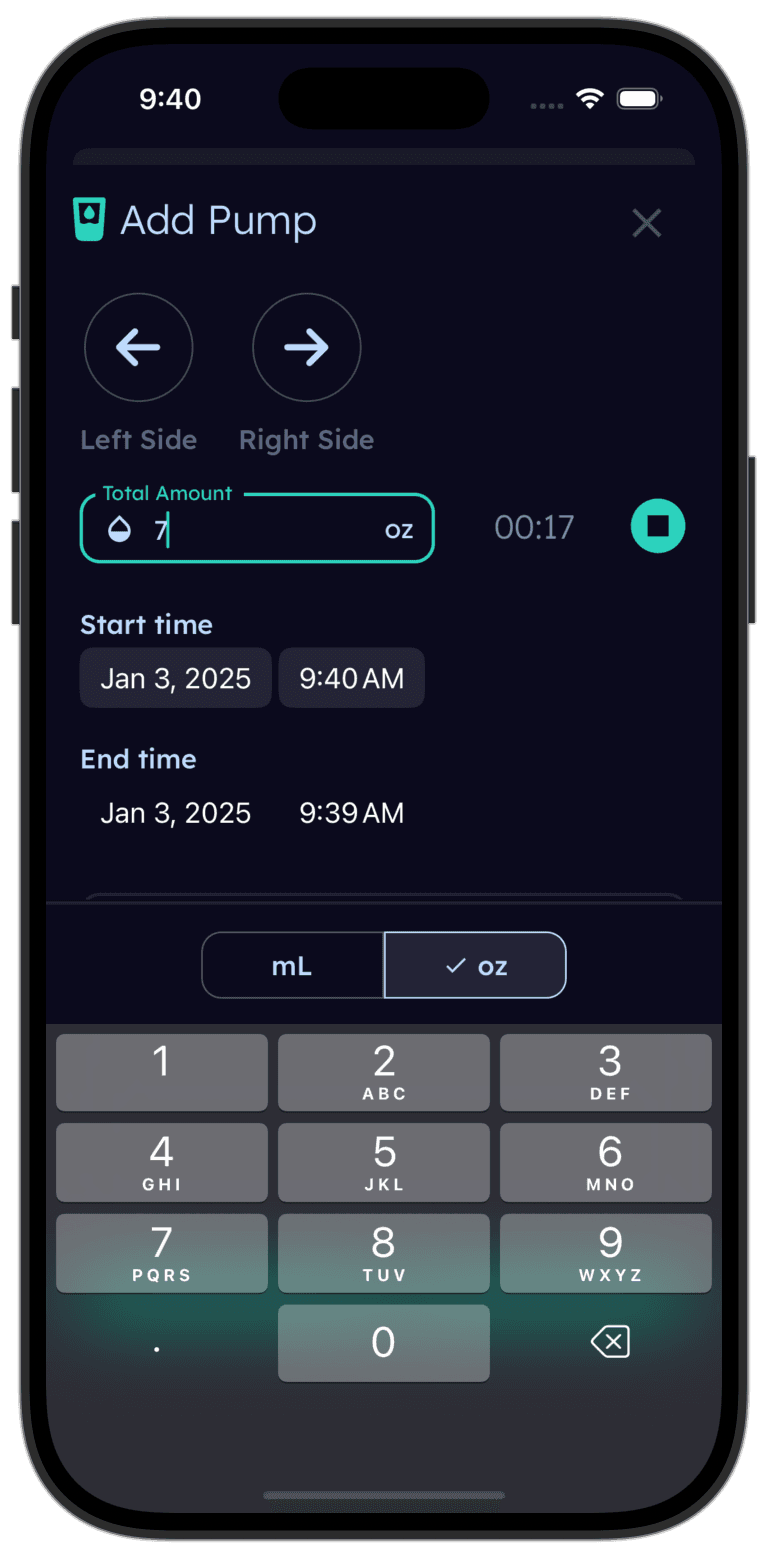
Tinylog tracks pumping sessions so you can see your supply trends.
Log pump output, track ounces over days and weeks, and spot supply changes before they become problems. Bring the data to your next lactation consultant visit.


Cleaning and Maintenance: One Clear Winner
The Spectra 9 Plus uses standard wide-neck flanges and bottles. You can replace parts at any baby store, wash everything in a standard bottle sterilizer, and reassemble without consulting a diagram.
The Elvie has proprietary parts — the hub, breast shield, valve, spout, bottle, and sealing ring — and they all need to fit together precisely to avoid leaks. Parents frequently report frustration with the tiny valve and the reassembly process, especially at 3 AM with wet hands. Replacement parts are also more expensive and harder to find locally.
This is one of those things that sounds minor until you are cleaning pump parts six times a day. Over months of pumping, the simplicity difference adds up.
| Product | Typical Price | Cost Per Session | Monthly Parts Cost |
|---|---|---|---|
| Elvie Double Electric Wearable Pump | $280–$350 | ~$0.56–$0.70 (over 500 sessions) | One-time purchase |
| Spectra 9 Plus Portable | $80–$120 | ~$0.16–$0.24 (over 500 sessions) | One-time purchase |
| Elvie replacement parts (6-month set) | $40–$60 | Varies | ~$7–$10/month |
Price: A Significant Gap
The Elvie Double Electric typically costs $280–$350. The Spectra 9 Plus runs $80–$120. That is a two-to-three-times price difference, and it does not include replacement parts.
Insurance can close the gap. Many plans cover both pumps, but the Spectra is more likely to be fully covered since its retail price often falls within standard insurance allowances. With the Elvie, you may owe $100–$200 out of pocket after insurance.
Replacement parts also cost more for the Elvie — proprietary shields, valves, and seals add up to roughly $40–$60 every six months. Spectra parts are standard, widely available, and cheaper.
If budget is a real concern, the Spectra 9 Plus gives you strong, reliable pumping performance at a fraction of the cost. The Elvie is a premium product with a premium price tag — you are paying for the wearable convenience.
Choose the Elvie Double Electric If
- You need to pump at work, in meetings, or around other people without anyone noticing
- Being hands-free while pumping is a top priority — you want to hold your baby, type, or cook
- You are willing to pay more for convenience and a wearable design
- You like app-based tracking for pumping sessions and output volume
- Noise is a dealbreaker — you need a pump that is essentially silent
- Your supply is established and you are maintaining rather than building
Choose the Spectra 9 Plus If
- You want the strongest suction possible in a portable pump
- Budget matters — you want great performance without the premium price tag
- You pump mostly at home or in a private space where hands-free wearability is less critical
- You prefer standard parts that are easy to clean, replace, and find at any baby store
- You are exclusively pumping and need a pump that can keep up with frequent, high-output sessions
Where to Buy
If hands-free wearable pumping is what you need, the Elvie Double Electric Wearable Pump (~$300) is the gold standard for invisible, silent pumping. It fits in your bra, connects to an app for session tracking, and lets you pump while doing literally anything else. The convenience factor is real.
If you want strong suction, reliable performance, and a much friendlier price, the Spectra 9 Plus Portable (~$100) punches well above its weight. Hospital-grade suction in a portable package, easy-to-find replacement parts, and a closed system with backflow protection — all for about a third of the Elvie's price.
Our honest take: if you can try both through insurance, do it. Your body responds differently to different pumps, and the "best" pump is whichever one gets you the most milk in the most comfortable way.
Tinylog earns a small commission on purchases made through these links, at no cost to you.
We've found promo.new handy for finding discounts on baby gear. Doesn't always have what you need, but it's worth a shot.
The Bottom Line
The Elvie Double Electric and Spectra 9 Plus are both good pumps that serve very different needs:
Elvie Double Electric wins on hands-free wearability, silent operation, app-based tracking, and discretion. It is the pump for parents who need to pump while moving through their day.
Spectra 9 Plus wins on suction power, price, part availability, ease of cleaning, and raw pumping output. It is the pump for parents who want maximum performance per dollar.
If you mostly pump at home or in a private room, the Spectra is hard to beat for the price. If you need to pump during meetings, while chasing a toddler, or anywhere you cannot sit with a traditional pump setup, the Elvie pays for itself in sanity.
If you are tracking pump output — and you should be, especially when building supply — Tinylog makes it easy to log sessions and watch your trends over time.
Related Guides
- Baby Feeding Chart — How much your baby should eat by age
- Breastfeeding Positions — Finding the hold that works for you and baby
- Baby Feeding Schedule — Sample feeding schedules from newborn through 12 months
- Cluster Feeding — What it is, why it happens, and how to survive it
Sources
- Elvie.com. "Elvie Stride — Product Specifications." 2026.
- Spectra-baby.com. "Spectra 9 Plus — Product Information." 2026.
- Journal of Human Lactation. "Breast Pump Suction Patterns and Milk Output." 2024.
- La Leche League International. "Choosing and Using a Breast Pump." llli.org, 2025.
- BabyGearLab. "Best Breast Pumps of 2026." babygearlab.com, 2026.
- Wirecutter (NY Times). "The Best Breast Pumps." nytimes.com, 2025.
- Mommyhood101. "Elvie vs. Spectra: Breast Pump Comparison." mommyhood101.com, 2025.
This guide is for informational purposes only. Breast pump choice is a personal decision based on your body, your schedule, and your feeding goals. If you are experiencing supply issues or pain while pumping, consult a board-certified lactation consultant.
Frequently asked questions
- Is the Elvie Double Electric worth the higher price?
- It depends on your lifestyle. If you need to pump at work, during meetings, or while caring for older kids, the hands-free wearable design can be worth every penny. If you pump mostly at home and have a dedicated space, the Spectra 9 Plus delivers comparable output for about half the cost.
- Which pump has stronger suction?
- The Spectra 9 Plus has stronger maximum suction at around 300 mmHg compared to the Elvie's approximately 200 mmHg. Stronger suction does not always mean more milk — comfort and proper flange fit matter more — but some parents with lower supply find the extra suction helpful.
- Can I use either pump with insurance coverage?
- Both pumps are eligible for insurance coverage under most plans, though the Elvie's higher retail price means you may owe a larger out-of-pocket difference. Check with your insurance provider and a DME supplier to confirm coverage specifics for each model.
- How loud is the Elvie compared to the Spectra 9 Plus?
- The Elvie is nearly silent — most people nearby will not notice it running. The Spectra 9 Plus is quiet for a traditional pump but still produces an audible hum. If pumping discreetly during calls or meetings matters to you, the Elvie wins this one easily.
- Which pump is easier to clean?
- The Spectra 9 Plus has fewer proprietary parts and uses standard bottles and flanges, making cleaning straightforward. The Elvie has more small components — the hub, valve, bra shield, bottle, and seals — and parents often report that the tiny pieces are fiddly to reassemble. Both require cleaning after every session.
- Can I use these pumps exclusively, or do I need a hospital-grade pump too?
- Many parents use the Spectra 9 Plus as their only pump with good results, especially since its suction rivals some hospital-grade models. The Elvie works well for maintaining supply but may not be strong enough for exclusively pumping parents who need maximum output. If you are EP-ing, the Spectra or a dedicated hospital-grade pump is typically the safer bet.