
Newborn period is non-negotiable
For the first 4-6 weeks, feed on demand. Full stop. Newborns need 8-12 feedings per day to establish milk supply and regain birth weight. Scheduling can wait.
GUIDE
Published on
Both approaches can work well. On-demand feeding is recommended for newborns, but many families gradually introduce loose routines as their baby grows. The best approach often evolves over time.
The real question isn't which is better — it's which fits your baby's age, temperament, and your family's needs right now.
See patterns in your baby's feeding data
“Instead of feeding preterm infants at scheduled times or prescribed intervals, it's important to feed them based on the signs and cues the infants show that indicate they're hungry and ready to feed.”
 Dr. Ani Jacob, DNP, Clinical Assistant Professor, Adelphi University College of Nursing and Public Health
The on-demand vs. scheduled feeding debate is one of the oldest in parenting, and it generates strong opinions on both sides. Strict scheduling advocates point to the benefits of predictability and structure. On-demand advocates argue that babies know best. The truth, as usual, is more nuanced.
The AAP and WHO both recommend responsive, on-demand feeding for newborns. This is well-supported by evidence — unrestricted early feeding helps establish breastmilk supply, supports weight gain, and aligns with newborn stomach capacity (which is tiny and empties quickly). A 2012 study in the European Journal of Public Health (Iacovou & Sevilla) found that demand-fed babies scored slightly higher on academic tests at ages 5, 7, 11, and 14, though the authors cautioned that confounding factors could explain part of this difference.
But "on demand" doesn't mean "forever without any rhythm." As babies grow, their stomach capacity increases, feeding efficiency improves, and natural patterns emerge. By 3-4 months, most babies fall into a loose routine on their own. The question isn't really demand vs. schedule — it's how much structure you overlay on your baby's natural tendencies, and when you start.
| Aspect | On Demand | Parent-Led Routine |
|---|---|---|
| How it works | Feed whenever baby shows hunger cues — rooting, sucking hands, fussing. No set times. | Feed at regular intervals (e.g., every 2.5-3 hours) with flexibility for hunger cues between. |
| Best age range | Essential for newborns (0-6 weeks). Works well through the first year. | More practical starting around 3-4 months when natural patterns emerge. |
| Milk supply (breastfeeding) | Frequent, unrestricted nursing supports supply establishment. Strongly recommended early on. | Rigid early scheduling can reduce milk supply. Looser routines after supply is established are generally fine. |
| Parental predictability | Low — you don't know when the next feeding will be, making planning harder. | Higher — you can roughly plan your day around feeding windows. |
| Weight gain | Strong evidence of adequate weight gain when hunger cues are followed. | Also supports weight gain when routine is flexible and baby's cues are respected. |
| Caregiver ease | Requires the primary feeder to be available and responsive. Harder to hand off. | Easier for multiple caregivers to follow a predictable plan. |
On-demand feeding is especially important in the first 6 weeks for breastfeeding families.
These challenges are real but usually temporary — patterns emerge naturally as baby grows.
A flexible routine that respects hunger cues offers the best of both worlds.
The key word is 'routine,' not 'rigid schedule.' Flexibility matters.
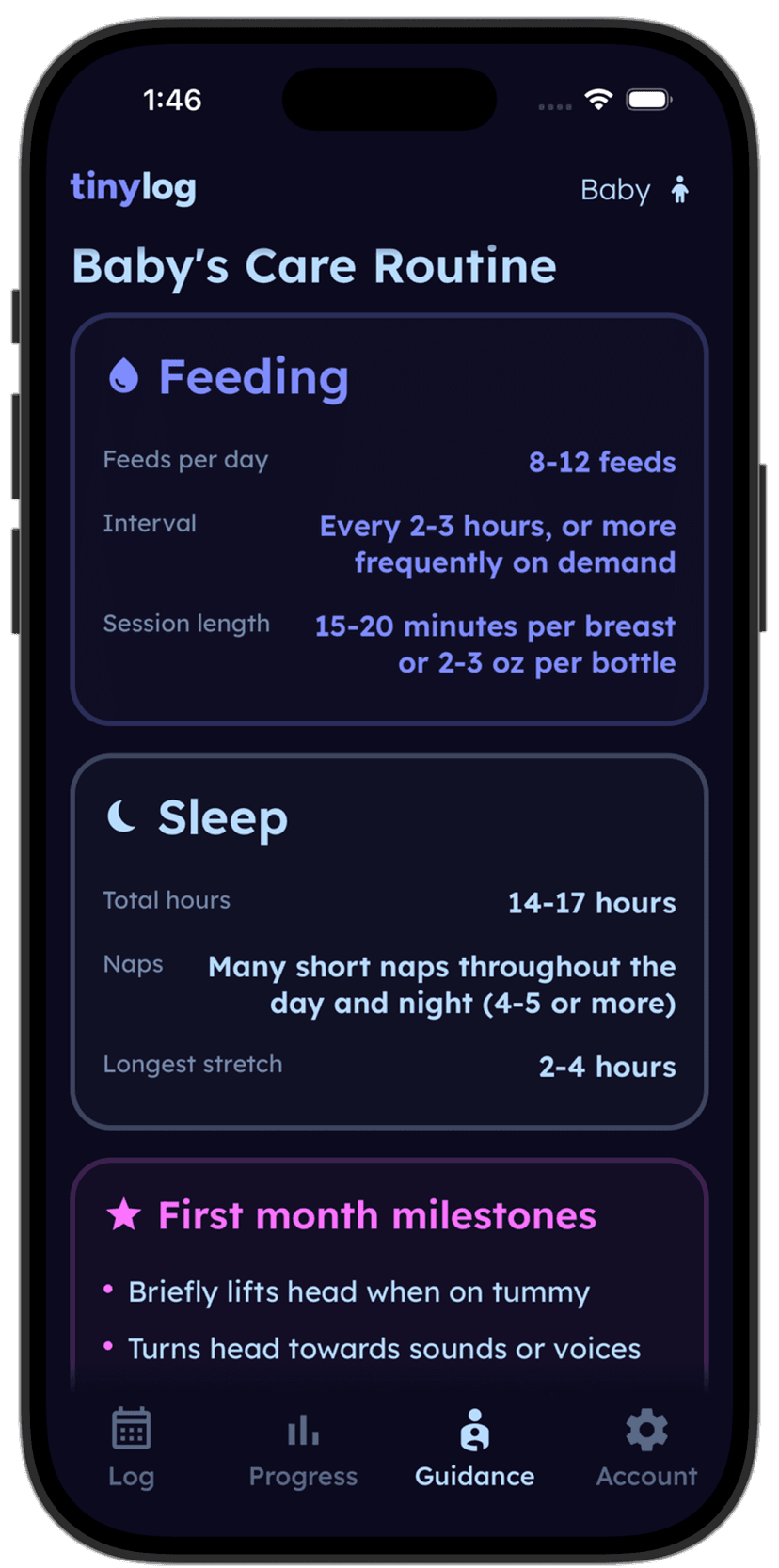
Tinylog logs every feeding so you can see your baby's natural rhythm emerge. Whether you're demand feeding or following a routine, the patterns in your data reveal what's actually working.


In practice, the binary choice between "pure on-demand" and "strict schedule" is a false one. Most experienced parents and pediatricians recommend what's often called "responsive routine" — a loose framework based on your baby's emerging patterns, with flexibility to respond to hunger cues, growth spurts, and off days.
This looks like knowing your baby generally eats every 3 hours, but feeding at 2.5 hours if they're showing hunger cues and not stressing if they go 3.5 hours. It means having a general shape to your day without white-knuckling a clock. It means recognizing that cluster feeding in the evening is normal and not a sign your schedule is "failing." If you're unsure whether your baby is getting enough, our guide on signs of adequate intake can help you gauge.
The research supports this middle ground. A 2016 review in Maternal & Child Nutrition found that responsive feeding — where parents recognize and respond to both hunger and satiety cues within a predictable mealtime structure — was associated with healthier eating behaviors and weight outcomes compared to either fully unstructured or highly controlled approaches.
Start with your baby's age. Under 6 weeks? On demand, no question. Between 6 weeks and 3 months? Still primarily on demand, but you'll start noticing natural patterns. After 3-4 months? You can lean into those patterns and build a flexible routine if that helps your household function.
Consider your feeding method. Breastfeeding mothers should be especially cautious about early scheduling because milk supply is regulated by demand. A rigid 4-hour schedule in the first month can tank your supply. Formula-fed babies tend to fall into predictable patterns slightly earlier because formula digests more slowly.
Think about your own needs. If the unpredictability of on-demand feeding is causing significant stress, a loose routine might improve your mental health — and a less-stressed parent is a better parent. If scheduling feels controlling and you'd rather follow your baby's lead, that's valid too.
For the first 4-6 weeks, feed on demand. Full stop. Newborns need 8-12 feedings per day to establish milk supply and regain birth weight. Scheduling can wait.
Even within a routine, always prioritize hunger cues over timing. A routine is a guide, not a rule. If your baby is hungry 30 minutes early, feed them.
Most babies develop their own loose pattern by 3-4 months. Logging feedings for a week often reveals a schedule you didn't know existed — one that came from your baby, not a book.
This guide is for informational purposes only and is not a substitute for professional medical advice. Consult your pediatrician for guidance specific to your baby.