
GUIDE
Lovevery The Play Gym vs. Tiny Love Black & White Gymini Magical Tales
Published on
Both are thoughtfully designed activity gyms. Lovevery is the premium pick with Montessori-backed zones and organic materials. Tiny Love delivers surprising developmental value at one-third the price. Your baby will thrive on either one.
Activity gyms are one of the first real 'toys' your baby will use — and they actually matter for development. Tummy time, reaching, batting, tracking high-contrast patterns — all of it builds the neural pathways your pediatrician keeps mentioning. Lovevery and Tiny Love take very different approaches to the same goal: getting your baby engaged from day one.
Log development and play activities
Two Very Different Activity Gyms — Same Goal
OK so real talk. Your baby is going to lie on the floor and swat at dangling things. That is the core product here. But the way they swat, what they are looking at while they swat, and how long the gym stays relevant — that is where Lovevery and Tiny Love diverge pretty hard.
Lovevery The Play Gym is the one your friend with the beautifully curated nursery has. It looks like it belongs in an interior design magazine. It also happens to be genuinely well thought out from a developmental standpoint, with five zones that introduce new skills as your baby grows.
Tiny Love Black & White Gymini Magical Tales is the one that actually understands what a two-week-old baby can see. High contrast everywhere. Bold patterns. It leans into newborn vision science in a way that is honestly kind of impressive for a $50 product.
Both will give your baby something to do during those early months when they are basically a potato with opinions. The question is which approach fits your family.
| Feature | Lovevery The Play Gym | Tiny Love Gymini Magical Tales | What It Means |
|---|---|---|---|
| Price | ~$140 | ~$50 | Tiny Love costs roughly one-third the price. That's a real difference. |
| Design philosophy | Montessori-inspired, minimalist, stage-based | High-contrast, sensory-rich, stimulation-forward | Different approaches. Lovevery is curated simplicity. Tiny Love is engaging variety. |
| Age range | 0–12 months (5 developmental zones) | 0–5 months (primary use) | Lovevery grows with your baby longer. Tiny Love covers the critical early months well. |
| Materials | Organic cotton batting, sustainably sourced wood bar | Polyester fabric, plastic arches | Lovevery wins on material quality. Tiny Love is standard baby product construction. |
| Newborn visual design | Includes high-contrast cards and black-and-white zone | Entire gym is high-contrast black and white | Tiny Love goes all-in on newborn vision science. Every inch is optimized for those early weeks. |
| Activities included | 5 learning zones with detachable toys and play guide | 18 activities including music, lights, textures | Tiny Love packs more raw activities. Lovevery curates fewer, more intentional ones. |
| Music / electronics | None — intentionally electronics-free | Yes — electronic music and light module | Preference call. Montessori folks love the no-electronics approach. Some babies love the music. |
| Tummy time support | Includes tummy time pillow and propped cards | Tummy time with overhead visual stimulation | Lovevery's tummy time setup is more thoughtfully designed with the wedge pillow. |
| Portability | Folds but bulky — not a travel gym | Compact fold, adjustable arches, lightweight | Tiny Love is easier to move around the house or bring to grandma's. |
| Play guide included | Yes — detailed stage-by-stage guide with activity ideas | Basic instruction manual | Lovevery's play guide is genuinely helpful, especially for first-time parents. |
| Washing | Mat is machine washable, wood bar wipe-clean | Machine washable mat, toys wipe-clean | Tie. Both handle the inevitable spit-up situation. |
The $90 Question
Let's address the obvious thing first. Lovevery costs almost three times more than Tiny Love. So what are you actually paying for?
Materials. Organic cotton batting, sustainably sourced wood for the play bar, and finishes that meet stricter standards than required. You are paying for what touches your baby's skin and what might end up in their mouth.
Longevity. Lovevery is engineered for 12 months of use across five developmental zones. The batting unzips. Cards swap in and out. The whole thing transforms as your baby grows from back-lying to sitting to pulling up. Tiny Love's sweet spot is really those first five months.
The play guide. This is honestly the sleeper feature. Lovevery includes a booklet that walks you through exactly what to do with the gym at each stage. If you are a first-time parent at 3 AM wondering whether your seven-week-old should be doing something different during tummy time, that guide is worth more than you'd expect.
What you are NOT paying for: electronics. Lovevery intentionally skips music, lights, and batteries. Whether that is a feature or a bug depends entirely on your parenting philosophy.
Newborn Vision: Where Tiny Love Quietly Wins
Here is something most activity gym marketing glosses over. Newborns cannot see pastel colors. Their vision at birth is roughly 20/400, and they can focus about 8–12 inches from their face. High-contrast black and white patterns are what their developing visual cortex actually processes.
Tiny Love built their entire product around this fact. The Black & White Gymini Magical Tales is high contrast everywhere — the mat, the arches, the hanging toys. For those first 6–8 weeks when your baby is learning to track objects and focus, this thing is basically a visual buffet optimized for their exact developmental stage.
Lovevery includes high-contrast cards and has a designated black-and-white zone, but it is one element of a larger design. Tiny Love made it the whole point.
Once your baby hits 2–3 months and starts seeing color, this advantage fades. But those first weeks of visual tracking practice? They actually matter. And Tiny Love nails them.
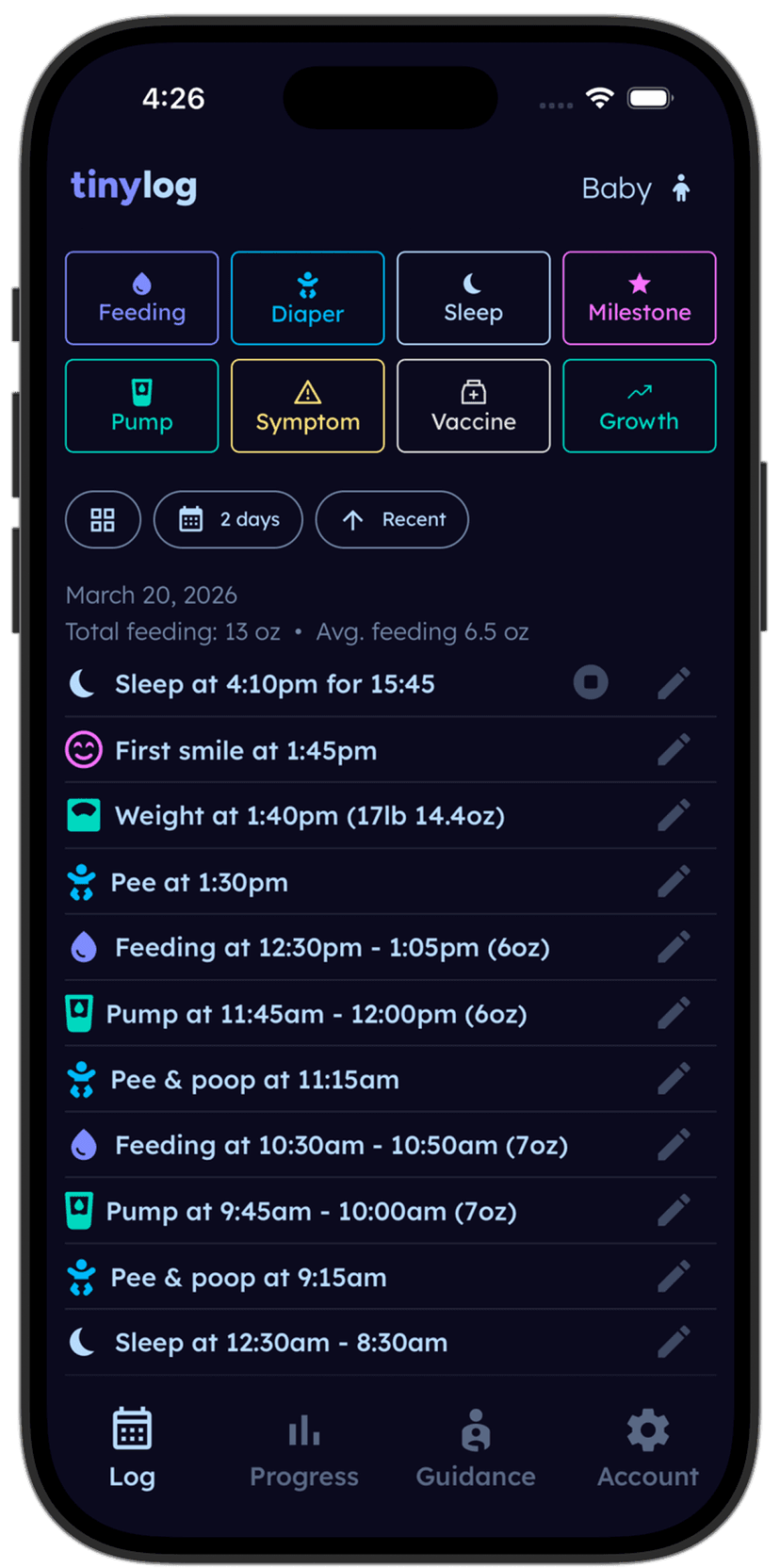
Tinylog tracks milestones so you can spot patterns.
Log tummy time, track reaching and batting milestones, note what activities your baby engages with most. See development unfold week by week.


The Montessori Factor
Lovevery is built on Montessori principles. Practically, this means a few things:
Less is more. Instead of 18 activities competing for attention, Lovevery presents a few intentional options at a time. The idea is that babies learn more deeply when they are not overstimulated.
Natural materials. Wood instead of plastic. Cotton instead of polyester. This is partly an aesthetic choice and partly a philosophy about what textures babies should explore.
No electronics. Montessori emphasizes real-world sensory input over artificial stimulation. No batteries, no music chips, no flashing lights. Your baby interacts with real textures, real sounds (crinkle fabric, wooden rings), and real visual patterns.
If this philosophy resonates with you, Lovevery is the only activity gym on the market that actually commits to it at this level. If you think your baby would benefit from some musical engagement and variety, Tiny Love's approach is totally valid too. There is no peer-reviewed evidence that one philosophy produces better outcomes than the other at this age.
| Product | Typical Price | Daily Cost (Amortized) | Monthly Cost (Amortized) |
|---|---|---|---|
| Lovevery The Play Gym | $130–$150 | ~$0.37–$0.41/day over 12 months | ~$11–$13 (amortized) |
| Tiny Love Black & White Gymini Magical Tales | $40–$55 | ~$0.27–$0.37/day over 5 months | ~$8–$11 (amortized) |
Price Per Use: The Math That Changes the Conversation
Activity gyms feel expensive until you do the math on daily use.
If you use the Lovevery Play Gym every day for 12 months, you are paying about 38 cents a day. For a toy that your baby will actively engage with during awake windows, tummy time, and independent play, that is genuinely cheap entertainment.
Tiny Love at $50 over five months of daily use comes out to about 33 cents a day. Slightly less per day, but also fewer total months of relevance.
Both are dramatically cheaper per use than most baby gear you will buy. That $300 swing your baby uses for three months? $3.33 a day. The activity gym is a bargain by comparison.
A few ways to bring the cost down even more:
- Registry. Activity gyms are a perfect registry item. Grandparents love gifting them.
- Resale. Lovevery holds its value shockingly well on Facebook Marketplace and Mercari. You can often recoup 50–60% of the purchase price.
- Sales. Tiny Love regularly drops to $35–$40 during Prime Day, Black Friday, and Target sales. Lovevery rarely discounts.
Choose Lovevery The Play Gym If
- You want premium, organic materials touching your baby's skin
- The Montessori approach resonates with you and you want curated, intentional play
- You plan to use the gym through the full first year, not just the newborn phase
- You value the detailed play guide and want stage-by-stage activity suggestions
- You prefer no electronics, no music, no blinking lights — just real-world sensory input
Choose Tiny Love Gymini Magical Tales If
- Budget matters and you want strong developmental value without the premium price
- Your baby is a newborn and you want something optimized specifically for those first weeks
- You like the idea of music and lights as part of the sensory experience
- You need something portable that folds down easily and moves room to room
- You want more activities and stimulation options out of the box
- You are not sure your baby will even like a play gym and want to test the waters at a lower price point
Where to Buy
The Lovevery The Play Gym (~$140) is available directly from Lovevery and through select retailers. It is the gold standard for parents who want a Montessori-aligned, organic-material, grows-with-baby activity gym that lasts the full first year. The play guide alone makes it worth serious consideration for first-time parents who want a roadmap for developmental play.
The Tiny Love Black & White Gymini Magical Tales (~$50) is widely available on Amazon, Target, and Buy Buy Baby. It punches way above its price point on newborn visual development, packs 18 activities into a compact and portable design, and is a legitimately smart buy if you want strong developmental stimulation without the premium markup. Frequently goes on sale.
Honestly? If budget allows, some parents buy both — Tiny Love for the first two months when the high-contrast design is maximally useful, then transition to Lovevery for the remaining first year. Not necessary, but not a bad strategy either.
Tinylog earns a small commission on purchases made through these links, at no cost to you.
Looking for a discount? Try checking promo.new. It doesn't always find what you're looking for, but when it does, it works like a charm.
The Bottom Line
Both of these activity gyms will give your baby a great start. The differences are real but they are about philosophy and budget more than developmental outcomes.
Lovevery The Play Gym is the pick if you want premium materials, Montessori principles, and a product that grows with your baby through the entire first year. The play guide is genuinely useful. The organic cotton and sustainably sourced wood feel good under tiny hands. It is expensive, but the per-day cost is low and the resale value is strong.
Tiny Love Black & White Gymini Magical Tales is the pick if you want maximum newborn-optimized visual stimulation at a price that does not make you wince. The high-contrast design is backed by real vision science, the 18 activities keep things interesting, and the compact fold means it actually moves around your house with you.
Your baby does not care about the price tag. They care about having something interesting to look at, reach for, and eventually grab. Both gyms deliver on that front.
If you are tracking your baby's developmental milestones — first reach, first grab, first time they track an object across midline — Tinylog makes it easy to log these moments and see the progression over time.
Related Guides
- Best Tummy Time Toys — Top picks to make tummy time less miserable
- Baby Milestones — What to expect month by month in the first year
- 3-Month-Old Sleep Schedule — Awake windows and nap timing for when activity gyms get the most use
- Tummy Time — How much, how often, and what to do when your baby hates it
Sources
- Lovevery.com. "The Play Gym — Product Information." 2026.
- TinyLove.com. "Black & White Gymini Magical Tales — Product Information." 2026.
- American Academy of Ophthalmology. "Infant Vision Development." aao.org, 2025.
- Faiola, E. et al. "High-Contrast Stimuli and Newborn Visual Development." Journal of Pediatric Ophthalmology, 2024.
- Montessori, M. "The Absorbent Mind." Holt Paperbacks, 1995 (reprint).
- Consumer Reports. "Best Baby Play Mats and Activity Gyms." consumerreports.org, 2026.
- BabyGearLab. "Best Baby Play Gyms and Activity Mats." babygearlab.com, 2026.
This guide is for informational purposes only. Activity gym selection is a personal preference based on your family's values and budget. Always supervise your baby during activity gym use and follow the manufacturer's safety guidelines.
Frequently asked questions
- Is the Lovevery Play Gym worth $140?
- It depends on your budget and values. The Lovevery Play Gym uses organic cotton batting, sustainably sourced wood, and comes with a stage-by-stage play guide. If you plan to use it daily for 12 months and appreciate Montessori-inspired design, the per-use cost is quite low. If budget is tight, the Tiny Love Gymini offers strong developmental stimulation at a fraction of the price.
- Which activity gym is better for newborns?
- Both work well from birth. Tiny Love's high-contrast black and white design is specifically optimized for newborn vision (which can only see about 8–12 inches in high contrast). Lovevery also includes high-contrast cards and a black-and-white zone, but Tiny Love makes it the entire visual theme.
- Can you use the Lovevery Play Gym for tummy time?
- Yes. The Lovevery Play Gym includes a tummy time pillow and detachable cards that prop up at baby's eye level during tummy time. The mat itself is padded enough for comfortable floor play.
- Does the Tiny Love Gymini play music?
- Yes. The Tiny Love Black & White Gymini Magical Tales includes an electronic music module with lights. Lovevery is intentionally screen-free and electronics-free, relying on tactile and visual stimulation instead.
- How long will my baby use an activity gym?
- Most babies actively use activity gyms from birth through 5–6 months. The Lovevery Play Gym is designed to convert for use up to 12 months with its different developmental zones and detachable toys. The Tiny Love Gymini is primarily useful during the 0–5 month window.
- Are activity gyms safe for unsupervised play?
- No. Activity gyms are designed for supervised play only. Never leave your baby unattended on an activity gym, especially during tummy time or once they start rolling.