
GUIDE
Nanit Pro vs. Infant Optics DXR-8 PRO
Published on
Both are top-tier baby monitors with very different philosophies. Nanit Pro is a Wi-Fi camera with AI-powered sleep tracking and breathing wear analytics. Infant Optics DXR-8 PRO is a dedicated FHSS monitor with zero internet dependency and interchangeable lenses. Your pick depends on whether you want smart data or bulletproof reliability.
The Nanit Pro and Infant Optics DXR-8 PRO are two of the highest-rated baby monitors on the market, but they take fundamentally different approaches to keeping an eye on your little one. Nanit connects to your home Wi-Fi and layers on AI sleep analytics. Infant Optics uses a closed radio signal and a dedicated parent unit. Neither approach is wrong — they just serve different priorities.
Log naps, wake windows, and sleep patterns
Two Different Philosophies for Watching Your Baby
The Nanit Pro and Infant Optics DXR-8 PRO are both excellent baby monitors, but they solve the problem of watching your sleeping baby in completely different ways.
Nanit Pro is a smart camera. It mounts above the crib, connects to your Wi-Fi, and streams to your phone. Layer on a subscription and you get AI sleep tracking, breathing wear analytics, and historical sleep data. It is a data machine wrapped in a baby monitor.
Infant Optics DXR-8 PRO is a dedicated monitor. It uses a closed radio signal, comes with its own parent unit, and never touches the internet. There is no app, no subscription, and no cloud. It just shows you your baby.
Neither approach is objectively better. It depends on what keeps you sane at 2 AM.
For more on building healthy sleep habits, see our baby sleep schedule guides.
| Feature | Nanit Pro | Infant Optics DXR-8 PRO | What It Means |
|---|---|---|---|
| Connection type | Wi-Fi (2.4 GHz) | FHSS closed signal (no Wi-Fi needed) | Infant Optics works during internet outages. Nanit requires stable Wi-Fi. |
| Video resolution | 1080p HD | 720p HD | Nanit is noticeably sharper, especially when zooming in. |
| Night vision | Infrared (clear, no visible light) | Infrared (clear, no visible light) | Tie. Both provide solid night vision without disturbing the baby. |
| Viewing device | Smartphone app (iOS / Android) | Dedicated 5-inch parent unit | Nanit lets you watch from anywhere. Infant Optics keeps a screen always ready in your hand. |
| Sleep tracking | AI-powered sleep analytics (with subscription) | None | Nanit gives you detailed sleep reports, trends, and tips. Infant Optics is a camera only. |
| Breathing monitoring | Breathing wear band (wearable, with subscription) | None | Nanit's breathing wear tracks motion-based breathing patterns. Not a medical device. |
| Camera lenses | Fixed wide-angle bird's-eye lens | Interchangeable optical lens system (normal, wide-angle, zoom) | Infant Optics lets you physically swap lenses for different rooms. Nanit's overhead mount gives a full crib view. |
| Two-way audio | Yes | Yes | Tie. Both let you talk to your baby from the parent unit or app. |
| Range | Anywhere with internet | Up to 700 ft (line of sight) | Nanit works from the office or grandma's house. Infant Optics is limited to your home but has zero lag. |
| Security / hacking risk | AES 256-bit encryption, TLS — low risk with good practices | No internet connection — zero hacking risk | Infant Optics wins on privacy by design. Nanit is well-secured but still internet-connected. |
| Multi-camera support | Unlimited cameras via app | Up to 4 cameras on one parent unit | Both support multiple cameras. Nanit is more flexible for larger setups. |
The Fundamental Tradeoff: Smart Data vs. Rock-Solid Reliability
This is the decision that should drive your choice.
Nanit Pro gives you data that no dedicated monitor can match. Its AI tracks every sleep session — when your baby fell asleep, how long they slept, how many wakings happened, and trends over weeks and months. The breathing wear band (a small wearable your baby wears over their clothes) tracks motion-based breathing patterns and alerts you if something looks off. These are genuinely useful features for anxious new parents.
The catch: all of that depends on your Wi-Fi. If your router hiccups at 3 AM, you temporarily lose your feed. There can be a 1–2 second delay on the stream. And the best features require a subscription that runs $50–$100 per year.
Infant Optics DXR-8 PRO gives you a feed that just works. The closed FHSS signal is independent of your home network. There is zero latency between the camera and your parent unit. It will not go down because your ISP had an outage. There is nothing to hack because there is nothing on the internet.
The catch: you get video, audio, and temperature readings. That is it. No sleep data, no trends, no breathing analytics, no remote viewing from outside your home.
Video Quality and Camera Design
The Nanit Pro shoots at 1080p, which is noticeably sharper than the Infant Optics DXR-8 PRO's 720p feed. If you are the type of parent who zooms in to check whether your baby's chest is rising, the extra resolution matters.
Nanit mounts overhead using a wall mount or floor stand, giving you a bird's-eye view straight down into the crib. This perspective makes it easy to see your baby's position and movement.
Infant Optics takes a different approach with its interchangeable optical lens system. You get a standard lens in the box and can buy wide-angle and zoom lenses separately. This is genuinely useful if you move the camera between rooms or want a tighter shot in a smaller nursery. The 5-inch dedicated screen is also larger than most phones when held at arm's length during a groggy night feed.
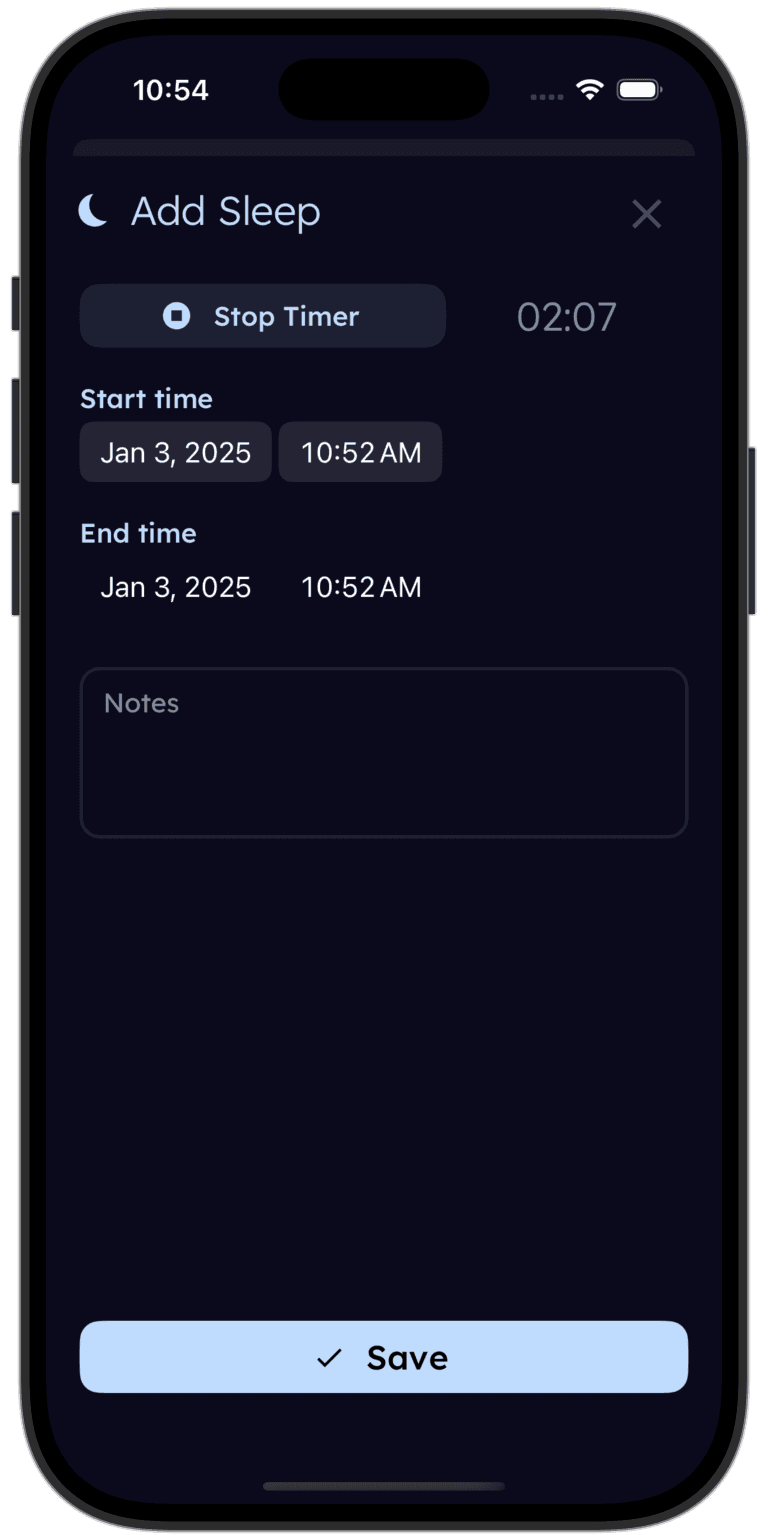
Tinylog tracks sleep so you can spot patterns.
Log naps and nighttime sleep, track wake windows, note regressions, and share your baby's sleep data with your pediatrician.


Security and Privacy: A Real Concern
This is not a hypothetical worry. Wi-Fi baby monitors have been hacked before. Strangers have spoken through cameras into nurseries. It is a small risk with modern encryption, but it is not zero.
Nanit Pro uses AES 256-bit encryption and TLS to protect its data streams. As long as you use a strong Wi-Fi password, enable two-factor authentication on your Nanit account, and keep firmware updated, the risk is very low. But "very low" is not "zero."
Infant Optics DXR-8 PRO has zero hacking risk because the signal never touches the internet. The FHSS (Frequency-Hopping Spread Spectrum) signal is encrypted and hops between frequencies, making interception extremely difficult even locally.
If privacy is a hard requirement for you, the Infant Optics approach is fundamentally more secure.
| Product | Typical Price | Cost Type | Monthly Cost |
|---|---|---|---|
| Nanit Pro Camera (with wall mount) | $180–$230 | One-time | $0 (live view only) |
| Nanit Insights subscription | $50–$100/year | Recurring | ~$5–$8/month |
| Infant Optics DXR-8 PRO (camera + parent unit) | $165–$200 | One-time | $0 — no subscription ever |
Cost: Upfront vs. Ongoing
The sticker prices are close — roughly $180–$230 for the Nanit Pro camera and $165–$200 for the Infant Optics DXR-8 PRO with its parent unit.
But the real cost difference is what happens after you buy it.
The Infant Optics DXR-8 PRO costs nothing after the initial purchase. No subscription, no cloud storage fees, no account required. Buy it, plug it in, done.
The Nanit Pro works for basic live viewing without a subscription, but the features that make it special — sleep tracking, breathing wear data, sleep tips, video history — all require Nanit Insights, which runs about $50–$100 per year depending on the plan. Over two years of use, that adds $100–$200 to the total cost.
If you are buying the Nanit specifically for its smart features (and most people are), factor in the subscription cost. If you just want a good camera and would skip the subscription, the Infant Optics gives you more for less.
Choose Nanit Pro If
- You want detailed AI sleep tracking with trends, tips, and historical data
- Remote access matters — you want to check the feed from work or while traveling
- You prefer viewing on your phone rather than carrying a separate device
- You are interested in breathing wear monitoring for extra peace of mind
- Your home has strong, reliable Wi-Fi coverage in the nursery
- You do not mind paying an ongoing subscription for premium features
Choose Infant Optics DXR-8 PRO If
- Reliability is your top priority — you want a feed that works during internet outages
- You are not comfortable with a Wi-Fi connected camera in your baby's room
- You prefer a dedicated parent unit that is always on and ready
- You want interchangeable lenses to customize the view for different rooms
- You want zero recurring costs after the initial purchase
Where to Buy
If you want smart sleep tracking and remote viewing, the Nanit Pro (~$200 for the camera) is the most data-rich baby monitor you can get. The AI sleep analytics and breathing wear are genuinely useful for new parents who want to understand their baby's patterns. Just budget for the annual subscription.
If you want a monitor that works every single time with zero internet dependency, the Infant Optics DXR-8 PRO (~$180 for camera and parent unit) is the gold standard for dedicated monitors. No subscription, no cloud, no hacking risk, and interchangeable lenses are a nice bonus. It does one thing and does it extremely well.
Our honest advice: think about what will stress you out more — not having sleep data, or worrying about Wi-Fi reliability at 3 AM. That answer picks your monitor.
Tinylog earns a small commission on purchases made through these links, at no cost to you.
Tip: check promo.new before purchasing. It's hit or miss depending on the product, but when it hits, you'll be glad you checked.
The Bottom Line
The Nanit Pro and Infant Optics DXR-8 PRO are both outstanding baby monitors that consistently rank at the top of every review list. The differences are philosophical:
Nanit Pro wins on video quality, sleep tracking intelligence, breathing wear monitoring, remote access, and the ability to review historical sleep data over time. It is the monitor for parents who want information.
Infant Optics DXR-8 PRO wins on connection reliability, privacy, zero latency, no recurring costs, and the peace of mind that comes from a system completely independent of your internet. It is the monitor for parents who want simplicity.
There is no wrong choice. Both will let you watch your baby sleep (and not sleep) with clarity and confidence. Pick the philosophy that matches how you parent.
If you are tracking your baby's sleep — which is genuinely helpful for spotting regressions and adjusting wake windows — Tinylog makes it easy to log naps, bedtimes, and patterns over time.
Related Guides
- 1-Month-Old Sleep Schedule — What to expect and how much sleep your newborn needs
- 4-Month Sleep Regression — Why it happens and how to get through it
- Baby Feeding Chart — How much your baby should eat by age
- Safe Sleep Guidelines — ABCs of safe sleep and reducing SIDS risk
Sources
- Nanit.com. "Nanit Pro Smart Baby Monitor — Product Information." 2026.
- InfantOptics.com. "DXR-8 PRO Baby Monitor — Product Information." 2026.
- Consumer Reports. "Best Baby Monitors of 2026." consumerreports.org, 2026.
- Wirecutter (NYT). "The Best Baby Monitors." nytimes.com/wirecutter, 2026.
- BabyGearLab. "Best Baby Monitor Reviews." babygearlab.com, 2026.
- AAP. "Reduce the Risk of SIDS." healthychildren.org, 2025.
- FCC.gov. "Wireless Baby Monitor Safety Information." fcc.gov, 2025.
This guide is for informational purposes only. Baby monitor choice is a personal preference based on your family's needs. Neither the Nanit breathing wear nor any consumer baby monitor is a medical device. Always follow AAP safe sleep guidelines regardless of which monitor you use.
Frequently asked questions
- Is the Nanit Pro or Infant Optics DXR-8 PRO more reliable?
- The Infant Optics DXR-8 PRO uses a closed FHSS radio signal that does not depend on Wi-Fi or internet. It will work during internet outages and has virtually zero latency. The Nanit Pro requires a stable Wi-Fi connection and can experience brief lag or dropouts if your network is congested. For pure reliability, Infant Optics wins.
- Does the Nanit Pro require a subscription?
- The Nanit Pro camera works without a subscription for live viewing. However, the sleep tracking insights, breathing wear analytics, tips, and video history require a Nanit Insights subscription starting around $5/month or $50/year. Without it, you lose most of the smart features that differentiate the Nanit from other monitors.
- Can the Infant Optics DXR-8 PRO connect to my phone?
- No. The DXR-8 PRO uses a dedicated parent unit with a 5-inch display. It does not connect to Wi-Fi or your smartphone. This is by design — it keeps the feed private and eliminates hacking risk. If remote phone access is a must, the Nanit Pro is the better fit.
- Which monitor has better video quality?
- The Nanit Pro streams at 1080p HD, which is sharper than the Infant Optics DXR-8 PRO's 720p feed. Both have infrared night vision. The Nanit's overhead bird's-eye view also provides a wider perspective of the crib. For raw video clarity, Nanit wins.
- Are Wi-Fi baby monitors safe from hacking?
- Any device connected to the internet carries some risk. Nanit uses AES 256-bit encryption and TLS to secure its streams. Using a strong Wi-Fi password, enabling two-factor authentication, and keeping firmware updated reduces risk significantly. The Infant Optics DXR-8 PRO has zero hacking risk because it never touches the internet.
- Can I use either monitor with multiple cameras?
- Yes. The Nanit Pro app supports multiple cameras across rooms, viewable from your phone. The Infant Optics DXR-8 PRO parent unit supports up to four cameras and can display split-screen or cycle between them. Both scale well for families with multiple children.