GUIDE

Newborn Growth Spurts Week by Week

Newborns grow faster in their first 12 weeks than at any other time in their lives. Growth spurts at weeks 1-3, 6, and 10-12 drive most of the chaos.

The first three months of your baby's life are a whirlwind of feeding, sleeping, and growing. Your newborn will roughly double their birth weight by 4-5 months, and much of that happens in intense bursts. Here's what to expect week by week — so you can stop googling 'is this normal' at 3 AM.

The First 12 Weeks: What's Happening

Your newborn's first three months are the most intense period of growth they'll ever experience. They'll gain roughly 5-7 ounces per week, grow about an inch per month in length, and their brain will be growing so fast you can practically watch their head get bigger.

This growth doesn't happen at a steady, linear pace. It happens in bursts — intense periods of 2-5 days where your baby eats like they've never seen food before, sleeps erratically, and tests your patience. These are growth spurts, and they're a sign that everything is working exactly right.

The major newborn growth spurts typically happen around weeks 1-3, week 6, and weeks 10-12. But every baby is different — your baby might spurt a week early or late, or skip one entirely. The timeline below is a guide, not a contract.


Newborn Growth: Week by Week
Week 1
WeightInitial loss of 5-10% birth weight (normal)
Feeding8-12 feeds/day, colostrum transitioning to mature milk by day 3-5
Sleep16-18 hours/day in short bursts
What to KnowFocus on feeding frequency, not schedule. Expect 1 wet diaper per day of life (1 on day 1, 2 on day 2, etc.).
Week 2
WeightRegaining birth weight — gaining 5-7 oz/week
FeedingGROWTH SPURT — feeding every 1-2 hours, cluster feeding begins
SleepStill 16-17 hours but more night waking for feeds
What to KnowFirst major growth spurt. Baby is placing orders for a bigger milk supply. This is intense but normal.
Week 3
WeightSteady gain of 5-7 oz/week
FeedingStill frequent — may ease slightly from the week 2 peak
SleepStarting to have slightly longer sleep stretches (2-3 hours)
What to KnowGrowth spurt may continue or taper. Some babies have a distinct week 3 spurt.
Weeks 4-5
WeightConsistent gain, usually above birth weight now
Feeding8-12 feeds/day, evening cluster feeding is common
SleepMay get one 3-4 hour stretch at night
What to KnowA brief lull between spurts. Feeding starts to feel slightly more predictable — enjoy it.
Week 6
WeightAccelerated gain during the biggest early spurt
FeedingMAJOR GROWTH SPURT — feeding constantly, fussy at breast/bottle
SleepSleep disrupted, nap resistance, more night waking
What to KnowThe 6-week spurt is the most intense. Overlaps with peak fussiness period. Feels relentless. Lasts 3-5 days.
Weeks 7-9
WeightSteady gain of 5-7 oz/week
FeedingFeeds may space out slightly, 7-10 feeds/day
SleepImproving — some babies start getting a longer night stretch
What to KnowRecovery period after the 6-week spurt. Baby becomes more alert and social. First smiles appear.
Weeks 10-12
WeightAnother acceleration for some babies
FeedingPossible growth spurt — increased feeds, fussiness
SleepVariable — some disruption if spurting, improvement if not
What to KnowSome babies have a clear 3-month spurt, others don't. By 12 weeks, many babies have nearly doubled their birth weight.
Every baby's timeline is slightly different. Use this as a rough guide, not a strict schedule. If your baby doesn't match a particular week exactly, that's completely normal.
tinylog feed tracking showing newborn feeding pattern

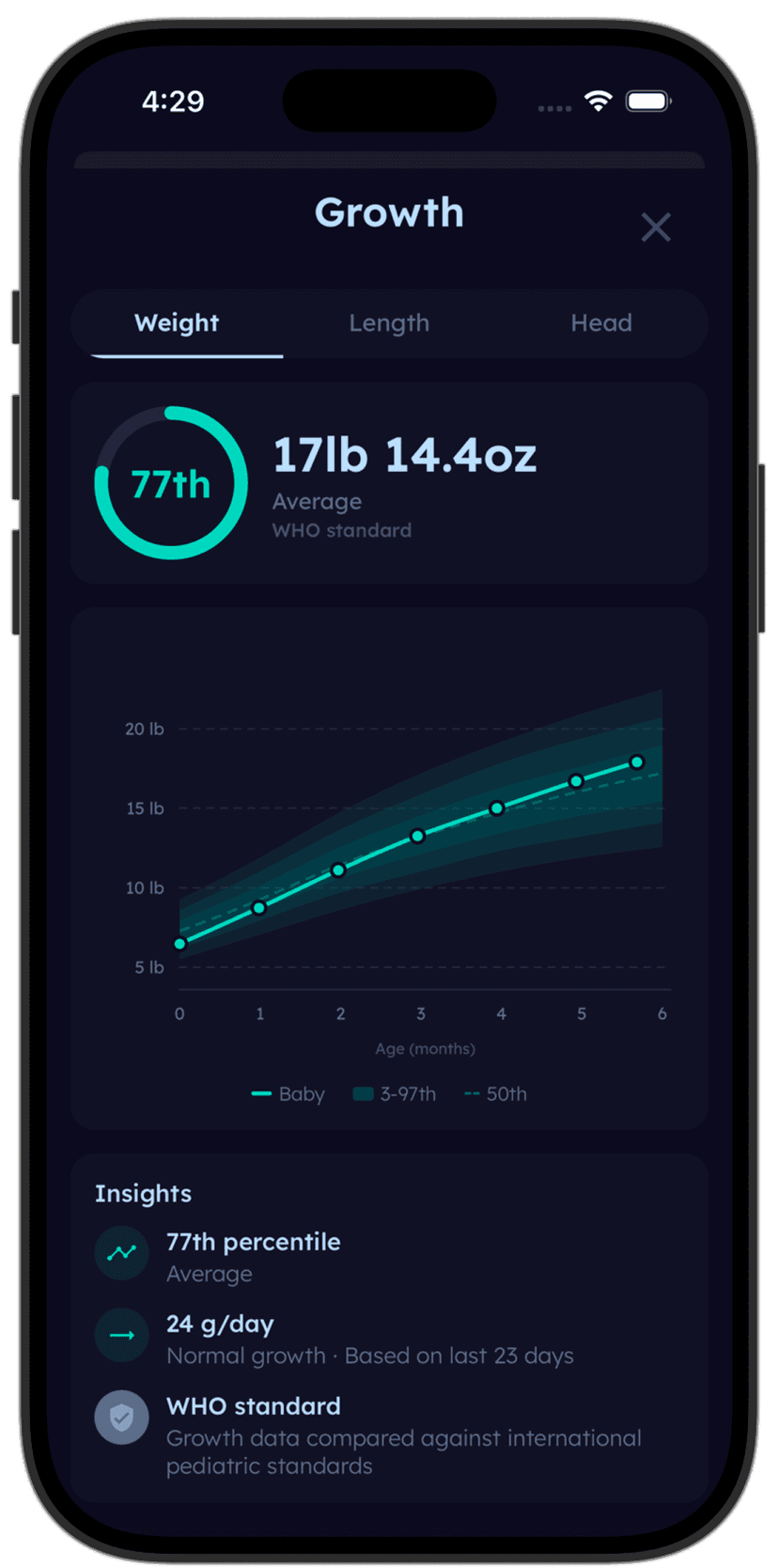
In the early weeks, tracking feeds and diapers gives you real data instead of anxious guessing.

tinylog makes feed logging fast — one tap to start, one tap to stop. When your pediatrician asks 'how often is the baby eating?' at the 2-week visit, you'll have an actual answer instead of a sleep-deprived guess.

Download on the App StoreGet It On Google Play

Average Growth in the First 3 Months

  • Average weight gain: 5-7 ounces (150-200 grams) per week in the first 3 months
  • Average length gain: about 1 inch (2.5 cm) per month in the first 3 months
  • Head circumference growth: about 0.5 inch (1.25 cm) per month
  • By 2 months: most babies have gained 2-3 pounds above birth weight
  • By 3 months: most babies weigh about 50% more than their birth weight
  • These are averages — your baby may gain more or less in any given week and still be perfectly healthy

These averages come from WHO growth standards. Your baby may gain more or less in any given week — what matters is the overall trend upward.

The Breastfeeding Supply Question

The most common worry during newborn growth spurts — especially for breastfeeding parents — is: "Do I have enough milk?"

The answer is almost always yes. When your baby feeds constantly during a growth spurt, they're not signaling that your supply is inadequate. They're building your supply. Breast milk works on a supply-and-demand system: more nursing = more milk production. The growth spurt is the demand signal; increased supply follows within 24-48 hours.

This is worth repeating because the anxiety is real: constant feeding during a growth spurt is not a sign of low supply. It's the mechanism that creates more supply.

For more on feeding frequency at each stage, see our baby feeding chart or our cluster feeding guide.

What You Might Not Know

Frequent nursing IS the solution, not the problem

When your newborn wants to eat every hour during a growth spurt, it can feel like your milk isn't enough. The opposite is true — frequent nursing is exactly how your body knows to make more milk. Supply and demand. The more your baby nurses, the more your body produces. This system works.

Your baby's stomach grows fast

At birth, your baby's stomach is the size of a marble (5-7ml). By day 3, it's a ping-pong ball (22-27ml). By day 10, it's an egg (60-80ml). Frequent small feeds in the first week aren't a sign of hunger — they're a reflection of tiny stomach capacity.

Colostrum is enough in the first days

Before your milk 'comes in' (day 3-5), your baby gets colostrum — small amounts of incredibly nutrient-dense liquid. A few milliliters per feed is normal and sufficient in those early days. You don't need to supplement with formula unless your pediatrician specifically recommends it.

Weight loss in the first week is expected

Almost all newborns lose 5-10% of their birth weight in the first few days. This is normal and expected — they're shedding extra fluid from birth. What matters is that they start gaining by day 4-5 and are back to birth weight by 10-14 days.

Signs Your Newborn Is Getting Enough

  • 6+ wet diapers per day after day 5
  • 3-4 dirty diapers per day (may decrease after the first month — that's normal too)
  • Baby seems satisfied after most feeds — relaxed and content
  • You can hear swallowing during breastfeeding
  • Baby is alert and active during wake windows
  • Gaining weight steadily at checkups

If you're seeing most of these, your baby is eating enough — even if it feels like they're never satisfied during a growth spurt.

When to Call Your Pediatrician

  • Baby hasn't regained birth weight by 2 weeks
  • Fewer than 4 wet diapers in 24 hours after day 5
  • Baby is excessively sleepy and hard to wake for feeds
  • No audible swallowing during breastfeeding
  • Weight loss exceeds 10% of birth weight
  • Baby seems lethargic or has a weak cry

These signs warrant a call to your pediatrician. They don't necessarily mean something is seriously wrong, but they need professional assessment.

The Bottom Line

The newborn period is intense. Your baby is growing faster than they ever will again, and growth spurts are the mechanism that makes it happen. They're exhausting, they disrupt whatever fragile routine you've established, and they can make you question whether you're doing everything right.

You are. Feed on demand, track the basics if it helps you feel grounded, and remember that every growth spurt ends. Your baby will be bigger on the other side, your milk supply will catch up, and things will settle — until the next one. But even the next one ends too.

Related Guides

Sources

  • World Health Organization (WHO) Child Growth Standards
  • American Academy of Pediatrics (AAP) — Newborn feeding and growth guidelines
  • Academy of Breastfeeding Medicine — Clinical protocols for breastfeeding management
  • Lampl M, Johnson ML. "Infant growth in length follows prolonged sleep and increased naps." Sleep, 2011.
  • Neville MC, et al. "Lactation and neonatal nutrition." Journal of Nutrition, 2001.

This guide is for informational purposes only and is not a substitute for professional medical advice. If you have concerns about your baby's growth, please consult your pediatrician.

Get this guide in your inbox.
We'll send you this week-by-week reference so you can check it during those 3 AM feeds.
Track feeds and weight in the early weeks — the data is genuinely useful.
Download tinylog free — one-tap logging for feeds, diapers, and weight.
Download on the App StoreGet It On Google Play