GUIDE

Painful Breastfeeding

Pain during breastfeeding is common, but it's not something you should just push through. Most causes are fixable once you know what you're dealing with.

Somewhere along the way, 'breastfeeding is natural' got translated to 'breastfeeding shouldn't hurt.' It often does at first — but persistent pain is your body telling you something needs to change.

Why Breastfeeding Pain Is Undertreated

There are two unhelpful extremes in breastfeeding pain conversations. One says "breastfeeding should never hurt — if it does, something is wrong." The other says "it hurts at first, just push through it." Neither is accurate, and both cause harm.

The reality: some initial nipple tenderness is common and typically resolves within the first 1-2 weeks as your tissue adapts. But pain beyond that — pain that makes you curl your toes, pain that continues after the feed, pain that gets worse instead of better — is a signal. It's telling you something specific is going on, and that something is almost always fixable.

Too many parents suffer through weeks of painful breastfeeding because they were told it was "normal," or because they feel like they should be tougher, or because they don't know that help exists. You are not supposed to cry through feeds. If you are, something needs to change — and it usually can.

Breastfeeding Pain: Cause, Symptoms, and What to Do
Shallow latch
What It Feels LikePinching, biting pain during the entire feed
When It HappensEvery feed, from the start
How to Fix ItRelatch deeper — baby needs more breast, not just nipple. See our latch guide.
When to See a ProIf repositioning doesn't help after a few days
Tongue tie
What It Feels LikeSharp pain, poor seal, clicking sounds
When It HappensEvery feed, doesn't improve with repositioning
How to Fix ItEvaluation by IBCLC + pediatrician or ENT
When to See a ProIf latch is consistently painful despite correct technique
Thrush (yeast infection)
What It Feels LikeBurning, stabbing pain that continues after feeding
When It HappensDuring and after feeds, may come on suddenly after pain-free period
How to Fix ItAntifungal treatment for both parent and baby simultaneously
When to See a ProAs soon as you suspect it — white patches in baby's mouth, shiny/pink nipples
Vasospasm
What It Feels LikeBurning, throbbing pain after feeding; nipple turns white then blue then red
When It HappensAfter feeds, especially in cold environments
How to Fix ItWarmth immediately after feeding, avoiding cold exposure to nipples
When to See a ProIf warmth doesn't help — some cases need medication (nifedipine)
Engorgement
What It Feels LikeBreasts feel hard, hot, heavy; baby can't latch on firm tissue
When It HappensDays 3-5 typically, or after a missed feed
How to Fix ItHand express before latching to soften areola, cold compresses between feeds
When to See a ProIf engorgement doesn't resolve within 48 hours or you develop fever
Mastitis
What It Feels LikeHot, red, painful area on breast; flu-like symptoms; fever
When It HappensCan occur anytime, often follows a clogged duct
How to Fix ItContinue nursing or pumping, rest, fluids; antibiotics if symptoms worsen or fever persists
When to See a ProWithin 24 hours of flu-like symptoms or fever above 101°F
Clogged (plugged) duct
What It Feels LikeTender lump in one area, aching during letdown
When It HappensUsually one breast, one spot
How to Fix ItContinue feeding from affected side, gentle massage toward nipple, warm compresses before feeds
When to See a ProIf it doesn't clear within 48 hours or you develop fever
Bleb (milk blister)
What It Feels LikeSharp, focused pain at a specific point on the nipple
When It HappensDuring feeds, localized to one spot
How to Fix ItMoist heat, continue nursing, gently clear after warm compress
When to See a ProIf it recurs or you can't clear it — do NOT pop it with an unsterilized needle
This is a starting point, not a diagnosis. If you're not sure what's causing your pain, an IBCLC can assess in person — which is always more accurate than a chart.

Normal: Pain That Will Resolve on Its Own

  • Mild nipple tenderness in the first 7-10 days that improves daily
  • A brief intense sensation at latch-on (first 10-15 seconds) that fades quickly
  • Uterine cramping during feeds in the first week (oxytocin-triggered — painful but normal)
  • Tingling or prickling sensation during letdown (not painful, just weird)
  • Some breast fullness or mild discomfort before a feed that resolves with nursing

These should be improving by the end of the first week. If they're getting worse instead of better, the cause is probably fixable — see the table above.

Not Normal: Pain That Needs Attention

  • Pain during the entire feed, not just at latch-on
  • Pain that gets worse over the first week instead of better
  • Cracked, bleeding, or blistered nipples
  • Burning or shooting pain that continues after the feed ends
  • Nipple that looks flattened, creased, or white after feeding
  • Fever, chills, or red streaks on the breast
  • A hard, tender lump that doesn't resolve after feeding
  • Pain so bad you're dreading the next feed or crying through it

Any of these is reason enough to call a lactation consultant or your doctor. You don't need to wait until it's unbearable.

How to Fix the Most Common Causes

Fix latch first — always

Before chasing exotic diagnoses, check the basics. A shallow latch causes the majority of breastfeeding pain. Break the seal, reposition, and relatch until baby has a deep, asymmetric latch with lips flanged. See our latch guide for step-by-step instructions.

Apply expressed breast milk to sore nipples

After feeding, express a few drops of breast milk and let it air dry on your nipples. Breast milk has natural antibacterial and healing properties. This is one of the few nipple pain remedies with actual evidence behind it.

Use medical-grade lanolin or all-purpose nipple ointment

A thin layer of purified lanolin (like Lansinoh) or a compounded all-purpose nipple ointment (APNO — a prescription that combines an antibiotic, antifungal, and steroid) can protect cracked nipples and promote moist wound healing. You don't need to wipe it off before nursing.

Cold compresses between feeds, warm before feeds

Cold gel pads after feeding reduce inflammation and pain. Warm compresses before feeding improve flow and make latching easier when you're engorged. Simple, but it makes a difference when you're doing it 10 times a day.

Consider a temporary pumping break

If your nipples are severely cracked or damaged, pumping for 24-48 hours (instead of direct nursing) gives them a chance to heal without losing supply. Use a properly fitted flange — the wrong size causes its own pain. This is a strategic pause, not giving up.

For detailed latch technique, see our breastfeeding latch guide. For position adjustments that can help with pain, see breastfeeding positions.

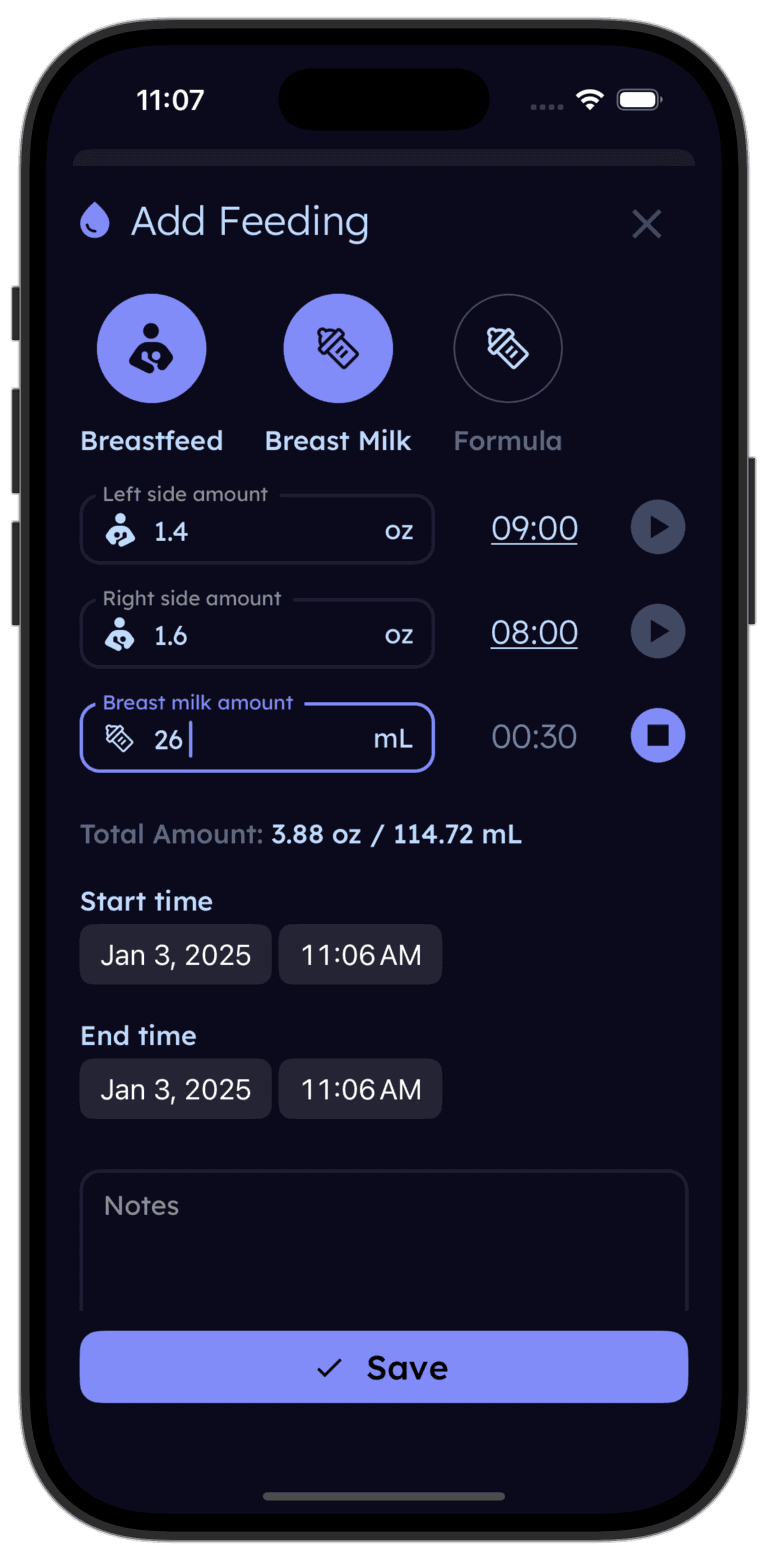
tinylog nursing session log with notes tracking breastfeeding pain

When you tell an IBCLC 'it hurts,' the first thing they'll ask is: which side? Every time? How long into the feed? Having that data ready means better answers faster.

tinylog lets you log nursing sessions with notes — so you can track pain by side, by feed, and over time. That's the kind of data that helps a professional pinpoint the cause.

Download on the App StoreGet It On Google Play

What the Evidence Actually Says

"Breastfeeding pain is always a latch problem." Mostly true, but not always. A 2020 ABM clinical protocol on persistent breastfeeding pain notes that while shallow latch is the most common cause, other factors — including infection (bacterial or fungal), vasospasm, dermatitis, and anatomical variations in both parent and baby — account for a significant number of cases. If you've worked on latch and pain persists, push for further evaluation. (ABM Protocol #26)

"Nipple creams heal damaged nipples." It depends. A Cochrane review found that lanolin, breast milk, and moist wound healing all perform similarly for basic nipple pain. The best evidence supports keeping cracked nipples moist (not dry — that "air them out" advice is outdated) and fixing the underlying cause. No cream will fix a bad latch.

"You need to toughen up your nipples before birth." This is an old wives' tale with zero evidence. Prenatal nipple preparation (rubbing with a towel, using creams, etc.) does not reduce breastfeeding pain. The only thing that prepares nipples for breastfeeding is breastfeeding.

"If you have mastitis, you should stop breastfeeding on that side." The opposite is true. Current guidelines from both the WHO and ABM recommend continuing to breastfeed (or pump) from the affected breast. Stopping can worsen the condition by increasing engorgement. Mastitis milk is safe for baby — the antibodies in it actually help fight the infection.

When to Get Help and What Kind

IBCLC (International Board Certified Lactation Consultant): For any persistent breastfeeding pain. They can observe a full feed, assess latch and baby's oral anatomy, and differentiate between causes. This is the first call for most pain issues.

Your OB/GYN or midwife: For suspected infections — mastitis (fever, red streaks, flu symptoms), thrush (burning pain, shiny nipples), or bacterial infection of cracked nipples. You may need antibiotics or antifungal medication.

Pediatrician: If you suspect tongue tie is contributing to latch difficulties, or if baby isn't gaining well due to inefficient transfer. They can evaluate and refer to an ENT or pediatric dentist if needed.

Dermatologist: If nipple pain is accompanied by rash, scaling, or eczema-like changes that don't respond to standard treatments. Nipple dermatitis is underdiagnosed and very treatable.

The biggest mistake parents make is waiting too long. Pain in week 1 that isn't improving by week 2 won't magically resolve in week 3. Get help when the trajectory is wrong, not when you've hit your breaking point.

If tongue tie is a suspected cause, our tongue tie and breastfeeding guide covers evaluation, diagnosis, and what to expect if revision is recommended.


Related Guides

Sources

  • Academy of Breastfeeding Medicine. (2020). ABM Clinical Protocol #26: Persistent Pain with Breastfeeding. Breastfeeding Medicine, 15(2).
  • Dennis, C. L., et al. (2014). Interventions for treating painful nipples among breastfeeding women. Cochrane Database of Systematic Reviews.
  • World Health Organization. (2000). Mastitis: Causes and Management.
  • Buck, M. L., et al. (2014). Nipple pain, damage, and vasospasm in the first 8 weeks postpartum. Breastfeeding Medicine, 9(2).
  • American Academy of Pediatrics (AAP). (2022). Breastfeeding and the Use of Human Milk. Pediatrics, 150(1).
  • Amir, L. H. (2014). ABM Clinical Protocol #4: Mastitis. Breastfeeding Medicine, 9(5).

Medical Disclaimer

This guide is for informational purposes only and is not a substitute for professional medical advice. If you're experiencing breastfeeding difficulties, consider consulting an IBCLC (International Board Certified Lactation Consultant) or your pediatrician.

Get this pain troubleshooting guide in your inbox.
We'll send you this reference so you can identify the cause at 2 AM instead of doom-scrolling forums.
Track which side hurts and when — patterns reveal causes.
Download tinylog free — log nursing sessions with notes so you can give your IBCLC the full picture.
Download on the App StoreGet It On Google Play