GUIDE

Paper Baby Log vs. Digital Baby Tracking

Paper logs work — parents have used them for decades. But digital tracking adds real-time caregiver sync, automatic trend visualization, growth chart plotting, and searchable history that paper simply cannot replicate. For multi-caregiver households, the difference is not small.

Both approaches record the same data. What you can do with that data is where they diverge.

Try digital tracking free

Log feeds, sleep, and diapers in seconds

We keep close tabs on whether your child is growing appropriately since so much development and growth goes on in those first few years.
Dr. Minh-Y CanhDr. Minh-Y Canh, DO, Pediatrician, Cleveland Clinic

Paper Works. Digital Works Better.

Let's start with the honest truth: paper baby logs work. Parents tracked their babies with notebooks for generations, and those babies grew up fine. A notebook by the changing table, a pen that actually writes, and the discipline to log feeds and diapers — that's a functional system.

But "functional" and "optimal" are different things. A paper log captures data. A digital tracker captures data AND does something with it — automatically charting your baby's feeding patterns over time, plotting growth against WHO curves, syncing entries between you and your partner in real time, and making the whole record searchable from any device. If you're unsure whether tracking is even necessary, our guide on tracking vs. going by instinct covers when data adds real value.

The gap between paper and digital narrows when you're a single parent with no other caregivers who just needs a basic record. It widens dramatically the moment you add a second caregiver. When your partner is on the night shift and you take mornings, a shared digital log means you both see exactly what happened without a foggy 6 AM handoff conversation. When your nanny logs the afternoon feeds and naps, you see them on your phone from work. When grandma watches the baby on Wednesdays, she logs to the same timeline. Paper cannot do this.

Paper Log vs. Digital Tracking: Full Comparison
Logging speed
Paper Log30-60 seconds — find pen, write details
Digital App3-5 seconds — one tap on your phone
Multi-caregiver access
Paper LogOne notebook, one location — no sync
Digital AppReal-time sync — every caregiver sees the same data instantly
Trend visualization
Paper LogManual — flip pages, count, tally, compare
Digital AppAutomatic — app generates charts, averages, and trends
Growth chart plotting
Paper LogPlot points by hand on a printed chart
Digital AppAutomatic WHO/CDC growth curve plotting
Searchable history
Paper LogFlip through pages — no search function
Digital AppSearch any date, type, or range instantly
Reminders and timers
Paper LogNone — you remember or you don't
Digital AppFeeding reminders, nap timers, medication alerts
Pediatrician sharing
Paper LogBring the notebook or transcribe notes
Digital AppShow the app or export a summary report
Data safety
Paper LogOne copy — lost notebook means lost data
Digital AppCloud-backed, encrypted, accessible from any device
Cost
Paper Log~$5-15 for a notebook
Digital AppFree for basic; $5-10/month for premium features
Battery/tech dependency
Paper LogNone — always works
Digital AppRequires charged phone and working app
Comparison reflects typical baby tracking apps with premium features. Free tiers may not include all capabilities listed.

Paper Log Advantages

  • Zero technology required — no apps, no accounts, no subscriptions
  • Tangible record that some parents find satisfying and meaningful to keep
  • No learning curve — anyone can pick up a pen and write
  • Works without battery, wifi, or phone access
  • Can double as a baby journal or keepsake with personal notes

Paper logs have served parents well for decades. There is nothing wrong with using one.

Paper Log Challenges

  • No real-time sharing — your partner, nanny, or daycare can't see it unless they're holding the notebook
  • No automatic trend analysis — you have to manually tally and compare across days and weeks
  • Searching for a specific entry means flipping through pages
  • Lost or damaged notebook means all data is gone permanently

The sharing limitation is the dealbreaker for most multi-caregiver families.

Digital Tracking Advantages

  • Real-time caregiver sync — every caregiver logs and views from their own device
  • Automatic trend visualization shows feeding patterns, sleep averages, and growth over time
  • Growth chart plotting against WHO/CDC curves without manual calculation
  • Searchable, filterable history — find any entry from any date in seconds
  • Reminders and timers prevent missed feeds and track intervals automatically

The most impactful features — sync, trends, and reminders — are what separate digital from paper.

Digital Tracking Challenges

  • Requires a smartphone and a working app — tech dependency is real
  • Premium features often require a paid subscription
  • Some parents find phones distracting during caregiving moments
  • Data privacy concerns — your baby's health data is stored by a company

Choose apps with clear privacy policies and data encryption. Your baby's data deserves protection.

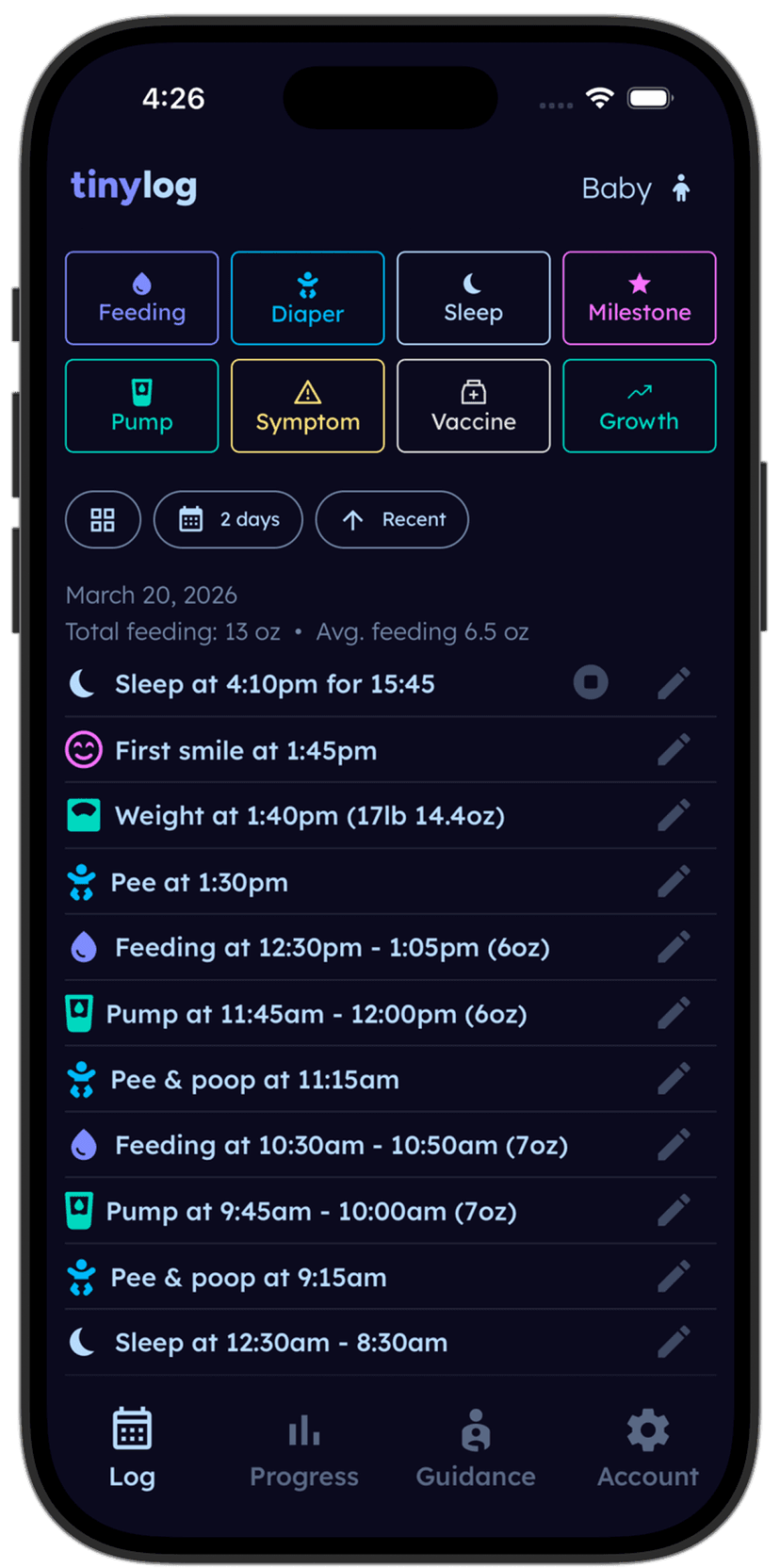
Tinylog activities overview showing daily baby care log with trend visualization

See what paper can't show you.

Tinylog turns raw logs into automatic trend charts, growth curves, and pattern insights. Sync with your partner, nanny, or grandparents so everyone tracks to the same timeline. It takes 3 seconds to log a feed — faster than finding a pen.

Download on the App StoreGet It On Google Play

The Multi-Caregiver Problem Paper Can't Solve

Here's the scenario that breaks paper logs: It's 2 PM. Your baby is with a nanny. You're at work. Your partner texts, "Has she eaten since I left this morning?" The nanny fed the baby at 11:30 and logged it in the notebook sitting on the kitchen counter. Your partner can't see the notebook. You can't see the notebook. Nobody knows the answer without calling the nanny.

With a shared digital tracker, this question never gets asked. The nanny logs the 11:30 feed from her phone. Both parents see it instantly on theirs. The pediatrician gets a clean summary at the next well-visit. The overnight caregiver sees the full day's record when they arrive.

This isn't a hypothetical nicety — it's the daily reality for families with multiple caregivers. According to the U.S. Census Bureau, the majority of infants under 12 months are cared for by at least two different people during a typical week. A tracking system that lives in one physical location doesn't serve a family that doesn't.

Paper logs also can't do trend analysis. After a month of digital tracking, an app can show you that your baby's average sleep duration has increased by 15 minutes per week, or that fussy periods cluster around 4-6 PM, or that growth is tracking along the 45th percentile curve. Getting this from a paper log would require hours of manual tallying and calculation. Getting it from an app requires zero effort — it happens automatically.


When Paper Still Makes Sense

Paper logs still have a place. If you're a single parent with sole caregiving responsibility, you don't need sync. If you find phones distracting during feeding and bonding time, a notebook removes that temptation. If you want a keepsake — a physical record of your baby's first months in your own handwriting — digital can't replicate that sentimentality.

Some parents also use a hybrid approach: a digital app for the functional tracking that gets shared with caregivers, and a paper journal for reflections, milestones, and memories. The app handles the data. The journal handles the heart.

The choice isn't really about paper versus technology. It's about whether the insights and sharing capabilities of digital tracking add enough value to justify the switch from a pen and notebook. For multi-caregiver families, the answer is almost always yes. For solo caregivers who prefer simplicity, paper remains a perfectly valid option. If you do decide to go digital, our best free baby tracker app roundup covers options that cost nothing to start.

Tips That Apply Either Way

Choose the method you'll actually use consistently

The best tracking method is the one you'll actually stick with at 3 AM. If you're naturally drawn to your phone, digital wins. If you find apps annoying and a notebook on the nightstand feels more natural, use paper. Inconsistent digital tracking is worse than consistent paper tracking.

If you have multiple caregivers, go digital

This is where the gap between paper and digital becomes undeniable. When your partner, nanny, grandparent, and daycare provider all need to know when the last feed was and how long the last nap went, a shared app eliminates the guessing game. One notebook in one location doesn't scale.

Bring your data to pediatrician visits

Regardless of format, having documented feeding frequency, diaper output, and sleep patterns for your pediatrician visit is more valuable than trying to reconstruct the past week from memory. Digital makes this easier with auto-generated summaries, but a filled-out paper log works too.

Related Guides

Sources

  • U.S. Census Bureau. (2023). Who's Minding the Kids? Childcare Arrangements.
  • American Academy of Pediatrics. (2022). Recommendations for Preventive Pediatric Health Care (Periodicity Schedule).
  • Radesky, J. S., et al. (2015). Mobile and Interactive Media Use by Young Children: The Good, the Bad, and the Unknown. Pediatrics, 135(1), 1-3.
  • World Health Organization. (2025). WHO Child Growth Standards: Length/Height-for-Age, Weight-for-Age, Weight-for-Length/Height.

This guide is for informational purposes only and is not a substitute for professional medical advice. Consult your pediatrician for guidance specific to your baby.

Get this comparison in your inbox.
We'll send you this breakdown so you can decide how to track your baby's care.
What if your baby log could think for you?
Download Tinylog — automatic trend detection, caregiver sync, and growth charts that paper can't touch.
Download on the App StoreGet It On Google Play