GUIDE

Tracking Baby Activities vs. Going by Instinct

Instinct is real and valuable — but it's also fallible, especially under sleep deprivation. Tracking gives you data that reveals patterns you'd miss, supports informed pediatrician conversations, and helps multiple caregivers stay aligned. The best approach isn't either/or — it's data-informed instinct.

This isn't about replacing your gut feeling. It's about giving your gut better information.

Track patterns, trust your instincts

Log feeds, sleep, and see trends

Your healthcare provider will monitor your child's weight, height, BMI, vital signs, hearing, vision, developmental/behavioral milestones, lead, TB and other screening tests at the appropriate age and interval during their well-child visits.
Dr. Wadie ShababDr. Wadie Shabab, MD, Pediatrician, Cleveland Clinic

The Case for Paying Attention on Purpose

Every parenting generation has a version of this debate. Your parents' generation didn't have apps, and they raised you just fine. So why would you need to log every feed, diaper, and nap in a digital tracker?

Because memory under sleep deprivation is unreliable — and the stakes matter. A 2017 study in the journal Sleep found that new parents average 4.4 hours of sleep per night in the first three months postpartum. At that level of sleep deprivation, cognitive performance drops to the equivalent of being legally drunk. You are not remembering accurately how many times the baby ate last night. You're reconstructing a plausible story from fragments.

Tracking doesn't fix the sleep deprivation. But it does create a reliable external memory. When your pediatrician asks "how many wet diapers in the last 24 hours?" — a critical indicator of hydration in newborns — the difference between "I think maybe six?" and "the log shows seven" could matter. When you're worried that your baby isn't eating enough, comparing against a baby feeding chart and seeing that intake has been steady is more reassuring than trying to remember each individual feed.

But there's a legitimate counterargument: tracking can become a crutch that undermines parental confidence. If you can't put the baby down without checking the app for the "correct" wake window, the tool is controlling you. The goal is data-informed instinct — not data-dependent paralysis.

Tracking vs. Instinct: Side-by-Side
Pattern identification
TrackingPrecise — shows trends over days and weeks
InstinctRough — relies on memory and general impression
Accuracy under sleep deprivation
TrackingHigh — data doesn't forget
InstinctLow — sleep-deprived memory is unreliable
Multi-caregiver coordination
TrackingExcellent — shared log keeps everyone informed
InstinctDifficult — relies on verbal handoffs and memory
Pediatrician conversations
TrackingSpecific — 'she ate 8 times yesterday, 4 oz average'
InstinctVague — 'she's eating well, I think'
Detecting gradual changes
TrackingStrong — trends show up in charts before they're obvious
InstinctWeak — slow changes are hard to notice day-to-day
Reading emotional/qualitative cues
TrackingWeak — data doesn't capture how the baby 'seems'
InstinctStrong — parents pick up on subtle signals data can't measure
Stress and anxiety risk
TrackingPossible — obsessive tracking can increase parental anxiety
InstinctLower — less data means fewer numbers to worry about
Time investment
TrackingMinimal with a good app (seconds per entry)
InstinctNone — no logging required
Confidence building
TrackingData-based confidence — 'I can see it's working'
InstinctExperience-based confidence — 'I know my baby'
Flexibility
TrackingMay create rigidity around numbers and schedules
InstinctMaximum flexibility — respond to the moment
The most effective parents combine both — tracking for data, instinct for context.

Tracking Advantages

  • Reveals feeding and sleep patterns that are invisible to day-to-day perception
  • Creates a reliable record for pediatrician visits — more useful than memory
  • Enables effective coordination between multiple caregivers without confusion
  • Helps identify issues early: insufficient intake, sleep regression onset, growth concerns
  • Provides data-based reassurance — 'she IS eating enough' instead of worrying

Tracking is most valuable in the first 3-6 months when patterns are still being established.

Tracking Challenges

  • Can become compulsive — the urge to log everything perfectly adds unnecessary stress
  • May undermine parental confidence if parents trust the app more than their own judgment
  • Quantitative data misses qualitative signals — a baby can eat the right amount and still seem 'off'
  • Some parents find phones during feeding and bonding moments distracting

If tracking increases your anxiety, reduce the scope or frequency. Not every data point matters.

Instinct Advantages

  • Fosters deep attunement to your baby's unique cues and communication
  • Reduces screen time during bonding moments
  • Eliminates tracking-related anxiety and perfectionism
  • Builds confidence in your own parenting judgment over time
  • Simpler — fewer tools, fewer distractions, more presence

Instinct develops over time. It's stronger at 4 months than at 4 days — and data accelerates the learning.

Instinct Challenges

  • Memory under sleep deprivation is unreliable — 'was that feed at 2 or 3 AM?'
  • Gradual changes (dropping intake, shortening naps) are easy to miss without data
  • Multiple caregivers have no shared record — handoff information gets lost
  • Pediatrician questions about frequency, duration, and output are harder to answer

The handoff problem between caregivers is the biggest practical limitation of instinct-only approaches.

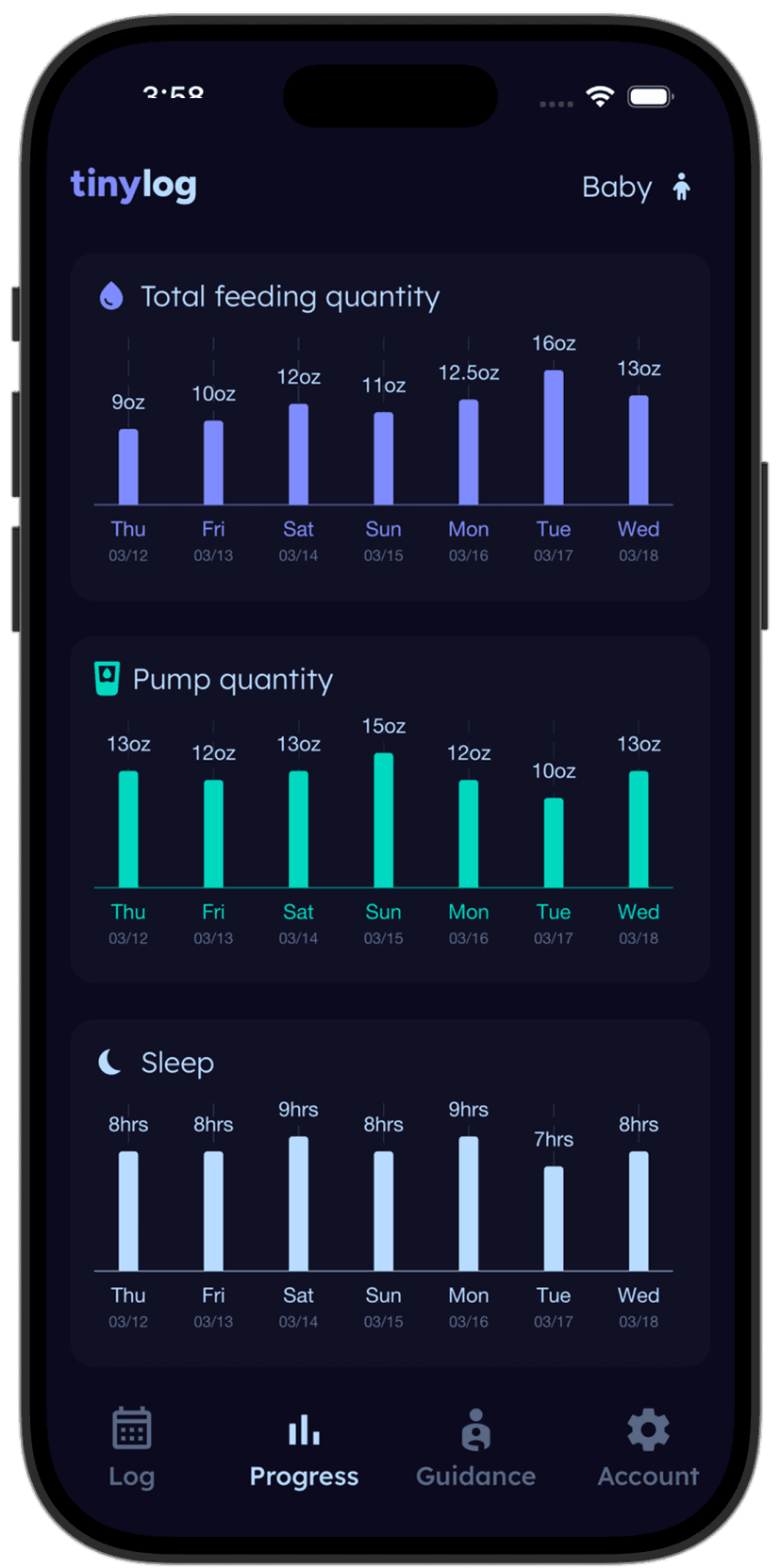
Tinylog trends screen showing baby feeding and sleep patterns over time

Spot patterns your tired brain can't.

Tinylog turns your daily logs into automatic trend charts — feeding frequency, sleep duration, diaper output over time. See what's actually happening versus what you think is happening. Then trust your gut with better information.

Download on the App StoreGet It On Google Play

Data + Instinct: Better Than Either Alone

The real answer isn't tracking OR instinct — it's both. Data gives you the quantitative picture: how many ounces, how many hours, how many diapers. Instinct gives you the qualitative picture: something feels off, the cry sounds different, the baby seems lethargic despite eating on schedule.

Data catches gradual changes that instinct misses. A baby whose daily intake drops by half an ounce per feeding over three weeks — that's a pattern you won't notice day-to-day but that shows up clearly on a trend chart. A slow decline in wet diapers that could signal dehydration is invisible without a count.

Instinct catches acute signals that data misses. No app can tell you that your baby's cry sounds different today, or that she's not making eye contact the way she usually does, or that something just feels wrong. These qualitative observations have real diagnostic value — pediatricians take parental instinct seriously because parents know their babies in ways that data points can't capture.

The parents who navigate the newborn period most confidently tend to do both: they track enough to see patterns, and they stay present enough to read their baby's cues. They use data to validate instinct, and instinct to contextualize data. One informs the other in a reinforcing loop. If you're wondering whether to use a notebook or an app, our paper vs. digital tracking comparison covers the practical differences.


How to Find Your Balance

Track more if you have multiple caregivers, your baby has health concerns that require close monitoring, your pediatrician has asked for specific data, or you're in the first 8 weeks when everything is new and patterns haven't emerged yet.

Track less if tracking is increasing your anxiety, you've developed strong confidence in reading your baby's cues, your baby is past the initial newborn phase with established patterns, or you feel more like a data entry clerk than a parent.

The healthy middle ground. Track feeds, diapers, and sleep for the first 3-4 months — enough to catch problems, enough to share with caregivers, enough to answer pediatrician questions. As your confidence builds and your baby's patterns stabilize, let the tracking frequency taper naturally. Our guide on when to stop tracking covers the signals that you're ready to ease up. You'll know you're ready to stop when the app confirms what you already feel.

Tips That Apply Either Way

Track for insight, not for perfection

The point of tracking isn't to log every second — it's to see patterns. If you miss logging a feed, the world doesn't end. Look for the big trends: Is intake going up over time? Are naps consolidating? Is growth on track? Don't sweat individual missed entries.

Use data to build instinct, then lean on instinct

Tracking is most valuable in the early months when you're still learning your baby's patterns. Over time, the data teaches you what normal looks like for YOUR baby. Once you've internalized that knowledge, you can track less and trust your gut more — because your gut is now informed by months of real data.

Know when to stop or scale back

If tracking is causing more anxiety than clarity, reduce it. If you're spending more time looking at charts than looking at your baby, step back. The goal is a parent who is both informed AND present. Data is a tool that should serve you, not the other way around.

Related Guides

Sources

  • Richter, D., et al. (2019). Long-term Effects of Pregnancy and Childbirth on Sleep Satisfaction and Duration of First-time and Experienced Mothers and Fathers. Sleep, 42(4).
  • Williamson, A. M., & Feyer, A. M. (2000). Moderate Sleep Deprivation Produces Impairments in Cognitive and Motor Performance Equivalent to Legally Prescribed Levels of Alcohol Intoxication. Occupational and Environmental Medicine, 57(10), 649-655.
  • American Academy of Pediatrics. (2022). Recommendations for Preventive Pediatric Health Care (Periodicity Schedule).
  • Mindell, J. A., & Williamson, A. A. (2018). Benefits of a Bedtime Routine in Young Children: Sleep, Development, and Beyond. Sleep Medicine Reviews, 40, 93-108.

This guide is for informational purposes only and is not a substitute for professional medical advice. Consult your pediatrician for guidance specific to your baby.

Get this comparison in your inbox.
We'll send you this guide so you can decide what level of tracking works for your family.
Data doesn't replace instinct. It sharpens it.
Download Tinylog — spot patterns, share care data, and make your parenting instinct more accurate.
Download on the App StoreGet It On Google Play