GUIDE

When Can You Stop Tracking Feeds?

Most pediatricians say you can relax daily tracking once baby is back to birth weight, gaining steadily, and producing enough wet diapers. That's usually around 2-4 weeks.

Here's something no other baby tracker app will tell you: you probably don't need to track forever. The early weeks are when logging matters most. After that, it depends on your situation, your baby, and honestly — whether tracking is making your life easier or harder.

Signs You Can Probably Relax

  • Baby is back to birth weight and gaining steadily (usually by 10-14 days)
  • You're seeing 6 or more wet diapers a day consistently
  • Baby is feeding 8-12 times a day without you having to force it
  • Your pediatrician says things look good at the well-child visits
  • You can read your baby's hunger cues without checking a log first
  • You feel confident about what a good feed looks and feels like

If most of these sound like your situation, you've earned the right to stop obsessing over the log. Your baby is telling you they're fine.

But Here's the Thing

A lot of parents keep tracking past the newborn stage — not because someone told them to, but because it genuinely makes their life easier. That's worth being honest about too.

Having data is calming. When your brain is running on four hours of sleep and you can't remember if the last feed was 45 minutes ago or two hours ago, opening the app and seeing the answer right there is a relief. It takes one decision off your plate at a time when every decision feels enormous.

Pediatrician visits go better when you have real numbers. Instead of saying "I think she's eating okay?" you can pull up a week of data. Doctors love this. It makes the appointment faster and more useful for everyone.

You can spot patterns you'd miss otherwise. Maybe baby eats less on the days they nap longer. Maybe they cluster-feed every evening but you didn't realize it until you saw it laid out. These patterns are invisible when you're in the middle of it. Data makes them obvious.

And if you have a nanny, a partner who does some feeds, or grandparents helping out — a shared log means nobody has to text "when did baby last eat?" every two hours. The handoff just works.

Signs You Should Keep Tracking a Bit Longer

  • Baby was premature or had a low birth weight
  • Your pediatrician has flagged concerns about growth or weight gain
  • You're combo feeding and still dialing in the breast milk-to-formula ratio
  • Baby has reflux, tongue tie, or other feeding challenges
  • You're returning to work and handing off to a caregiver who needs clear instructions
  • Baby is starting solids and you want to track for allergies or reactions
  • You're working with a lactation consultant and they've asked for feed data

None of these are permanent situations. They're just reasons to keep logging for now. Revisit this list in a few weeks — you might find you've graduated past most of them.

When Tracking Becomes Stressful — Stop

This is the part we have to be really honest about. If tracking is making you more anxious, not less — put the app down. Seriously.

If you're obsessing over whether the last feed was 3.2 ounces or 3.5 ounces. If you feel guilty logging a shorter nursing session. If the first thing you think after feeding your baby is "I need to open the app" instead of just being present — that's a sign the tool is no longer serving you.

Your baby will still eat. You will still know if something is wrong. Parents raised healthy babies for thousands of years before apps existed. The data is supposed to make your life easier. The moment it doesn't, it's just another task on a list that's already too long.

We built tinylog to take about five seconds per log. But even five seconds isn't worth it if it's adding stress instead of removing it. Trust yourself. You know your baby better than any app does.

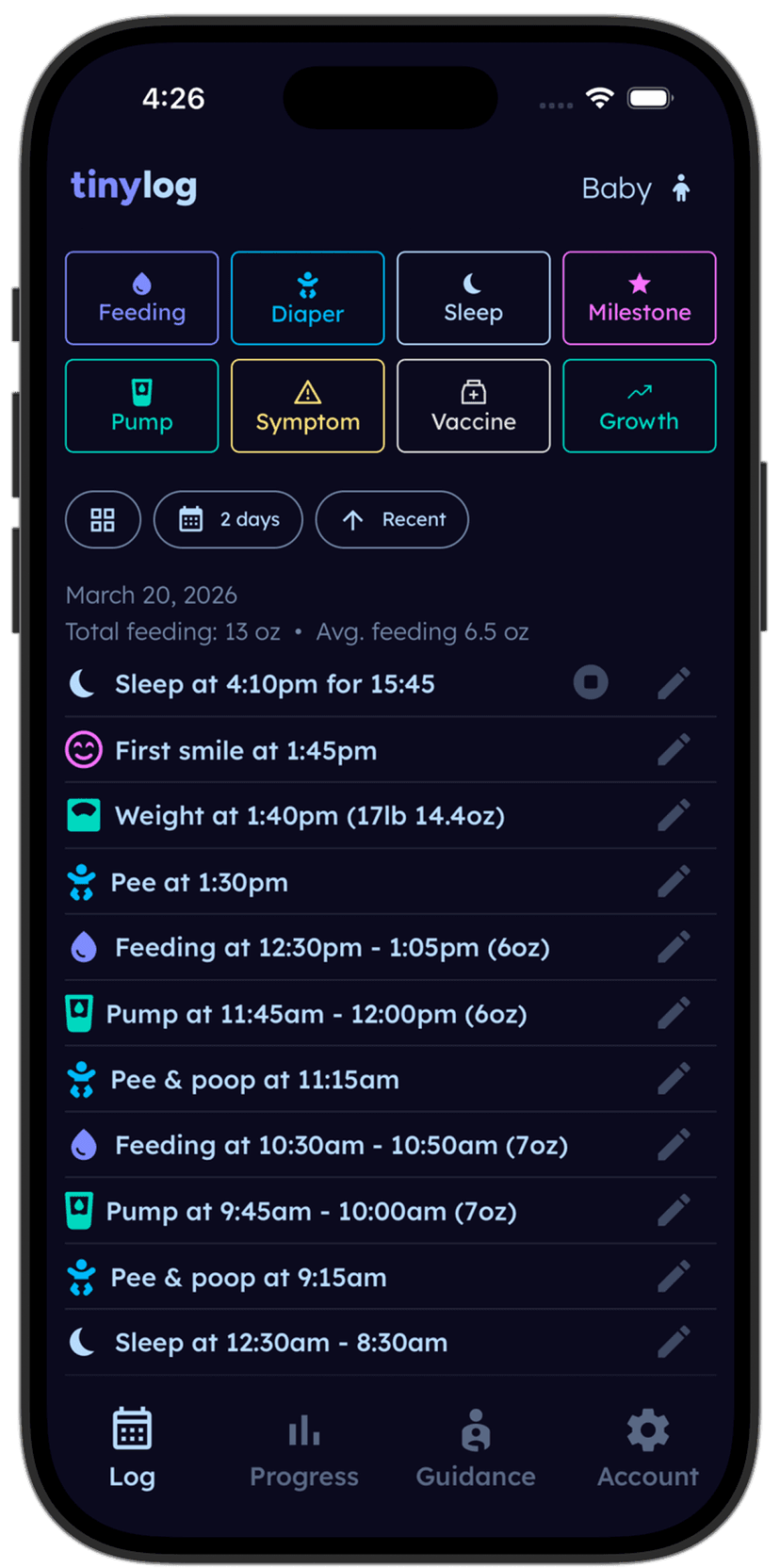
tinylog feeding tracker showing a quick-log interface

Track as long as it helps. We built it to take 5 seconds — so if it stops feeling useful, you'll know.

tinylog is designed to be the kind of tool you pick up when you need it and put down when you don't. No streaks, no guilt trips, no push notifications shaming you for not logging. Just quick, useful data when you want it.

Download on the App StoreGet It On Google Play

The Middle Ground Most Parents Land On

Switch to spot-checking

You don't have to log every single feed forever. Try tracking for just one or two days a week — enough to notice patterns without it running your life. Think of it like checking your bank account: you don't open the app after every coffee, but you glance at it once in a while.

Use tracking for transitions

Starting solids? Going back to work? New caregiver? These are the moments when logging for a week or two is genuinely useful. You'll get through the transition faster with data, then ease off again.

It's not all-or-nothing

You can track diapers without tracking feeds. You can log bottles but not nursing sessions. You can track during the week and skip weekends. There's no tracking police. Use whatever slice of data actually helps you.

Night feeds are the first to stop logging

If you want to wind down tracking, night feeds are a great place to start. You're exhausted, it's dark, and honestly the last thing you need is one more thing to do before you close your eyes. Just log daytime feeds and let nighttime be about survival.

Keep the app installed

Even if you stop daily tracking, don't delete the app. You'll want it when baby gets sick, when you start solids, or when your pediatrician asks 'so how much is baby eating?' at the next visit. Having it there for occasional use is the sweet spot for most parents after the early weeks.

Track for your pediatrician visits

Log feeds for a few days before each well-child visit so you have concrete data to share. This is especially helpful if your doctor asks 'how often is the baby eating?' — actual data beats a guess.

Track when something feels off

Keep the app ready but don't use it daily. When feeding feels different — baby seems less interested, or suddenly more hungry, or you're concerned about intake — log for a few days to see if there's a real pattern or if it's just a bad day.

Related Guides

Get this guide in your inbox.
We'll send you these guidelines so you can revisit them whenever you're wondering if it's time to ease up.
Track as long as it helps. Not a day longer.
tinylog is free — use it when you need it, put it down when you don't.
Download on the App StoreGet It On Google Play