
GUIDE
Parker Baby Co. Bibs vs. Mushie Silicone Bibs
Published on
Parker Baby cloth bibs are better for drool and light spit-up in the newborn months. Mushie silicone bibs are better for solid food feeding — the catch pocket actually catches food and the whole bib wipes clean in seconds.
These two bibs target different stages. Parker Baby's cotton-front bibs shine in the early drool-heavy months. Mushie's silicone bibs come into their own once solids start around 4–6 months. Many families buy both and use each for the stage it was designed for.
Log meals, solids, and more
Two Bibs, Two Different Problems
Parker Baby Co. Soft Baby Bibs and Mushie Silicone Bibs are both popular, well-reviewed products — but they are not solving the same problem.
Parker Baby bibs are drool bibs at heart. The absorbent cotton front soaks up saliva, milk dribble, and light spit-up. The waterproof polyester backing keeps it from soaking through to your baby's clothes. In a 10-pack, they give you enough rotation to get through a day or two without needing to do laundry. They are soft against a newborn's neck and easy to snap on and off one-handed.
Mushie silicone bibs are meal bibs. The food-grade silicone does not absorb anything — it deflects it. The deep rigid catch pocket is the whole point: food that falls off the spoon, off the tray, or out of your baby's mouth lands in the pocket instead of on clothes or the floor. Cleanup is a rinse under the tap or a quick run through the dishwasher.
Knowing which stage you are in goes a long way toward knowing which bib you actually need.
| Feature | Parker Baby Co. | Mushie Silicone | What It Means |
|---|---|---|---|
| Material | Cotton front, polyester waterproof backing | 100% food-grade silicone | Different materials for different jobs. Cotton absorbs; silicone repels and catches. |
| Catch pocket | None | Deep rigid catch pocket | Mushie wins decisively for solid food feeding. The pocket catches dropped food before it hits clothes or the floor. |
| Absorbency | High — cotton absorbs drool, milk, and spit-up | None — silicone does not absorb liquid | Parker Baby is better for drool-heavy newborn and infant months. Silicone bibs pool liquid rather than absorb it. |
| Waterproof backing | Yes — polyester waterproof layer prevents bleed-through | N/A — silicone is inherently non-porous | Both keep clothes dry, through different mechanisms. |
| Cleanup | Machine washable | Wipe clean, rinse under tap, or dishwasher safe | Mushie is faster to clean after a single meal. Parker Baby requires laundry. |
| Closure | Snap closure — adjustable, stays fastened | Adjustable neck strap — fits a range of baby sizes | Both close securely. Snaps are quick but can wear out; Mushie's adjustable strap offers more fit flexibility. |
| Pack size | 10 bibs per pack | 2 bibs per pack | Parker Baby gives you more rotation, useful when you go through multiple bibs a day. |
| Price per bib | ~$2–$2.50 per bib | ~$7.50–$9 per bib | Parker Baby is significantly cheaper per unit. Mushie's durability and dishwasher convenience factor into the higher price. |
| Travel portability | Flat, lightweight, easy to pack several | Rolls up, snaps closed — compact in a diaper bag | Both travel well. Silicone is easier to clean on the go — rinse and it is ready. |
| Durability | Moderate — snaps and waterproof layer wear over time | High — silicone resists staining, odor, and degradation | Silicone bibs typically last longer. Cloth bibs may need replacement sooner if snaps weaken. |
| Best age range | Newborn through drool phase (~0–6 months) | Solid foods onward (~4–6 months and beyond) | Different sweet spots. Many families buy both and use each for the stage it fits. |
| Patterns / style | Neutral patterns — grays, muted tones, prints | Solid muted colors — sage, blush, stone, ivory | Both brands have strong aesthetics. Parker Baby has more pattern variety; Mushie leans minimal. |
The Catch Pocket: Why It Changes Everything at Mealtime
If you have ever watched a baby eat purees, you know what happens: half of it goes in, a quarter of it ends up on the bib, and the rest lands somewhere between the tray, the onesie, and the floor.
The Mushie bib's rigid catch pocket is designed for exactly this. Because the silicone holds its shape, the pocket stays open at the bottom of the bib and catches food before it falls past the bib entirely. Soft cloth bibs — including Parker Baby's — have no pocket, so food that slides off the bib hits clothing underneath.
This is not a minor convenience difference. For parents doing three solid food meals a day, the catch pocket reduces outfit changes, laundry loads, and floor cleanup meaningfully. Once your baby is in the solid food stage, the lack of a catch pocket on a cloth bib starts to feel like a real gap.
Parker Baby bibs earn back points in the pre-solids phase. A stiff silicone bib on a two-month-old who is just drooling and spitting up is overkill — the rigid edges can be uncomfortable against soft newborn skin, and there is no drool to absorb anyway.
Cleanup: A Real Daily Factor
Cleanup is not glamorous, but it matters when you are washing bib after bib.
Parker Baby bibs go in the washing machine. That is convenient for batch washing — toss a stack of bibs in with the rest of the baby laundry. The downside is you need that batch to accumulate, which means you need enough bibs in rotation. The 10-pack helps here. One note: high heat in the dryer can degrade the polyester waterproof backing over time, so air drying or low heat is better for longevity.
Mushie silicone bibs require almost no effort after a meal. A rinse under the kitchen faucet removes most food immediately, since silicone is non-porous. If the meal was particularly messy, the dishwasher handles the rest. There is no waiting for laundry, no worrying about stains setting, and no delamination risk. The tradeoff is that you only have 2 bibs per pack — fine if you rinse after every meal, but less comfortable if you want to let cleanup stack up.
For families doing three solid food meals a day, the Mushie rinse-and-go workflow adds up to real time savings over weeks and months.
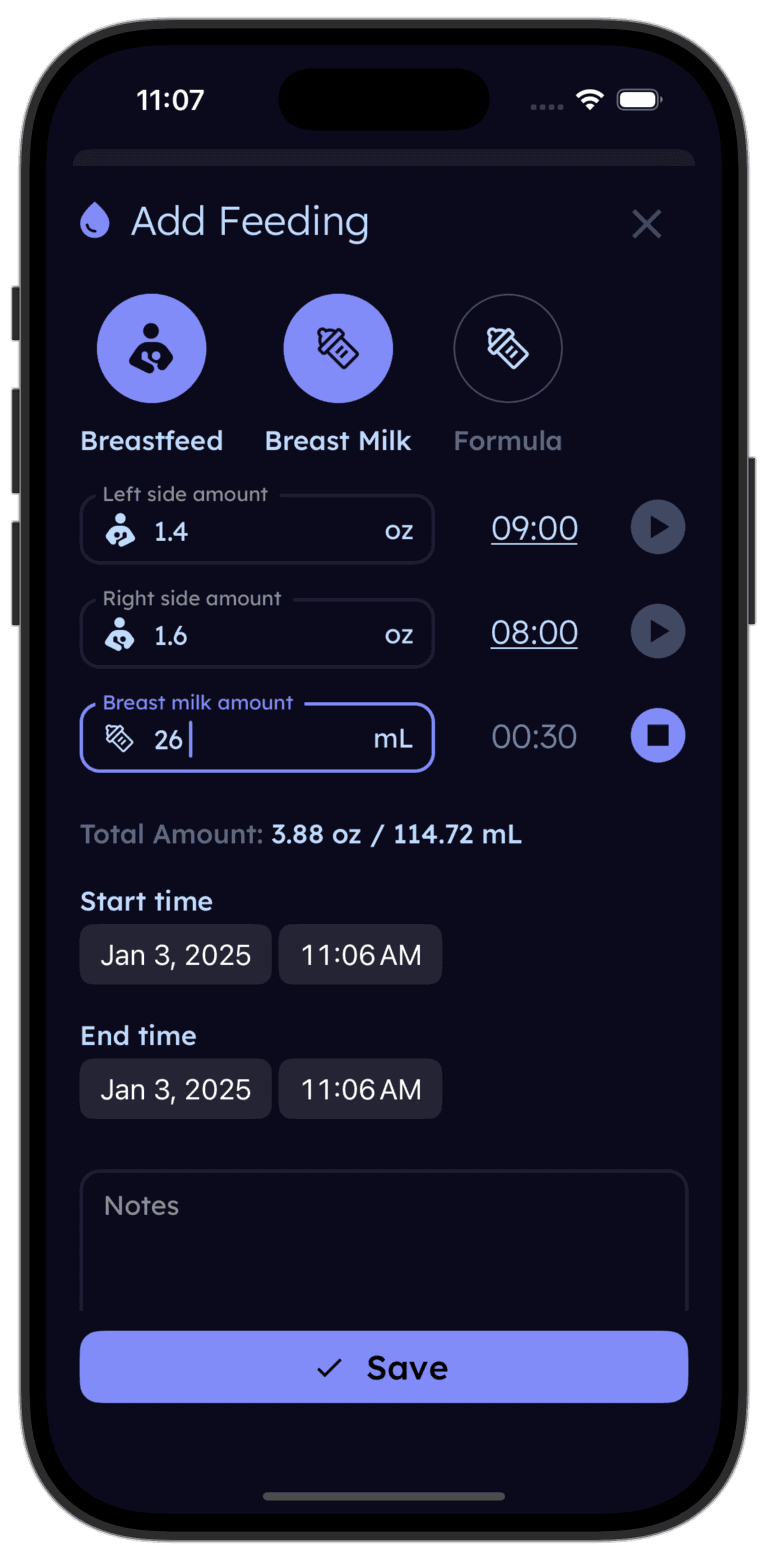
Tinylog tracks meals so you can spot patterns.


Fit and Comfort Across Stages
Both bibs cover a reasonable range of baby neck sizes, but they fit differently depending on your baby's age.
Parker Baby bibs are soft, flat, and lightweight. The snap closure keeps them firmly in place without adding bulk. On a small infant, this is the right form factor — nothing stiff or rigid near a sensitive neck. The bibs lie flat and move with the baby.
Mushie bibs have an adjustable neck strap and are designed to fit roughly 3 months and up, though many parents wait until 4–6 months when solids begin. The silicone is flexible but has more structure than cloth. On a very small baby, the bib can feel oversized and the rigid edges may not sit as comfortably. By the time a baby is sitting up for solid food meals, the fit is typically excellent.
One practical note: Mushie bibs are easy to size-adjust on the fly, which matters as your baby grows through the solid food phase. The adjustable strap means the same bib works from early purees through toddler finger food meals.
| Product | Typical Price | Cost Per Bib | Notes |
|---|---|---|---|
| Parker Baby Co. Soft Baby Bibs (10-pack) | $20–$25 | ~$2.00–$2.50 per bib | 10 bibs per pack; machine washable |
| Mushie Silicone Baby Bibs (2-pack) | $15–$18 | ~$7.50–$9.00 per bib | 2 bibs per pack; dishwasher safe |
| Parker Baby (2 packs — 20 bibs) | $40–$50 | ~$2.00–$2.50 per bib | Enough rotation for heavy drool phases |
| Mushie (2 packs — 4 bibs) | $30–$36 | ~$7.50–$9.00 per bib | 4 silicone bibs covers most meal rotations |
Price: More Different Than It Looks
At first glance, Mushie bibs seem expensive — roughly 3–4x the per-bib cost of Parker Baby. But the comparison is not quite apples to apples.
Parker Baby bibs will wear out faster. The polyester waterproof layer degrades with repeated washing and heat. Snap closures weaken. A 10-pack that costs $22 may last a year of heavy use and then need replacing.
Mushie silicone bibs are highly durable. Silicone resists staining, odor absorption, and structural degradation. A Mushie bib bought for your first child can go directly to a second child in the same condition. For parents who plan to have more children, the math on silicone improves significantly.
That said, if you need high bib volume — for a drool-heavy infant going through four or five bibs a day — buying 10 cloth bibs for $22 makes far more sense than buying five Mushie bibs for $40+.
The smart approach for most families: buy Parker Baby for the drool phase, add Mushie bibs when solids start. Total investment is reasonable and you have the right tool for each stage.
Choose Parker Baby Co. Bibs If
- Your baby is in the newborn or early infant stage, producing more drool and spit-up than solid food mess
- You want to rotate through bibs without doing laundry constantly — 10 bibs per pack gives you a full week's supply
- You prefer a soft, lightweight bib that does not add bulk around a small baby's neck
- Budget matters and you want more bibs for less money
- You like neutral patterns that match a variety of outfits
Choose Mushie Silicone Bibs If
- Your baby has started solids — purees, mashes, or finger foods — and you need actual mess containment
- You want cleanup to take 10 seconds instead of a full laundry cycle
- You travel often and need a bib that rinses clean at a restaurant sink
- You want a bib that will not stain orange after five servings of sweet potato
- You value dishwasher-safe convenience as part of your mealtime routine
- You want a bib that holds up for a second or third child without wearing out
Where to Buy
The Parker Baby Co. Bibs (~$20–$25 for 10) are the right call for the newborn through early infant phase — soft against sensitive skin, absorbent enough for drool and spit-up, and the 10-pack gives you the rotation you need without doing laundry twice a day.
Once solids begin, Mushie Silicone Bibs (~$15–$18 for 2) are the better mealtime tool. The catch pocket, wipe-clean surface, and dishwasher compatibility make them the most practical bib for the feeding months — and they hold up well enough to use with multiple children.
For most families, owning both is the best outcome: Parker Baby through the drool phase, Mushie from solids onward.
Tinylog earns a small commission on purchases made through these links, at no cost to you.
Looking for a discount? Try checking promo.new. It doesn't always find what you're looking for, but when it does, it works like a charm.
The Bottom Line
Parker Baby Co. Soft Baby Bibs and Mushie Silicone Bibs are each well-designed for the stage they target. The mistake is expecting either one to do both jobs well.
Parker Baby bibs are the right tool from birth through the pre-solids phase — soft, absorbent, affordable, and available in enough quantity to handle a drool-heavy day.
Mushie silicone bibs are the right tool once your baby starts eating solid foods — the catch pocket, instant cleanup, and durability make them the most practical mealtime bib available at their price point.
If you are tracking what your baby eats — which is especially useful in the first weeks of solids to note reactions, textures, and new foods tried — Tinylog makes it straightforward to log each meal and build a record you can share with your pediatrician.
Related Guides
- First Foods for Baby — What to start with and the order myth, debunked
- Baby Gagging on Solids — Normal gagging vs. choking, and what to do
- Baby-Led Weaning vs. Purees — How to choose the right approach for your family
- Baby Feeding Chart — How much your baby should eat by age
Sources
- Parker Baby Co. "Soft Baby Bibs (10-Pack) — Product Information." parkerbabyCo.com, 2026.
- Mushie. "Silicone Baby Bib with Catch Pocket — Product Information." mushie.com, 2026.
- American Academy of Pediatrics. "Starting Solid Foods." healthychildren.org, 2025.
- Babylist. "Best Baby Bibs." babylist.com, 2025.
- Wirecutter (NYT). "The Best Baby Bibs." nytimes.com/wirecutter, 2025.
- What to Expect. "Best Baby Bibs." whattoexpect.com, 2026.
- US Food & Drug Administration. "Questions & Answers on Food-Grade Silicone." fda.gov.
This guide is for informational purposes only. Product features and prices are subject to change. Always check current product listings before purchasing. If your baby has a latex or silicone sensitivity, consult your pediatrician before use.
Frequently asked questions
- Are silicone bibs or cloth bibs better for babies starting solids?
- Silicone bibs are generally better once solids start. The rigid catch pocket collects dropped food instead of letting it fall into your baby's lap, and the bib wipes clean with a damp cloth or goes in the dishwasher. Cloth bibs absorb purees but don't catch them — food soaks through to clothes underneath.
- Are Mushie silicone bibs safe?
- Yes. Mushie silicone bibs are made from 100% food-grade silicone and are BPA-free, PVC-free, and phthalate-free. Food-grade silicone is widely considered safe for contact with food. Look for the food-grade designation on any silicone bib — it indicates the material meets higher purity standards.
- How do you clean Parker Baby cloth bibs?
- Parker Baby bibs are machine washable. Toss them in with your regular baby laundry. The polyester waterproof backing helps prevent saturation, but heavily soiled bibs may need a rinse before washing. Avoid high heat in the dryer to preserve the waterproof layer.
- Can you put Mushie silicone bibs in the dishwasher?
- Yes. Mushie silicone bibs are dishwasher safe. Place them on the top rack. You can also rinse them under the tap immediately after a meal — food wipes off easily when fresh. Silicone does not stain from common baby foods like carrots or sweet potato, though orange-pigmented foods may leave a faint tint over time.
- At what age should I switch from cloth bibs to silicone bibs?
- Most families make the switch around 4–6 months when solid foods begin. Before solids, a drool bib like the Parker Baby style handles milk, spit-up, and drool well. Once your baby is eating purees or finger foods, a silicone bib with a catch pocket becomes far more practical.
- Which bib is better for travel?
- Mushie silicone bibs roll up tightly and most pack with a snap closure to stay compact in a diaper bag. They do not absorb food, so there is nothing wet or smelly to deal with after a meal on the go. Parker Baby cloth bibs are lighter and thinner, but a soiled cloth bib in a bag is less convenient than a rinsed silicone one.