GUIDE

Sharing Baby Updates vs. Privacy

Families want to be involved. You deserve boundaries. The answer isn't all-or-nothing — it's finding the right level of sharing that keeps loved ones connected without making you feel exposed, overwhelmed, or pressured. Technology can help, but only if you control it.

The boundaries you set now will shape your family dynamic for years.

Share care data on your terms

Control who sees what, and when

Parents really have an opportunity to role model what is and isn't OK to share online.
Susan AlbersSusan Albers, PsyD, Psychologist, Cleveland Clinic

The Boundary Nobody Warns You About

The moment you have a baby, your privacy changes. Family members who respected your boundaries for decades may suddenly feel entitled to constant updates, live-streamed milestones, and daily photo access. The group chat blows up. Grandparents call three times a day. Aunts you see once a year want weekly FaceTime sessions. Everyone means well. The pressure is still real.

A 2023 C.S. Mott Children's Hospital National Poll on Children's Health found that 56% of parents reported feeling pressured to share more about their children on social media than they were comfortable with. The pressure came from family members, friends, and the broader social expectation that new parents should document and broadcast their baby's life.

Meanwhile, the concept of "sharenting" — parents sharing their children's information and images online — has drawn increasing scrutiny. Digital privacy researchers have noted that the average child has 1,300 photos of themselves posted online before age 13, most uploaded by parents. Your child cannot consent to this, and once images are online, you cannot control how they're used, downloaded, or shared.

This isn't an argument for total privacy lockdown. Family connection matters, social support matters, and sharing joy with people who love your baby matters. But doing it intentionally, with clear boundaries, is different from doing it reactively because the group chat won't stop asking. Having these conversations early — ideally during your baby's first 30 days — sets the tone for years to come.


Sharing vs. Privacy: Full Comparison
Family relationships
More SharingStrengthened — loved ones feel included and valued
More PrivacyMay create distance if family feels shut out
Parental autonomy
More SharingCan feel reduced — updates invite opinions and advice
More PrivacyFully preserved — you parent without commentary
Unsolicited advice
More SharingIncreases significantly with more information shared
More PrivacyDecreases — less data means fewer opinions
Social support
More SharingHigher — family knows what's happening and can offer help
More PrivacyLower — family may not know when you need support
Privacy for your child
More SharingReduced — baby's data and images circulate beyond your control
More PrivacyProtected — you control what exists about your child online
Emotional labor
More SharingHigh — responding to messages, managing reactions, curating updates
More PrivacyLow — minimal communication overhead
Partner alignment
More SharingBoth partners must agree on what to share and with whom
More PrivacyEasier — default to sharing less requires less coordination
Digital footprint
More SharingYour child's online presence begins before they can consent
More PrivacyYour child's digital identity stays under your control
Emergency communication
More SharingFamily is looped in and can respond quickly
More PrivacyFamily may be out of the loop when it matters
Boundary enforcement
More SharingRequires ongoing management of who shares what
More PrivacySimpler — fewer people have information to redistribute
Most families land on a spectrum — sharing with some people, private with others.

Sharing Advantages

  • Grandparents, aunts, uncles, and close friends feel connected and involved
  • Shared joy — milestones, funny moments, and growth celebrated by people who care
  • Creates a support network that knows your situation and can help proactively
  • Reduces isolation for stay-at-home parents who need social connection
  • Family members who are far away can feel present in the baby's life

Sharing is genuinely valuable when it's intentional and on your terms.

Sharing Challenges

  • Every update is an invitation for unsolicited advice, opinions, and judgment
  • Family members may re-share photos or information without your permission
  • The emotional labor of curating updates, responding to messages, and managing expectations is real
  • Difficult to set limits once a pattern of oversharing is established

Setting boundaries early is easier than pulling back later.

Privacy Advantages

  • Full control over your baby's digital footprint and personal information
  • Reduced unsolicited advice and commentary on your parenting choices
  • Protects your child's right to decide their own online presence in the future
  • Less emotional labor — no audience to perform for or manage
  • Preserves the intimacy of your new family unit during a vulnerable time

Privacy is not secrecy. You can be private while still maintaining close family relationships.

Privacy Challenges

  • Family members may feel hurt, excluded, or resentful
  • You may miss out on support because people don't know what you're going through
  • Requires proactive communication to prevent relationship damage
  • Can feel isolating, especially for parents without a strong local social network

Proactive communication prevents hurt feelings — tell family WHY you've made these choices.

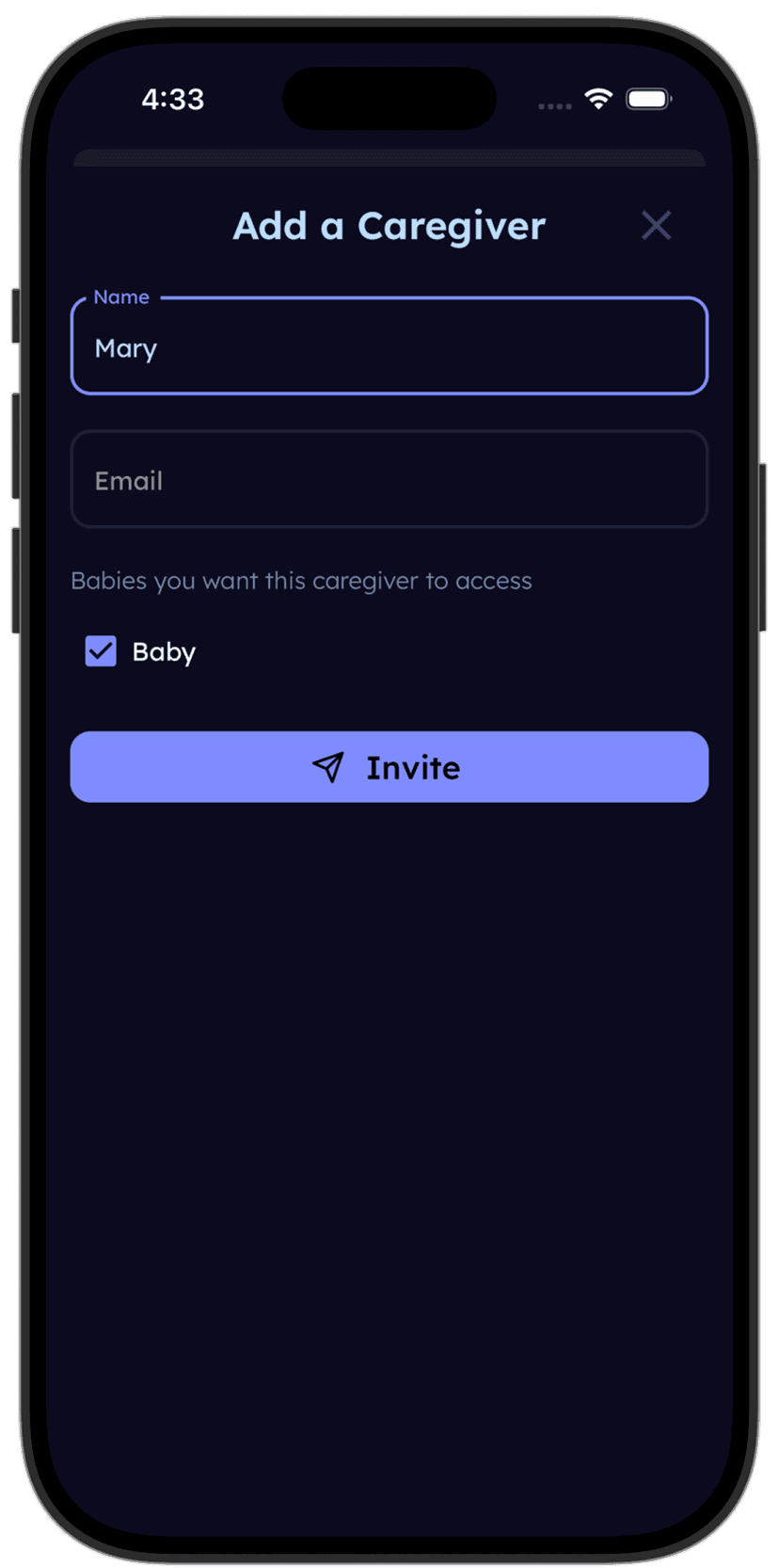
Tinylog caregiver sync showing controlled sharing between parents and active caregivers

Caregivers get care data. Everyone else gets the highlights.

Tinylog's caregiver sync gives active caregivers — your partner, nanny, or babysitting grandparent — real-time access to feeds, naps, and diapers. That's care coordination with clear boundaries, not oversharing.

Download on the App StoreGet It On Google Play

A Framework for Deciding What to Share

Not all sharing is equal. Think about information in three tiers:

Tier 1 — Active caregivers only. Feeding logs, diaper counts, sleep data, medications, health concerns. This is operational care data that your partner, nanny, or regular babysitting grandparent needs to provide consistent care. A shared baby tracking app handles this efficiently.

Tier 2 — Close family and friends. Photos, milestones (first smile, first roll, first food), and general updates. This is the "grandma wants to feel connected" tier. A private shared photo album or regular update message works well here.

Tier 3 — Social media and broader network. Optional and entirely up to you. Some parents share freely. Some post nothing. Some share occasionally with the baby's face obscured. There is no right answer, only your answer.

The problems arise when people in Tier 2 or 3 expect Tier 1 access, or when Tier 1 information leaks to Tier 3 without your consent. Clear boundaries prevent both.

How to Set Boundaries Without Damaging Relationships

Lead with love, not rules. Instead of "we're not sharing photos with you," try "we've decided to limit our baby's online presence, and we'd love to share photos with you in person or through a private album."

Get your partner aligned first. Nothing undermines a boundary faster than one parent sharing what the other wanted private. Agree on policies before announcing them to family — this is part of the broader conversation about shared parenting duties that every couple should have early.

Offer alternatives. If you're limiting social media posts, offer more in-person visits, video calls, or a private photo-sharing app. People accept boundaries better when they're given a different way to connect.

Be consistent. If you ask grandma not to post photos on Facebook, that applies to everyone. Inconsistent enforcement creates justified resentment.

Tips That Apply Either Way

Set boundaries before the baby arrives

Discuss with your partner: What goes on social media? Who gets photos? Who gets medical updates? Who has baby tracking app access? Having these decisions made before the baby arrives prevents reactive boundary-setting during an emotional time.

Separate caregivers from spectators

Active caregivers (partner, nanny, grandparent who babysits regularly) need care data — feeding logs, nap schedules, diaper counts. Everyone else gets curated updates: photos, milestones, and growth celebrations. A baby tracking app with caregiver sync gives the right people the right level of access.

Create a proactive update rhythm

Instead of fielding constant 'how's the baby?' texts, establish a rhythm: a weekly group photo, a monthly milestone update, or a shared photo album that you add to at your own pace. This satisfies family's desire for connection while keeping the cadence on your terms.

Related Guides

Sources

  • C.S. Mott Children's Hospital. (2023). National Poll on Children's Health: Parents and Social Media Sharing.
  • Pew Research Center. (2023). Parenting Children in the Age of Screens.
  • Steinberg, S. B. (2017). Sharenting: Children's Privacy in the Age of Social Media. Emory Law Journal, 66, 839.
  • Ouvrein, G., & Verswijvel, K. (2019). Sharenting: Parental Adoration or Public These kids? An Exploration of Parents' Motivations for Sharing Their Children's Information Online. Children and Youth Services Review, 98, 111-119.

This guide is for informational purposes only and is not a substitute for professional medical advice. Consult your pediatrician for guidance specific to your baby.

Get this comparison in your inbox.
We'll send you this guide so you can discuss boundaries with your partner before the family group chat takes over.
Caregivers get care data. Family gets the highlights.
Download Tinylog — share baby logs with active caregivers, and keep everyone else on a need-to-know basis.
Download on the App StoreGet It On Google Play