
GUIDE
Similac vs. Up & Up Formula
Published on ·Updated on
Up & Up meets the same FDA nutritional standards as Similac and costs 35–45% less. Target Circle deals and frequent coupons make it even more affordable.
Target's Up & Up infant formula is manufactured by Perrigo, the same company behind most U.S. store-brand formulas. It meets every FDA requirement under 21 CFR 107. The real question is whether Similac's proprietary additions justify the price difference.
Free 2-min quiz. Personalized match plus an instant recall check.
“All infant formulas must meet requirements that ensure optimal nutrition for babies. If your baby's formula is sold in the U.S., it has the nutrients your baby needs.”
 Dr. Matthew Badgett, MD, Pediatrician, Cleveland Clinic
The Honest Starting Point
If you are choosing between Similac and Target's Up & Up formula, here is the essential fact: both meet the same FDA nutritional standards. The FDA regulates all infant formula under 21 CFR 107, setting minimum and maximum levels for 29 nutrients. Up & Up must pass the same testing as Similac.
Up & Up infant formula is manufactured by Perrigo, the largest store-brand formula producer in the United States. Perrigo also makes Parent's Choice (Walmart), Kirkland (Costco), and Member's Mark (Sam's Club). These are well-established, FDA-inspected manufacturing operations.
Target frequently runs promotions on Up & Up formula through Target Circle, making an already-affordable formula even cheaper. Combined with the base price difference, Up & Up can cost up to 50% less than Similac when promotions are stacked.
For a broader look at feeding schedules by age, see our baby feeding chart.
| Feature | Similac 360 Total Care | Up & Up Infant Formula | What It Means |
|---|---|---|---|
| Manufacturer | Abbott Laboratories | Perrigo (for Target) | Both are established manufacturers with FDA-inspected facilities |
| Protein source | Nonfat milk, whey protein concentrate | Nonfat milk, whey protein concentrate | Same base proteins |
| Fat source | High oleic safflower, soy, coconut oils (no palm olein) | Palm olein, soy, coconut, high oleic safflower oils | Similac is palm-olein-free. Up & Up uses palm olein. |
| Carbohydrate source | Lactose | Lactose | Same primary carbohydrate |
| Signature ingredient | 2'-FL HMO (human milk oligosaccharide) | None | Similac's HMO is a prebiotic with promising but limited evidence in formula |
| DHA/ARA | Yes, from algal oil | Yes, from algal and fungal oils | Both include DHA and ARA |
| FDA approved | Yes | Yes | Both meet all FDA requirements under 21 CFR 107 |
| Price per oz (powder) | ~$1.10–$1.30/oz prepared | ~$0.75–$0.90/oz prepared | Up & Up costs roughly 35–45% less before Target promotions |
| Available at | Grocery stores, pharmacies, Amazon, Walmart, Target | Target stores and Target.com | Similac is available everywhere. Up & Up at Target only. |
The Ingredient Differences That Actually Matter
Two differences are worth your attention: the proprietary ingredients and the fat source.
2'-FL HMO: Similac's marketing differentiator
Similac 360 Total Care includes 2'-FL HMO, a human milk oligosaccharide that acts as a prebiotic. Early research on this compound is promising, suggesting potential benefits for gut health and immune function. However, the evidence in formula-fed infants is still limited — most studies are short-term and manufacturer-funded.
Up & Up does not include HMO. This does not make it nutritionally deficient — it means it does not include one specific bioactive addition above the FDA baseline.
Fat source: palm olein again
Up & Up uses palm olein oil. Similac does not. Some research links palm olein to slightly firmer stools and modestly reduced calcium absorption. For most babies, this will not be noticeable. If constipation is a concern, the palm-olein-free option may be worth considering.
Base nutrition: identical standards
The protein, carbohydrates, vitamins, minerals, and caloric density are equivalent between the two. Both provide the same nutritional foundation that supports healthy development in full-term infants.
What the Marketing Doesn't Tell You
The FDA requires every infant formula sold in the United States to meet identical base nutritional standards. Similac's proprietary additions (2'-FL HMO) are above the required baseline — they are marketing differentiators, not safety necessities.
Target's Up & Up formula costs less because Target does not have hospital distribution contracts, formula manufacturer advertising budgets, or proprietary ingredient licensing fees baked into the price. The formula inside the can is manufactured by Perrigo, a company that produces millions of cans per year across multiple store brands.
Target also makes Up & Up more affordable through frequent Target Circle promotions — gift card offers on bulk purchases, percentage-off deals, and digital coupons. If you are strategic about timing your purchases, the savings can be substantial.
The AAP does not recommend name-brand formula over store-brand formula for healthy infants.
| Product | Typical Price | Cost Per Oz (Prepared) | Monthly Estimate |
|---|---|---|---|
| Similac 360 Total Care (powder, 20.6 oz) | $33–$38 | ~$1.20/oz prepared | ~$150–$175/month |
| Up & Up Infant Formula (powder, 22.2 oz) | $17–$23 | ~$0.80/oz prepared | ~$100–$120/month |
| Up & Up with Target Circle deals | $14–$20 | ~$0.65–$0.75/oz prepared | ~$85–$100/month |
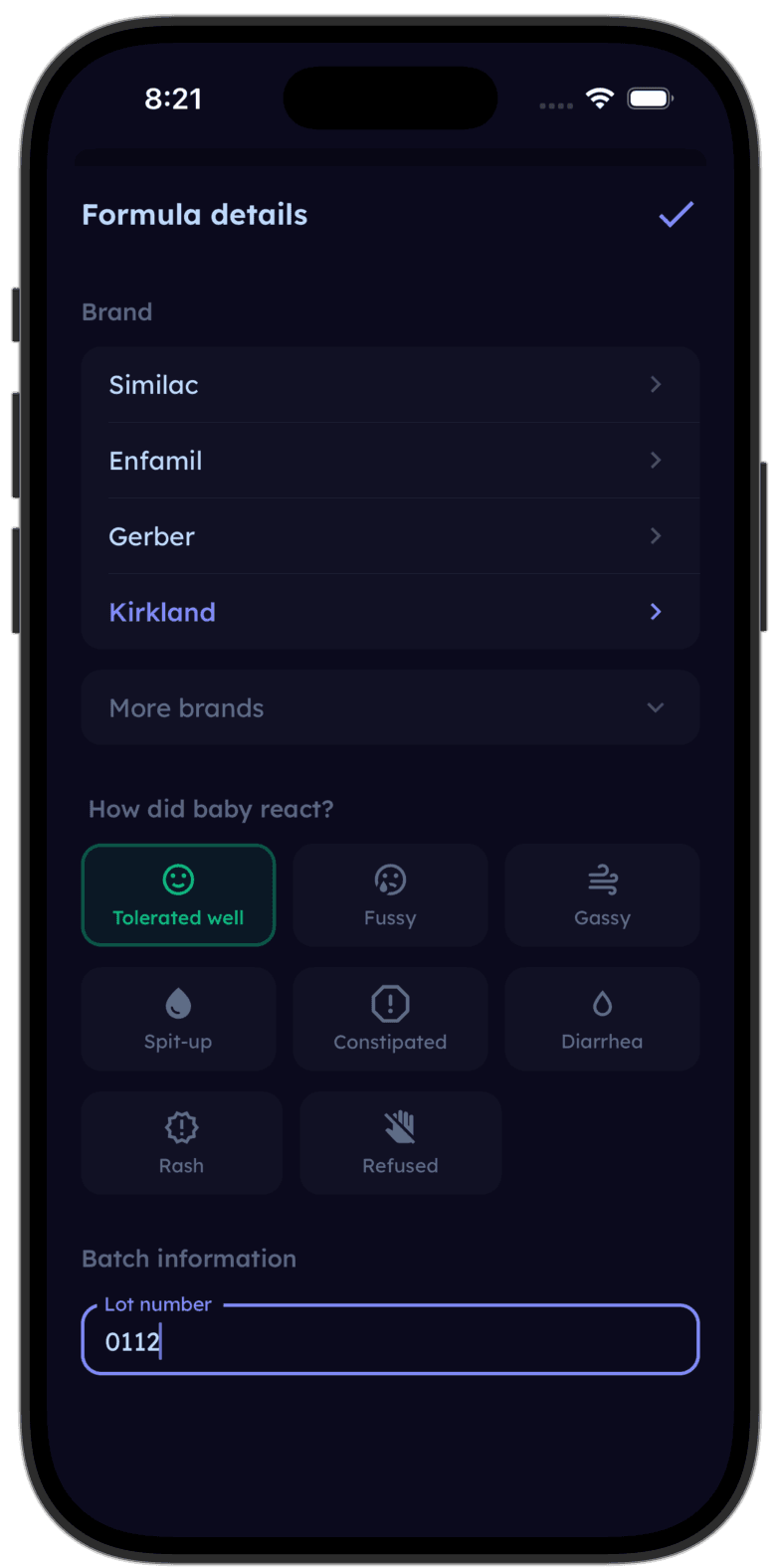
Know if the Up & Up switch is actually working.
Log each bottle, note any fussiness or stool changes, and see the pattern over time. If something feels different after switching from Similac, you'll have real data for your pediatrician instead of guessing.


Taste, Mixing, and Practical Differences
Beyond ingredients, here is what parents notice day-to-day.
Taste: Similac and Up & Up taste slightly different. Most babies who switch adjust within a few days. If your baby is hesitant, mixing the two during transition usually helps.
Mixing: Both dissolve without significant difficulty. Some parents report Up & Up can be slightly foamier — a formula pitcher or letting the bottle settle eliminates this.
Target shopping experience: If you already shop at Target regularly, Up & Up formula integrates into your routine. Same-day delivery via Target.com and in-store pickup make it convenient. Target Circle promotions on formula are frequent, and you can stack them with manufacturer coupons.
Product range: Similac offers a wider range of specialty formulas. Up & Up has a more limited selection — standard, gentle, and sensitive options. If your baby needs a highly specialized formula (hypoallergenic, amino acid-based), you may need to look beyond the store brand.
No membership required: Unlike Kirkland (Costco), Up & Up does not require a membership. Anyone can buy it at Target or Target.com.
When to Talk to Your Pediatrician
Switching from Similac to Up & Up should not require a doctor's visit for most healthy babies. However, contact your pediatrician if your baby shows signs of formula intolerance after the change.
Signs to Discuss With Your Pediatrician
- Your baby is consistently refusing feeds or eating significantly less than expected
- Persistent vomiting (not just spit-up) after most feedings
- Blood or mucus in stools
- Significant fussiness that does not improve after 1–2 weeks on a new formula
- Poor weight gain or weight loss
- Signs of allergic reaction: hives, facial swelling, wheezing, or difficulty breathing (seek immediate care)
Most formula discomfort (mild gas, occasional spit-up) is normal and does not require a formula change. Give any new formula at least 1–2 weeks before deciding it is not working. If you are tracking symptoms, bring that data to your appointment.
The Bottom Line
Up & Up meets the same FDA nutritional standards as Similac and costs 35–45% less at retail — even more with Target Circle deals. The base nutrition is equivalent.
Choose Similac if: you want the 2'-FL HMO prebiotic, you prefer a palm-olein-free formula, or your baby is thriving on it with no reason to change.
Choose Up & Up if: you want to save $50–75 per month, you shop at Target regularly, and your baby has no specific tolerance issues requiring a specialty formula.
Either works well if: your baby is healthy, full-term, and growing normally.
If you switch to Up & Up, give it 1–2 weeks and track what you see. Most babies adjust without any issues — but if stool consistency changes or your baby seems fussier, you'll want a record. Tinylog lets you log bottles, note any changes, and see the pattern clearly. Free to try, takes about 10 seconds per feed. Once you've settled on a formula, sign up for free recall alerts so you'll know immediately if it's ever recalled.
If you decide to stay with Similac, you can pick it up on Amazon without a trip to a specific retailer.
Tinylog earns a small commission on purchases made through these links, at no cost to you.
Tip: check promo.new before purchasing. It's hit or miss depending on the product, but when it hits, you'll be glad you checked.
For more comparisons, see Similac vs. Parent's Choice, Similac vs. Kirkland, and cheapest baby formulas.
Related Guides
-
Best Baby Formulas 2026 — An evidence-based guide
-
Cheapest Formulas — Options that meet every nutritional standard
Sources
- U.S. Food and Drug Administration. "21 CFR Part 107 — Infant Formula." Code of Federal Regulations.
- American Academy of Pediatrics. "Choosing an Infant Formula." HealthyChildren.org, 2024.
- Marriage BJ, et al. "Infants fed a lower calorie formula with 2'-FL show growth and 2'-FL uptake similar to breastfed infants." Journal of Pediatric Gastroenterology and Nutrition, 2015.
- Alarcon PA, et al. "Effect of individual fatty acids on calcium absorption in infant formulas." Food and Nutrition Research, 2017.
- U.S. FDA. "Infant Formula Guidance Documents and Regulatory Information." fda.gov, 2023.
This guide is for informational purposes only and is not a substitute for professional medical advice. Formula recommendations should be discussed with your pediatrician, especially for babies with allergies, reflux, or other medical conditions.
Frequently asked questions
- Is Up & Up formula the same as Similac?
- Not identical, but the base nutrition is equivalent. Both meet FDA requirements under 21 CFR 107. Up & Up lacks Similac's proprietary 2'-FL HMO and uses palm olein oil (Similac does not). The foundational protein, carbohydrates, vitamins, and minerals are comparable.
- Is Target formula safe for babies?
- Yes. Up & Up infant formula is FDA-compliant, manufactured by Perrigo in FDA-inspected facilities, and meets all 29 nutrient requirements. It is safe for healthy, full-term babies.
- Can I use Target Circle to save on Up & Up formula?
- Yes. Target frequently offers Target Circle deals, coupons, and promotions on Up & Up formula. Combining these with the already-lower base price can make Up & Up one of the most affordable formula options available.
- Can I switch from Similac to Up & Up?
- Yes. Most healthy babies switch between standard formulas without issues. You can transition gradually by mixing for a few days. Minor stool changes during transition are normal and typically resolve within a week.
- Does Up & Up formula have DHA?
- Yes. Up & Up infant formula includes DHA and ARA, the same types of fatty acids found in Similac. Both are important for brain and eye development and are required in modern infant formula formulations.