
GUIDE
Cheapest Baby Formulas
Published on ·Updated on
Store-brand formulas cost 30–50% less than Enfamil and Similac while meeting the exact same FDA nutritional standards. The price difference is mostly branding, marketing, and proprietary ingredient additions — not safety or quality.
Formula costs $1,200–2,400 per year for most families. Choosing a store-brand formula over a name brand can save $700–1,000 annually without compromising on safety or nutrition. Here are the best budget options and how to save even more.
Free 2-min quiz. Matched to your baby's symptoms and budget.
“All infant formulas must meet requirements that ensure optimal nutrition for babies. If your baby's formula is sold in the U.S., it has the nutrients your baby needs.”
 Dr. Matthew Badgett, MD, Pediatrician, Cleveland Clinic
The FDA Baseline Every Formula Shares
Every infant formula sold in the United States must meet the same FDA nutritional requirements under 21 CFR 107. This is not optional. There are no "premium" or "basic" tiers of FDA compliance — either a formula meets the requirements or it cannot be sold.
The FDA mandates minimum and maximum levels for 29 nutrients, including protein, fat, carbohydrates, iron, calcium, vitamin D, and DHA. The FDA also requires manufacturers to test each batch for nutrient content and conducts periodic facility inspections. This applies equally to a $54 can of ByHeart and an $18 can of Kirkland.
Store-brand formulas are manufactured by Perrigo, the largest infant formula producer in the United States. Perrigo operates multiple FDA-inspected manufacturing plants and produces millions of cans per year. These are not made in unregulated facilities — they are made in the same type of plants that name brands use, held to the same standards.
The AAP has stated that store-brand formulas are a nutritionally appropriate option for healthy infants. Your pediatrician will not tell you one is better than the other — because for base nutrition, they are not.
For more on feeding amounts by age, see our baby feeding chart.
| Formula | Retailer | Typical Price | Cost Per Oz | Monthly Cost | Notes |
|---|---|---|---|---|---|
| Kirkland Signature (Costco) | Costco | $18–$23 (34 oz) | ~$0.65–$0.80/oz | ~$85–$105/month | Membership required ($65/year). Largest tub size. |
| Member's Mark (Sam's Club) | Sam's Club | $17–$22 (34 oz) | ~$0.65–$0.80/oz | ~$85–$105/month | Membership required ($50/year). |
| Parent's Choice (Walmart) | Walmart | $16–$22 (22.2 oz) | ~$0.70–$0.85/oz | ~$90–$110/month | No membership. WIC eligible in many states. |
| Up & Up (Target) | Target | $17–$23 (22.2 oz) | ~$0.75–$0.90/oz | ~$95–$115/month | No membership. Target Circle deals. |
| Enfamil NeuroPro (reference) | Everywhere | $33–$38 (20.7 oz) | ~$1.10–$1.30/oz | ~$150–$175/month | Name brand with MFGM. |
| Similac 360 Total Care (reference) | Everywhere | $33–$38 (20.6 oz) | ~$1.10–$1.30/oz | ~$150–$175/month | Name brand with HMO. No palm olein. |
All Made by the Same Companies
Here is something most parents do not know: Perrigo manufactures the vast majority of store-brand infant formula in the United States. This single company makes:
- Parent's Choice (Walmart)
- Up & Up (Target)
- Kirkland Signature (Costco)
- Member's Mark (Sam's Club)
- CVS Health (CVS)
- Rite Aid (Rite Aid)
- Comforts (Kroger)
The formulas from these different retailers are very similar — they come from the same manufacturer using the same FDA-regulated processes. The main differences are tub size, retailer pricing strategy, and minor formulation variations.
Perrigo's infant formula division is not a side project. It is a major operation that produces more formula cans than most parents realize. The scale, safety processes, and regulatory oversight match those of Abbott (Similac) and Reckitt/Mead Johnson (Enfamil).
What You Give Up (and What You Don't)
When you choose a store-brand formula over Enfamil or Similac, here is exactly what changes — and what stays the same.
What stays the same: all 29 FDA-required nutrients, protein quality, caloric density, vitamin and mineral levels, manufacturing safety standards, and the fundamental nutrition that feeds and grows your baby.
What you give up: proprietary bioactive additions. Enfamil NeuroPro's MFGM and Similac's 2'-FL HMO are not in store-brand formulas. These are real compounds with some research behind them — but the evidence that they produce measurably different outcomes in healthy term babies is limited. Most studies are short-term, manufacturer-funded, and measure biomarkers rather than long-term clinical outcomes.
The honest assessment: the $15-per-can difference between name brand and store brand buys you proprietary ingredients with promising but unproven benefits, plus the reassurance of a familiar brand name. It does not buy fundamentally different nutrition. If MFGM or HMO matter to you, name brands are the only option. If base nutrition is what you care about, store brands deliver the same thing for less.
Budget Tips Beyond Brand Switching
Switching to store brand is the biggest single savings move. Here are additional ways to reduce formula costs.
| Tip | Detail |
|---|---|
| WIC Benefits | If eligible, WIC provides formula at no cost. Check your state's WIC program. Covers most standard and some specialty formulas. |
| Manufacturer Rewards Programs | Enfamil Family Beginnings and Similac StrongMoms offer coupons, checks, and free samples. Sign up for both — even if you use store brand, the coupons can help. |
| Warehouse Club Memberships | Costco and Sam's Club memberships ($50–65/year) pay for themselves in 1 month of formula savings. The per-ounce cost is the lowest available. |
| Store Loyalty Programs | Target Circle, Walmart+, and Amazon Subscribe & Save offer 5–15% additional savings on formula. Stack with manufacturer coupons when possible. |
| Powder Over Ready-to-Feed | Powder formula costs 50–70% less per ounce than ready-to-feed. RTF is convenient but dramatically more expensive. Use RTF for travel; powder at home. |
| Buy in Bulk | Larger tub sizes cost less per ounce. The 34 oz warehouse tubs are the best value. Check expiration dates and store properly. |
What the Marketing Doesn't Tell You
The formula industry spends hundreds of millions of dollars on marketing annually. Hospital distribution contracts, pediatrician relationships, television commercials, and social media campaigns all create the perception that name-brand formula is necessary for your baby's health. This is marketing, not medicine.
The $15-per-can premium you pay for Enfamil or Similac over a store brand funds these marketing efforts. It funds the sample in your hospital discharge bag. It funds the advertisements that make you worry about choosing "the best." The base nutrition inside the can costs roughly the same to produce.
Over a year of formula feeding, the store-brand savings add up to $700–1,000. That is real money that can go toward diapers, childcare, pediatric visits, or your baby's savings account. Choosing a cheaper formula is not cutting corners — it is making an informed financial decision backed by FDA regulation.
No parent should feel guilty about choosing the most affordable formula that meets their baby's nutritional needs. Every FDA-approved formula does that.
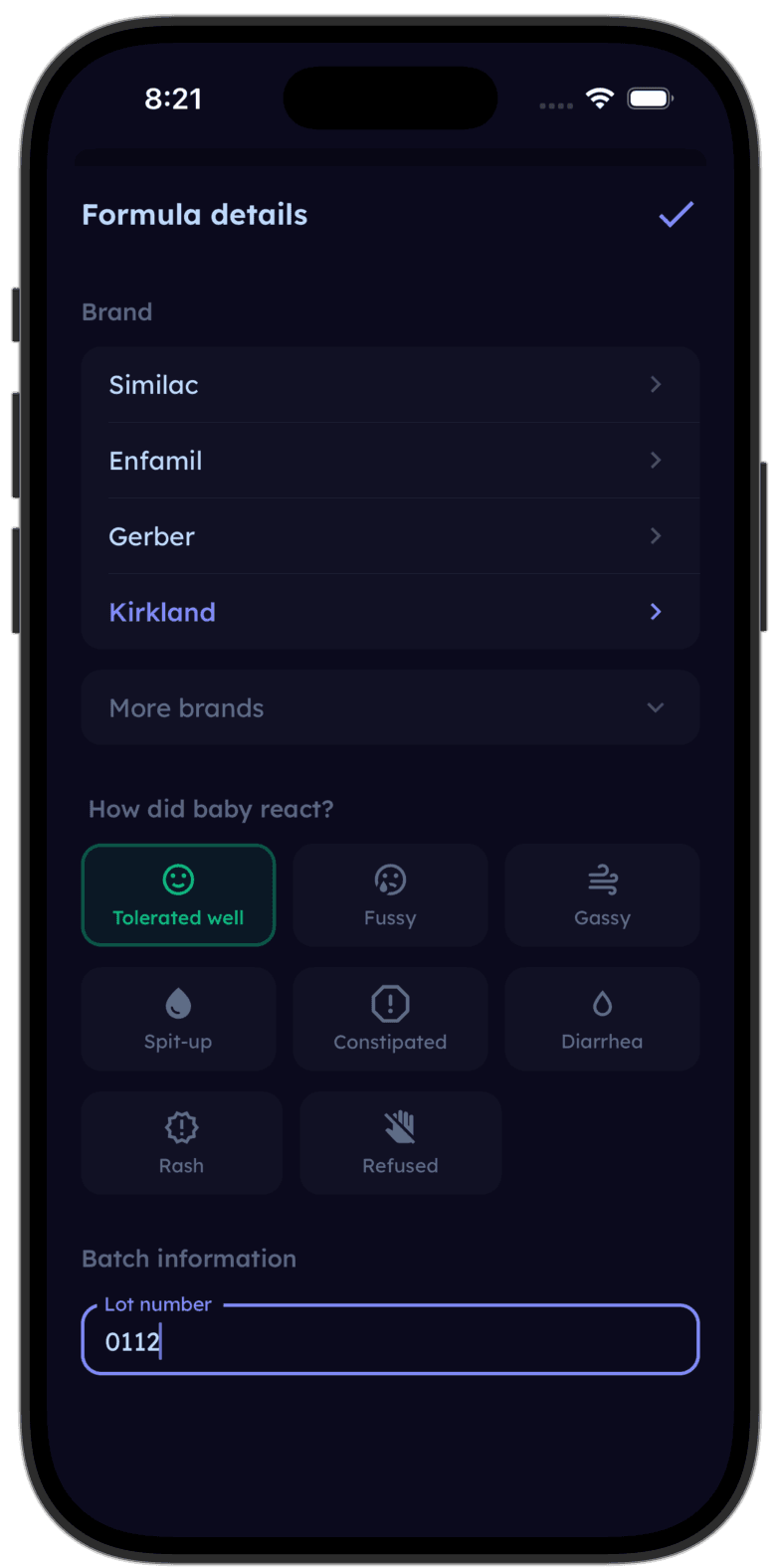
Know your baby is thriving on the budget formula — not just hoping.
Log each bottle, note any changes in stool or fussiness, and see the pattern over two weeks. If the store-brand switch is going well, you'll see it. If something feels off, you'll have real data for your pediatrician instead of a gut feeling.


When to Talk to Your Pediatrician
Choosing between store-brand and name-brand formula is not a medical decision for healthy babies. However, contact your pediatrician if your baby has specific needs (allergy, reflux, prematurity) that may require a specialty formula not available in store brands.
Signs to Discuss With Your Pediatrician
- Your baby is consistently refusing feeds or eating significantly less than expected
- Persistent vomiting (not just spit-up) after most feedings
- Blood or mucus in stools
- Significant fussiness that does not improve after 1–2 weeks on a new formula
- Poor weight gain or weight loss
- Signs of allergic reaction: hives, facial swelling, wheezing, or difficulty breathing (seek immediate care)
Formula intolerance symptoms are not related to brand pricing. If your baby shows these signs on any formula, consult your pediatrician.
The Bottom Line
Every FDA-approved infant formula meets the same nutritional standards. Store-brand formulas cost 30–50% less and provide the same base nutrition. The price difference buys branding and proprietary ingredients, not safety or quality.
Cheapest per ounce: Kirkland (Costco) and Member's Mark (Sam's Club) — requires membership.
Cheapest without membership: Parent's Choice (Walmart) and Up & Up (Target).
Maximum savings strategy: Warehouse club formula + manufacturer coupons + WIC benefits (if eligible) can reduce formula costs to under $75/month.
The guiding principle: Choose what fits your budget without guilt. Your baby will thrive on any FDA-approved formula. The best formula is the one you can consistently afford, that your baby tolerates, and that you can easily obtain.
Whichever formula you choose, tracking the first few weeks on a new formula tells you everything. Tinylog lets you log each bottle, note stools and fussiness, and see day-by-day whether your baby is adjusting well — so you can feel confident in the switch, not just cost-conscious about it.
If you do decide a name brand is right for your family, Similac 360 Total Care Baby Formula and Enfamil NeuroPro Baby Formula are the two most widely purchased options — useful benchmarks whether you're buying them or comparing against the store brand you chose instead.
Tinylog earns a small commission on purchases made through these links, at no cost to you.
We've found promo.new handy for finding discounts on baby gear. Doesn't always have what you need, but it's worth a shot.
For specific brand comparisons, see Enfamil vs. Kirkland, Similac vs. Parent's Choice, Enfamil vs. Similac, and best organic baby formulas.
Related Guides
-
Kirkland vs. Name Brand — Is generic formula really the same
-
Best Baby Formulas 2026 — An evidence-based guide
Sources
- U.S. Food and Drug Administration. "21 CFR Part 107 — Infant Formula." Code of Federal Regulations.
- American Academy of Pediatrics. "Choosing an Infant Formula." HealthyChildren.org, 2024.
- U.S. FDA. "Infant Formula Guidance Documents and Regulatory Information." fda.gov, 2023.
- Perrigo Company. "Infant Formula Manufacturing." perrigo.com, 2025.
- USDA Food and Nutrition Service. "WIC — Women, Infants, and Children." fns.usda.gov, 2025.
This guide is for informational purposes only and is not a substitute for professional medical advice. Formula recommendations should be discussed with your pediatrician, especially for babies with allergies, reflux, or other medical conditions.
Frequently asked questions
- Is cheap baby formula safe?
- Yes. Every infant formula sold in the United States — regardless of price — must meet the same FDA nutritional requirements under 21 CFR 107. This includes 29 mandatory nutrients at specified minimum and maximum levels. Store-brand formulas are manufactured in FDA-inspected facilities and undergo the same testing as name brands.
- Who makes store-brand baby formula?
- Perrigo Company manufactures most U.S. store-brand infant formulas, including Parent's Choice (Walmart), Up & Up (Target), Kirkland Signature (Costco), and Member's Mark (Sam's Club). Perrigo is the largest store-brand formula manufacturer in the U.S. and operates FDA-inspected facilities.
- What is the cheapest baby formula?
- Warehouse club brands (Kirkland at Costco, Member's Mark at Sam's Club) are typically the cheapest per ounce at $0.65–0.80/oz prepared. Parent's Choice (Walmart) and Up & Up (Target) are close behind at $0.70–0.90/oz. All meet FDA standards.
- Is store-brand formula the same as name-brand formula?
- The base nutrition is equivalent — both meet the same FDA requirements for 29 nutrients. Name brands like Enfamil and Similac add proprietary ingredients (MFGM, HMO) that store brands do not include. These additions have promising but limited evidence of benefit. The core nutrition that feeds and grows your baby is the same.
- Can I get free or discounted baby formula?
- Yes. WIC (Women, Infants, and Children) provides formula assistance for eligible families. Manufacturer coupons are available from Enfamil and Similac through their rewards programs. Store loyalty programs (Target Circle, Walmart+) offer additional discounts. Amazon Subscribe & Save provides 5–15% off regular deliveries.