
GUIDE
Kirkland ProCare vs. Enfamil NeuroPro
Published on ·Updated on
Kirkland Signature ProCare meets the same FDA nutritional standards as Enfamil NeuroPro and costs 40–50% less. The main difference is Enfamil's MFGM addition and brand marketing — not the base nutrition.
Costco's Kirkland Signature ProCare infant formula is made by Perrigo, the largest store-brand formula manufacturer in the U.S. It meets every FDA requirement under 21 CFR 107 — the same regulations Enfamil must follow. Here is what genuinely differs and what is just branding.
Free 2-min quiz. Personalized match plus an instant recall check.
“All infant formulas must meet requirements that ensure optimal nutrition for babies. If your baby's formula is sold in the U.S., it has the nutrients your baby needs.”
 Dr. Matthew Badgett, MD, Pediatrician, Cleveland Clinic
Is Kirkland Formula the Same as Enfamil?
Not identical, but nutritionally equivalent. Kirkland Signature ProCare and Enfamil NeuroPro both meet the same FDA nutritional requirements under 21 CFR 107, contain the same core ingredients (nonfat milk, whey, lactose, DHA, ARA), and support healthy growth. The main differences are Enfamil's MFGM addition and prebiotic blend — not the base nutrition.
The FDA requires every infant formula sold in the U.S. to meet minimum and maximum levels for 29 nutrients. Kirkland ProCare passes the same regulatory bar as Enfamil NeuroPro. The genuine differences come down to Enfamil's proprietary MFGM addition, its prebiotic blend, and its brand ecosystem (hospital samples, pediatrician relationships, marketing). Whether those extras are worth $60–80 more per month is the real question this guide addresses.
Who Makes Kirkland Formula?
Perrigo Company manufactures four major U.S. store-brand infant formulas: Kirkland Signature ProCare for Costco, Parent's Choice for Walmart, Up & Up for Target, and Member's Mark for Sam's Club.
Kirkland Signature ProCare infant formula is manufactured by Perrigo Company, the largest store-brand infant formula producer in the United States. Perrigo makes formula in FDA-inspected U.S. facilities and also manufactures Parent's Choice (Walmart), Up & Up (Target), and Member's Mark (Sam's Club) — meaning Kirkland shares its production lineage with most major store-brand formulas.
This is not a discount knock-off. Perrigo has been making infant formula for decades and produces more store-brand infant formula cans than any other U.S. manufacturer. Every can of Kirkland ProCare is made to the same FDA requirements as every can of Enfamil NeuroPro. The difference you're paying for with the name-brand isn't safety or manufacturing rigor — it's the MFGM additive, prebiotics, and marketing overhead.
For a broader look at how formula fits into feeding at every age, see our baby feeding chart.
| Feature | Enfamil NeuroPro | Kirkland Signature ProCare | What It Means |
|---|---|---|---|
| Manufacturer | Reckitt (Mead Johnson) | Perrigo (for Costco) | Both are established formula manufacturers with decades of experience |
| Protein source | Nonfat milk, whey protein concentrate | Nonfat milk, whey protein concentrate | Same base proteins |
| Fat source | Palm olein, soy, coconut, high oleic sunflower oils | Palm olein, soy, coconut, high oleic safflower oils | Very similar fat blends. Both use palm olein oil. |
| Carbohydrate source | Lactose | Lactose | Same primary carbohydrate |
| Signature ingredient | MFGM (milk fat globule membrane) | None | MFGM is found in breast milk and has promising research, but evidence of clinical benefit in formula is limited |
| DHA/ARA | Yes, from algal and fungal oils | Yes, from algal and fungal oils | Both include DHA and ARA from similar sources |
| Prebiotics/Probiotics | Polydextrose and GOS (prebiotics) | None listed | Enfamil includes prebiotics. Kirkland standard line does not. |
| FDA approved | Yes | Yes | Both meet all FDA requirements under 21 CFR 107 |
| Price per oz (powder) | ~$1.10–$1.30/oz prepared | ~$0.65–$0.80/oz prepared | Kirkland costs roughly 40–50% less per ounce |
| Available at | Grocery stores, pharmacies, Amazon, Walmart, Target | Costco (membership required) | Enfamil is available everywhere. Kirkland requires a Costco membership. |
Kirkland Signature ProCare Ingredient List
- Nonfat milk and whey protein concentrate (protein source)
- Lactose (primary carbohydrate)
- Vegetable oils: palm olein, soy, coconut, and high oleic safflower oils (fat blend)
- DHA (docosahexaenoic acid) from algal oil
- ARA (arachidonic acid) from fungal oil
- Vitamins: A, D, E, K, C, B1, B2, B6, B12, niacin, folic acid, pantothenic acid, biotin
- Minerals: calcium, phosphorus, iron, zinc, copper, iodine, manganese, selenium, sodium, potassium, chloride
- Choline, taurine, L-carnitine, inositol (additional nutrients)
Based on the Kirkland Signature ProCare milk-based infant formula label. Check the can for the most current formulation, as manufacturers occasionally update ingredients.
The Ingredient Differences That Actually Matter
The formulas share a very similar foundation. The differences are in what Enfamil adds on top of that foundation.
MFGM: Enfamil's headline ingredient
Enfamil NeuroPro features MFGM (milk fat globule membrane), a complex lipid found naturally in breast milk that contains phospholipids, sphingomyelin, and other bioactive compounds. Enfamil positions MFGM as supporting brain development, citing studies showing cognitive benefits.
The research on MFGM in formula is promising but limited. Most studies are short-term, manufacturer-funded, and measure biomarker changes rather than long-term clinical outcomes. No major pediatric organization has identified MFGM as essential in infant formula. Kirkland does not include MFGM, but its base nutrition meets all the same requirements.
Fat blends: very similar
Unlike the Similac vs. Kirkland comparison, Enfamil and Kirkland actually use very similar fat blends — both include palm olein oil. This means the common concern about palm olein (firmer stools, slightly reduced calcium absorption) applies equally to both formulas. If palm olein is a concern for you, neither of these is the palm-free option — you would want to look at Similac or Kendamil instead.
Prebiotics
Enfamil includes a prebiotic blend (polydextrose and galactooligosaccharides). Kirkland's standard formula does not include added prebiotics. Prebiotics support gut bacteria development, but breastfed babies get prebiotics from breast milk and formula-fed babies develop healthy gut bacteria regardless.
What the Marketing Doesn't Tell You
The most important thing Enfamil's marketing does not say: the FDA nutritional floor is the same for every formula. Kirkland must meet the same 29 nutrient minimums and maximums as Enfamil NeuroPro. The MFGM and prebiotics are additions above that floor — not the foundation of what feeds your baby.
Enfamil has extensive hospital distribution contracts. The sample you received at discharge was determined by a business agreement, not a clinical recommendation from your pediatrician. Enfamil also invests heavily in pediatrician marketing and consumer advertising. These costs are built into the price of every can.
Kirkland does not spend on hospital contracts, pediatrician marketing, or television commercials. The formula inside the can costs roughly the same to manufacture — the price difference reflects marketing and distribution overhead, not ingredient quality.
The AAP has stated that store-brand formulas are a nutritionally appropriate option for healthy infants. You should not feel guilty about choosing the less expensive option.
| Product | Typical Price | Cost Per Oz (Prepared) | Monthly Estimate |
|---|---|---|---|
| Enfamil NeuroPro (powder, 20.7 oz) | $33–$38 | ~$1.20/oz prepared | ~$150–$175/month |
| Kirkland Signature ProCare (powder, 34 oz) | $18–$23 | ~$0.70/oz prepared | ~$90–$110/month |
| Annual savings switching to Kirkland | — | ~$0.50/oz saved | ~$720–$960/year saved |
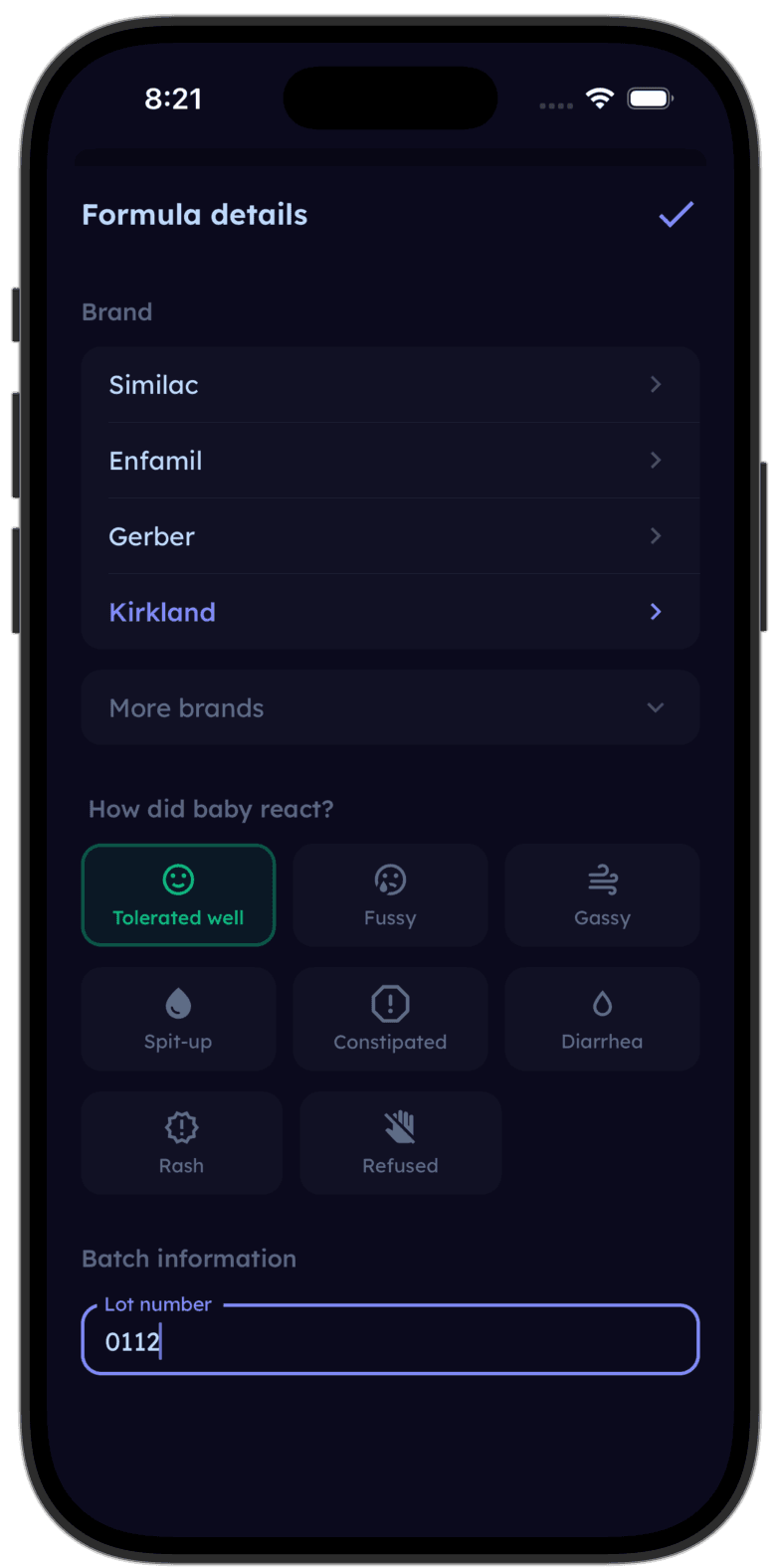
Know if the Kirkland switch is actually working.
Log each bottle, note any fussiness or stool changes, and see the pattern over time. If something feels off after switching from Enfamil, you'll have real data for your pediatrician instead of guessing.


Taste, Mixing, and Practical Differences
Beyond ingredients, here are the real-world differences parents notice.
Taste: Enfamil and Kirkland taste slightly different due to processing variations. Babies who have been on one brand for weeks may notice the switch. Most adjust within a few days — you can mix the two during transition if your baby is hesitant.
Mixing: Both dissolve reasonably in room-temperature water. Enfamil powder tends to dissolve slightly more easily. Some parents find Kirkland slightly grainier, though a formula pitcher or vigorous shaking handles this.
Packaging: Kirkland comes in larger tubs (34 oz vs. Enfamil's 20.7 oz), which means fewer purchases and contributes to the lower per-ounce cost.
Availability: You need a Costco membership ($65/year) for Kirkland. Enfamil is available at virtually every retailer. If Costco access is inconvenient, the savings may not be practical for your family. However, Costco.com delivers, which solves the access issue for many.
WIC: Enfamil is WIC-eligible in many states. Kirkland is generally not WIC-eligible. If you receive WIC benefits, check your state's approved formula list before switching.
When to Talk to Your Pediatrician
Switching from Enfamil to Kirkland should not require a doctor's visit for most healthy babies. However, contact your pediatrician if your baby shows signs of formula intolerance after the switch.
Signs to Discuss With Your Pediatrician
- Your baby is consistently refusing feeds or eating significantly less than expected
- Persistent vomiting (not just spit-up) after most feedings
- Blood or mucus in stools
- Significant fussiness that does not improve after 1–2 weeks on a new formula
- Poor weight gain or weight loss
- Signs of allergic reaction: hives, facial swelling, wheezing, or difficulty breathing (seek immediate care)
Most formula discomfort (mild gas, occasional spit-up) is normal and does not require a formula change. Give any new formula at least 1–2 weeks before deciding it is not working. If you are tracking symptoms, bring that data to your appointment.
The Bottom Line
Enfamil NeuroPro and Kirkland Signature ProCare share the same FDA nutritional foundation. The meaningful difference is Enfamil's MFGM and prebiotic additions — which have promising but limited evidence of clinical benefit in healthy babies — and the substantial price gap.
Choose Enfamil if: you value the MFGM and prebiotic additions, your baby is thriving on it, you receive WIC benefits that cover it, or you do not have convenient Costco access.
Choose Kirkland if: you want to save $60–80 per month on formula without compromising on FDA-regulated nutrition, you have a Costco membership, and your baby is healthy without specific tolerance issues.
Either works well if: your baby is healthy, full-term, and growing normally. Both formulas meet the same regulatory standards, and the AAP does not recommend name brands over store brands.
If you switch to Kirkland, give it 1–2 weeks and track what you see. Most babies adjust without any issues — but if stool consistency or fussiness changes, you'll want a record. Tinylog lets you log bottles, note fussiness or stool changes, and see the full picture in one place. Free to try, takes about 10 seconds per feed.
If you decide name-brand is the right call, you can find Enfamil NeuroPro Baby Formula and Similac 360 Total Care Baby Formula on Amazon; Kirkland is available exclusively at Costco.
Tinylog earns a small commission on purchases made through these links, at no cost to you.
Want to save a few bucks? promo.new is worth a quick look. It won't always have your product, but when it does, the savings are real.
For more comparisons, see Similac vs. Kirkland and cheapest baby formulas. For the name-brand head-to-head, see Enfamil vs. Similac.
Related Guides
- Best Baby Formulas 2026 — An evidence-based guide - Kirkland vs. Name Brand — Is generic formula really the same - Cheapest Formulas — Options that meet every nutritional standard
- Similac vs. Kirkland
- Enfamil vs. Up & Up
Sources
- U.S. Food and Drug Administration. "21 CFR Part 107 — Infant Formula." Code of Federal Regulations. - American Academy of Pediatrics. "Choosing an Infant Formula." HealthyChildren.org, 2024. - Timby N, et al. "Neurodevelopment, nutrition, and growth until 12 mo of age in infants fed a low-energy, low-protein formula supplemented with bovine milk fat globule membranes." American Journal of Clinical Nutrition, 2014. - Koo WW, et al. "Palm olein in infant formula affects bone mineralization and calcium absorption." Journal of the American College of Nutrition, 2006. - U.S. FDA. "Infant Formula Guidance Documents and Regulatory Information." fda.gov, 2023. - Perrigo Company. "Infant Formula Manufacturing." perrigo.com, 2025.
This guide is for informational purposes only and is not a substitute for professional medical advice. Formula recommendations should be discussed with your pediatrician, especially for babies with allergies, reflux, or other medical conditions.
Frequently asked questions
- Is Kirkland formula the same as Enfamil?
- Not identical, but nutritionally equivalent. Kirkland Signature ProCare and Enfamil NeuroPro both meet the same FDA nutritional requirements under 21 CFR 107 and contain the same core ingredients (nonfat milk, whey, lactose, DHA, ARA). The main differences are Enfamil's MFGM addition and prebiotic blend — not the base nutrition.
- What is Kirkland Signature ProCare?
- Kirkland Signature ProCare is Costco's store-brand infant formula, manufactured by Perrigo. It's a standard milk-based infant formula for 0-12 months that meets all FDA nutritional requirements under 21 CFR 107. ProCare is positioned as Costco's equivalent to premium name-brand formulas like Enfamil NeuroPro at roughly half the price.
- Who makes Kirkland baby formula?
- Perrigo Company makes Kirkland Signature ProCare infant formula for Costco. Perrigo is the largest store-brand infant formula manufacturer in the United States and also produces Parent's Choice (Walmart), Up & Up (Target), and Member's Mark (Sam's Club) formulas. All are made in FDA-inspected U.S. facilities.
- Where is Kirkland formula made?
- Kirkland Signature ProCare is manufactured in the United States by Perrigo Company, in FDA-inspected facilities that follow the same manufacturing regulations as every other U.S. infant formula producer. Perrigo has been making infant formula for decades and produces more store-brand formula than any other manufacturer in the country.
- Does Kirkland formula have palm oil?
- Yes. Kirkland Signature ProCare includes palm olein as part of its fat blend, alongside soy, coconut, and high oleic safflower oils. Enfamil NeuroPro also contains palm olein, so neither is a palm-free option. If you're avoiding palm oil, consider formulas like Similac 360 Total Care or Kendamil instead.
- Can I switch from Enfamil to Kirkland?
- Yes. Most babies switch between standard formulas without difficulty. You can transition gradually by mixing the two over several days. Minor changes in stool color or consistency are normal and typically resolve within a week. If your baby has specific medical needs or is on a specialty formula, consult your pediatrician first.
- Does Kirkland formula have DHA?
- Yes. Kirkland Signature ProCare includes DHA and ARA, which are also found in Enfamil. Both brands source DHA from algal oils. The amounts meet FDA guidelines for infant formula.
- Is Enfamil worth the extra cost over Kirkland?
- That depends on your priorities. Enfamil's MFGM addition has some promising research behind it, but the evidence of measurable benefit in healthy term babies is limited. The base nutrition in both formulas is equivalent under FDA standards. Many families choose Kirkland ProCare and use the $60–80 monthly savings for other baby needs.