
GUIDE
Kirkland vs. Name Brand Formula
Published on ·Updated on
Every infant formula sold in the US must meet the same FDA nutritional requirements — store brand or premium. The difference is mostly packaging and price.
The FDA regulates infant formula under 21 CFR 107, which sets minimum (and maximum) levels for 29 nutrients. Kirkland, Similac, Enfamil — they all have to hit the same targets. The $15-20 per can price difference? That's branding, not nutrition.
Free 2-min quiz. Personalized match plus an instant recall check.
“You usually don't need the most expensive formula to have a healthy, happy baby.”
 Dr. Matthew Badgett, MD, Pediatrician, Cleveland Clinic
What the FDA Actually Requires
Every infant formula sold in the United States — from the priciest European import to the Costco house brand — must comply with FDA regulations under 21 CFR 107. This isn't a suggestion. It's federal law.
The FDA sets minimum levels for 29 nutrients, including protein, fat, vitamins, and minerals. It also sets maximum levels for certain nutrients to prevent oversupplementation. Every manufacturer must register with the FDA, follow current good manufacturing practices (cGMP), test each batch before distribution, and notify the FDA at least 90 days before introducing a new formula to market.
This means Kirkland formula doesn't just happen to be similar to Similac. It is required by law to meet the same nutritional floor. The FDA doesn't have a separate, lower standard for store brands. There is one standard. Every formula meets it, or it doesn't get sold.
| Feature | Kirkland Signature | Similac Advance | Notes |
|---|---|---|---|
| Protein source | Nonfat milk, whey protein concentrate | Nonfat milk, whey protein concentrate | Essentially identical protein base |
| Carbohydrate source | Lactose | Lactose | Both use lactose as the primary carbohydrate |
| Fat sources | Palm olein, soy, coconut, high oleic sunflower oils | High oleic safflower, soy, coconut oils | Slightly different oil blends — both meet FDA fat requirements |
| DHA / ARA | Yes (from Mortierella alpina and Crypthecodinium cohnii oils) | Yes (from Mortierella alpina and Crypthecodinium cohnii oils) | Same sourcing for both |
| Prebiotics | Galactooligosaccharides (GOS) | Galactooligosaccharides (GOS) | Both include prebiotic support |
| Iron | Iron-fortified (meets FDA minimum) | Iron-fortified (meets FDA minimum) | Both are iron-fortified as required |
| Lutein | Yes | Yes | Both include lutein for eye development |
Who Actually Makes Store-Brand Formula
Here's something most parents don't realize: nearly every store-brand infant formula in the United States is made by the same company. Perrigo Nutritionals, headquartered in Vermont, is the largest manufacturer of store-brand infant formula in the country. They produce formula for Costco (Kirkland), Walmart (Parent's Choice), Target (Up&Up), Walgreens (Well Beginnings), Kroger (Comforts), and many other retailers.
The formula inside these cans comes from the same facilities, using the same manufacturing processes, and meeting the same FDA requirements. The primary difference between a can of Kirkland and a can of Parent's Choice is the label and the price, which varies by retailer.
This is not a secret. Perrigo publicly states that they are the leading manufacturer of store-brand infant formula. But the name-brand companies spend hundreds of millions on marketing each year to make sure you don't think too hard about this fact.
| Brand | Manufacturer | Comparable To | Approx. Price |
|---|---|---|---|
| Kirkland Signature (Costco) | Perrigo Nutritionals | Similac Advance | $20-25/can |
| Parent's Choice (Walmart) | Perrigo Nutritionals | Similac Advance / Enfamil NeuroPro | $18-22/can |
| Up&Up (Target) | Perrigo Nutritionals | Similac Advance | $19-24/can |
| Well Beginnings (Walgreens) | Perrigo Nutritionals | Similac Advance | $20-25/can |
| Comforts (Kroger) | Perrigo Nutritionals | Similac Advance | $18-22/can |
The Cost Difference Is Real
Formula is expensive regardless of which brand you choose. But the gap between store brand and name brand adds up fast. A baby who is exclusively formula-fed for the first year will go through roughly 50-60 cans of powdered formula. At a $15-20 difference per can, that is $750-1,200 in savings over the course of a year.
That's not a rounding error. That's a month or two of groceries for many families. Or a chunk of a childcare payment. Or a college fund contribution. The nutritional content is functionally equivalent, which means the savings come at no cost to your baby's health.
| Item | Kirkland Signature | Similac Advance | Enfamil NeuroPro |
|---|---|---|---|
| Price per can (powder, ~23 oz) | $20-25 | $35-42 | $37-44 |
| Estimated monthly cost | $80-100 | $140-170 | $150-175 |
| Estimated yearly cost | $960-1,200 | $1,680-2,040 | $1,800-2,100 |
| Savings vs. Kirkland (yearly) | — | $720-840 | $840-900 |
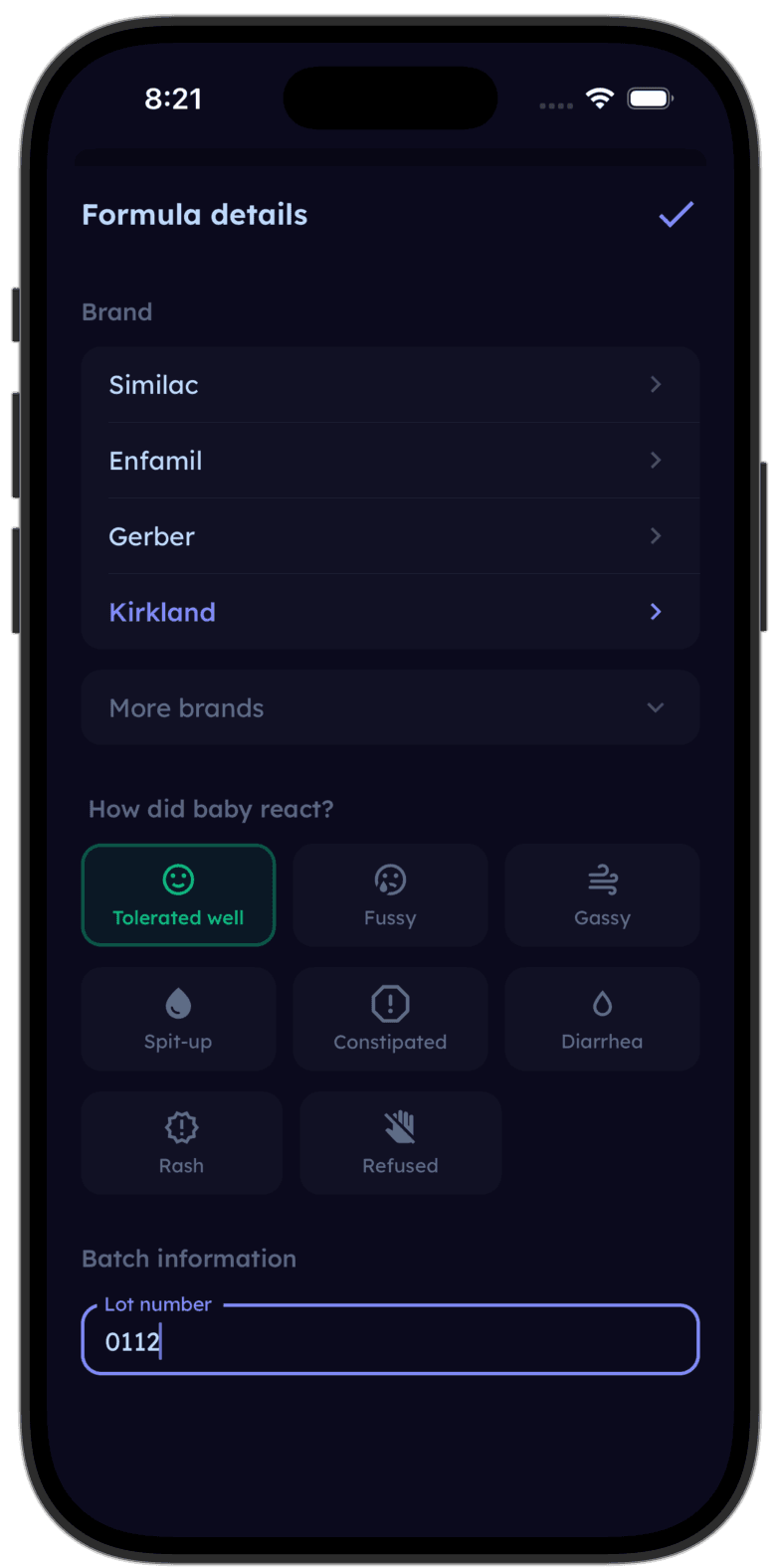
Know if the Kirkland switch is actually working.
Log each bottle, note any fussiness or stool changes, and see the pattern over time. Most babies adjust without any issues — but if something changes, you'll have real data for your pediatrician instead of guessing.


What the Marketing Doesn't Tell You
The infant formula industry is worth over $4 billion in the United States alone. Name-brand companies like Abbott (Similac) and Reckitt (Enfamil) spend hundreds of millions on advertising, hospital partnerships, and pediatrician marketing each year. That money doesn't go into the formula. It goes into making sure you associate their brand with safety, quality, and good parenting.
Here's what the marketing doesn't say:
The $15-20 price premium per can is almost entirely branding. The actual manufacturing cost difference between store-brand and name-brand formula is minimal. You're paying for the advertising budget, the hospital sample program, and the brand name on the can.
"Closer to breast milk" claims are carefully worded marketing, not clinical proof of superiority. Every formula company claims their product is "closest to breast milk." These claims are based on adding specific ingredients (like HMOs or MFGM) that exist in breast milk, but the FDA does not allow any formula to claim it is equivalent to breast milk. The addition of these ingredients has not been proven to produce meaningfully different health outcomes compared to formulas without them.
Hospital samples are marketing, not medical endorsement. When the hospital sends you home with Similac or Enfamil samples, that's not your doctor recommending that specific brand. It's the result of an exclusive contract between the formula company and the hospital. The formula companies pay for that placement.
None of this means name-brand formula is bad. It's perfectly good formula. It just isn't better formula — and the price tag doesn't reflect a quality difference. It reflects a marketing spend.
Switching From Name Brand to Store Brand
If you're considering switching your baby from a name-brand formula to Kirkland or another store brand, the process is straightforward. Because the nutritional profile is so similar, most babies handle the switch without any issues.
Some parents prefer a gradual approach — mixing 75% old formula with 25% new for a couple of days, then 50/50, then fully switching over 3-5 days. This is reasonable but not medically required for most babies. Many families switch cold turkey with no problems at all.
If you're tracking your baby's feeds with an app like Tinylog, the transition is a good time to pay attention to intake patterns. Note how much your baby is eating, how they're tolerating the new formula, and whether their diaper output stays consistent. Most of the time, everything continues normally.
Signs the Switch Is Going Smoothly
- Baby tolerates the new formula without excessive fussiness, spitting up, or changes in stool that last more than a few days
- Diaper output remains consistent — 6+ wet diapers per day
- Baby continues to eat the expected volume for their age
- No rash, hives, or signs of allergic reaction
- Weight gain continues on track at the next checkup
Minor changes in stool color or consistency during the first few days of a formula switch are normal and usually resolve within a week. If symptoms persist beyond a week, check in with your pediatrician.
When Store Brand Might Not Be the Right Fit
Store-brand formula covers the most common formulation — standard milk-based, iron-fortified infant formula. This works for the majority of babies. However, there are situations where a specialty formula is needed, and the store-brand options may be more limited:
If your baby has been diagnosed with cow's milk protein allergy (CMPA), you'll need an extensively hydrolyzed or amino acid-based formula. Store brands offer some sensitive and gentle options, but for true hypoallergenic formulas, your options may be limited to name brands like Similac Alimentum or Enfamil Nutramigen.
If your pediatrician has recommended a specific formula for a medical reason — such as a metabolic condition or severe reflux — stick with what was prescribed. In these cases, the specific formulation matters more than cost savings.
For babies on standard formula with no special dietary needs, store brand is nutritionally equivalent and significantly less expensive.
When to Talk to Your Pediatrician
Most formula decisions don't require a doctor's input — but some do. Talk to your pediatrician if:
Your baby shows signs of formula intolerance after switching — persistent vomiting (not just spitting up), blood in stool, or a rash that doesn't resolve within a few days.
You're considering switching to a specialty formula (hypoallergenic, soy-based, or amino acid-based) — these are best used under medical guidance, not based on marketing claims.
Your baby isn't gaining weight appropriately — regardless of which formula you use, inadequate weight gain should be evaluated.
You're unsure which formula type is right for your baby's specific needs — your pediatrician can help match the formulation to your baby's situation without the influence of marketing.
For more on how to tell if your baby is eating enough regardless of formula brand, see our guide on adequate intake signs.
The Bottom Line
Kirkland formula and other store brands are not inferior versions of name-brand formula. They are nutritionally equivalent products that meet the same FDA requirements, are often made by the same manufacturer (Perrigo), and cost significantly less. The price difference between store brand and name brand is driven by marketing budgets, not ingredient quality.
If your baby is on standard formula and doing well, switching to Kirkland is one of the simplest ways to save money without compromising nutrition. Whichever brand you choose, sign up for free recall alerts so you're notified if it's ever recalled. Give it 1–2 weeks and track what you see. Most babies adjust without any issues — but if stool consistency or fussiness changes, you'll want a record. Tinylog lets you log bottles, note any changes, and see the full picture in one place. Free to try, takes about 10 seconds per feed.
If you want the name-brand option, Similac 360 Total Care Baby Formula and Enfamil NeuroPro Baby Formula are both widely available online — Kirkland is the exception, sold exclusively through Costco.
Tinylog earns a small commission on purchases made through these links, at no cost to you.
Want to save a few bucks? promo.new is worth a quick look. It won't always have your product, but when it does, the savings are real.
For a broader look at how different formula types compare, see our guides on organic formula options and goat milk vs. cow milk formula.
Related Guides
-
Cheapest Formulas — Options that meet every nutritional standard
-
Best Baby Formulas 2026 — An evidence-based guide
-
How to Read a Formula Label — Understanding ingredients that matter
Sources
- U.S. Food and Drug Administration — 21 CFR 107: Infant Formula Requirements
- U.S. Food and Drug Administration — "Infant Formula Guidance Documents & Regulatory Information"
- Perrigo Company — "Infant Nutrition" (corporate information on store-brand formula manufacturing)
- American Academy of Pediatrics — "Choosing an Infant Formula" (HealthyChildren.org)
- U.S. Government Accountability Office — "Infant Formula: Regulatory Framework and FDA Oversight" (GAO report)
- Consumer Reports — "Best Baby Formula" (comparison testing and analysis)
This guide is for informational purposes only and is not a substitute for professional medical advice. If you have concerns about your baby's formula or nutrition, please consult your pediatrician.
Frequently asked questions
- Is Kirkland formula the same as Similac?
- Kirkland Signature infant formula is manufactured by Perrigo, the largest producer of store-brand formula in the US. It is designed to be nutritionally comparable to Similac Advance and meets the same FDA requirements under 21 CFR 107. The ingredients are very similar, though not identical — minor differences exist in specific prebiotics and flavor. Nutritionally, they provide the same essential nutrients.
- Who makes Kirkland baby formula?
- Kirkland Signature infant formula is manufactured by Perrigo Nutritionals, based in Vermont. Perrigo is the largest manufacturer of store-brand infant formula in the United States and also produces Parent's Choice (Walmart), Up&Up (Target), and many other retailer-brand formulas.
- Is generic formula safe for babies?
- Yes. The FDA requires all infant formulas sold in the US — including store brands — to meet the same nutritional standards under 21 CFR 107. Every formula must be registered with the FDA, follow current good manufacturing practices, and undergo testing before and after it goes to market. Store-brand formula is held to the same safety and nutrition standards as name-brand formula.
- How much money can you save using Kirkland formula instead of Similac?
- Depending on current pricing, families typically save $800-1,200 per year by using Kirkland formula instead of Similac Advance. At roughly $20-25 per can versus $35-42 for name brands, the savings add up to $15-20 per can, which over 50+ cans per year is significant.
- Can I switch from Similac to Kirkland formula?
- Yes. Because store-brand formulas like Kirkland are designed to be nutritionally comparable to their name-brand counterparts, most babies transition smoothly. Some parents prefer a gradual switch — mixing the two formulas over 3-5 days — but many babies handle an immediate switch without any issues.