GUIDE

Goat Milk Formula vs. Cow Milk Formula

Goat milk formula has structural differences from cow milk — smaller fat globules and a different protein profile — but the evidence for easier digestion in healthy babies is limited. It is NOT safe for babies with cow's milk protein allergy.

Goat milk formula has become one of the trendiest options in the formula aisle, with brands like Kabrita, Kendamil Goat, and Holle Goat leading the charge. The marketing emphasizes 'gentler digestion' and 'closer to breast milk.' Here's what the research actually says — and what the marketing doesn't.

The Real Structural Differences

Goat milk and cow milk are genuinely different, and those differences carry over into formula. This isn't marketing fiction — the milk itself has a different protein ratio, different fat globule size, and different curd-forming behavior. The question is whether these differences translate into meaningful benefits for your baby.

The protein difference is real. Goat milk has more A2 beta-casein and less alpha-s1 casein compared to cow milk. Alpha-s1 casein is the protein responsible for firm curd formation in the stomach. Less of it means softer curds, which theoretically means easier digestion.

The fat difference is real. Goat milk naturally has smaller fat globules with a larger surface-area-to-volume ratio. This could mean more efficient fat digestion, though the homogenization process used in formula manufacturing reduces this difference compared to raw milk.

What's NOT established is whether these structural differences produce measurably better outcomes for healthy infants. A 2014 review published in the British Journal of Nutrition looked at studies comparing goat milk and cow milk formulas and found comparable growth, nutritional adequacy, and tolerance in healthy infants. The babies on goat milk formula grew just as well as those on cow milk formula — but not demonstrably better.

Goat Milk vs. Cow Milk Formula: Key Differences
Primary protein
Goat Milk FormulaGoat milk casein and whey (higher A2 beta-casein, lower alpha-s1 casein)
Cow Milk FormulaCow milk casein and whey (higher A1 beta-casein, higher alpha-s1 casein)
NotesDifferent protein ratios, but both provide complete amino acid profiles
Fat globule size
Goat Milk FormulaNaturally smaller fat globules
Cow Milk FormulaLarger fat globules (homogenized in formula production)
NotesSmaller fat globules may be easier to digest, but evidence is limited
Curd formation
Goat Milk FormulaForms softer, smaller curds in the stomach
Cow Milk FormulaForms firmer, larger curds
NotesSofter curds may transit faster — a theoretical digestive advantage
Lactose
Goat Milk FormulaYes — goat milk contains lactose
Cow Milk FormulaYes — cow milk contains lactose
NotesBoth contain lactose. Goat milk is NOT lactose-free.
A2 protein content
Goat Milk FormulaNaturally high in A2 beta-casein
Cow Milk FormulaTypically contains both A1 and A2 beta-casein
NotesA2 protein is marketed as easier to digest, but evidence is preliminary
Oligosaccharides
Goat Milk FormulaHigher levels of natural oligosaccharides
Cow Milk FormulaLower natural oligosaccharide levels (often supplemented with HMOs)
NotesGoat milk oligosaccharides are structurally different from human milk oligosaccharides
FDA approved options
Goat Milk FormulaKabrita (FDA-approved 2022), Kendamil Goat
Cow Milk FormulaSimilac, Enfamil, Kirkland, and many others
NotesCow milk formula has far more FDA-approved options
Suitable for CMPA
Goat Milk FormulaNo — over 90% cross-reactivity with cow's milk protein
Cow Milk FormulaNo — the source of the allergen
NotesNeither is appropriate for CMPA. Hydrolyzed formula is needed.
Both types meet FDA nutritional requirements when sold in the US. The structural differences are real, but their clinical significance for healthy infants is not well-established.

The Digestion Claims: Plausible but Unproven

Much of goat milk formula's appeal rests on the claim that it's "easier to digest." Let's break down each specific claim and what the evidence actually supports.

Smaller fat globules

Goat milk naturally has smaller fat globules than cow milk. In theory, smaller fat globules have more surface area for digestive enzymes to work on, which could mean faster and more complete fat digestion. In practice, most infant formulas homogenize their fat content during manufacturing, which reduces fat globule size in cow milk formula as well. The difference may be less pronounced in the final product than in raw milk.

Softer curd formation

When goat milk hits stomach acid, it forms softer, smaller curds compared to cow milk. This is because goat milk has less alpha-s1 casein, the protein responsible for firm curd formation. Softer curds may pass through the stomach faster and cause less discomfort. This is a plausible mechanism, but clinical studies haven't demonstrated a measurable reduction in fussiness or digestive symptoms in healthy infants.

A2 protein advantage

Goat milk is naturally high in A2 beta-casein, as opposed to A1 beta-casein which is more common in standard cow milk. Some research suggests A2 protein may be easier to digest, but most of this research has been done in adults with self-reported dairy discomfort — not in infants. The applicability to infant formula digestion is theoretical at this point.

Natural oligosaccharides

Goat milk contains higher levels of naturally occurring oligosaccharides than cow milk. These are structurally similar (but not identical) to the human milk oligosaccharides (HMOs) found in breast milk. They may have prebiotic benefits. However, many cow milk formulas now add synthetic HMOs to achieve a similar effect, narrowing this gap.

The Bottom Line on Digestion

The digestion claims are plausible — the mechanisms make biological sense. But "plausible" and "proven" are different things. The current research doesn't show that healthy babies digest goat milk formula significantly better than cow milk formula. Some parents report their babies tolerate goat milk formula better, and those anecdotal experiences are valid. But they haven't been replicated in controlled studies at a level that would change pediatric recommendations.

If your baby is comfortable on cow milk formula, there's no evidence-based reason to switch to goat milk formula for digestive benefits. If your baby seems uncomfortable on cow milk formula, goat milk formula is worth trying — but so is a different cow milk formula brand, since babies can react differently to different formulations.

Goat Milk Formula Brands Compared
Kabrita
TypeGoat milk
OriginNetherlands (FDA-approved for US)
Key FeatureFirst FDA-approved goat milk formula. Uses goat whey and nonfat goat milk.
Approx. Price$36-42/can
Kendamil Goat
TypeGoat milk
OriginUnited Kingdom (FDA-registered for US)
Key FeatureWhole goat milk. No palm oil or soy. Fish oil DHA.
Approx. Price$38-45/can
Holle Goat
TypeGoat milk
OriginGermany (not FDA-registered — must import)
Key FeatureEU organic certified. Must be imported via third-party sellers.
Approx. Price$40-50/can (imported)
Similac Advance
TypeCow milk
OriginUnited States (FDA-registered)
Key FeatureMost widely available US formula. Includes HMO, DHA/ARA.
Approx. Price$35-42/can
Kirkland Signature
TypeCow milk
OriginUnited States (FDA-registered)
Key FeatureStore brand by Perrigo. Same FDA standards, much lower cost.
Approx. Price$20-25/can
Prices are approximate and vary by retailer. Holle Goat must be imported and is not FDA-registered. For more on store-brand pricing, see our Kirkland vs. name brand guide.
Cost Comparison: Goat Milk vs. Cow Milk Formula
Price per can (powder, ~12-14 oz)
Goat Milk Formula$36-50 (Kabrita / Kendamil Goat)
Cow Milk Formula$18-25 (store brand) / $35-42 (name brand)
NotesGoat milk formula is consistently more expensive
Estimated monthly cost
Goat Milk Formula$180-300
Cow Milk Formula$72-170
Notes1.5-3x the cost of cow milk formula
Estimated yearly cost
Goat Milk Formula$2,160-3,600
Cow Milk Formula$864-2,040
NotesPremium of $1,000-1,500+ per year
Availability
Goat Milk FormulaGrowing but limited — specialty retailers, Amazon, select stores
Cow Milk FormulaWidely available at all retailers
NotesCow milk formula is easier to find in an emergency
Goat milk formula is a premium product. The cost reflects higher raw ingredient prices — goats produce less milk per animal than cows, and the supply chain is less industrialized.
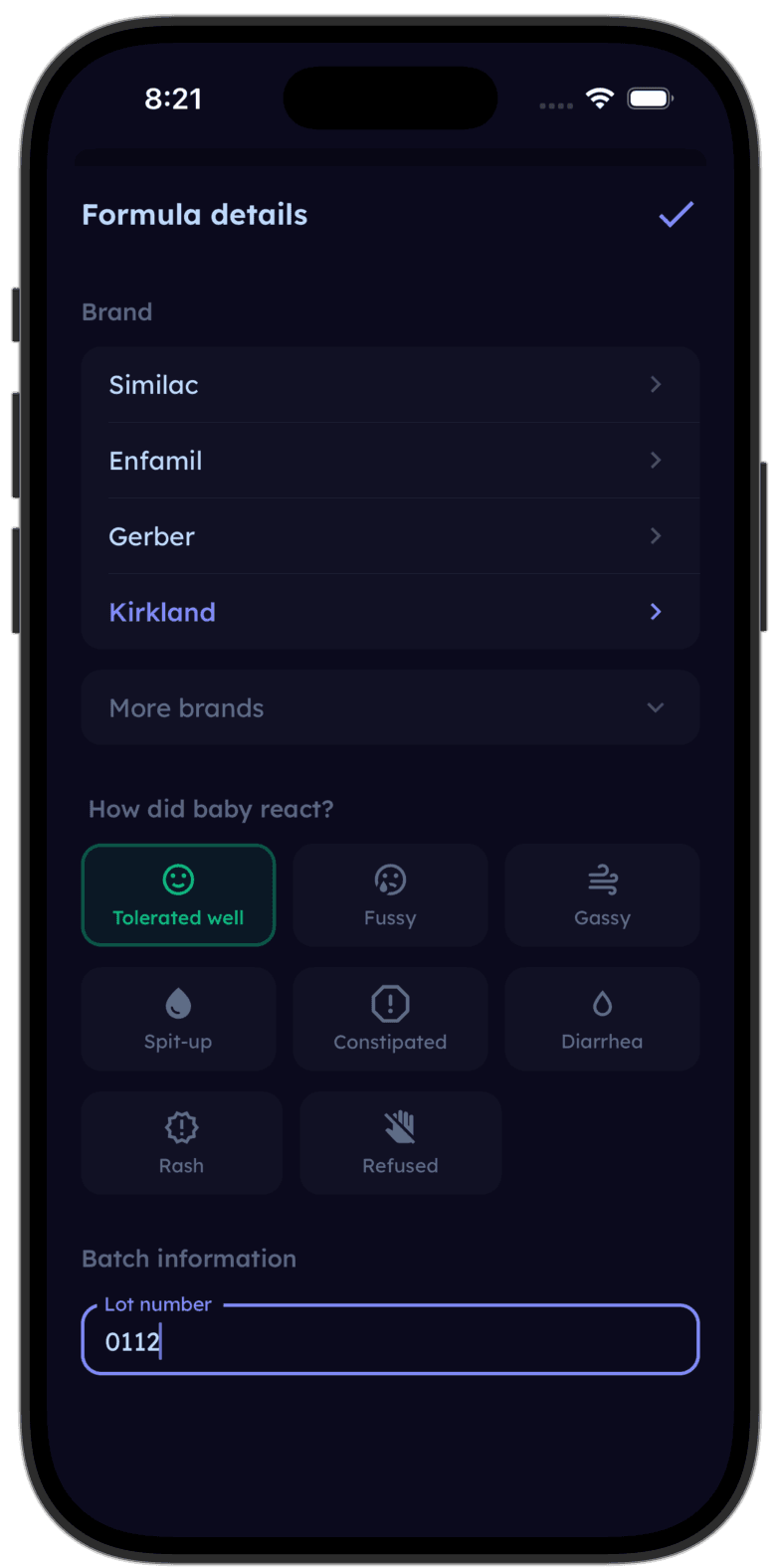
tinylog baby tracker showing formula feed logging

tinylog makes formula transitions easier to track — whatever type you're using.

When you're trying a new formula, tracking feeds and your baby's response helps you see the real picture. Log bottles, note any changes, and have clear data for your next pediatrician visit.

Download on the App StoreGet It On Google Play

The Critical CMPA Warning

This is the single most important point in this guide: goat milk formula is NOT appropriate for babies with cow's milk protein allergy (CMPA).

The proteins in goat milk and cow milk are structurally similar enough that they cross-react in over 90% of CMPA cases. This means that if your baby's immune system reacts to cow's milk protein, it will almost certainly react to goat milk protein as well. Giving goat milk formula to a baby with CMPA will not resolve their symptoms and may cause the same allergic reactions — blood in stool, vomiting, eczema, and GI distress.

This is not a theoretical concern. It's well-documented in allergy research and is the reason the AAP and every major pediatric allergy organization advises against goat milk formula as a CMPA alternative.

If your baby has CMPA, they need an extensively hydrolyzed formula (like Alimentum or Nutramigen) or an amino acid-based formula. Not goat milk. Not sheep milk. Not any other animal milk.

Why Goat Milk Formula Is NOT for CMPA Babies

  • Goat milk protein cross-reacts with cow's milk protein in over 90% of CMPA cases
  • The cross-reactivity is due to structural similarity between goat and cow milk caseins
  • Babies with confirmed CMPA should NOT be given goat milk formula
  • Goat milk formula is NOT hypoallergenic — despite marketing that implies it's 'gentler'
  • If your baby has CMPA, you need an extensively hydrolyzed formula (Alimentum or Nutramigen) or an amino acid-based formula

If your baby has been diagnosed with or is suspected of having CMPA, do not use goat milk formula. Talk to your pediatrician about appropriate hypoallergenic options.

What the Marketing Doesn't Tell You

Goat milk formula marketing is effective because it taps into real structural differences between goat and cow milk. But it extends those differences well beyond what the evidence supports. Here's what the labels and Instagram ads don't mention:

"Gentler" doesn't mean hypoallergenic. The word "gentle" on goat milk formula marketing implies it's suitable for sensitive babies. For babies with general fussiness or mild digestive discomfort, it might be worth trying. But for babies with a genuine protein allergy, "gentle" is dangerously misleading. Goat milk formula will trigger the same immune response as cow milk formula in CMPA babies. The marketing creates a false sense of safety.

The "closer to breast milk" claim is misleading. Some goat milk formula brands highlight that goat milk oligosaccharides are more similar to human milk oligosaccharides than cow milk oligosaccharides. This is technically true in structure but practically irrelevant — neither goat milk nor cow milk oligosaccharides function the same way as the HMOs in breast milk. No formula is close to breast milk, regardless of the milk source.

You're paying a premium for limited evidence. At $36-50 per can, goat milk formula costs as much as name-brand cow milk formula and significantly more than store-brand cow milk formula. The premium is driven by higher raw ingredient costs (goats produce less milk) and the premium positioning of the brands. You're paying more, but the evidence doesn't show you're getting measurably better outcomes for your baby.

The "A2 protein" advantage is borrowed from adult research. The A2 milk trend started with adult dairy consumption, where some people with self-reported dairy discomfort reported feeling better on A2 milk. Applying this to infant formula is a significant extrapolation. Infant digestive systems are different from adult ones, and the studies showing A2 benefits in adults haven't been replicated in infant formula research.

For more on how formula marketing works and what you're really paying for with name brands, see our Kirkland vs. name brand formula guide.

When Goat Milk Formula Might Make Sense

Despite the caveats, goat milk formula is a legitimate option for certain families. It might be worth considering if:

Your baby seems uncomfortable on cow milk formula and you've ruled out CMPA with your pediatrician. Some babies do seem to tolerate goat milk formula better — even if the research can't explain exactly why yet. Anecdotal evidence from parents is consistent enough that it's worth trying if standard formula isn't working.

You prefer a formula without soy or palm oil. Both Kabrita and Kendamil Goat avoid these ingredients, which some parents prefer. This is a valid ingredient preference, though it's also available in some cow milk formulas (like Kendamil Classic).

You value the naturally occurring oligosaccharides and A2 protein profile. If these components align with your research and values, goat milk formula delivers them naturally rather than through supplementation.

You can afford the premium without financial strain. Formula is a daily expense for months. If the higher cost of goat milk formula would create stress, a nutritionally equivalent cow milk formula — including very affordable store brands — will serve your baby just as well.

When to Talk to Your Pediatrician

Talk to your pediatrician before switching to goat milk formula if:

Your baby is showing signs of CMPA — blood in stool, persistent vomiting, eczema, or chronic diarrhea. Goat milk formula is not the answer here. You need a proper allergy evaluation and likely a hypoallergenic formula. See our Alimentum vs. Nutramigen guide for those options.

Your baby is under 6 months and you want to switch formula types. Any formula change in the early months is worth discussing with your doctor, who can help you determine whether the switch is likely to help.

You're considering a goat milk formula that is not FDA-registered (like Holle Goat). Your pediatrician can help you weigh the ingredient benefits against the regulatory and supply chain risks of imported formula. See our Kendamil vs. HiPP guide for more on this topic.

Your baby isn't gaining weight appropriately on any formula. Weight gain concerns are always worth evaluating, regardless of formula type. See our guide on adequate intake for what to watch for.

The Bottom Line

Goat milk formula has real structural differences from cow milk formula — smaller fat globules, more A2 protein, softer curd formation, and higher natural oligosaccharides. These differences are genuine. What hasn't been established is whether they produce meaningfully better outcomes for healthy infants.

The evidence shows comparable growth, nutrition, and tolerance between goat and cow milk formulas. Some babies may do better on one or the other, which is true for any formula comparison. Goat milk formula is a valid choice — but it's not a proven upgrade, and it costs significantly more.

Most importantly: goat milk formula is not hypoallergenic. If your baby has CMPA, goat milk will not help and may cause the same reactions. "Gentle" marketing should not be confused with medical suitability for allergy management.

Choose goat milk formula if the ingredient profile appeals to you, your baby tolerates it well, and the cost is manageable. But don't choose it out of fear that cow milk formula is somehow inadequate. It isn't. Both types meet the same FDA requirements, and both will support your baby's growth and development.

For a broader look at formula options across the market, check out our guides on organic formula and combination feeding.


Related Guides

Sources

  • Zhou SJ, et al. "Nutritional adequacy of goat milk infant formula for term infants: a double-blind randomised controlled trial." British Journal of Nutrition, 2014.
  • Prosser CG. "Compositional and functional characteristics of goat milk and relevance as a base for infant formula." Journal of Food Science, 2021.
  • U.S. Food and Drug Administration — FDA approval of Kabrita goat milk infant formula, 2022
  • U.S. Food and Drug Administration — 21 CFR 107: Infant Formula Requirements
  • Restani P, et al. "Cross-reactivity between milk proteins from different animal species." Clinical & Experimental Allergy, 1999.
  • American Academy of Pediatrics — "Choosing an Infant Formula" (HealthyChildren.org)
  • Maathuis A, et al. "Protein digestion and quality of goat and cow milk infant formula and human milk." Journal of Pediatric Gastroenterology and Nutrition, 2017.

This guide is for informational purposes only and is not a substitute for professional medical advice. If you have concerns about your baby's formula or nutrition, please consult your pediatrician.

Get this comparison in your inbox.
We'll email you this breakdown so you can reference it when researching formula options for your baby.
Trying a new formula type? Keep a clear record.
Download tinylog free — track feeds and see how your baby responds.
Download on the App StoreGet It On Google Play