
GUIDE
Best Baby Formulas in 2026
Published on ·Updated on
The honest answer? Most babies do great on any standard FDA-approved formula. The 'best' one is the one your baby tolerates well and you can afford consistently.
This is not a sponsored listicle. What follows is a category-by-category breakdown based on ingredients, evidence, and real-world value — not marketing budgets.
Free 2-min quiz. Personalized to your baby plus a recall check.
“You usually don't need the most expensive formula to have a healthy, happy baby.”
 Dr. Matthew Badgett, MD, Pediatrician, Cleveland Clinic
A Note Before We Start: There's No 'Bad' Formula on US Shelves
Every infant formula sold in the United States must meet strict nutritional requirements set by the FDA under 21 CFR 107. That means every formula on the shelf — name brand, store brand, organic, conventional — provides the calories, protein, fat, vitamins, and minerals your baby needs to grow. The FDA also inspects manufacturing facilities and requires testing of every batch before it ships.
This is genuinely good news. It means you cannot pick a "wrong" formula at the store. The differences between formulas are real but they are at the margins — protein source, carbohydrate type, added extras like HMOs or prebiotics. None of these marginal differences have been shown to produce meaningfully different health outcomes in healthy, full-term infants.
So when you see a "best formula" list (including this one), keep that context in mind. We are comparing good options against other good options.
| Category | Our Pick | Why It Wins | Price | Best For |
|---|---|---|---|---|
| Best Overall (Standard) | Enfamil NeuroPro / Similac 360 Total Care | Widely available, well-tolerated, includes 2'-FL HMO and DHA. Strong track record. | $$$ | Most babies — a safe starting point |
| Best Budget | Kirkland ProCare (Costco) / Parent's Choice (Walmart) | Meets identical FDA standards. Nearly identical ingredient lists to name brands at 40-50% less cost. | $ | Every baby. Seriously. |
| Best Organic | Bobbie Organic / Kendamil Organic | USDA organic, lactose-based, no corn syrup solids or palm oil. Clean ingredient lists. | $$$$ | Parents who prioritize organic sourcing and can afford the premium |
| Best for Gassy Babies | Enfamil Gentlease / Similac Total Comfort | Partially hydrolyzed whey protein — easier to digest for sensitive tummies. Reduced lactose. | $$$ | Babies with persistent gas or fussiness on standard formula |
| Best Hypoallergenic | Nutramigen / Similac Alimentum | Extensively hydrolyzed casein. Clinically proven for cow's milk protein allergy management. | $$$$ | Babies with diagnosed or suspected CMPA |
| Best European-Style (FDA-Registered) | Kendamil Classic / Bobbie | EU-inspired formulations with lactose as primary carb. FDA registered with US recall infrastructure. | $$$$ | Parents who want EU-style ingredients with US safety oversight |
Best Overall: Enfamil NeuroPro and Similac 360 Total Care
These are the two most widely used standard formulas in the US, and for good reason. Both are milk-based, include DHA, and feature human milk oligosaccharides (HMOs) — prebiotics naturally found in breast milk that support gut health. Both have decades of clinical use behind them.
Enfamil NeuroPro uses a blend of lactose and corn syrup solids as carbohydrates and includes MFGM (milk fat globule membrane), a fat fraction found in breast milk. It contains palm olein oil, which some parents prefer to avoid (more on that below).
Similac 360 Total Care is notable for being palm oil-free and including five different HMOs (most formulas include one or two). It uses a blend of high oleic safflower, soy, and coconut oils.
Both are widely available at grocery stores, pharmacies, and online. Both are covered by WIC in most states. You really cannot go wrong with either one. If your baby tolerates one and you can find it consistently, stick with it.
Best Budget: Store-Brand Formulas
Here is the part the formula industry would rather you not think about too hard: store-brand formulas are made in FDA-inspected facilities, meet the exact same 21 CFR 107 nutritional requirements, and often have nearly identical ingredient lists to the name brands they are modeled after.
Kirkland ProCare (Costco) and Parent's Choice Advantage (Walmart) are both excellent. They include DHA, 2'-FL HMO, and a standard milk-based protein blend. At roughly $0.60-0.65 per ounce of prepared formula, they cost 40-50% less than name brands.
Target's Up and Up and Amazon's Mama Bear lines are also solid options.
The cost savings add up fast. If your baby drinks 25-30 ounces per day, switching from a name brand to store brand can save you $50-80 per month — that is $600-960 over the first year. Same nutrition. Same FDA oversight. Different label.
Best Organic: Bobbie and Kendamil Organic
If organic sourcing matters to you, Bobbie and Kendamil Organic are the standout options in the US market.
Bobbie is a US-made formula with a deliberately simple ingredient list: organic milk, organic lactose (no corn syrup solids), organic vegetable oils (no palm oil), and standard vitamin and mineral fortification. It was designed to align with EU formulation principles while meeting FDA requirements.
Kendamil Organic is made in the UK, FDA-registered for US sale, and uses whole milk as its protein source (most US formulas use skim milk with added whey). It is also palm oil-free and uses lactose as the sole carbohydrate.
Both cost more — roughly $1.30-1.40 per ounce of prepared formula. Whether that premium is worth it depends on your values and budget. For the evidence on organic vs. conventional, see our organic vs. conventional formula guide.
Best for Gassy Babies: Enfamil Gentlease and Similac Total Comfort
Most newborn gassiness is developmental — their digestive systems are immature and they swallow air during feeds. Before switching formula, try slower-flow nipples, better burping technique, and paced bottle feeding.
If gassiness persists beyond 2-3 weeks on standard formula, partially hydrolyzed options can help. These formulas use proteins that have been partially broken down, making them easier to digest.
Enfamil Gentlease uses partially hydrolyzed nonfat milk and whey protein with a reduced-lactose carbohydrate blend. Similac Total Comfort uses 100% whey protein (partially hydrolyzed) and is also reduced-lactose.
Important: these are "gentle" formulas, not hypoallergenic formulas. They are not appropriate for babies with a diagnosed cow's milk protein allergy. For that, you need an extensively hydrolyzed or amino acid-based formula — see our hypoallergenic formula guide.
For a deeper dive on what actually helps gassy babies, see our full guide to formulas for gassy babies.
Best Hypoallergenic: Nutramigen and Alimentum
True hypoallergenic formulas — meaning the FDA allows them to use that label — use extensively hydrolyzed protein or free amino acids. The two most widely available options are Enfamil Nutramigen (casein hydrolysate) and Similac Alimentum (casein hydrolysate).
These formulas are designed for babies with cow's milk protein allergy (CMPA), which affects roughly 2-3% of infants. They should only be used under pediatrician guidance, and the cost is significant — typically $35-50 per can.
For babies who do not tolerate even extensively hydrolyzed formulas, amino acid-based options like EleCare and PurAmino are the next step.
We cover this topic in detail in our hypoallergenic formula guide, including symptoms, the diagnostic process, insurance coverage, and a full comparison table.
Best European-Style (FDA-Registered): Kendamil and Bobbie
The interest in European formulas is driven by real regulatory differences: the EU requires lactose as the primary carbohydrate for Stage 1 formulas, has stricter pesticide limits, and does not allow corn syrup solids. These are legitimate distinctions.
However, importing non-FDA-registered formulas (like HiPP, Holle, or Lebenswert) carries real risks: no US recall infrastructure, potential shipping and storage issues, and labels in languages you may not read.
Kendamil and Bobbie represent the best of both worlds. They are FDA-registered (meaning full US safety oversight) but formulated with EU-inspired principles — lactose-based, palm oil-free, clean ingredient lists. For the full breakdown of EU vs. US formula differences, see our European vs. American formula guide.
| Formula | Protein Source | Carbohydrate | Fat Blend | Key Extras | Cost per Oz (Prepared) |
|---|---|---|---|---|---|
| Enfamil NeuroPro | Nonfat milk, whey | Lactose, corn syrup solids | Palm olein, soy, coconut, HMFO oils | 2'-FL HMO, DHA, MFGM | ~$1.10 |
| Similac 360 Total Care | Nonfat milk, whey | Lactose, galactooligosaccharides | High oleic safflower, soy, coconut oils (no palm) | 5 HMOs, DHA, lutein | ~$1.15 |
| Kirkland ProCare (Costco) | Nonfat milk, whey | Lactose, corn syrup solids | Palm olein, soy, coconut oils | 2'-FL HMO, DHA | ~$0.65 |
| Parent's Choice Advantage (Walmart) | Nonfat milk, whey | Lactose, corn syrup solids | Palm olein, soy, coconut oils | 2'-FL HMO, DHA | ~$0.60 |
| Bobbie Organic | Organic nonfat milk, organic whey | Organic lactose | Organic soy, coconut, sunflower oils (no palm) | DHA, iron | ~$1.40 |
| Kendamil Classic | Whole milk | Lactose | Whole milk fat, coconut, rapeseed oils (no palm) | 3'-GL HMO, DHA from algae | ~$1.30 |
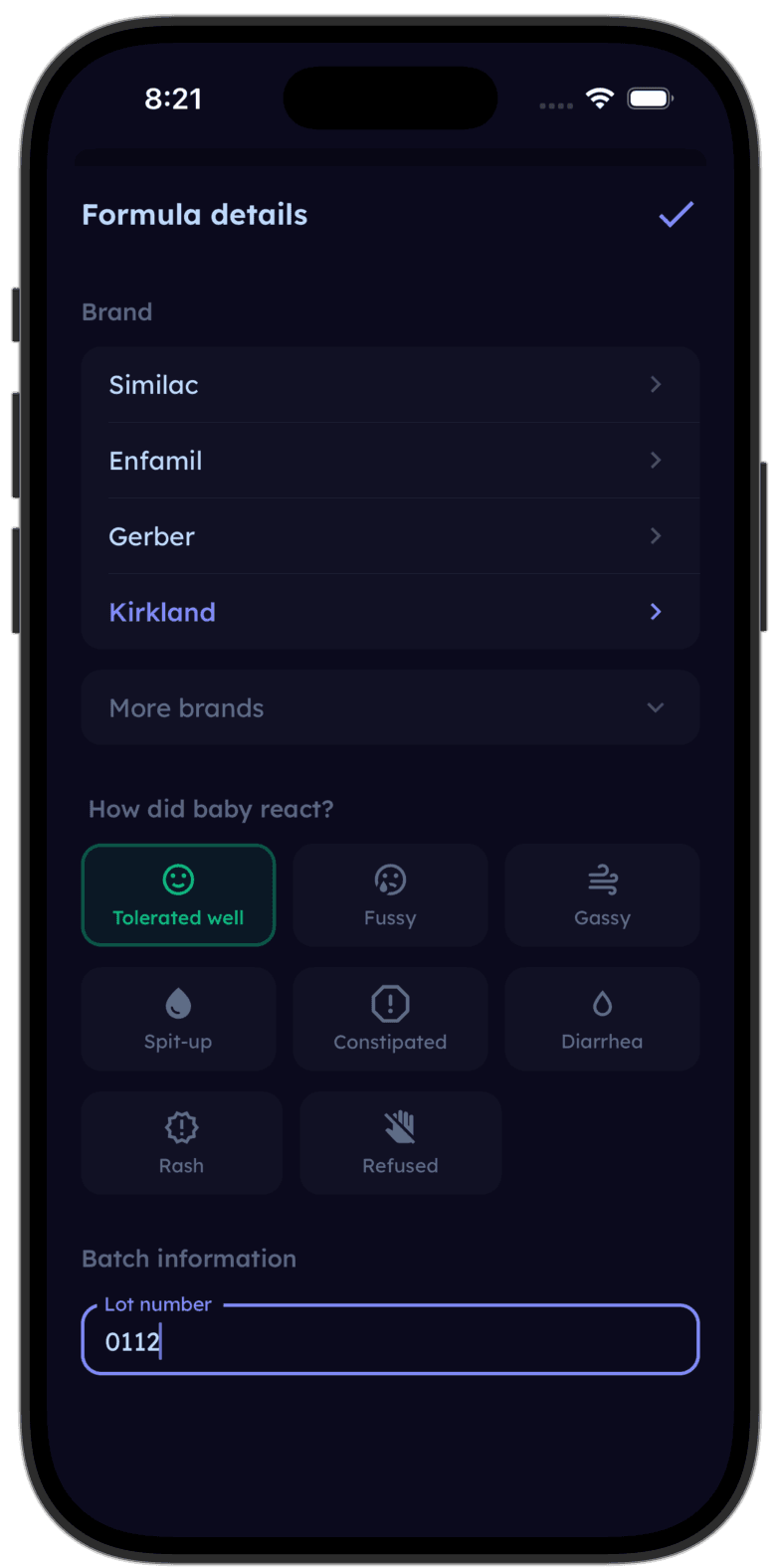
Know which formula is actually working for your baby.
Log each bottle, note the formula type, and track any fussiness, gas, or stool changes. When you're comparing options — or wondering if a switch made a difference — you'll have a week or two of real data instead of trying to remember how things went.


What the Marketing Doesn't Tell You
"Closest to breast milk" is a marketing phrase, not a regulated claim. No formula replicates breast milk. Breast milk contains living cells, antibodies, and thousands of bioactive compounds that cannot be manufactured. Formulas that add one or two HMOs or include MFGM are closer in specific ways, but calling any formula "closest to breast milk" is misleading at best.
Added DHA doesn't guarantee brain benefits. DHA (docosahexaenoic acid) is naturally present in breast milk, and adding it to formula seems reasonable. But the research on whether supplemental DHA in formula improves cognitive outcomes is mixed. A 2017 Cochrane review found no clear benefit on neurodevelopment from LCPUFA supplementation in formula. It probably doesn't hurt, but it may not do what the label implies.
The ingredient list matters less than you think. Assuming the formula meets FDA requirements (and it must, to be sold), the specific fat blend, protein source, and added extras have not been shown to produce different health outcomes in healthy term infants. The biggest factor in your baby's health and development is consistent, adequate nutrition — which any FDA-approved formula provides.
Store brand is genuinely the same. Perrigo, the company that manufactures most US store-brand formulas, uses the same FDA-compliant processes and nearly identical formulations. The main thing you are paying for with name brands is the brand itself.
Signs You May Need to Switch Formulas
- Persistent vomiting after most feeds (not occasional spit-up, which is normal)
- Blood or mucus in stool
- Severe eczema or rash that worsens after feeding
- Extreme fussiness during or immediately after every feed for more than 2 weeks
- Poor weight gain or weight loss
- Refusing to eat consistently
Give any new formula at least 1-2 weeks before deciding. Transitional fussiness is normal. If you see these signs persistently, talk to your pediatrician before switching.
Signs You Do NOT Need to Switch
- Occasional spit-up without discomfort (happy spitter)
- Normal newborn gassiness (almost all newborns are gassy)
- Stool color changes (formula stool varies widely and that's normal)
- Fussiness at specific times of day (evening fussiness is developmental)
- Your baby's poop doesn't look like a breastfed baby's poop (it won't, and that's fine)
Normal newborn behavior is often mistaken for formula intolerance. When in doubt, call your pediatrician — but don't assume you need to switch just because your baby is doing normal baby things.
When to Talk to Your Pediatrician
Your pediatrician is the best resource for formula decisions specific to your baby. Talk to them if:
- Your baby has persistent symptoms that concern you (vomiting, blood in stool, rash, poor weight gain)
- You are considering switching to a specialty formula (gentle, hypoallergenic, or amino acid-based)
- Your baby was premature or has specific medical conditions that may affect formula choice
- You are considering an imported formula that is not FDA-registered
- You are feeling overwhelmed by the choices and just want a clear recommendation
Bring data to the conversation. If you have been tracking feeds and symptoms — how much your baby eats, when they seem uncomfortable, how their output looks — that information helps your pediatrician give you a specific, personalized recommendation rather than a generic one. A feeding log from an app like Tinylog can make that conversation much more productive.
The Bottom Line
The best baby formula in 2026 is the one your baby tolerates well, that you can find and afford consistently, and that is FDA-approved. That is genuinely the whole answer.
If your baby is happy on a store-brand formula, there is no evidence-based reason to switch to something more expensive. If your baby needs a specialty formula, the right one depends on their specific symptoms and your pediatrician's guidance. And if you are choosing between two comparable options, pick the one that is easier for you to buy regularly — consistent nutrition matters more than any specific ingredient on the label.
Once you pick a formula, give it two full weeks before deciding. Logging bottles and noting any reactions in Tinylog during that window gives you a clear before-and-after — so your next conversation with your pediatrician starts with data, not uncertainty.
If you are starting with a standard formula and want a well-tested starting point, Enfamil NeuroPro Baby Formula and Similac 360 Total Care Baby Formula are both widely available and a reasonable first choice for most babies.
Tinylog earns a small commission on purchases made through these links, at no cost to you.
Tip: check promo.new before purchasing. It's hit or miss depending on the product, but when it hits, you'll be glad you checked.
For more on feeding amounts by age, see our baby feeding chart. If you are combining formula with breastfeeding, our combination feeding guide covers how to make that work.
Related Guides
-
Best Organic Formulas — Honest, evidence-based rankings
-
Best Hypoallergenic Formulas — When you need one and how to choose
-
Enfamil vs. Similac — A complete comparison for new parents
-
Cheapest Formulas — Options that meet every nutritional standard
-
Similac Soy vs. Enfamil ProSobee — Soy formula options compared
-
Similac vs. Up&Up — Name brand vs. Target's store brand
-
Enfamil vs. Up&Up — Name brand vs. Target's store brand
Sources
- U.S. Food and Drug Administration — "21 CFR 107: Infant Formula Requirements." Code of Federal Regulations.
- U.S. Food and Drug Administration — "Infant Formula Guidance Documents & Regulatory Information," 2024.
- American Academy of Pediatrics — "Choosing an Infant Formula." HealthyChildren.org, 2023.
- Jasani B, et al. "Long chain polyunsaturated fatty acid supplementation in infants born at term." Cochrane Database of Systematic Reviews, 2017.
- Martin CR, et al. "Review of Infant Feeding: Key Features of Breast Milk and Infant Formula." Nutrients, 2016.
- Bournez M, et al. "Comparison of the nutritional composition of infant formulas marketed in France." Archives de Pediatrie, 2022.
- Rossen LM, et al. "Types of Infant Formulas Consumed in the United States." Clinical Pediatrics, 2016.
This guide is for informational purposes only and is not a substitute for professional medical advice. If you have concerns about your baby's feeding or formula tolerance, please consult your pediatrician.
Frequently asked questions
- What is the best baby formula in 2026?
- There is no single 'best' formula. All FDA-approved formulas sold in the US meet the same minimum nutritional requirements under 21 CFR 107. The best formula for your baby is one they tolerate well, that you can find consistently, and that fits your budget. Most babies thrive on any standard formula.
- Is expensive formula better than cheap formula?
- Not necessarily. Store-brand formulas (Kirkland, Parent's Choice, Up&Up) are required to meet the same FDA nutritional standards as name brands. The ingredients are often nearly identical. The main differences are usually in marketing, packaging, and added extras like prebiotics or DHA levels — none of which have strong evidence of meaningful clinical differences.
- Should I choose organic baby formula?
- Organic formula meets the same FDA nutritional requirements as conventional formula. The organic label refers to ingredient sourcing and farming practices, not nutritional superiority. No published study has shown different health outcomes between organic and conventional formula. If it fits your budget and values, it's a fine choice — but don't stretch financially for it.
- How do I know if I should switch formulas?
- Give any new formula at least 1-2 weeks before deciding it isn't working. Signs your baby may not tolerate a formula include persistent vomiting (not just spit-up), bloody stool, severe rash or eczema, extreme fussiness during or after every feed, and poor weight gain. Talk to your pediatrician before switching, especially before moving to a specialty formula.
- Are European formulas better than American formulas?
- EU and US formulas have different regulatory standards, and each has strengths. EU regulations require lactose as the primary carbohydrate and have a staged system. US regulations require different vitamin and mineral levels. Neither is objectively 'better.' Some US brands like Kendamil and Bobbie now offer FDA-registered formulas with EU-inspired formulations.