GUIDE

Best Hypoallergenic Baby Formulas

True hypoallergenic formulas use extensively hydrolyzed or amino acid-based protein. The two most common are Nutramigen and Alimentum. You should only use them under pediatrician guidance.

The word 'hypoallergenic' gets thrown around loosely in formula marketing. In FDA terms, it has a specific meaning — and most 'gentle' formulas don't qualify. Here's what you actually need to know.

What 'Hypoallergenic' Actually Means (and What It Doesn't)

The term "hypoallergenic" is regulated by the FDA for infant formula. A formula can only carry this label if clinical evidence demonstrates it is tolerated by at least 90% of infants with confirmed cow's milk protein allergy, with 95% confidence. This is a specific, testable standard.

This means only two types of formulas qualify:

Extensively hydrolyzed formulas break cow's milk protein into peptides smaller than 3,000 daltons — fragments so small that the immune system of most CMPA babies doesn't recognize them as the allergen. Nutramigen and Alimentum are the two main options in this category.

Amino acid-based formulas go further. They contain no intact protein at all — just free amino acids, the individual building blocks of protein. EleCare and PurAmino are the two primary US options. These are reserved for babies who react even to extensively hydrolyzed formulas, which happens in roughly 5-10% of CMPA cases.

What does NOT qualify as hypoallergenic:

Partially hydrolyzed formulas like Enfamil Gentlease, Similac Total Comfort, and Gerber GentlePro break proteins into smaller pieces, but not small enough. They still contain peptide fragments large enough to trigger an immune response in babies with CMPA. These formulas are designed for general fussiness and gas — not allergy management. Using them for a CMPA baby is not just ineffective, it continues to expose the baby to the allergen.

The Formula Spectrum: From Standard to Amino Acid-Based
Standard
ExamplesEnfamil NeuroPro, Similac 360 Total Care
Protein StateIntact cow's milk proteins
Designed ForMost babies — no allergy concerns
Hypoallergenic?No
Partially Hydrolyzed
ExamplesEnfamil Gentlease, Similac Total Comfort, Gerber GentlePro
Protein StateProteins partially broken down
Designed ForFussy/gassy babies — NOT for milk allergy
Hypoallergenic?No
Extensively Hydrolyzed
ExamplesNutramigen (Enfamil), Alimentum (Similac)
Protein StateProteins broken into very small peptides (< 3,000 daltons)
Designed ForDiagnosed or suspected CMPA
Hypoallergenic?Yes (FDA definition)
Amino Acid-Based
ExamplesEleCare (Abbott), PurAmino (Enfamil)
Protein StateFree amino acids — no intact protein at all
Designed ForSevere CMPA, multiple food protein allergies, or no improvement on extensively hydrolyzed
Hypoallergenic?Yes (FDA definition)
This spectrum represents an escalation path. Most babies thrive on standard formula. Only 2-3% of infants have CMPA, and most of those do well on extensively hydrolyzed formulas.

Cow's Milk Protein Allergy: What to Watch For

CMPA (cow's milk protein allergy) affects approximately 2-3% of infants. It is an immune response to the proteins in cow's milk — distinct from lactose intolerance, which involves the milk sugar. CMPA can present as IgE-mediated (immediate reactions within minutes to hours) or non-IgE-mediated (delayed reactions over hours to days). Non-IgE-mediated CMPA is more common in infants and harder to identify because the symptoms are delayed and can overlap with normal newborn fussiness.

The key is looking for patterns and severity. Every baby spits up sometimes. Every baby is gassy. CMPA symptoms are persistent, often severe, and typically involve multiple symptoms occurring together.

Symptoms That May Indicate CMPA

  • Blood or mucus in stool (even small streaks count)
  • Severe eczema or persistent rash, especially worsening after feeds
  • Frequent forceful vomiting (not normal spit-up — we're talking projectile or large volumes)
  • Extreme fussiness or inconsolable crying during and right after feeds
  • Poor weight gain or failure to thrive despite adequate intake
  • Chronic diarrhea or very watery stools
  • Refusing to eat or arching away from the bottle
  • Wheezing or respiratory symptoms after feeding (less common but possible)

These symptoms can also have other causes. The presence of multiple symptoms together — especially bloody stool combined with eczema or vomiting — is more suggestive of CMPA than any single symptom alone. Always consult your pediatrician for diagnosis.

Symptoms That Are Probably NOT CMPA

  • Normal spit-up without distress (the 'happy spitter')
  • Occasional gassiness or fussiness that resolves between feeds
  • Normal newborn acne or cradle cap
  • Stool color variations (green, yellow, tan — all normal for formula-fed babies)
  • Evening fussiness (developmental, peaks at 6 weeks, resolves by 3-4 months)
  • Fussiness during a growth spurt (temporary and related to increased hunger)

Normal newborn behavior is frequently mistaken for food allergy. If your baby has mild, intermittent symptoms with good weight gain and is generally happy between feeds, CMPA is unlikely.

Hypoallergenic Formula Comparison
Nutramigen (Enfamil)
Protein SourceExtensively hydrolyzed casein
CarbohydratesCorn syrup solids, modified corn starch
Fat BlendPalm olein, soy, coconut, high oleic sunflower oils
Key ExtrasLGG probiotic, DHA, ARA, iron
Cost$38-45 / 12.6 oz can
TasteBitter (normal for hydrolysates)
Alimentum (Similac)
Protein SourceExtensively hydrolyzed casein
CarbohydratesSucrose, modified tapioca starch
Fat BlendSafflower, MCT, soy oils (no palm oil)
Key ExtrasDHA, ARA, lutein, iron
Cost$35-42 / 12.1 oz can
TasteSlightly sweeter than Nutramigen (sucrose vs. corn syrup)
EleCare (Abbott)
Protein SourceFree amino acids (100%)
CarbohydratesCorn syrup solids
Fat BlendHigh oleic safflower, MCT, soy oils
Key ExtrasDHA, ARA, lutein, iron
Cost$45-55 / 14.1 oz can
TasteLess bitter than casein hydrolysates
PurAmino (Enfamil)
Protein SourceFree amino acids (100%)
CarbohydratesCorn syrup solids, modified corn starch
Fat BlendMCT, soy, high oleic sunflower oils
Key ExtrasDHA, ARA, iron
Cost$48-58 / 14.1 oz can
TasteLess bitter than casein hydrolysates
All extensively hydrolyzed and amino acid-based formulas meet FDA requirements for the 'hypoallergenic' claim. The choice between them often comes down to baby's tolerance, availability, insurance coverage, and WIC eligibility.

The Diagnostic Process: How CMPA Is Identified

CMPA is diagnosed through an elimination and reintroduction process — not a blood test. Here is how it typically works:

Step 1: Suspect. You notice persistent symptoms — bloody stool, worsening eczema, frequent vomiting, extreme fussiness with feeds. You bring this to your pediatrician with your observations. This is where a detailed feeding log is genuinely valuable. If you have been tracking feeds, stools, and symptoms in tinylog or a similar app, bring that data to your appointment.

Step 2: Eliminate. Your pediatrician recommends switching to an extensively hydrolyzed formula (Nutramigen or Alimentum) for a trial period, typically 2-4 weeks. During this time, you watch for symptom improvement.

Step 3: Evaluate. If symptoms resolve on the hypoallergenic formula, CMPA is likely. Some pediatricians will then do a supervised reintroduction of standard formula to confirm — if symptoms return, the diagnosis is confirmed.

Step 4: Manage. Your baby stays on the hypoallergenic formula. Most children outgrow CMPA by age 1 (about 50%) to age 3 (about 80-90%). Your pediatrician will guide you on when and how to trial reintroduction of milk protein.

Blood tests (specific IgE) and skin prick tests can help identify IgE-mediated CMPA but cannot diagnose non-IgE-mediated CMPA, which is the more common form in infants. The elimination diet remains the gold standard diagnostic tool.


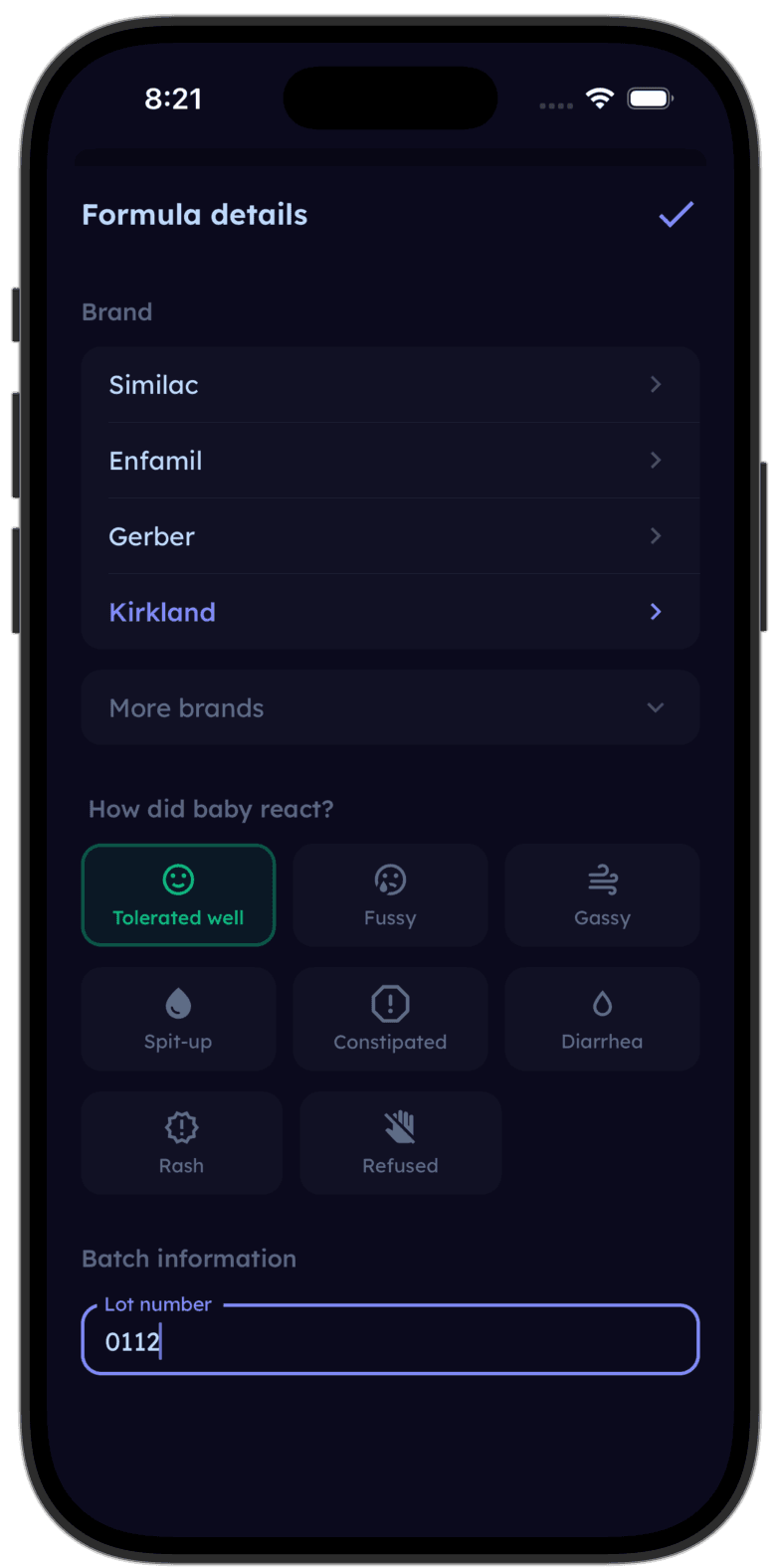
tinylog feeding tracker showing logged feeds with symptom notes

tinylog makes the elimination trial easier to evaluate.

Log every feed, note symptoms, and track stool changes during a formula transition. When you see your pediatrician for the 2-week check-in, you'll have real data to share — not just 'I think things are a little better.'

Download on the App StoreGet It On Google Play

Transitioning to a Hypoallergenic Formula

Switching to a hypoallergenic formula is an adjustment for both you and your baby. Here is what to expect:

Expect the taste to be different

Extensively hydrolyzed formulas taste bitter. This is normal — it's the broken-down proteins. Some babies transition easily. Others resist for a few feeds. Try mixing 25% new formula with 75% old, then gradually increase over 3-5 days. If your baby is in significant discomfort from CMPA, they often accept the new formula quickly because they feel better.

Stools will change

Hypoallergenic formula stools are often darker (greenish or brownish), looser, and smell different. This is expected. If you see LESS blood in stool after switching, that's a very good sign. Full resolution of bloody stools usually takes 1-2 weeks.

Give it at least 2-4 weeks

CMPA symptoms take time to resolve. Gut inflammation from the allergic reaction needs time to heal. Most pediatric allergists recommend a 2-4 week elimination trial before declaring the formula ineffective. Track symptoms daily to see the trend.

Don't go back and forth

Reintroducing the allergenic protein during an elimination trial resets the clock. Commit to the trial period. If symptoms resolve and then return when you reintroduce standard formula, that's a strong confirmation of CMPA.

The Cost Reality: What Hypoallergenic Formulas Actually Cost
Standard (Enfamil NeuroPro)
Price per Can$28-33
Monthly Estimate$150-180
Annual Estimate$1,800-2,160
Standard (Store Brand)
Price per Can$15-20
Monthly Estimate$85-110
Annual Estimate$1,020-1,320
Extensively Hydrolyzed (Nutramigen)
Price per Can$38-45
Monthly Estimate$210-250
Annual Estimate$2,520-3,000
Extensively Hydrolyzed (Alimentum)
Price per Can$35-42
Monthly Estimate$195-235
Annual Estimate$2,340-2,820
Amino Acid-Based (EleCare)
Price per Can$45-55
Monthly Estimate$250-305
Annual Estimate$3,000-3,660
Amino Acid-Based (PurAmino)
Price per Can$48-58
Monthly Estimate$265-320
Annual Estimate$3,180-3,840
Estimates based on a baby consuming approximately 25-30 oz per day. Prices are approximate retail as of early 2026 and vary by retailer. Store-brand hypoallergenic options (like Walmart's Parent's Choice Hypoallergenic) are available and cost 20-30% less.

Paying for Hypoallergenic Formula: Insurance, WIC, and Other Options

The cost of hypoallergenic formula is a real burden. At $200-320 per month, it can strain family budgets significantly. Here are your options:

WIC (Women, Infants, and Children): Most state WIC programs cover Nutramigen and Alimentum with medical documentation from your pediatrician. Some states also cover amino acid-based formulas. Contact your local WIC office with your pediatrician's documentation.

Health insurance: Coverage varies widely. Some plans cover hypoallergenic formula as a medical food with a prescription and prior authorization. Your pediatrician's office can help with the paperwork. It is worth submitting even if you expect a denial — appeals sometimes succeed, especially with documented CMPA diagnosis.

Manufacturer assistance programs: Both Enfamil and Similac offer savings programs, coupons, and sometimes rebates for specialty formulas. Sign up directly on their websites.

Store brands: Walmart's Parent's Choice Hypoallergenic and other store-brand extensively hydrolyzed formulas are available at lower cost. They meet the same FDA requirements and use the same casein hydrolysate base.

FSA/HSA: If you have a Flexible Spending Account or Health Savings Account, hypoallergenic formula purchased with a prescription may be an eligible expense. Check with your plan administrator.

What the Marketing Doesn't Tell You

"Gentle" and "hypoallergenic" are not the same thing. Formulas marketed as "gentle" (Gentlease, Total Comfort) use partially hydrolyzed protein. They are not hypoallergenic, and the FDA does not allow them to make that claim. The marketing makes them seem like they are on the same spectrum, just milder. They are not. If your baby has CMPA, a gentle formula is not a step in the right direction — it is the wrong category entirely.

Most babies on hypoallergenic formula do not actually have CMPA. Studies suggest that hypoallergenic formulas are overprescribed. A 2018 review in the British Medical Journal found that CMPA prevalence in self-reported populations is 4-6 times higher than confirmed by diagnostic criteria. Many babies placed on expensive hypoallergenic formulas would have done fine on a standard or partially hydrolyzed formula. This is why proper diagnosis matters — both for your baby's sake and for your wallet.

The formulas are not interchangeable with partially hydrolyzed options. Despite similar-sounding names and shelf placement, Gentlease and Nutramigen are fundamentally different products. One reduces protein size. The other reduces it dramatically further. That difference determines whether a CMPA baby's immune system recognizes the protein as an allergen.

For an in-depth comparison of the two main brands, see our guide comparing the gassy baby formulas: best formulas for gassy babies.

When to Talk to Your Pediatrician

Talk to your pediatrician if you notice any of the following:

  • Blood or mucus in your baby's stool (even small amounts)
  • Eczema or rash that is worsening or not responding to treatment
  • Persistent vomiting (not just spit-up) after most feeds
  • Your baby is not gaining weight adequately
  • Extreme fussiness during or after every feed that does not resolve
  • You have tried a gentle formula for 2 weeks with no improvement
  • Your baby is already on a hypoallergenic formula but symptoms persist (may need amino acid-based)
  • You want to trial reintroduction of standard formula after a period on hypoallergenic

Your pediatrician may refer you to a pediatric gastroenterologist or allergist for complex cases. Bring your feeding and symptom data — the timeline of what you tried and when helps the specialist understand the full picture quickly.

The Bottom Line

True hypoallergenic formula is a specific medical product designed for a specific condition. If your baby has CMPA, it is essential. If your baby is just fussy or gassy, it is expensive overkill.

The diagnostic process — elimination, observation, evaluation — takes a few weeks but saves you from months on a formula you may not need. Work with your pediatrician. Track symptoms carefully. And remember that most children outgrow CMPA, so this is almost certainly a temporary chapter.

For our overall formula comparison, see our best baby formulas 2026 guide. For more on the "gentle" formula category, see our formulas for gassy babies guide.

Related Guides

Sources

  • American Academy of Pediatrics Committee on Nutrition — "Hypoallergenic Infant Formulas." Pediatrics, 2000.
  • Koletzko S, et al. "Diagnostic Approach and Management of Cow's-Milk Protein Allergy in Infants and Children: ESPGHAN GI Committee Practical Guidelines." Journal of Pediatric Gastroenterology and Nutrition, 2012.
  • Venter C, et al. "Better recognition, diagnosis and management of non-IgE-mediated cow's milk allergy in infancy." Clinical and Translational Allergy, 2013.
  • Munblit D, et al. "Assessment of Evidence About Common Infant Symptoms and Cow's Milk Allergy." JAMA Pediatrics, 2020.
  • Vandenplas Y, et al. "Guidelines for the diagnosis and management of cow's milk protein allergy in infants." Archives of Disease in Childhood, 2007.
  • U.S. Food and Drug Administration — "21 CFR 107: Infant Formula Requirements."
  • Host A. "Frequency of cow's milk allergy in childhood." Annals of Allergy, Asthma & Immunology, 2002.

This guide is for informational purposes only and is not a substitute for professional medical advice. Hypoallergenic formulas should only be used under the guidance of your pediatrician. If you suspect your baby has a cow's milk protein allergy, consult your pediatrician for proper diagnosis and management.

Get this guide in your inbox.
We'll email you this guide with the full comparison table so you can reference it during pediatrician visits.
Track symptoms during a formula transition.
Download tinylog free — log feeds, note reactions, and share the data with your pediatrician.
Download on the App StoreGet It On Google Play