
GUIDE
Alimentum vs. Nutramigen vs. PurAmino
Published on ·Updated on
Alimentum and Nutramigen are extensively hydrolyzed casein formulas for most CMPA babies. PurAmino is amino acid-based for the most severe cases. All three require pediatric guidance.
Cow's milk protein allergy (CMPA) affects 2–3% of infants. These three hypoallergenic formulas represent escalating levels of protein breakdown — from extensively hydrolyzed (Alimentum, Nutramigen) to completely amino acid-based (PurAmino). Here is how to understand the options.
Log formula and bottles
“Most babies don't need extensively hydrolyzed formula, so only use this kind if your pediatrician recommends it.”
 Dr. Matthew Badgett, MD, Pediatrician, Cleveland Clinic
The Honest Starting Point
If your pediatrician has recommended a hypoallergenic formula, your baby likely has confirmed or strongly suspected cow's milk protein allergy (CMPA). This affects approximately 2–3% of infants and typically presents with one or more of: blood in stool, persistent vomiting, failure to thrive, severe eczema, or chronic diarrhea.
This is not the same as mild fussiness or gas. CMPA is a medical condition that requires appropriate formula — not a gentle or sensitive formula, but a truly hypoallergenic one.
Alimentum and Nutramigen are the first-line hypoallergenic options. They use extensively hydrolyzed casein — cow's milk protein broken into fragments small enough that approximately 90% of CMPA babies can tolerate them. PurAmino goes further, using free amino acids instead of protein chains. It is for the roughly 10% of CMPA babies who react even to extensively hydrolyzed formulas, or babies with multiple food protein intolerances.
These formulas should be used under pediatric guidance. This guide helps you understand the differences, but your doctor should direct the decision.
For more on feeding amounts by age, see our baby feeding chart.
| Feature | Alimentum | Nutramigen | PurAmino | What It Means |
|---|---|---|---|---|
| Type | Extensively hydrolyzed casein | Extensively hydrolyzed casein | Amino acid-based | Alimentum and Nutramigen break protein into small fragments. PurAmino uses free amino acids. |
| Manufacturer | Abbott (Similac family) | Reckitt / Mead Johnson (Enfamil family) | Reckitt / Mead Johnson (Enfamil family) | One from Abbott, two from Mead Johnson. |
| Protein source | Casein hydrolysate (from cow's milk, extensively broken down) | Casein hydrolysate (from cow's milk, extensively broken down) | Free amino acids (no protein chains at all) | PurAmino eliminates all protein chain exposure. This is for the most severe cases. |
| Carbohydrate source | Corn maltodextrin, sucrose | Corn syrup solids, modified corn starch | Corn syrup solids, modified tapioca starch | All use corn-derived carbs. None contains lactose. |
| Fat source | Safflower, MCT, soy oils (no palm olein) | Palm olein, soy, coconut, high oleic sunflower oils | MCT oil, soy, high oleic sunflower oils | Alimentum and PurAmino include MCT oil (easier to absorb). Nutramigen uses palm olein. |
| Probiotics | No | LGG probiotic (Lactobacillus rhamnosus GG) | No | Nutramigen adds LGG, which may help develop cow's milk tolerance faster. |
| Suitable for CMPA | Yes — ~90% of CMPA babies tolerate it | Yes — ~90% of CMPA babies tolerate it | Yes — for the ~10% who react to extensively hydrolyzed formulas | Start with Alimentum or Nutramigen. PurAmino is the escalation if those fail. |
| Price per oz (powder) | ~$1.80–$2.20/oz prepared | ~$1.80–$2.20/oz prepared | ~$2.50–$3.50/oz prepared | PurAmino is significantly more expensive. Alimentum and Nutramigen are comparably priced. |
The Ingredient Differences That Actually Matter
All three are designed for the same problem but at different levels of protein breakdown.
Extensively hydrolyzed vs. amino acid-based
Alimentum and Nutramigen use extensively hydrolyzed casein. The protein is broken into small peptides (protein fragments) that are too small to trigger an immune response in most allergic babies. About 90% of CMPA babies tolerate these formulas.
PurAmino uses free amino acids — the building blocks of protein, with no protein chains at all. This eliminates any possibility of protein-triggered immune response. It is reserved for babies who react to even the small peptides in extensively hydrolyzed formulas, or babies with multiple food protein intolerances (e.g., FPIES — food protein-induced enterocolitis syndrome).
LGG probiotic: Nutramigen's differentiator
Nutramigen includes LGG (Lactobacillus rhamnosus GG), a well-studied probiotic. Research suggests LGG may help some CMPA babies develop cow's milk tolerance faster. A study in the Journal of Allergy and Clinical Immunology found that infants receiving Nutramigen with LGG were more likely to acquire tolerance by 12 months compared to those on formula without LGG. This is a meaningful addition backed by evidence.
Fat source: MCT oil and palm olein
Alimentum and PurAmino include MCT oil (medium-chain triglycerides), which is easier to absorb — important for babies with compromised gut function from allergic inflammation. Nutramigen uses palm olein, which may contribute to firmer stools. For a baby already dealing with gastrointestinal inflammation from CMPA, the easier-absorbing fat blend in Alimentum may be an advantage.
What the Marketing Doesn't Tell You
Hypoallergenic formulas taste and smell significantly worse than standard formula. The hydrolysis process that breaks down proteins also produces bitter-tasting peptides. PurAmino, being amino acid-based, has the most distinctive taste and odor. Parents should be prepared for this — it is an unavoidable consequence of the formulation, not a defect.
Babies who start on hypoallergenic formula from birth typically accept the taste without issue. Older babies transitioning from standard formula may resist. Gradual transition over several days can help, but some babies need time to adjust.
Store-brand hypoallergenic formulas exist. Perrigo makes extensively hydrolyzed store-brand options (Parent's Choice Hypoallergenic, Up & Up Hypoallergenic) that cost 25–35% less than name brands. They meet the same FDA requirements. Ask your pediatrician if a store-brand option is appropriate for your baby.
Insurance coverage: some insurance plans and WIC programs cover hypoallergenic formula with a prescription or letter of medical necessity from your pediatrician. The cost difference ($200–380/month) makes this worth pursuing.
| Product | Typical Price | Cost Per Oz (Prepared) | Monthly Estimate |
|---|---|---|---|
| Similac Alimentum (powder, 19.8 oz) | $38–$46 | ~$2.00/oz prepared | ~$210–$260/month |
| Enfamil Nutramigen (powder, 19.8 oz) | $40–$48 | ~$2.00/oz prepared | ~$210–$260/month |
| Enfamil PurAmino (powder, 14.1 oz) | $44–$52 | ~$3.00/oz prepared | ~$280–$380/month |
| Store-brand hypoallergenic (for reference) | $28–$36 | ~$1.50–$1.80/oz prepared | ~$160–$210/month |
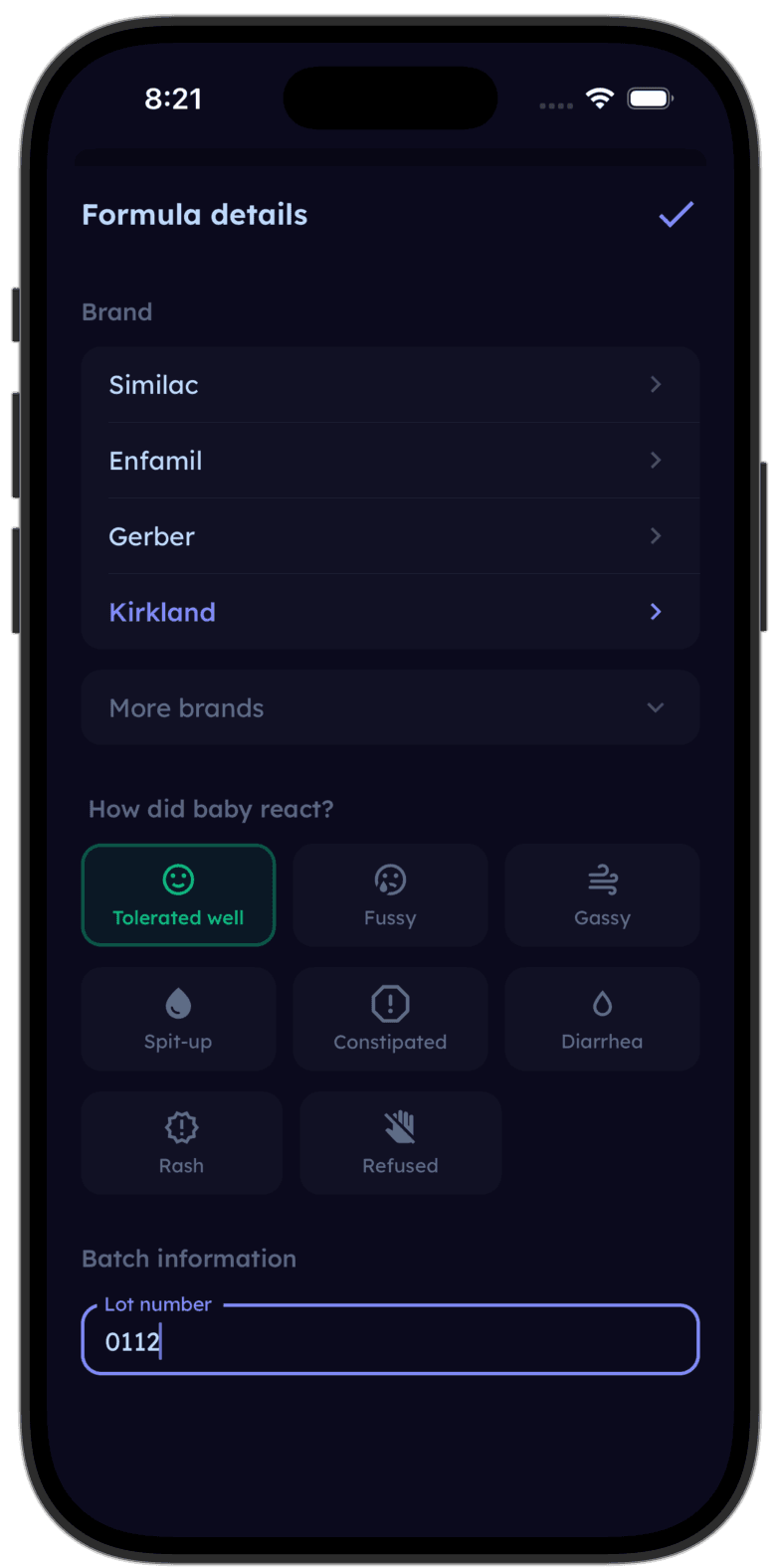
Tinylog tracks feeds and symptoms so your pediatrician has real data.
Log each bottle, track stool changes, note fussiness and eczema flares. Bring 2 weeks of data to your next appointment — it makes a real difference in CMPA management.


Taste, Mixing, and Practical Differences
Taste and smell: All three have a strong, distinctive taste and odor. PurAmino is the most intense. This is normal and unavoidable.
Mixing: Alimentum and Nutramigen can be clumpy and benefit from vigorous shaking or a formula pitcher. PurAmino dissolves more easily. All may produce frothy bottles — let them settle before feeding.
Stool changes: Expect changes. Stools on hypoallergenic formula are often greenish, looser, and stronger-smelling. This is normal and expected — not a sign of intolerance.
Availability: Alimentum and Nutramigen are available at major retailers and pharmacies. PurAmino may need to be ordered online or through a pharmacy. Stock varies — keep a backup supply.
When to Escalate to Your Pediatrician
If your baby is on a hypoallergenic formula and symptoms persist or worsen, your pediatrician needs to know. This may indicate a need to escalate from extensively hydrolyzed (Alimentum/Nutramigen) to amino acid-based (PurAmino), or it may suggest a different diagnosis.
Signs to Report Immediately
- Blood or mucus in stools that does not resolve within 2 weeks on hypoallergenic formula
- Persistent vomiting despite formula change
- Failure to gain weight or continued weight loss
- Severe eczema that worsens
- Chronic diarrhea (more than 2 weeks)
- Any signs of anaphylaxis: difficulty breathing, severe swelling, widespread hives (call 911)
CMPA management is a process. Most babies improve significantly within 2–4 weeks on the right formula. If symptoms persist, escalation may be needed. Do not give up — work with your pediatrician.
The Bottom Line
For most CMPA babies, Alimentum or Nutramigen will resolve symptoms. They are comparably priced and both extensively hydrolyzed. PurAmino is reserved for severe cases.
Choose Alimentum if: you want a palm-olein-free fat blend with MCT oil, or your baby has compromised gut absorption.
Choose Nutramigen if: the LGG probiotic for faster tolerance development appeals to you, or your baby's pediatrician specifically recommends it.
Choose PurAmino if: your baby does not improve on Alimentum or Nutramigen after 2–4 weeks, has multiple food protein intolerances, or has FPIES.
All three decisions should involve your pediatrician. CMPA management benefits from professional guidance and careful symptom tracking.
If you are trialing a hypoallergenic formula, tracking feeds, diapers, fussiness, and skin symptoms for 2–4 weeks gives your pediatrician the data needed to make informed decisions. Tinylog makes this easy. Because hypoallergenic formulas are harder to source, sign up for free recall alerts so you'll know right away if your baby's formula is ever recalled.
For gentle (non-hypoallergenic) options, see Similac Sensitive vs. Enfamil Gentlease. For the standard formula comparison, see Enfamil vs. Similac.
Related Guides
-
Best Hypoallergenic Formulas — When you need one and how to choose
-
Milk Protein Allergy in Poop — Signs of allergy in your baby's diaper
-
Switching Formulas — How to do it safely
Sources
- U.S. Food and Drug Administration. "21 CFR Part 107 — Infant Formula." Code of Federal Regulations.
- American Academy of Pediatrics. "Choosing a Formula for a Baby with Cow's Milk Allergy." HealthyChildren.org, 2024.
- Canani RB, et al. "Formula selection for management of children with cow's milk allergy influences the rate of acquisition of tolerance." Journal of Allergy and Clinical Immunology, 2013.
- Koletzko S, et al. "Diagnostic approach and management of cow's-milk protein allergy." Journal of Pediatric Gastroenterology and Nutrition, 2012.
- Vandenplas Y, et al. "Guidelines for the diagnosis and management of cow's milk protein allergy in infants." Archives of Disease in Childhood, 2007.
- U.S. FDA. "Infant Formula Guidance Documents and Regulatory Information." fda.gov, 2023.
This guide is for informational purposes only and is not a substitute for professional medical advice. Hypoallergenic formula decisions should be made in consultation with your pediatrician. If you suspect your baby has a food allergy, seek professional evaluation.
Frequently asked questions
- What is the difference between Alimentum, Nutramigen, and PurAmino?
- Alimentum (Similac) and Nutramigen (Enfamil) are extensively hydrolyzed casein formulas — the protein is broken into very small fragments. Most CMPA babies tolerate them. PurAmino (Enfamil) is amino acid-based — the protein is completely broken into individual amino acids. It is for babies who react to even extensively hydrolyzed formulas.
- How do I know if my baby needs hypoallergenic formula?
- Signs of CMPA include blood or mucus in stools, persistent vomiting, failure to gain weight, severe eczema, and chronic diarrhea. Your pediatrician should evaluate these symptoms and recommend the appropriate formula. Do not self-diagnose CMPA — many symptoms overlap with normal infant fussiness.
- Why do hypoallergenic formulas taste and smell so bad?
- Extensively hydrolyzed and amino acid-based proteins taste bitter because the protein chains are broken down. This is an unavoidable consequence of the hydrolysis process. Babies who start on these formulas early usually accept them. Older babies transitioning from standard formula may resist initially.
- How much do hypoallergenic formulas cost?
- Alimentum and Nutramigen cost roughly $1.80–2.20/oz prepared ($200–270/month). PurAmino costs $2.50–3.50/oz prepared ($280–380/month). These are significantly more expensive than standard formula. Some insurance plans and WIC programs cover hypoallergenic formulas with a prescription.
- Do babies outgrow cow's milk protein allergy?
- Most do. Approximately 80% of babies with CMPA outgrow it by age 3, and about 90% by age 6. Your pediatrician will typically recommend a supervised milk challenge at an appropriate age to test tolerance.