
GUIDE
Kendamil vs. HiPP European Formula
Published on ·Updated on
Kendamil is FDA-registered and available at US retailers like Target and Amazon. HiPP must be imported through third-party sellers and is not FDA-registered. Both have loyal followings, but their regulatory status is very different.
European formula has become increasingly popular with US parents, driven by cleaner ingredient lists and stricter EU regulations on things like sugar content. But the landscape has changed dramatically now that Kendamil has become the first European formula to gain FDA registration and enter the US market officially.
Log formula and bottles
“All infant formulas must meet requirements that ensure optimal nutrition for babies. If your baby's formula is sold in the U.S., it has the nutrients your baby needs.”
 Dr. Matthew Badgett, MD, Pediatrician, Cleveland Clinic
The Big Picture: One You Can Buy at Target, One You Can't
The most important practical difference between Kendamil and HiPP isn't about ingredients. It's about regulatory status and accessibility.
Kendamil made history by becoming the first European infant formula to achieve full FDA registration in the United States. This means it has gone through the same regulatory process as Similac and Enfamil — meeting FDA nutrient requirements, following US manufacturing standards, and submitting to FDA oversight. You can buy it at Target, on Amazon, and at other major US retailers with standard shipping and English-language labeling.
HiPP has not gone through FDA registration. To use HiPP in the US, you must order it from third-party importers who ship it from Germany. The formula arrives with German-language labels, may or may not have been stored properly during transit, and is not subject to FDA recall authority if a safety issue is identified.
This doesn't mean HiPP is unsafe. It is manufactured under stringent EU regulations and is one of the most trusted infant formula brands in Europe. But importing it introduces logistical and safety variables that don't exist with an FDA-registered product.
| Feature | Kendamil | HiPP | Notes |
|---|---|---|---|
| Country of origin | United Kingdom (Lake District) | Germany | Both are manufactured in Europe under EU regulations |
| FDA registered (US) | Yes — fully FDA-registered | No — must be imported via third-party sellers | Major practical difference for US families |
| US availability | Target, Amazon, Whole Foods, and others | Third-party importers only (e.g., MyOrganicCompany, OrganicBabyShop) | Kendamil has standard US retail distribution |
| Milk base | Whole milk (retains milk fat) | Skim milk + vegetable oils | Kendamil's whole milk approach retains natural MFGM |
| Fat source | Whole milk fat + coconut oil, rapeseed oil, sunflower oil (no palm oil) | Palm oil, rapeseed oil, sunflower oil | Kendamil avoids palm oil; HiPP includes it |
| DHA source | Fish oil (from sustainable fisheries) | Algal oil (plant-based) | Both provide required DHA levels. Different sourcing. |
| MFGM (milk fat globule membrane) | Naturally present from whole milk fat | Not naturally present (skim milk base) | MFGM is a component found in breast milk |
| Prebiotics | GOS (galactooligosaccharides) | GOS (galactooligosaccharides) | Both include prebiotic support |
| Probiotics | No | Select formulations include L. fermentum | HiPP Combiotic line includes probiotics |
| Palm oil | No | Yes | Some parents prefer palm-oil-free formulas |
| Soy ingredients | No soy | No soy | Neither contains soy-based ingredients |
| Organic certification | Kendamil Organic line is available (EU organic) | Yes — HiPP Organic is EU-certified organic | Both offer organic options |
The Whole Milk Fat Difference
The most distinctive feature of Kendamil's formula is its use of whole milk fat. Most infant formulas — including HiPP, Similac, and Enfamil — start with skim milk and then add vegetable oils back in to reach the required fat content. Kendamil keeps the milk fat intact.
Why does this matter? Whole milk fat naturally contains MFGM (milk fat globule membrane), a complex structure also found in breast milk. MFGM contains phospholipids, sphingomyelins, and other bioactive compounds that research suggests may support cognitive development and gut health. A 2014 randomized controlled trial published in The Journal of Pediatrics found that infants fed formula supplemented with MFGM scored higher on cognitive assessments at 12 months compared to those fed standard formula.
Kendamil doesn't add MFGM as a supplement — it retains it naturally by using whole milk. This is a genuinely different approach from most formulas on the market. HiPP, by comparison, uses skim milk plus vegetable oils, which strips out the milk fat and the MFGM with it.
That said, the research on MFGM is still emerging. It's a promising area, but it hasn't yet led to official recommendations from the AAP or FDA to prefer MFGM-containing formulas.
| Item | Kendamil (US retail) | HiPP (imported) | US Name Brand |
|---|---|---|---|
| Price per can (powder, ~28 oz / 800g) | $28-34 (US retail) | $35-45 (imported, varies significantly) | $35-42 (Similac/Enfamil) |
| Estimated monthly cost | $112-136 | $140-180 | $140-170 |
| Estimated yearly cost | $1,344-1,632 | $1,680-2,160 | $1,680-2,040 |
| Shipping cost | Standard US shipping (free with Prime/Target Circle) | $10-30 per order from importers | Standard US shipping |
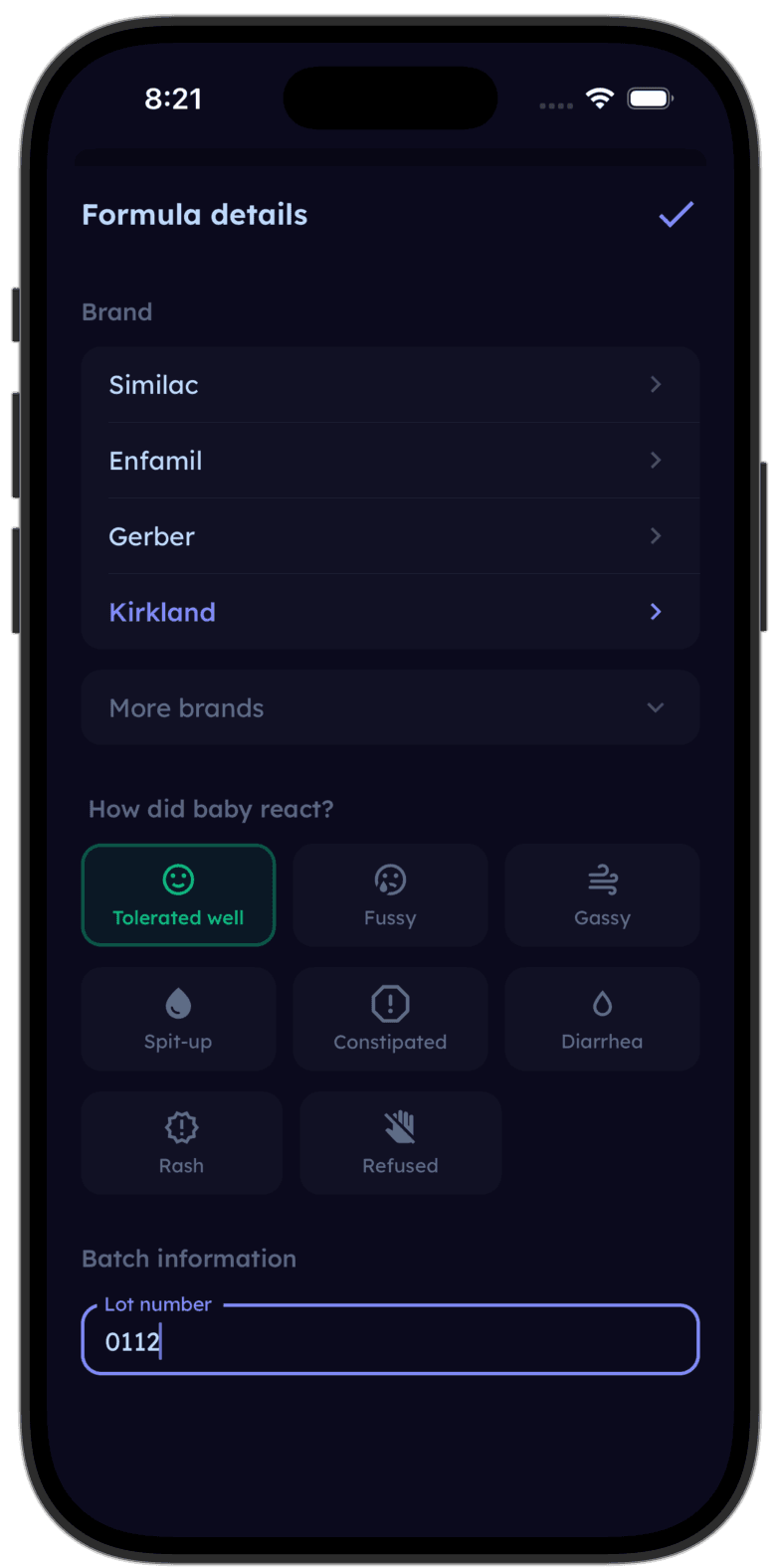
Tinylog logs every feed — so you have data, not just guesses, during a formula transition.
When switching to a new formula, tracking intake and how your baby responds makes the process less stressful. Log bottles in seconds and see the pattern over days, not just one feeding.


The Regulatory Reality
Regulatory status is not glamorous, but when it comes to what you're feeding your baby every day, it matters. Here's how Kendamil and HiPP compare on the regulatory front.
| Aspect | Kendamil | HiPP | Why It Matters |
|---|---|---|---|
| Manufacturing standards | EU + FDA cGMP | EU only | Kendamil is inspected under both regulatory frameworks |
| Nutrient testing | Meets both EU and FDA nutrient requirements | Meets EU nutrient requirements | FDA has slightly different minimum/maximum levels for some nutrients |
| Labeling | English labels with FDA-compliant nutrition facts | German labels (importers may add English translations) | Non-English labels increase preparation error risk |
| Recall process | Subject to FDA recall authority | Not subject to FDA recall process | If a safety issue arises, FDA can enforce recalls on Kendamil but not HiPP imports |
| Supply chain control | Standard retail distribution with controlled shipping | Imported via third parties — temperature and storage not guaranteed | Formula shipped internationally may be exposed to temperature extremes |
Risks of Importing Non-FDA-Registered Formula
- Formula may be exposed to temperature extremes during international shipping, potentially degrading nutrients
- Labels are in German — preparation errors (wrong water ratio) can occur with translated instructions
- No FDA oversight means no US recall process if a safety issue is identified
- Third-party importers may sell formula near or past its expiration date
- Customs seizures can interrupt supply, leaving you without formula unexpectedly
- Higher cost due to international shipping and importer markup
These are practical risks, not certainties. Many families have used imported HiPP without issues. But the risks are real, and they don't exist with FDA-registered formulas.
What the Marketing Doesn't Tell You
European formula has developed a premium reputation among US parents, partly deserved and partly driven by marketing and social media influence. Here's what the messaging often leaves out:
"European standards are stricter" is true in some ways but oversimplified. The EU bans corn syrup solids and sucrose as primary carbohydrates in infant formula — the US does not (though most US formulas use lactose anyway). The EU requires DHA supplementation — the US now does too (as of 2020 FDA guidance). In other areas, FDA and EU standards are comparable. Neither system is comprehensively "better."
Importing formula introduces risks that offset the ingredient benefits. If you're choosing HiPP specifically for its ingredient quality, but the formula sits in a hot shipping container for days during transit, the nutritional integrity you're paying for may be compromised. Temperature-sensitive nutrients (like certain vitamins and probiotics) can degrade under improper storage conditions.
Kendamil's US entry changed the equation. Before Kendamil received FDA registration, the only way to get a European formula with whole milk fat and no palm oil was to import it. Now, you can buy Kendamil at Target with the same convenience and safety assurances as any US formula. For parents who want European-style ingredients, the case for importing HiPP has weakened significantly.
The "European formula is better" narrative is partly a marketing story. HiPP and other European brands have benefited from a perception that anything European is more natural, more regulated, and more trustworthy. While EU regulations do have some genuine advantages, the gap between US and EU formula quality is much smaller than the price premium and import hassle would suggest — especially now that Kendamil bridges the two.
DHA Sourcing: Fish Oil vs. Algal Oil
One ingredient difference that parents often ask about: Kendamil uses fish oil for DHA, while HiPP uses algal oil.
Both provide the same omega-3 fatty acid (DHA) that supports brain and eye development. The concern some parents have with algal-oil-derived DHA is the extraction process — some methods use hexane, a chemical solvent. Kendamil's fish oil avoids this, sourced from sustainable fisheries and processed without hexane.
On the other hand, algal oil is plant-based, which some parents prefer for environmental or dietary reasons. Both forms of DHA are well-absorbed by infants.
If DHA sourcing is a priority for you, Kendamil's fish oil approach may be preferable. If you prefer a plant-based DHA source, HiPP aligns with that. Nutritionally, the DHA your baby receives is the same molecule regardless of its source.
When to Talk to Your Pediatrician
Choosing between European and US formula is generally a preference decision, not a medical one. But bring your pediatrician into the conversation if:
You're currently importing formula and want to ensure it's meeting your baby's nutritional needs. Your pediatrician can check growth and development and help you evaluate whether the formula you're using is appropriate.
Your baby shows signs of intolerance after switching formulas — whether from one brand to another or from US to European. Persistent vomiting, blood in stool, rash, or significant fussiness warrants a conversation.
You're considering a European formula because your baby seems to have trouble with US formulas. Before importing, ask your pediatrician whether a different US formulation (like a hypoallergenic formula) might address the issue — or whether Kendamil's FDA-registered option might work.
You're feeling overwhelmed by formula choices. Your pediatrician has seen thousands of babies thrive on all kinds of formula. They can cut through the noise and help you find what works for your baby without the marketing pressure. For more on what to bring to your next appointment, see our pediatrician visit prep guide.
The Bottom Line
Kendamil and HiPP are both high-quality European formulas with thoughtful ingredient lists. The game-changing difference is that Kendamil is now FDA-registered and available at US retailers, while HiPP still requires importing with all the associated costs, risks, and inconveniences.
If you want European-style formula with whole milk fat, no palm oil, and no soy — Kendamil delivers that with the convenience and safety of FDA oversight. If you specifically want HiPP's formulation with its probiotic blend and are comfortable with the importing process, it remains a respected option in Europe.
For most US families who are drawn to European formula, Kendamil has made the decision simpler. You get the ingredient profile you're looking for without the regulatory gray area. Whichever formula you choose, sign up for free recall alerts to get notified if your brand is ever recalled.
For comparisons of other formula types, see our guides on store brand vs. name brand formula and goat milk vs. cow milk formula.
Related Guides
-
European vs. American Formula — Real differences explained
-
HiPP vs. Kendamil — Same comparison, different angle
-
HiPP vs. Holle — European formulas compared
Sources
- U.S. Food and Drug Administration — 21 CFR 107: Infant Formula Requirements
- U.S. Food and Drug Administration — "FDA Advises Parents and Caregivers to Not Make or Feed Homemade Infant Formula to Infants" (guidance on imported formula)
- European Commission — Regulation (EU) No 609/2013 on food intended for infants and young children
- Timby N, et al. "Neurodevelopment, nutrition, and growth until 12 months of age in infants fed a low-energy, low-protein formula supplemented with bovine milk fat globule membranes." The Journal of Pediatrics, 2014.
- Kendamil — Product specifications and FDA registration documentation
- HiPP — Product specifications (EU labeling)
- American Academy of Pediatrics — "Choosing an Infant Formula" (HealthyChildren.org)
This guide is for informational purposes only and is not a substitute for professional medical advice. If you have concerns about your baby's formula or nutrition, please consult your pediatrician.
Frequently asked questions
- Is Kendamil sold in the US?
- Yes. Kendamil became the first European infant formula to receive FDA registration and is now sold at major US retailers including Target, Amazon, and Whole Foods. It meets both EU and FDA standards. You no longer need to import it.
- Is it safe to import HiPP formula to the US?
- HiPP is not FDA-registered, which means it hasn't gone through the US regulatory process. While HiPP meets stringent EU regulations and is widely trusted in Europe, importing it means the formula may not have been stored or transported under proper conditions, the labels aren't in English (which can lead to preparation errors), and you have limited recourse if there's a product issue. The FDA advises against using non-registered imported formulas.
- What makes Kendamil different from US formulas?
- Kendamil uses whole milk fat rather than skim milk plus vegetable oils, which retains naturally occurring MFGM (milk fat globule membrane) — a component found in breast milk. It also uses fish oil for DHA rather than algal oil processed with hexane. Kendamil does not contain palm oil, soy, or corn syrup.
- Is HiPP better than Kendamil?
- Neither is objectively better. HiPP uses skim milk plus vegetable oils and adds prebiotics (GOS). Kendamil uses whole milk fat and retains natural MFGM. HiPP uses algal oil for DHA, Kendamil uses fish oil. Both meet EU standards. The key practical difference is that Kendamil is FDA-registered and legally sold in the US, while HiPP is not.
- Why do parents prefer European formula?
- EU regulations ban certain sugars (like corn syrup solids) as primary carbohydrates in infant formula and require stricter standards for pesticide residues. European formulas also tend to have simpler ingredient lists. However, US formulas meet FDA standards that are also rigorous, and the nutritional outcomes are comparable.