GUIDE

HiPP vs. Holle

Both are high-quality European formulas with stricter EU ingredient standards. But importing them to the U.S. carries real risks — no FDA recall infrastructure, shipping temperature concerns, and significantly higher cost.

A growing number of U.S. parents seek out European formulas, drawn by stricter ingredient regulations, organic standards, and the absence of corn syrup solids. HiPP and Holle are the two most popular European brands in this market. Here is what you need to know before you buy.

Why U.S. Parents Look Across the Atlantic

The European formula trend among U.S. parents is not a fad — it is a response to real regulatory differences. EU formula regulations, governed by EFSA (European Food Safety Authority), differ from FDA regulations in several meaningful ways:

EU regulations require lactose as the primary carbohydrate in infant formula and restrict the use of sucrose and corn syrup solids. Many U.S. formulas use corn syrup solids as a primary or secondary carb source — not because it is harmful (it provides glucose, which is nutritionally fine), but because it is cheaper than lactose. For parents who want their baby's formula to more closely mirror breast milk's carbohydrate profile, the EU approach is appealing.

EU regulations also mandate DHA supplementation (minimum 20 mg/100 kcal since 2020), have stricter pesticide residue limits for infant food, and operate within tighter nutrient ranges. The organic standards are also more established, with options like Demeter biodynamic certification that go beyond standard organic.

None of this means U.S. formulas are unsafe. They meet rigorous FDA requirements, and millions of healthy children are raised on them every year. But the regulatory differences are real, and understanding them helps you evaluate whether European formulas are worth the premium and the import risks.

HiPP vs. Holle: Side-by-Side Comparison
Country of origin
HiPPGermany
HolleSwitzerland / Germany
NotesBoth manufactured under EU regulations governed by EFSA (European Food Safety Authority)
Organic certification
HiPPEU organic certified
HolleDemeter biodynamic certified (stricter than EU organic)
NotesDemeter certification requires biodynamic farming practices — a step beyond standard organic
Primary carbohydrate
HiPPLactose
HolleLactose
NotesBoth use lactose as the primary carb. EU regulations restrict the use of sucrose and corn syrup solids in infant formula.
Protein source
HiPPOrganic skimmed milk, organic whey (varies by stage)
HolleOrganic skimmed milk, organic whey
NotesBoth use cow's milk protein. Holle also offers a goat milk line.
Fat source
HiPPOrganic vegetable oils (palm oil, rapeseed, sunflower)
HolleOrganic vegetable oils (palm oil, rapeseed, sunflower)
NotesBoth include palm oil. HiPP has experimented with reduced-palm formulations in some markets.
Prebiotics/Probiotics
HiPPYes — GOS (galacto-oligosaccharides) prebiotics and Lactobacillus fermentum probiotic
HolleNo added prebiotics or probiotics
NotesThis is a key differentiator. HiPP takes a more interventionist approach to gut health.
DHA source
HiPPFish oil (from sustainable sources)
HolleFish oil (or algal oil depending on version)
NotesEU requires DHA at minimum 20 mg/100 kcal since 2020. U.S. formulas are not required to contain DHA (though most do).
Stage system
HiPPPre (0-6 mo), Stage 1 (0-6 mo), Stage 2 (6+ mo), Stage 3 (10+ mo)
HollePre (0-6 mo), Stage 1 (0-6 mo), Stage 2 (6+ mo), Stage 3 (10+ mo)
NotesEU formulas use a staged system. U.S. formulas typically offer one infant formula for 0-12 months.
Price in the U.S. (imported)
HiPP$35-$45 per can (400-600g)
Holle$35-$45 per can (400-600g)
NotesSignificantly more expensive than U.S. brands. Price includes import markup, shipping, and exchange rates.
FDA registration
HiPPNot FDA-registered
HolleNot FDA-registered
NotesNeither brand has gone through FDA review. Not subject to FDA recalls or inspections.
Both brands offer multiple stages and specialty options (goat milk, hypoallergenic). This comparison covers the standard cow's milk Stage 1 infant formula.

How EU and U.S. Formula Regulations Actually Differ

Understanding the regulatory landscape helps you cut through the marketing and assess what you are actually paying for.

EU vs. U.S. Formula Regulation: Key Differences
Sugar sources
EU (EFSA)Lactose must be primary carbohydrate. Sucrose is banned in Stage 1. Corn syrup solids are restricted.
U.S. (FDA)No restriction on carbohydrate source. Corn syrup solids, maltodextrin, and sucrose are all permitted.
Why It MattersThis is the biggest regulatory difference and a primary reason U.S. parents seek European formulas.
DHA requirement
EU (EFSA)Mandatory minimum of 20 mg/100 kcal since February 2020 (EU Regulation 2016/127)
U.S. (FDA)Not required. Most major brands include it voluntarily, but at varying levels.
Why It MattersEU mandates DHA. U.S. does not. In practice, most U.S. formulas now include DHA voluntarily.
Organic standards
EU (EFSA)EU organic certification is well-established. Demeter biodynamic is available as a higher tier.
U.S. (FDA)USDA Organic certification exists but is less common in formula. Only a few U.S. formulas are organic.
Why It MattersIf organic sourcing matters to you, EU brands have a broader selection and longer track record.
Pesticide limits
EU (EFSA)Stricter pesticide residue limits for infant food. Maximum 0.01 mg/kg for most substances.
U.S. (FDA)FDA sets limits but they are generally less restrictive than EU standards for infant food.
Why It MattersEU standards for pesticide residues in baby food are among the strictest in the world.
Nutrient ranges
EU (EFSA)EFSA sets both minimums and maximums for most nutrients, with tighter ranges than the U.S.
U.S. (FDA)FDA sets minimums for 29 nutrients. Maximums exist for some but not all.
Why It MattersEU formulas operate within narrower nutrient windows. Whether tighter ranges produce better outcomes is unproven.
Both regulatory systems produce safe infant formulas. The EU approach tends to be more prescriptive (specifying what must and must not be used). The U.S. approach is more permissive (setting nutritional floors and letting manufacturers choose ingredients).

HiPP: The Science-Forward European Option

HiPP is a German family-owned company that has been making baby food since the 1930s and organic baby food since the 1950s. Their formula is the more complex of the two European options, with several distinctive features:

Prebiotics and probiotics: HiPP includes GOS (galacto-oligosaccharides) as a prebiotic and Lactobacillus fermentum as a probiotic. This is a meaningful differentiator — neither Holle, Enfamil, nor Similac includes live probiotics in their standard infant formula. The research on probiotic supplementation in infant formula shows modest benefits for reducing certain GI issues, though the evidence is not conclusive for all strains.

Lactose as sole carbohydrate: Like all EU-compliant formulas, HiPP uses lactose as the primary carb. No corn syrup solids, no maltodextrin in the standard line.

Stage system: HiPP offers a Pre stage (closer to breast milk composition, lower casein) and a Stage 1 (slightly higher caloric density). Most parents of newborns start with Pre.

Taste: Parents frequently report that HiPP tastes milder and more "natural" than U.S. formulas, though this is subjective.

Holle: The Minimalist Approach

Holle is a Swiss company that holds Demeter biodynamic certification — the highest level of organic certification available. Their formula philosophy is "less is more":

Demeter biodynamic certification: This goes beyond standard organic farming. Demeter standards require biodynamic agricultural practices, including specific soil health requirements, crop rotation, and animal welfare standards that exceed EU organic minimums. Whether biodynamic farming produces nutritionally superior milk is not established by research, but it does represent a higher environmental and animal welfare standard.

Simpler ingredient list: Holle does not add prebiotics, probiotics, or additional bioactive compounds. The ingredient list is shorter than HiPP's. For parents who prefer a minimalist formulation, this is appealing.

Goat milk option: Holle offers a goat milk formula, which some parents prefer for babies who seem sensitive to cow's milk protein. Goat milk protein is structurally different from cow's milk protein, though it is not appropriate for babies with confirmed cow's milk protein allergy (there is significant cross-reactivity).

Higher price per gram: Holle typically costs slightly more than HiPP when accounting for package size, and the smaller packaging (400g vs. HiPP's 600g) means more frequent purchases.


What the Marketing Doesn't Tell You

European formula marketing to U.S. parents leans heavily on the narrative that EU regulations are "better" and that choosing European formula is choosing the best for your baby. Here is what the marketing leaves out:

The import risks are real and not trivial. No FDA recall infrastructure means if there is a contamination issue, the system that protects U.S. consumers from unsafe formula does not apply to your imported can. This is not a theoretical concern — formula contamination events do happen (as the 2022 Abbott/Similac recall demonstrated). The difference is that FDA-registered products have a mandatory recall system. Imported products do not.

Shipping degrades formula quality. Infant formula is designed to be stored at controlled temperatures. A can that sat in a hot shipping container for a week during transit from Germany to your doorstep may have degraded nutrient levels. You have no way to verify this.

The regulatory differences, while real, have not been shown to produce different health outcomes. U.S. babies raised on FDA-regulated formula are not less healthy than EU babies raised on EFSA-regulated formula. The ingredient differences (lactose vs. corn syrup solids, mandatory DHA, stricter pesticide limits) are philosophically meaningful but clinically unproven as determinants of infant health outcomes.

FDA-registered European-style options now exist. Kendamil (UK-based, now sold at Target and other U.S. retailers) and Bobbie (U.S. company with EU-style formulation) are FDA-registered, eliminating the import risks while providing lactose-based, organic formulations. If the ingredient philosophy appeals to you but the import risks concern you, these are worth considering. See our Bobbie vs. Enfamil vs. Similac comparison for more.

The Import Risk Reality

No FDA recall protection

If a contamination issue is discovered in a batch of HiPP or Holle, the FDA has no mechanism to recall it from U.S. consumers. You would depend on the European manufacturer and your importer to notify you — and there is no guarantee that happens quickly or at all. FDA-registered formulas have mandatory recall procedures.

Shipping temperature concerns

Infant formula is temperature-sensitive. Imported formula may spend days or weeks in transit, potentially in warehouses or shipping containers without climate control. Excessive heat can degrade nutrients, particularly vitamins and fatty acids. You have no way to verify the cold chain integrity of an imported can.

Labeling is not in FDA-compliant English

HiPP and Holle labels are in German or other European languages. Some importers include translated instruction sheets, but these are not official. Mixing ratios between EU and U.S. standards can differ, and misreading preparation instructions due to language barriers is a real risk.

Retailer accountability varies

Third-party importers of European formula range from established businesses with good reputations to small operations with little accountability. There is no standardized quality control for the import process. Research your retailer carefully — look for established businesses with transparent sourcing and return policies.

Customs and legal gray area

Importing formula for personal use is generally tolerated, but selling non-FDA-registered formula commercially violates U.S. law. The retailers you buy from are technically operating in a regulatory gray area. This has not resulted in widespread enforcement, but it means there are fewer consumer protections than with FDA-registered products.

What European Formula Actually Costs in the U.S.
HiPP Stage 1 (imported, 600g can)
U.S. Price$38-$45
Monthly Estimate$175-$225
NotesPrice includes import markup and shipping. Slightly less per gram if bought in bulk.
Holle Stage 1 (imported, 400g box)
U.S. Price$35-$42
Monthly Estimate$190-$240
NotesSmaller packaging means more frequent purchases. Holle tends to cost slightly more per gram than HiPP.
Kendamil Organic (FDA-registered, 28.2 oz)
U.S. Price$28-$34
Monthly Estimate$130-$160
NotesUK-origin, now FDA-registered. Sold at major U.S. retailers. EU-style formulation without import risk.
Bobbie Organic (FDA-registered, 14.1 oz)
U.S. Price$26-$30
Monthly Estimate$140-$170
NotesU.S. company, EU-style ingredients, subscription model. FDA-registered.
Enfamil NeuroPro / Similac 360 (20+ oz)
U.S. Price$33-$38
Monthly Estimate$150-$175
NotesStandard U.S. premium formula. FDA-regulated with full recall infrastructure.
Store brand (Target, Walmart, Costco, ~20 oz)
U.S. Price$18-$25
Monthly Estimate$90-$120
NotesMeets same FDA nutritional requirements. Corn syrup solids may be primary carb.
Monthly estimates based on a 3-6 month old consuming approximately 25-30 oz per day. Imported formula prices fluctuate with exchange rates and shipping costs.
tinylog formula feeding tracker

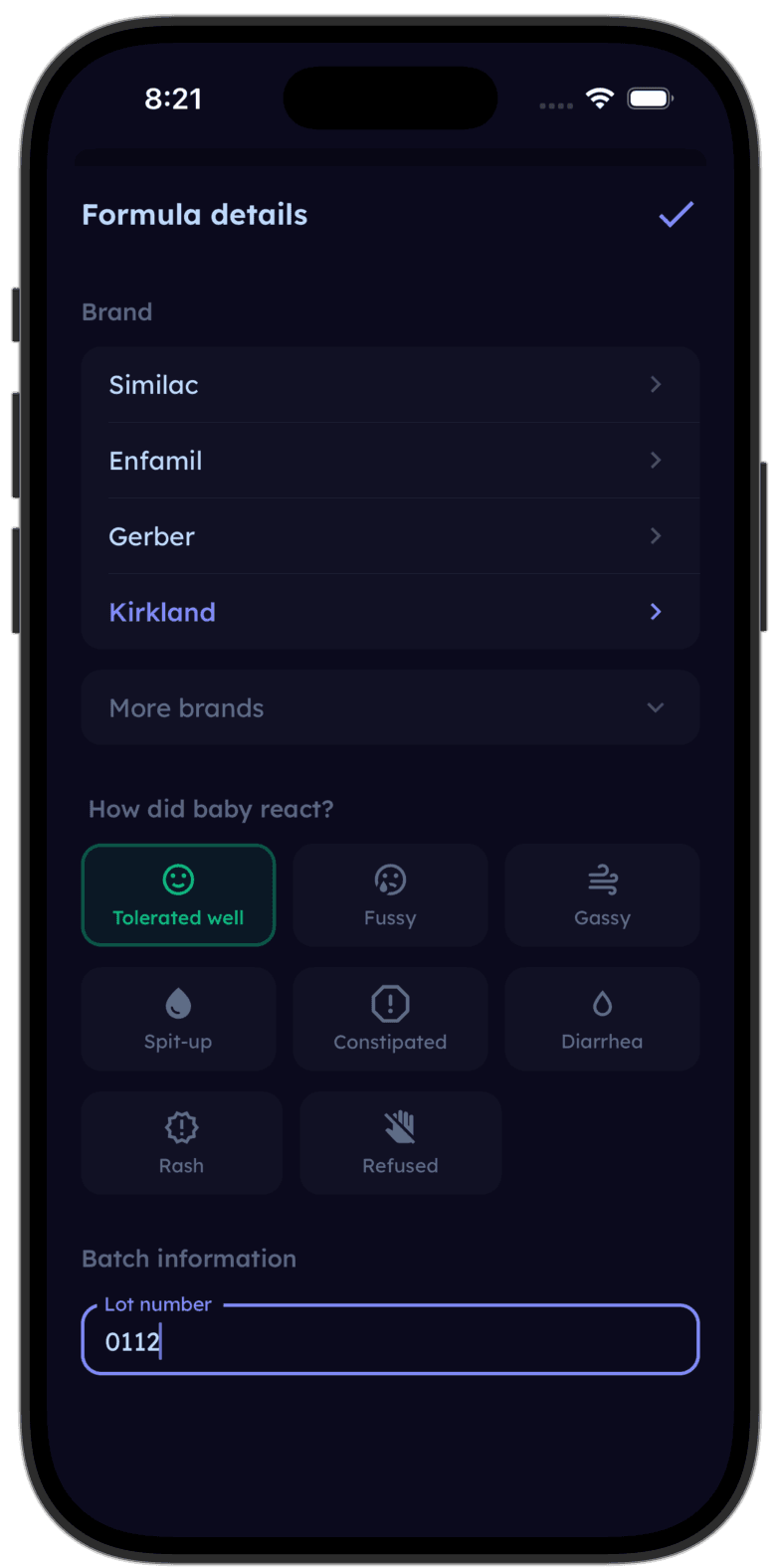
tinylog tracks feeds and growth no matter which formula you choose.

Whether you use European or domestic formula, what matters is how your baby responds. Log feeds, track growth, and see patterns over time — real data that's more useful than ingredient debates.

Download on the App StoreGet It On Google Play

When to Talk to Your Pediatrician

If you are considering or currently using European formula, these situations warrant a conversation with your pediatrician:

Discuss With Your Pediatrician

  • Your baby is having difficulty tolerating the formula (persistent vomiting, blood in stools, significant fussiness)
  • You are unsure about mixing instructions due to language differences on the label
  • Your baby has a medical condition that requires a specific formula type
  • You want to discuss whether the ingredient differences in European formulas are relevant to your baby's specific needs
  • You are considering switching from a U.S. formula to an imported European formula and want guidance on the transition

Most pediatricians will not specifically recommend imported European formula due to the lack of FDA oversight. But they can help you evaluate whether the ingredient differences matter for your specific baby and suggest FDA-registered alternatives with similar formulations.

The Bottom Line

HiPP and Holle are both high-quality formulas manufactured under strict EU regulations. HiPP is the more feature-rich option with prebiotics and probiotics. Holle is the minimalist, biodynamic-certified choice. Both use lactose as the primary carbohydrate and meet EFSA nutritional standards.

The EU regulatory differences — lactose requirements, mandatory DHA, stricter pesticide limits — are real and meaningful. Whether they produce measurably better health outcomes is not established.

The import risks — no FDA recall system, shipping temperature concerns, labeling language barriers — are also real. If the EU ingredient philosophy appeals to you, consider FDA-registered alternatives like Kendamil or Bobbie that provide similar formulations without the import risks.

If you do choose to import European formula, use a reputable retailer, verify the expiration date and batch information, and follow the preparation instructions carefully (ideally confirmed by an English translation from a trusted source). And regardless of which formula you choose, tracking your baby's feeds and growth is the best way to confirm it is working. tinylog can help you do that with just a few taps per feed.

For how U.S. brands compare, see our Enfamil vs. Similac comparison and our baby feeding chart for general feeding guidance.

Related Guides

Sources

  • European Food Safety Authority (EFSA). "Scientific opinion on the essential composition of infant and follow-on formula." EFSA Journal, 2014.
  • EU Commission Delegated Regulation 2016/127 — compositional and labeling requirements for infant formula.
  • U.S. Food and Drug Administration. "21 CFR Part 107 — Infant Formula." Code of Federal Regulations.
  • Koletzko B, et al. "Global Standard for the Composition of Infant Formula." Annals of Nutrition and Metabolism, 2005.
  • Vandenplas Y, et al. "Probiotics and prebiotics in infant formula." Journal of Pediatric Gastroenterology and Nutrition, 2015.
  • FDA. "FDA 101: Infant Formula." U.S. Food and Drug Administration, 2023.
  • Codex Alimentarius Commission. "Standard for Infant Formula and Formulas for Special Medical Purposes Intended for Infants." CODEX STAN 72-1981.

This guide is for informational purposes only and is not a substitute for professional medical advice. Formula choices, especially regarding imported products, should be discussed with your pediatrician.

Get this comparison in your inbox.
We'll email you this full breakdown of European formula options, import considerations, and cost comparisons.
No matter which formula you choose, tracking feeds tells you how it's going.
Download tinylog free — log bottles, spot patterns, and track growth.
Download on the App StoreGet It On Google Play