GUIDE

Bobbie vs. Enfamil vs. Similac

Bobbie offers an EU-style, FDA-registered formula with organic lactose and no corn syrup solids. Nutritional outcomes are comparable to Enfamil and Similac. The biggest differences are ingredient sourcing, price, and marketing.

Bobbie launched in 2021 and positioned itself as the formula for parents who wanted European-style ingredients without the import risk. It has built a loyal following among parents who want organic, lactose-based formula that is also FDA-registered. But how does it actually compare to the two dominant brands? Here is the honest breakdown.

The Newcomer in Context

Bobbie entered the U.S. formula market in 2021 with a clear value proposition: an FDA-registered formula made with European-style ingredients. It fills a specific gap — parents who wanted lactose-based, organic formula without the risks of importing HiPP or Holle from Europe.

For those parents, Bobbie is a genuinely good option. It delivers what it promises: organic ingredients, lactose as the sole carbohydrate, DHA from fish oil, no corn syrup solids, no palm olein, and full FDA registration with domestic manufacturing oversight.

But how does it compare to Enfamil and Similac on the merits — not the marketing?

The short answer: the base nutrition is comparable across all three. They all meet FDA requirements. They all provide adequate protein, fat, carbohydrates, vitamins, and minerals for healthy infant growth. The differences are in ingredient sourcing (organic vs. conventional, fish oil vs. algal oil, lactose vs. some corn syrup solids in specialty lines), proprietary additions (Enfamil's MFGM, Similac's HMOs, Bobbie's nothing-extra approach), and price.

For broader context on formula at every age, see our baby feeding chart.

Bobbie vs. Enfamil vs. Similac: Three-Way Comparison
Company
BobbieBobbie (founded 2018, launched 2021)
Enfamil NeuroProReckitt/Mead Johnson (est. 1905)
Similac 360 Total CareAbbott Laboratories (est. 1903)
FDA registration
BobbieYes — FDA-registered
Enfamil NeuroProYes — FDA-registered
Similac 360 Total CareYes — FDA-registered
Organic
BobbieUSDA Organic certified
Enfamil NeuroProNo (organic version available at higher price)
Similac 360 Total CareNo (Similac Organic available at higher price)
Primary carbohydrate
BobbieOrganic lactose (sole carb source)
Enfamil NeuroProLactose (standard line)
Similac 360 Total CareLactose (standard line)
Corn syrup solids
BobbieNone
Enfamil NeuroProNone in standard NeuroPro; present in Gentlease and some specialty lines
Similac 360 Total CareNone in 360 Total Care; present in Sensitive and some specialty lines
Fat source
BobbieOrganic high oleic sunflower, organic coconut, organic soybean oils (no palm olein)
Enfamil NeuroProPalm olein, soy, coconut, high oleic sunflower oils
Similac 360 Total CareHigh oleic safflower, soy, coconut oils (no palm olein)
DHA source
BobbieFish oil (organic)
Enfamil NeuroProAlgal oil (Crypthecodinium cohnii)
Similac 360 Total CareAlgal oil (Schizochytrium sp.)
Signature bioactive
BobbieNone marketed — focuses on 'clean' ingredient list
Enfamil NeuroProMFGM (milk fat globule membrane)
Similac 360 Total Care5 HMOs including 2'-FL
Whey:casein ratio
Bobbie60:40 (closer to breast milk ratio)
Enfamil NeuroPro60:40
Similac 360 Total Care48:52 (varies by product)
Price (powder, per can)
Bobbie$26-$30 (14.1 oz can, subscription)
Enfamil NeuroPro$33-$38 (20.7 oz can)
Similac 360 Total Care$33-$38 (20.6 oz can)
Price per oz prepared
Bobbie~$1.30-$1.50/oz
Enfamil NeuroPro~$1.10-$1.30/oz
Similac 360 Total Care~$1.10-$1.30/oz
Availability
BobbieOnline subscription (primary), select retailers (Target, others)
Enfamil NeuroProWidely available — all major retailers, pharmacies, grocery stores
Similac 360 Total CareWidely available — all major retailers, pharmacies, grocery stores
Comparison based on each brand's primary infant formula (0-12 months) in powder form as of 2026. Specialty lines (gentle, sensitive, organic variants) differ. Always check the label.

Ingredient Differences: What Actually Matters

Lactose vs. corn syrup solids: the biggest talking point

Bobbie uses organic lactose as its sole carbohydrate. Lactose is the primary sugar in human breast milk and supports calcium absorption and the growth of beneficial gut bacteria. Many U.S. formulas use corn syrup solids as a carbohydrate source — either partially or fully — because they are cheaper than lactose. Corn syrup solids provide glucose, which is a perfectly adequate energy source for babies. The clinical significance of this difference in healthy, full-term infants has not been established, but for parents who want their baby's formula to mirror breast milk's carbohydrate profile, lactose-only formulas are appealing.

DHA from fish oil vs. algal oil

Bobbie sources DHA from fish oil. Enfamil and Similac use algal oil (from microalgae). Both deliver the same omega-3 fatty acid. The fish oil vs. algal oil debate matters mostly to parents who have concerns about the hexane extraction process historically used to extract DHA from algal/fungal oils. Enfamil and Similac have updated their processing methods over the years. From a nutritional standpoint, the DHA molecule is the same regardless of the source.

No palm olein oil

Like Similac, Bobbie does not use palm olein oil. Enfamil does. Some research links palm olein to harder stools and slightly reduced calcium absorption due to the formation of calcium soaps in the gut. For most babies, this is not clinically significant, but it is a point of differentiation that Bobbie and Similac both emphasize.

No MFGM, no HMOs

Unlike Enfamil (MFGM) and Similac (HMOs), Bobbie does not add proprietary bioactive compounds. Bobbie's philosophy is 'clean and simple' rather than 'enhanced with additives.' Whether you view the absence of MFGM and HMOs as a drawback or a feature depends on your perspective. The clinical evidence for these ingredients is promising but not conclusive, and their absence does not make Bobbie nutritionally inferior.

Organic certification

Bobbie is USDA Organic, meaning the milk and other agricultural ingredients meet organic farming standards — no synthetic pesticides, antibiotics, or growth hormones in the dairy source. Enfamil and Similac's standard lines are not organic, though both offer organic versions at higher prices. Whether organic ingredients produce meaningfully different nutritional outcomes is debated, but reduced pesticide exposure is a commonly cited benefit.

What the Marketing Doesn't Tell You

Every formula brand has a marketing angle. Enfamil sells brain development. Similac sells total care. Bobbie sells clean, honest, European-style feeding. Here is what the marketing across all three brands does not emphasize:

The nutritional outcomes are comparable. There is no published clinical evidence that babies fed Bobbie have different health outcomes than babies fed Enfamil or Similac. The ingredient sourcing differences (organic vs. conventional, lactose vs. corn syrup solids, fish oil vs. algal oil) are philosophically meaningful to many parents but have not been shown to produce measurably different developmental or health results in healthy, full-term infants.

You are paying for ingredient philosophy, not nutritional superiority. Bobbie costs more per ounce than Enfamil or Similac, and considerably more than store brands. That premium buys you USDA Organic certification, lactose-only carbohydrate, and fish oil DHA sourcing. These are preferences, not medical necessities. If they align with your values and your budget supports them, that is a perfectly valid reason to choose Bobbie. But if money is tight, you are not giving your baby less by choosing a standard formula.

Bobbie does not have MFGM or HMOs. This is not inherently a negative — the evidence for these ingredients is still emerging. But if you value the addition of bioactive breast milk components, Enfamil and Similac offer something Bobbie does not.

The Marketing Reality

Bobbie's 'mom-founded' story is compelling but not a quality differentiator

Bobbie was founded by a mother frustrated with U.S. formula options. It is a genuine origin story and the founders clearly care about their product. But 'mom-founded' is a marketing narrative, not a quality certification. Enfamil and Similac employ thousands of nutritional scientists and have decades of clinical research behind their formulations. A compelling founding story does not make a formula inherently superior.

The 'clean label' appeal has limits

Bobbie markets a shorter, more recognizable ingredient list — and for many parents, that transparency is genuinely reassuring. But 'clean' is a marketing term, not a scientific one. The ingredients in Enfamil and Similac that sound unfamiliar (like specific algal oil strains) are not unclean — they are well-studied, FDA-approved nutrient sources. A shorter ingredient list is not automatically a better one.

The subscription model creates both convenience and friction

Bobbie primarily sells through a subscription model. This is convenient for consistent delivery but means you cannot walk into any store and buy a can when you run out unexpectedly. At 2 AM with an empty can, Enfamil and Similac's ubiquitous retail availability is a meaningful practical advantage. Bobbie has expanded retail availability through Target and other stores, but it is still far less accessible than the major brands.

The target demographic is specific

Bobbie markets heavily to parents who identify with natural, organic, and 'crunchy' parenting philosophies. Their branding, social media presence, and partnerships are deliberately aimed at this audience. If you do not identify with that community, Bobbie's marketing may feel alienating. The formula inside the can works the same regardless of the marketing aesthetic.

Real Cost Comparison
Bobbie Organic
Can Size14.1 oz powder
Price Per Can$26-$30 (subscription)
Monthly Estimate$170-$200
Annual Estimate$2,040-$2,400
Enfamil NeuroPro
Can Size20.7 oz powder
Price Per Can$33-$38
Monthly Estimate$150-$175
Annual Estimate$1,800-$2,100
Similac 360 Total Care
Can Size20.6 oz powder
Price Per Can$33-$38
Monthly Estimate$150-$175
Annual Estimate$1,800-$2,100
Store brand (generic)
Can Size~20 oz powder
Price Per Can$18-$25
Monthly Estimate$90-$120
Annual Estimate$1,080-$1,440
Monthly and annual estimates based on a 3-6 month old consuming approximately 25-30 oz per day. Bobbie subscription pricing shown. Enfamil and Similac prices are typical retail. Store brand prices from major retailers.
tinylog formula feeding log showing daily bottle tracking

tinylog tracks feeds no matter which brand is in the bottle.

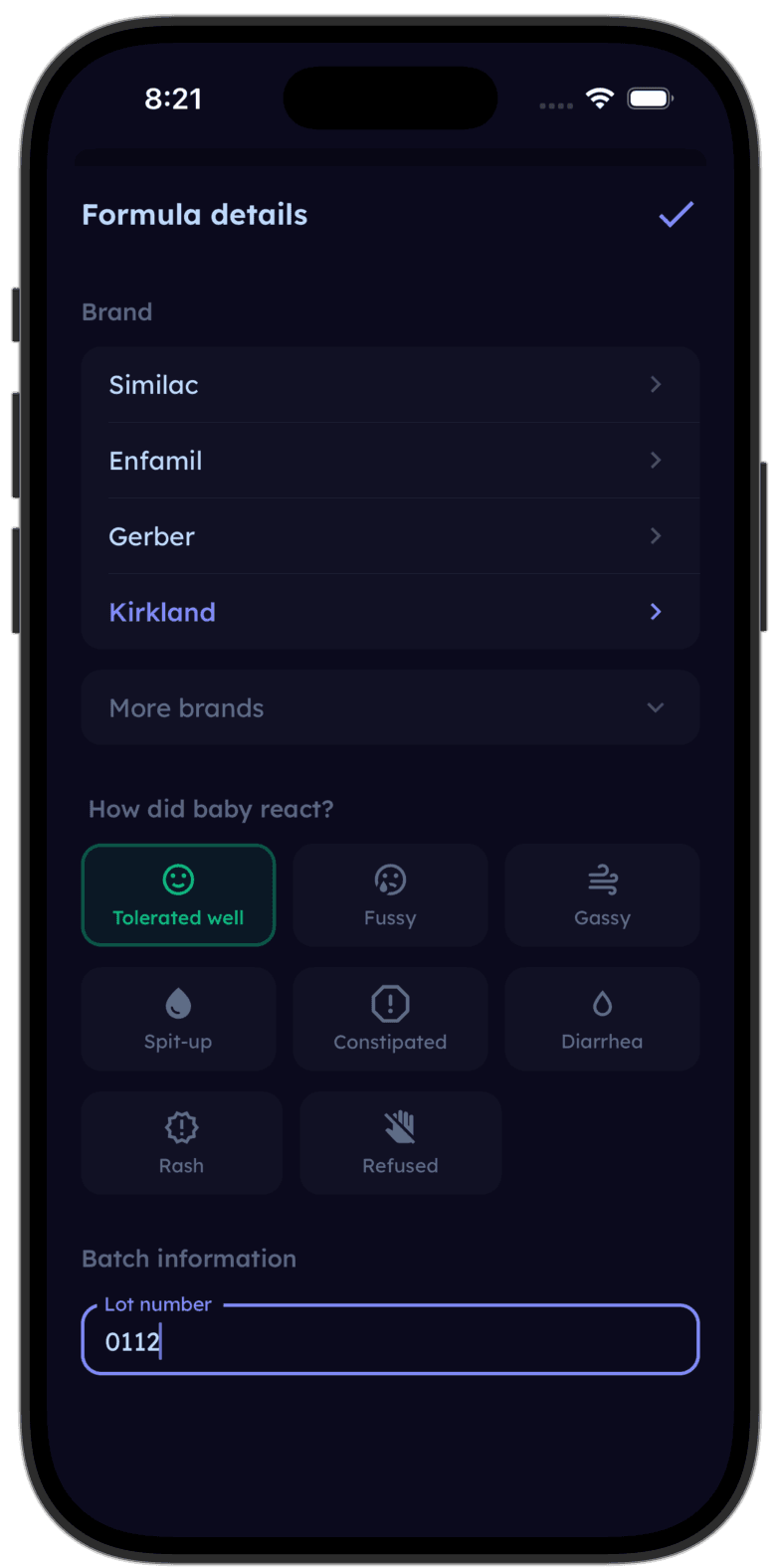
Log formula type and amount in seconds. If you are switching formulas, track feeds alongside symptoms and output so you have real data on how the transition is going — not just a feeling.

Download on the App StoreGet It On Google Play

When to Talk to Your Pediatrician

Choosing between Bobbie, Enfamil, and Similac for a healthy baby does not require a doctor's visit. But talk to your pediatrician in these situations:

When to Consult Your Pediatrician

  • Your baby is consistently refusing the new formula after a 1-2 week transition period
  • You notice blood or mucus in stools after switching
  • Significant increase in vomiting or spit-up that does not resolve within a week
  • Poor weight gain or weight loss after a formula change
  • Your baby has a diagnosed milk protein allergy or other condition requiring specialty formula
  • You want help deciding whether organic or specific ingredient sourcing is medically relevant for your baby

Most formula switches go smoothly. Temporary changes in stool color or consistency are normal during transitions and usually resolve within a week. If symptoms persist or worsen, contact your pediatrician.

Making the Decision

Here is a simplified framework:

Choose Bobbie if: organic ingredients, lactose-only carbohydrate, and a shorter ingredient list are priorities for you. You are comfortable with the subscription model (or can access it at a nearby retailer). Your budget can absorb the slightly higher cost. You were considering importing European formula and want a domestic, FDA-registered alternative.

Choose Enfamil if: you value the MFGM bioactive addition, want the widest possible retail availability, or your baby is already doing well on it. Enfamil also has the broadest range of specialty formulas (Gentlease, Nutramigen, AR) if your baby needs something beyond standard formula.

Choose Similac if: you value the HMO additions, prefer the no-palm-olein fat profile, or your baby is already thriving on it. Like Enfamil, Similac offers a comprehensive range of specialty options.

Choose a store brand if: budget is a priority and you want the same FDA-regulated nutrition at 30-50% lower cost. Store brands do not offer MFGM, multiple HMOs, or organic certification, but they meet all FDA nutritional requirements.

The honest truth: for a healthy, full-term baby, all of these options will support normal growth and development. The "best" formula is the one your baby tolerates well, that you can access reliably, and that does not cause financial stress. Everything else is optimization at the margins.

For a comparison of European imports, see our HiPP vs. Holle guide. For the gentle and sensitive lines, see our Enfamil Gentlease vs. Similac Sensitive guide.


The Bottom Line

Bobbie is a well-made formula that delivers on its promise of EU-style, FDA-registered, organic infant nutrition. It is a strong option for parents who prioritize clean ingredient sourcing and want to avoid corn syrup solids and non-organic dairy.

But it is not nutritionally superior to Enfamil or Similac in ways that have been proven to affect infant health outcomes. The differences are in ingredient philosophy and sourcing, not in the nutritional results for your baby. All three brands — and store brands — produce healthy, well-fed babies.

If you are transitioning between any of these formulas, tracking your baby's feeds, output, and any symptoms for a week or two will give you a much clearer picture of how the switch is going than relying on memory alone. tinylog makes that tracking effortless so you can focus on your baby, not spreadsheets.

For more on feeding at every age, see our baby feeding chart and our guide on knowing if your baby is eating enough.

Related Guides

Sources

  • U.S. Food and Drug Administration. "21 CFR Part 107 — Infant Formula." Code of Federal Regulations.
  • American Academy of Pediatrics. "Choosing an Infant Formula." HealthyChildren.org, 2024.
  • Bobbie. "Our Ingredients." bobbie.com, 2026.
  • Martin CR, et al. "Review of Infant Feeding: Key Features of Breast Milk and Infant Formula." Nutrients, 2016.
  • Koo WW, et al. "Palm olein in infant formula affects calcium and fat absorption." Journal of the American College of Nutrition, 2006.
  • European Food Safety Authority. "Scientific opinion on the essential composition of infant and follow-on formula." EFSA Journal, 2014.
  • U.S. Department of Agriculture. "USDA Organic Standards." usda.gov.

This guide is for informational purposes only and is not a substitute for professional medical advice. If you have concerns about your baby's formula, feeding, or growth, consult your pediatrician.

Get this three-way comparison in your inbox.
We'll email you this full analysis so you can reference the ingredient and cost breakdowns anytime.
Trying a new formula? Track how your baby responds.
Download tinylog free — log feeds and symptoms so you have real data, not just guesses.
Download on the App StoreGet It On Google Play