
GUIDE
Goat Milk Formula Brands Compared
Published on ·Updated on
Goat milk formula forms a softer curd that may be easier to digest, but it is NOT hypoallergenic — roughly 90% of babies with cow's milk protein allergy also react to goat milk. Kabrita and Kendamil Goat are the two leading options. Use goat milk formula for digestive comfort, not for confirmed allergy.
Goat milk formula has become popular among parents looking for an alternative to cow's milk formula. The softer curd and different protein profile are genuine differences. But the marketing often overstates the benefits. Here is an honest assessment.
Free 2-min quiz. Personalized match plus a recall check.
“All infant formulas must meet requirements that ensure optimal nutrition for babies. If your baby's formula is sold in the U.S., it has the nutrients your baby needs.”
 Dr. Matthew Badgett, MD, Pediatrician, Cleveland Clinic
The Honest Starting Point
Goat milk formula has earned a passionate following among parents who view it as a gentler, more digestible alternative to cow's milk formula. There are genuine reasons for interest — goat milk naturally contains more A2 beta-casein, forms a softer curd, and has a different protein profile. But the marketing frequently overstates these benefits.
The most critical thing to understand: goat milk formula is NOT hypoallergenic. Goat milk and cow's milk proteins are highly similar, and approximately 90% of babies with cow's milk protein allergy (CMPA) also react to goat milk. If your baby has confirmed CMPA, goat milk formula is not the solution — you need an extensively hydrolyzed or amino acid-based formula.
For babies without allergy who simply seem to digest cow's milk formula with some difficulty, goat milk formula is a reasonable option to try. Both Kabrita and Kendamil Goat are FDA-registered and nutritionally complete. Here is how they compare.
For more on cow's milk vs. goat milk formula, see our goat milk formula vs. cow milk formula guide.
| Feature | Kabrita | Kendamil Goat | What It Means |
|---|---|---|---|
| Country of origin | Netherlands (Dutch) | United Kingdom (English Lake District) | Both are European-made formulas with long dairy traditions. |
| Protein source | Goat milk, goat whey protein concentrate | Whole goat milk (includes cream) | Kabrita uses skim + whey approach. Kendamil retains whole milk with natural MFGM. |
| Fat source | High oleic sunflower, coconut, rapeseed oils, goat milk fat | Whole goat milk fat, coconut oil, rapeseed oil (no palm oil) | Neither uses palm oil. Both include some natural goat milk fat. |
| Carbohydrate source | Lactose | Lactose | Both use lactose. No corn syrup solids. |
| DHA source | Fish oil and algal oil | Plant-based algal oil (no fish oil) | Kendamil avoids fish oil. Kabrita uses both fish and algal sources. |
| Prebiotics | GOS (galactooligosaccharides) | GOS (in some versions) | Kabrita consistently includes GOS prebiotics. |
| MFGM | Not specifically added | Naturally present from whole goat milk cream | Kendamil's whole-milk approach naturally provides MFGM. |
| FDA registered | Yes | Yes | Both are FDA-registered and legal in the U.S. |
| Price per oz (powder) | ~$2.00–$2.40/oz prepared | ~$2.00–$2.40/oz prepared | Similarly priced. Both are premium options. |
| Available at | Amazon, Target, specialty retailers | Amazon, Target, specialty retailers | Similar distribution. Both available online and at select retailers. |
The Ingredient Differences That Actually Matter
Both formulas use goat milk, but their formulation approaches differ.
Whole milk vs. skim + whey
Kendamil Goat uses whole goat milk, retaining the cream and its natural MFGM (milk fat globule membrane). Kabrita uses a skim goat milk + whey concentrate approach, which is the standard method most formulas use. Kendamil argues their whole-milk approach preserves more of the natural milk fat structure.
DHA sourcing
Kabrita sources DHA from both fish oil and algal oil. Kendamil Goat uses plant-based algal DHA without fish oil. For parents who want to avoid fish-derived ingredients, Kendamil Goat is the fish-oil-free option.
Prebiotics
Kabrita consistently includes GOS (galactooligosaccharides) prebiotics. Kendamil Goat may include GOS depending on the version. Prebiotics support beneficial gut bacteria, which may complement goat milk's naturally easier digestibility.
What makes goat milk different from cow's milk
Goat milk naturally contains more A2 beta-casein (similar to human milk) and less alpha-s1 casein (the protein most associated with cow's milk allergy symptoms in non-allergic sensitivity). Goat milk fat globules are smaller, and the curd formed in the stomach is softer. These are real structural differences that may contribute to easier digestion for some babies — but they are not a solution for true protein allergy.
What the Marketing Doesn't Tell You
Goat milk formula marketing often implies it is a solution for babies who are "intolerant" of cow's milk. The important distinction: mild digestive discomfort (not allergy) may improve with goat milk formula, but confirmed cow's milk protein allergy will not — the proteins are too similar.
Both Kabrita and Kendamil Goat are premium-priced, costing 60–100% more than standard cow's milk formula. The premium reflects goat milk production costs (goats produce less milk than cows) and smaller market scale, not fundamentally superior nutrition. Both meet the same FDA nutritional baseline as a $0.70/oz store-brand cow's milk formula.
There is limited clinical research specifically comparing goat milk infant formula to cow's milk infant formula in terms of health outcomes. The softer curd and different protein profile are real, but the evidence that these translate into measurably different developmental outcomes is not established.
If you try goat milk formula and your baby's symptoms do not improve within 2 weeks, the issue is likely not a cow's milk digestibility problem — talk to your pediatrician about other possibilities, including true CMPA (which requires hypoallergenic formula).
| Product | Typical Price | Cost Per Oz (Prepared) | Monthly Estimate |
|---|---|---|---|
| Kabrita Goat Milk Formula (powder, 14 oz) | $32–$38 | ~$2.20/oz prepared | ~$230–$280/month |
| Kendamil Goat Stage 1 (powder, 28.2 oz) | $38–$46 | ~$2.10/oz prepared | ~$220–$270/month |
| Standard cow's milk formula (for reference) | $33–$38 | ~$1.20/oz prepared | ~$150–$175/month |
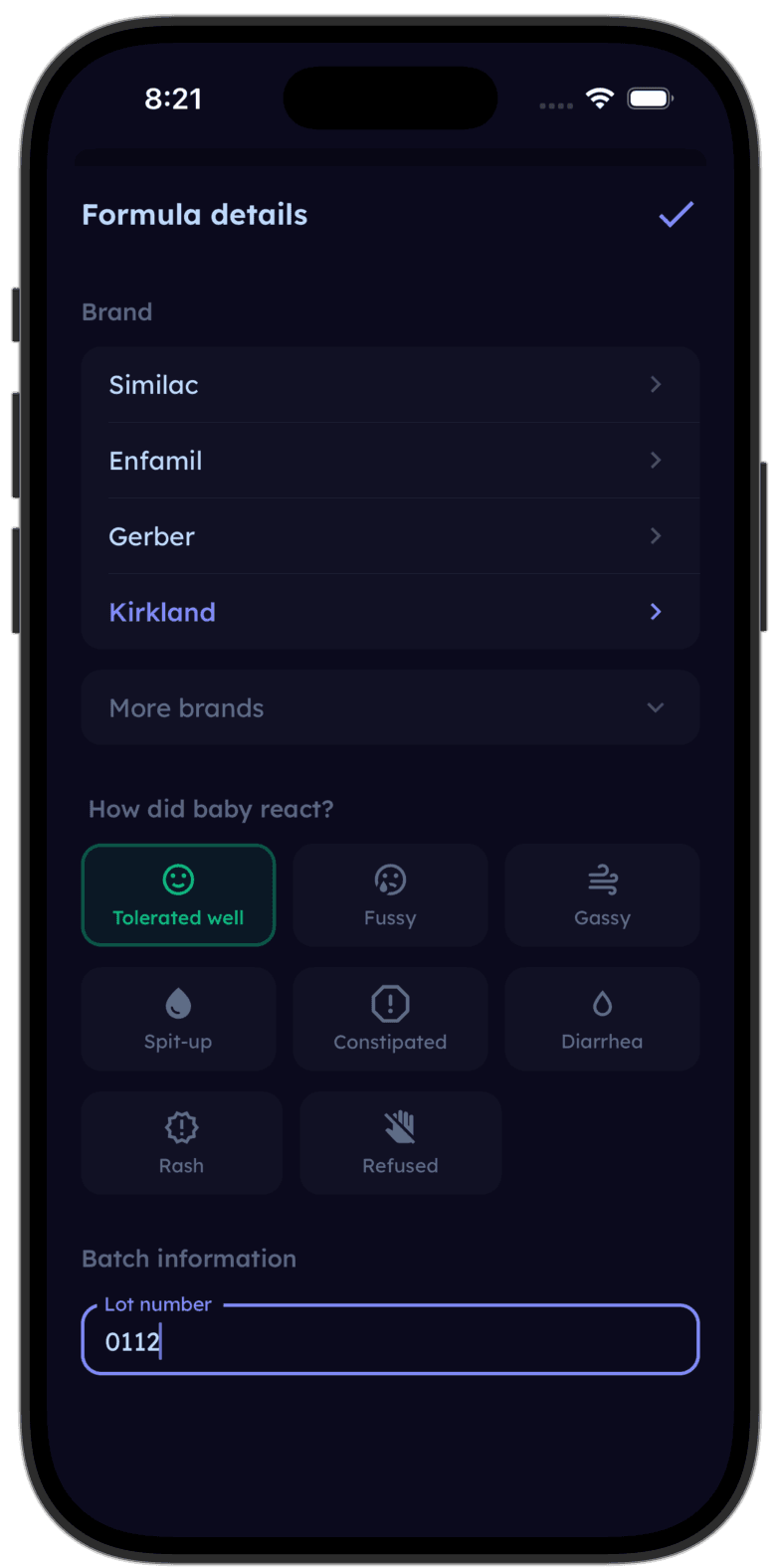
Know if the goat milk formula is actually making a difference.
Log each bottle, note any fussiness or stool changes, and see the pattern over two weeks. If Kabrita or Kendamil Goat is helping your baby, you'll see it clearly. If symptoms aren't improving, you'll have the timeline your pediatrician needs to figure out what's actually going on.


Taste, Mixing, and Practical Differences
Taste: Goat milk formula has a slightly different taste than cow's milk formula — milder for some, slightly tangier for others. Most babies adjust quickly. Kendamil Goat tends to taste creamier due to the whole milk base.
Mixing: Both dissolve reasonably well. Kendamil Goat may be slightly thicker. A formula pitcher handles any mixing issues.
Availability: Both are available on Amazon and at some Target locations. Neither is as widely available as Enfamil or Similac. Plan ahead to avoid running out.
Staging: Both use European-style staging (Stage 1 for 0–6 months, Stage 2 for 6–12 months). Follow your pediatrician's guidance on stage transitions.
When to Talk to Your Pediatrician
If you are considering goat milk formula because your baby has digestive issues on cow's milk formula, a brief conversation with your pediatrician can help determine whether goat milk, a gentle cow's milk formula, or a hypoallergenic formula is the right next step.
Signs That Need Medical Evaluation
- Blood or mucus in stools (suggests protein allergy — goat milk will NOT help)
- Persistent vomiting after feedings
- Failure to gain weight or weight loss
- Severe eczema flares
- Symptoms that do not improve after 2 weeks on goat milk formula
- Signs of allergic reaction: hives, facial swelling, wheezing (seek immediate care)
Blood in stool and persistent vomiting suggest protein allergy, NOT simple digestive sensitivity. Goat milk formula will NOT help with true CMPA. Ask your pediatrician about hypoallergenic options.
The Bottom Line
Kabrita and Kendamil Goat are both well-made goat milk formulas with slightly different approaches. Kendamil uses whole goat milk with natural MFGM. Kabrita uses skim + whey with added prebiotics.
Choose Kabrita if: you want consistent prebiotic inclusion (GOS) and are comfortable with fish-oil-sourced DHA.
Choose Kendamil Goat if: you prefer whole-milk formulation with natural MFGM and want plant-based DHA without fish oil.
Consider a different option if: your baby has confirmed cow's milk protein allergy (use hypoallergenic formula instead), your budget is tight (goat milk formula costs 60–100% more than standard formula), or mild fussiness is your only concern (try a gentle cow's milk formula first — it is cheaper and widely available).
If you're trialing goat milk formula, the two-week window is when everything becomes clear. Tinylog logs feeds, stools, and fussiness so you can see whether Kabrita or Kendamil Goat is making a real difference — or whether something else needs to be ruled out. Either way, you'll have data instead of guesswork.
For more, see goat milk vs. cow milk formula, best organic baby formulas, and Kendamil vs. Similac.
Related Guides
-
Goat vs. Cow Milk Formula — Differences and what pediatricians say
-
Best Baby Formulas 2026 — An evidence-based guide
Sources
- U.S. Food and Drug Administration. "21 CFR Part 107 — Infant Formula." Code of Federal Regulations.
- American Academy of Pediatrics. "Choosing an Infant Formula." HealthyChildren.org, 2024.
- Jandal JM. "Comparative aspects of goat and sheep milk." Small Ruminant Research, 1996.
- Restani P, et al. "Cross-reactivity between milk proteins from different animal species." Clinical and Experimental Allergy, 1999.
- U.S. FDA. "Infant Formula Guidance Documents and Regulatory Information." fda.gov, 2023.
This guide is for informational purposes only and is not a substitute for professional medical advice. Formula recommendations should be discussed with your pediatrician, especially for babies with allergies or digestive concerns.
Frequently asked questions
- Is goat milk formula better than cow's milk formula?
- Not necessarily better, but different. Goat milk naturally contains more A2 beta-casein, forms a softer curd in the stomach, and has slightly less alpha-s1 casein. Some babies may digest it more easily. But there is no strong evidence that goat milk formula produces different outcomes in healthy babies. Both are nutritionally complete.
- Can babies with cow's milk allergy use goat milk formula?
- No. Goat milk and cow's milk proteins are highly similar. Approximately 90% of babies with cow's milk protein allergy (CMPA) also react to goat milk protein. Goat milk formula is NOT suitable for CMPA. These babies need extensively hydrolyzed or amino acid-based formula.
- Is Kabrita FDA approved?
- Yes. Kabrita is FDA-registered and legally sold in the United States as an infant formula. It meets all FDA requirements under 21 CFR 107.
- Why is goat milk formula more expensive?
- Goat milk costs more to produce than cow's milk — goats produce less milk per animal, and goat dairy farming is a smaller industry. The premium price reflects these production economics plus the smaller market scale of goat milk formula brands.
- Is Kendamil Goat different from regular Kendamil?
- Yes. Kendamil Goat uses whole goat milk instead of whole cow's milk. It retains Kendamil's whole-milk approach (with natural MFGM from goat milk cream) and plant-based DHA. The protein profile differs because of the goat milk source.