
GUIDE
Kendamil vs. Similac
Published on ·Updated on
Kendamil uses whole milk with natural MFGM and no palm oil. Similac uses skim milk + whey with added 2'-FL HMO and no palm olein. Different philosophies, both FDA-compliant.
Kendamil is a UK-made formula that has gained a strong following among U.S. parents drawn to its whole-milk approach and European pedigree. Similac is America's top-selling formula with decades of market dominance. Here is how they actually compare.
Log formula and bottles
“All infant formulas must meet requirements that ensure optimal nutrition for babies. If your baby's formula is sold in the U.S., it has the nutrients your baby needs.”
 Dr. Matthew Badgett, MD, Pediatrician, Cleveland Clinic
The Honest Starting Point
Kendamil and Similac represent two different philosophies of infant formula. Kendamil, made in the UK's Lake District, uses whole milk — retaining the cream and its natural MFGM. Similac, America's market leader, uses skim milk + whey protein concentrate and adds proprietary bioactive ingredients like 2'-FL HMO.
Both are FDA-compliant. Both are nutritionally complete. Both will feed your baby just fine. The decision comes down to which formulation philosophy resonates with you — and whether the price difference matters to your family.
Kendamil has earned a devoted following among U.S. parents who are drawn to European-style formulations. Similac has decades of market presence, hospital distribution networks, and the broadest availability of any formula brand. Neither advantage makes the formula itself better or worse — they are different strengths.
For a deeper look at European vs. American formula differences, see our European vs. American formula guide.
| Feature | Kendamil Classic | Similac 360 Total Care | What It Means |
|---|---|---|---|
| Country of origin | United Kingdom (English Lake District) | United States | Kendamil is the only UK-made formula widely available in the U.S. Similac is manufactured domestically. |
| Protein source | Whole milk (includes cream and natural MFGM) | Nonfat milk, whey protein concentrate | Fundamentally different approaches. Kendamil retains whole milk; Similac separates and recombines. |
| Fat source | Whole milk fat, coconut oil, rapeseed oil (no palm oil) | High oleic safflower, soy, coconut oils (no palm olein) | Neither uses palm oil/olein. Kendamil gets some fat from whole milk. Both use plant oils. |
| Carbohydrate source | Lactose | Lactose | Both use lactose as the sole carb. No corn syrup solids. |
| Signature ingredient | Natural MFGM (from whole milk cream) | 2'-FL HMO (human milk oligosaccharide) | Different bioactive compounds. Both found in breast milk. Neither has strong evidence of superiority. |
| DHA source | Plant-based algal oil (no fish oil, no hexane) | Algal oil (Schizochytrium sp.) | Both use algal DHA. Kendamil specifically avoids fish oil. |
| FDA registered | Yes | Yes | Both meet all FDA requirements under 21 CFR 107 |
| Price per oz (powder) | ~$1.70–$2.00/oz prepared | ~$1.10–$1.30/oz prepared | Kendamil costs 40–60% more per ounce |
| Available at | Amazon, Target, specialty retailers | Everywhere — grocery, pharmacy, online | Similac wins on availability. Kendamil is growing but not yet universal. |
The Ingredient Differences That Actually Matter
These formulas differ in genuine, meaningful ways — not just branding.
Whole milk vs. skim milk + whey
Kendamil's whole-milk approach is its defining feature. By keeping the cream in the milk, Kendamil retains natural MFGM (milk fat globule membrane) — the same compound Enfamil adds separately. Whole milk also provides a different fat profile, with some fat coming naturally from the milk rather than entirely from added plant oils.
Similac uses the conventional skim milk + whey protein concentrate approach, where milk is separated and the protein components are recombined at a specific whey-to-casein ratio. This is the standard method used by most formulas worldwide.
There is no large-scale evidence that whole-milk formula produces different developmental outcomes than skim-milk formula. The whole-milk approach is interesting from a formulation standpoint, but its clinical significance in healthy term infants is unproven.
MFGM vs. HMO: different bioactive strategies
Kendamil provides natural MFGM from its cream. Similac adds 2'-FL HMO, a prebiotic oligosaccharide. Both are real compounds found in breast milk. Neither has strong evidence of superiority when added to formula. They target different aspects of development — MFGM is associated with brain development research, HMO with gut health and immune function.
No palm oil from either
Both Kendamil and Similac avoid palm oil, which is a shared advantage. Many parents specifically seek palm-free formulas due to research linking palm olein to firmer stools and reduced calcium absorption. On this front, both formulas deliver.
What the Marketing Doesn't Tell You
Kendamil's marketing emphasizes its whole-milk heritage and European provenance — it supplies formula to NHS hospitals and has been used in the UK for decades. This is true, but it does not mean Kendamil is clinically superior to American formulas. Different countries have different formula traditions, not different nutritional science.
Similac's marketing emphasizes its 2'-FL HMO addition and positions itself as the most advanced formula. The research on HMO in formula is promising but limited. Similac's hospital distribution contracts create a perception of medical endorsement that is actually a business relationship.
The price gap is real: Kendamil costs roughly $40–55 more per month than Similac. Over a year, that is $480–660. This buys you whole-milk formulation and natural MFGM — ingredients that are philosophically appealing but clinically unproven to produce different outcomes.
Both formulas meet the same FDA nutritional baseline. A store-brand formula at $0.70/oz also meets this baseline. The premium you pay for either Kendamil or Similac is for above-baseline additions and brand positioning.
| Product | Typical Price | Cost Per Oz (Prepared) | Monthly Estimate |
|---|---|---|---|
| Kendamil Classic Stage 1 (powder, 28.2 oz) | $34–$40 | ~$1.80/oz prepared | ~$190–$230/month |
| Similac 360 Total Care (powder, 20.6 oz) | $33–$38 | ~$1.20/oz prepared | ~$150–$175/month |
| Store brand (for reference) | $16–$23 | ~$0.70–$0.85/oz prepared | ~$90–$120/month |
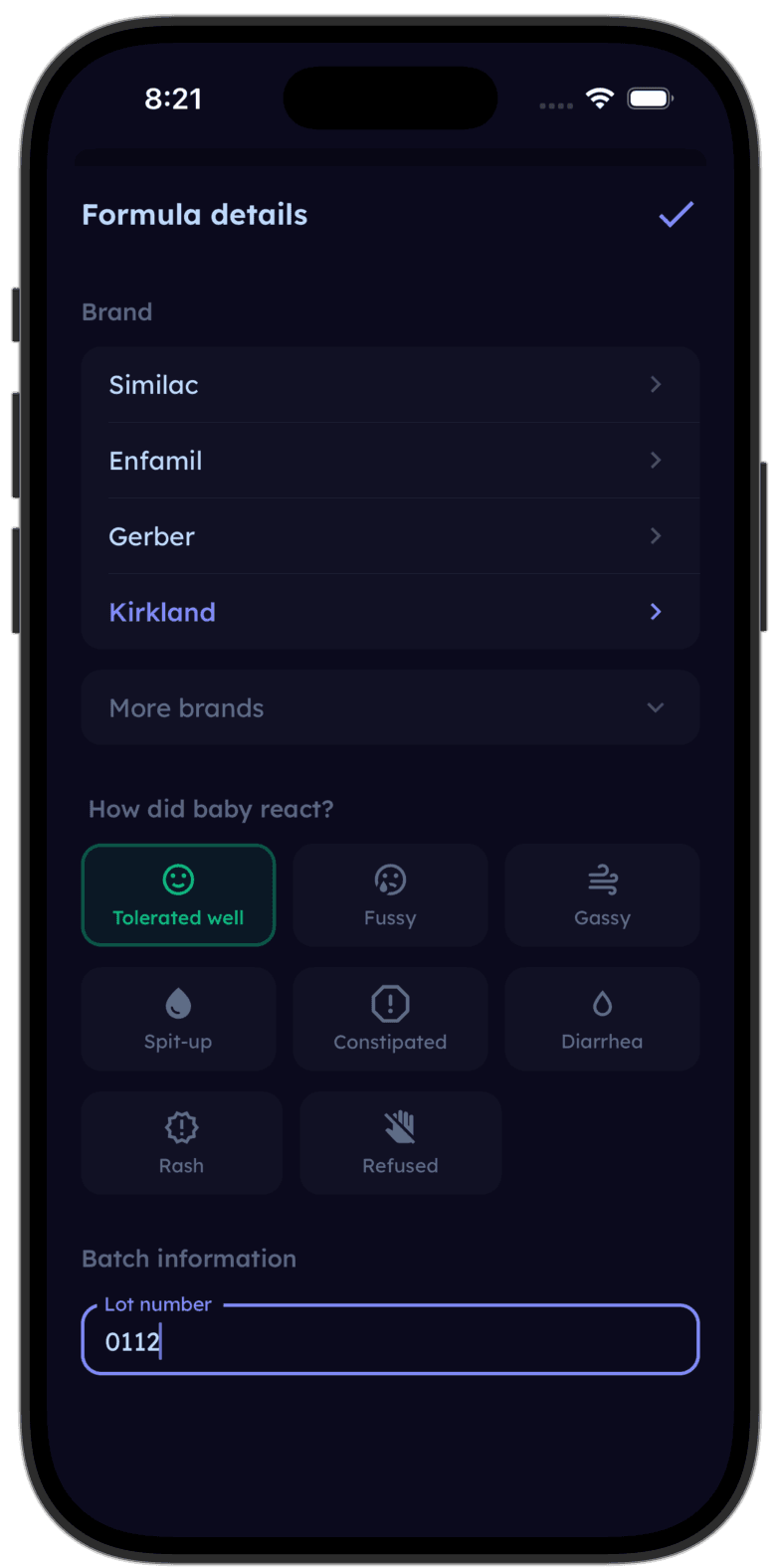
Tinylog tracks formula intake so you can spot what's working.
Log each bottle in seconds — see daily totals, track which formula your baby is on, and have real data ready for your pediatrician. Especially useful during formula transitions.


Taste, Mixing, and Practical Differences
These formulas feel different in daily use.
Taste: Kendamil tends to have a creamier, richer taste due to the whole milk base. Similac is milder. Some parents report babies who are transitioning from breast milk take to Kendamil more easily, though this varies widely between babies.
Mixing: Kendamil can be slightly thicker due to the whole milk. Warmer water helps it dissolve. Similac powder can clump but dissolves reasonably in room temperature water. A formula pitcher works well for both.
Availability: Similac wins decisively here. It is available at every grocery store, pharmacy, and major retailer. Kendamil is available on Amazon, at Target (limited), and at specialty retailers — but you cannot always grab it at a corner store at 2 AM. Plan ahead if you use Kendamil.
Product range: Similac offers sensitive, soy, hypoallergenic, and many other specialty lines. Kendamil's U.S. range is more limited — Classic, Organic, and Goat Milk are the main options. If your baby needs a specialty formula, Similac has broader options.
When to Talk to Your Pediatrician
Switching between Kendamil and Similac does not require a doctor's visit for most healthy babies. However, contact your pediatrician if your baby shows signs of intolerance after switching.
Signs to Discuss With Your Pediatrician
- Your baby is consistently refusing feeds or eating significantly less than expected
- Persistent vomiting (not just spit-up) after most feedings
- Blood or mucus in stools
- Significant fussiness that does not improve after 1–2 weeks on a new formula
- Poor weight gain or weight loss
- Signs of allergic reaction: hives, facial swelling, wheezing, or difficulty breathing (seek immediate care)
Most formula discomfort (mild gas, occasional spit-up) is normal. Give any new formula at least 1–2 weeks before deciding it is not working.
The Bottom Line
Kendamil and Similac are both excellent formulas with genuinely different approaches. Kendamil offers whole-milk formulation with natural MFGM, no palm oil, and European heritage. Similac offers engineered bioactive additions (HMO), no palm olein, wider availability, and lower cost.
Choose Kendamil if: you prefer whole-milk formulation with natural MFGM, European-style ingredients appeal to you, and the premium price fits your budget.
Choose Similac if: you want broad availability, the HMO prebiotic addition, a lower price point, or access to a wider range of specialty formulas.
Either works well if: your baby is healthy and full-term. Both are nutritionally complete and FDA-compliant.
If you are switching, tracking feeds and symptoms for 1–2 weeks gives you real data. Tinylog logs feeds, diapers, and fussiness so you can see whether the switch actually made a difference. Once you've decided on a formula, sign up for free recall alerts so you'll know right away if it's ever recalled.
For more, see Kendamil vs. Enfamil, HiPP vs. Kendamil, and Enfamil vs. Similac.
Related Guides
-
Best Baby Formulas 2026 — An evidence-based guide
-
Kendamil vs. Enfamil — Full ingredient and value comparison
-
European vs. American Formula — Real differences explained
Sources
- U.S. Food and Drug Administration. "21 CFR Part 107 — Infant Formula." Code of Federal Regulations.
- American Academy of Pediatrics. "Choosing an Infant Formula." HealthyChildren.org, 2024.
- Timby N, et al. "Neurodevelopment, nutrition, and growth until 12 mo of age in infants fed a low-energy, low-protein formula supplemented with bovine milk fat globule membranes." American Journal of Clinical Nutrition, 2014.
- Marriage BJ, et al. "Infants fed a lower calorie formula with 2'-FL show growth and 2'-FL uptake similar to breastfed infants." Journal of Pediatric Gastroenterology and Nutrition, 2015.
- U.S. FDA. "Infant Formula Guidance Documents and Regulatory Information." fda.gov, 2023.
This guide is for informational purposes only and is not a substitute for professional medical advice. Formula recommendations should be discussed with your pediatrician, especially for babies with allergies, reflux, or other medical conditions.
Frequently asked questions
- Is Kendamil better than Similac?
- Neither is objectively better. Kendamil uses whole milk with natural MFGM and plant-based DHA without palm oil. Similac uses skim milk + whey with added 2'-FL HMO and no palm olein. Both are FDA-compliant. Kendamil costs more. The best choice depends on your priorities and budget.
- Is Kendamil worth the extra cost?
- Kendamil costs 40–60% more than Similac. You get whole-milk formulation, natural MFGM, plant-based DHA, and no palm oil. Whether this justifies the premium depends on your values. There is no evidence that Kendamil produces meaningfully different developmental outcomes in healthy babies.
- Is Kendamil safe for American babies?
- Yes. Kendamil is FDA-registered and legally sold in the U.S. It meets all FDA requirements under 21 CFR 107. It has been sold in Europe for decades and is the formula supplied to the British royal family's hospitals.
- Does Kendamil have HMO like Similac?
- No. Kendamil does not include 2'-FL HMO. Instead, it provides natural MFGM from its whole-milk base. MFGM and HMO are different bioactive components — both found in breast milk — with different research profiles.
- Can I switch from Similac to Kendamil?
- Yes. Most healthy babies can switch between formulas. You can mix them during transition. Some parents report slight stool changes due to the different fat profiles, which typically resolve within a week or two.