GUIDE

Skin-to-Skin vs. Immediate Swaddling

Skin-to-skin contact immediately after birth is the evidence-based standard for healthy newborns. It stabilizes temperature, heart rate, and breathing, and facilitates early breastfeeding. Swaddling has benefits later, but the first hours are for skin-to-skin.

What happens in the first hour after birth sets the tone for feeding, bonding, and regulation.

Track from the first hour

Log feedings and milestones

Every situation is a little bit different, but in the perfect situation where everything has gone well, baby would be delivered and then immediately baby would go onto mom's chest and they would do skin-to-skin.
Dr. Michelle SchimelpfenigDr. Michelle Schimelpfenig, MD, Pediatrician, Sanford Health

The Golden Hour Is Evidence-Based

The "golden hour" — the first 60 minutes after birth — has become a standard concept in newborn care for good reason. Research consistently shows that placing a healthy newborn directly on the parent's bare chest immediately after delivery produces measurable physiological benefits.

A Cochrane review (Moore et al., 2016) of 46 trials involving over 3,800 mother-infant pairs found that early skin-to-skin contact improved breastfeeding initiation, helped stabilize newborn cardiorespiratory function, and reduced infant crying. These aren't small effects — skin-to-skin newborns were significantly more likely to breastfeed successfully in the first 1-4 hours compared to swaddled and separated newborns.

The mechanism is partly thermal (parent's chest is a biological thermostat), partly hormonal (oxytocin release supports bonding and milk letdown), and partly behavioral (skin-to-skin triggers the newborn's innate crawling and rooting reflexes that lead to self-attachment at the breast). Our guide on breastfeeding in the first week covers how to build on this early success. Wrapping a baby in a blanket and placing them in a bassinet eliminates all three of these pathways.

Skin-to-Skin vs. Swaddling After Birth
Temperature regulation
Skin-to-SkinParent's chest acts as thermal regulator — as effective as an incubator for healthy term newborns
SwaddlingBlanket provides passive warmth but no active thermal regulation
Heart rate and breathing
Skin-to-SkinStabilizes newborn vital signs faster than separation
SwaddlingNeutral — does not destabilize but doesn't actively regulate
Breastfeeding initiation
Skin-to-SkinNewborns placed skin-to-skin are more likely to latch and breastfeed successfully in the first hour
SwaddlingSwaddled newborns may be less likely to self-attach and initiate feeding
Stress response
Skin-to-SkinReduces cortisol levels in both baby and parent; baby cries less
SwaddlingBaby may cry more when separated from parent for wrapping
Blood sugar
Skin-to-SkinSkin-to-skin helps stabilize newborn blood glucose through warmth and early feeding
SwaddlingNo direct blood sugar benefit
Bonding
Skin-to-SkinOxytocin release in both parent and baby; supports attachment
SwaddlingBonding still occurs but without the hormonal facilitation of direct contact
Best timing
Skin-to-SkinImmediately after birth — the 'golden hour'
SwaddlingAfter the first skin-to-skin period and initial feed — hours to days after birth
Comparison applies to the immediate postpartum period for healthy term newborns. Medical situations may require different approaches.

Skin-to-Skin: Advantages

  • WHO and AAP recommended standard of care for healthy newborns immediately after birth
  • Thermoregulation as effective as or superior to incubator warming for term infants
  • Significantly improves breastfeeding initiation rates and first-feed success
  • Reduces newborn crying and cortisol (stress hormone) levels
  • Promotes beneficial bacterial colonization from parent's skin

The evidence is strong enough that WHO, AAP, and UNICEF all recommend skin-to-skin as standard care.

Skin-to-Skin: Considerations

  • Requires alertness and safe positioning — drowsy parents need monitoring support
  • Not always possible immediately after C-section or complicated deliveries
  • Baby may need initial medical assessment if there are concerns at birth
  • Can feel overwhelming for some parents in the emotionally charged postpartum moment

If skin-to-skin isn't possible with the birthing parent, the other parent can provide it. The baby benefits either way.

Swaddling: Advantages

  • Helpful for sleep in the days and weeks after birth — contains the Moro (startle) reflex
  • Provides comfort and security when skin-to-skin isn't possible
  • Practical for safe sleep in the bassinet or crib
  • Can be comforting for baby when transitioning between caregivers
  • Useful when parents need rest and baby needs contained, safe sleep positioning

Swaddling is a valuable tool — just not in the first hour after birth for a healthy newborn.

Swaddling: Limitations

  • Should not replace skin-to-skin in the first hour — delays thermoregulation and feeding initiation
  • Swaddled babies may be less likely to self-attach for first breastfeed
  • Separating baby for wrapping increases crying and stress in the immediate postpartum period
  • Improper swaddling technique (too tight on hips) carries DDH risk

Swaddling becomes appropriate after the initial skin-to-skin period, typically for sleep in the first weeks of life.

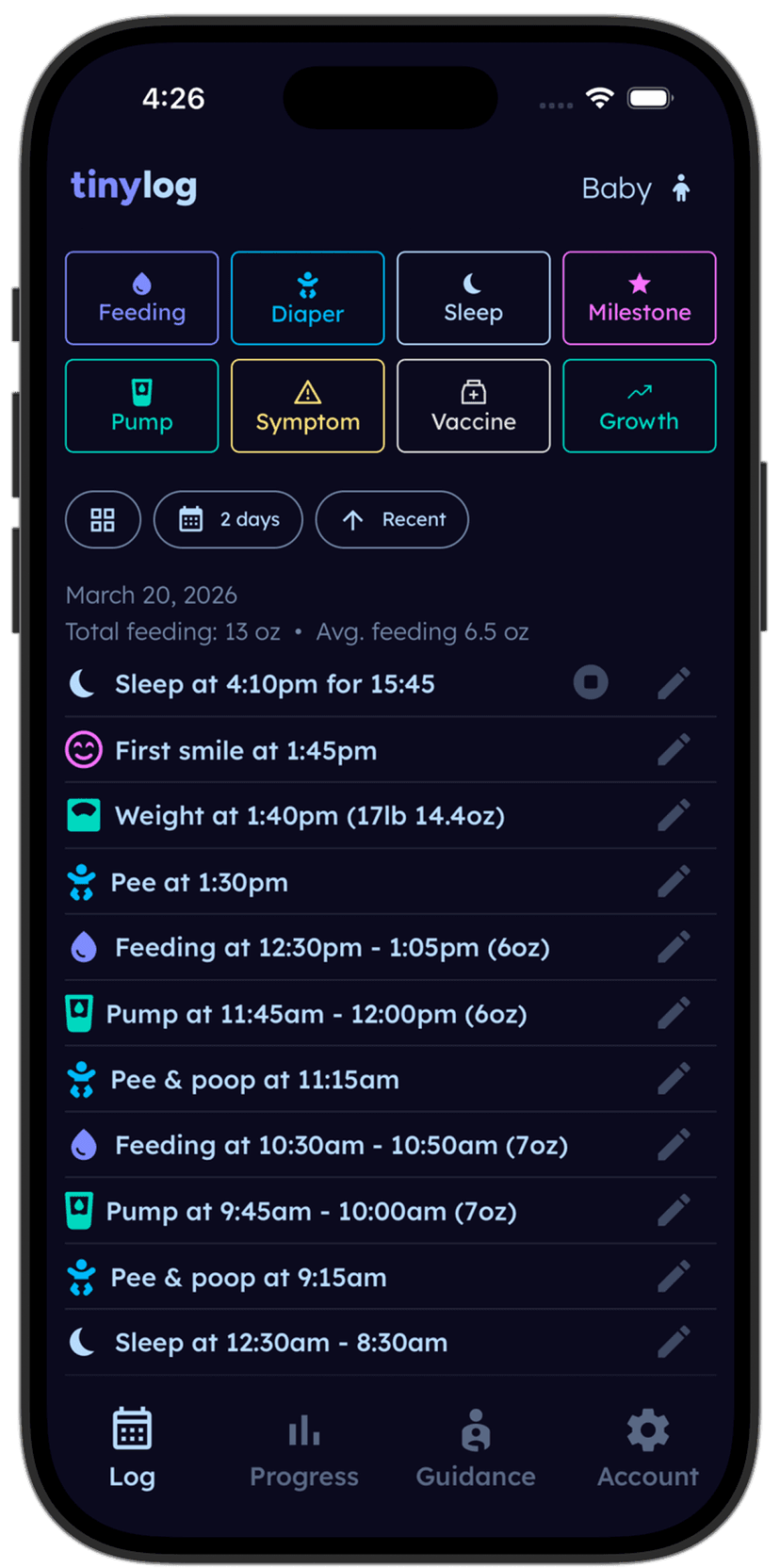
Tinylog activity tracking showing newborn milestones and feedings

Log the first feed and every one after.

Tinylog tracks feedings from the very first latch. Start in the delivery room and build a complete record of your baby's feeding patterns from hour one.

Download on the App StoreGet It On Google Play

When Skin-to-Skin Isn't Possible

Some births don't allow for immediate skin-to-skin. Cesarean sections under general anesthesia, neonatal resuscitation needs, maternal hemorrhage, and preterm delivery complications may all require separation. This is not a failure — it's appropriate medical care.

When the birthing parent can't do skin-to-skin immediately, the partner should be offered the opportunity. Studies show that babies benefit from skin-to-skin with any caregiver. If neither parent can hold the baby, skin-to-skin should happen as soon as medically feasible.

Parents who missed the golden hour should know that the benefits of skin-to-skin don't expire after 60 minutes. Regular skin-to-skin in the hours, days, and weeks after birth continues to support bonding, temperature regulation, and breastfeeding. Our guide to the first 48 hours with a newborn walks through what to expect and how to maximize these early moments. The window is not closed — it's always open.


Swaddling: When and How to Start

Once the golden hour has passed and the first feed is established, swaddling becomes a useful tool for newborn sleep. Here's when swaddling makes sense:

For sleep: Swaddling contains the Moro reflex (startle reflex) that wakes babies. A properly swaddled newborn often sleeps longer and more peacefully. Always place a swaddled baby on their back. You can also pair delayed cord clamping and skin-to-skin contact in your birth plan for an evidence-based start.

For calming: The 5 S's framework (swaddle, side/stomach position for holding, shush, swing, suck) uses swaddling as a foundation for soothing a fussy newborn.

Safety reminders: Swaddle snugly around the arms but leave hips loose enough for leg movement. Stop swaddling when baby shows signs of rolling (usually around 8 weeks). Never place a swaddled baby on their stomach.

Tips That Apply Either Way

Request the golden hour in your birth plan

Tell your birth team you want at least one hour of uninterrupted skin-to-skin after birth. Most hospitals now support this and will delay weighing, measuring, and eye ointment until after the first feed. Put it in writing and discuss it at a prenatal visit.

Skin-to-skin isn't just for the delivery room

Continue skin-to-skin contact in the days and weeks after birth. It's not a one-time event. Regular skin-to-skin (during feedings, after baths, during quiet time) continues to support temperature regulation, bonding, and milk production for breastfeeding parents.

Both have their time and place

Skin-to-skin is for the first hours and for ongoing bonding throughout the newborn period. Swaddling is for sleep and settling in the weeks that follow. They're complementary strategies, not competing ones. Use both in their appropriate context.

Related Guides

Sources

  • Moore, E. R., et al. (2016). "Early Skin-to-Skin Contact for Mothers and Their Healthy Newborn Infants." Cochrane Database of Systematic Reviews, (11).
  • WHO. (2017). "Protecting, Promoting and Supporting Breastfeeding in Facilities Providing Maternity and Newborn Services." World Health Organization.
  • Feldman, R., et al. (2014). "Maternal and Paternal Skin-to-Skin Contact and Cortisol Reactivity in Infants." Biological Psychiatry, 75(1), 56-64.
  • Bystrova, K., et al. (2009). "Early Contact Versus Separation: Effects on Mother-Infant Interaction One Year Later." Birth, 36(2), 97-109.

This guide is for informational purposes only and is not a substitute for professional medical advice. Consult your pediatrician for guidance specific to your baby.

Get this comparison in your inbox.
We'll send you this guide so you can discuss your postpartum preferences with your birth team.
The first feed matters. The second feed matters. They all matter.
Download Tinylog — start logging feedings from the golden hour and build the tracking habit that helps through the whole first year.
Download on the App StoreGet It On Google Play