GUIDE

Breastfeeding in the First Week

The first week is a crash course. Your milk changes, your baby's stomach grows, and neither of you has done this before. Here's what each day actually looks like.

Nobody tells you that breastfeeding is a learned skill — for both of you. The first week is messy, confusing, and completely normal. This is your day-by-day cheat sheet.

What Nobody Tells You About Week One

Breastfeeding in the first week is not what most people imagine. There's this picture in your head of a calm parent and a peacefully nursing baby, and then reality hits: your baby doesn't seem to know what to do, your nipples are sore, you can't tell if anything is coming out, and everyone has an opinion.

Here's the honest truth: breastfeeding is a learned skill. It's supposed to be "natural," and in the sense that your body is designed for it, it is. But so is walking, and that took you about a year to figure out. Your baby has never eaten before. You've never lactated before. You're both learning.

The first week is the steepest part of the learning curve. After that, it starts to smooth out. Most parents who are still breastfeeding at 6 weeks say it got dramatically easier after the first 1-2 weeks. So if you're in the thick of it right now and wondering whether it's always this hard — it's not. But this part is, and that's normal.

Day-by-Day: What to Expect
Day 1
What's in Your MilkColostrum (thick, golden)
Volume per Feed1-5 ml per feed (teaspoons, not ounces)
Number of Feeds8-12+ times
Expected Diapers1 wet, 1-2 meconium (black/tar)
NotesBaby is recovering from birth too. Lots of skin-to-skin. Colostrum is small in volume but packed with antibodies and exactly what baby needs.
Day 2
What's in Your MilkColostrum
Volume per Feed5-15 ml per feed
Number of Feeds8-12+ times
Expected Diapers2 wet, 1-2 meconium
NotesBaby may be sleepier today. Wake them to feed every 2-3 hours if they're not asking. Cluster feeding often starts tonight.
Day 3
What's in Your MilkTransitional milk starting
Volume per Feed15-30 ml per feed
Number of Feeds8-12+ times (often more)
Expected Diapers3 wet, stools transitioning to green/brown
NotesThis is often the hardest day. Milk is coming in, breasts may feel engorged, baby may be extra fussy. Your hormones are also crashing. It gets better.
Day 4
What's in Your MilkTransitional milk
Volume per Feed30-60 ml per feed
Number of Feeds8-12 times
Expected Diapers4+ wet, stools turning yellow
NotesEngorgement may peak. Hand express a little before latching to soften the areola if baby is struggling. Warm compresses help.
Day 5-7
What's in Your MilkMature milk arriving
Volume per Feed60-90 ml per feed
Number of Feeds8-12 times
Expected Diapers6+ wet, 3-4 yellow seedy stools
NotesThings start to click. Feeds may get more efficient. Weight should stabilize and start trending up. You might feel letdown as a tingling sensation.
These are typical ranges. Your baby might hit these benchmarks a day early or late. The overall trajectory matters more than any single day.

Your Milk Is Changing — Here's What's Happening

Your body starts producing colostrum during pregnancy — that thick, golden liquid is ready before your baby is born. Colostrum is low in volume but incredibly concentrated. It's packed with antibodies (especially IgA), white blood cells, and growth factors. Think of it as your baby's first immune system booster shot.

Between days 2-5, your milk transitions. You'll feel it — your breasts get noticeably fuller, sometimes uncomfortably so. This is called lactogenesis II, and it's triggered by the drop in progesterone after you deliver the placenta, combined with prolactin surges from your baby nursing. The more your baby nurses in the first 48-72 hours, the stronger the signal to your body to ramp up production.

By the end of the first week, you're producing transitional milk that's increasing in volume daily. By about 2 weeks, you'll have mature milk and your supply will be calibrating to your baby's demand. This entire process is driven by one principle: the more milk that's removed, the more milk you make. That's why frequent feeding in week one is so critical — your baby isn't just eating, they're programming your supply.

For a closer look at colostrum specifically — how much is enough and why it matters — see our colostrum guide.

Normal Week One Experiences

  • Baby wanting to eat constantly — especially on days 2-3 and in the evenings
  • Nipple tenderness that improves over the first few days
  • One breast feeling more 'productive' than the other
  • Baby falling asleep at the breast mid-feed (wake them gently — tickle feet, undress slightly)
  • Feeling emotional, weepy, or overwhelmed — the 'baby blues' affect up to 80% of postpartum parents
  • Milk leaking from the other breast during feeds
  • Uterine cramping while nursing (oxytocin causes your uterus to contract — painful but good)

If you're experiencing most of these, you're in the normal zone — even though it doesn't feel like it.

Feeding Frequency: Why It Feels Like Nonstop

The standard recommendation is 8-12 feeds per 24 hours, but in the first week, many babies nurse even more than that. Your baby's stomach on day 1 is about the size of a cherry — roughly 5-7 ml. It grows to the size of a walnut by day 3 (about 22-27 ml) and an egg by day 10 (about 60-80 ml). Small stomach = frequent meals. That's just math.

Cluster feeding — where your baby feeds every 30-60 minutes for several hours — commonly starts in the first few days. This is not a sign of low supply. It's your baby's way of placing a bulk order with your body. More demand now means more supply later. It's exhausting, but it's exactly how the system is designed to work.

Feed on demand. Watch your baby, not the clock. Hunger cues include rooting (turning their head and opening their mouth), hand-to-mouth movements, sucking on their fist, and fussiness. Crying is actually a late hunger cue — try to catch the earlier ones when you can.

For more on cluster feeding patterns, see our cluster feeding guide.

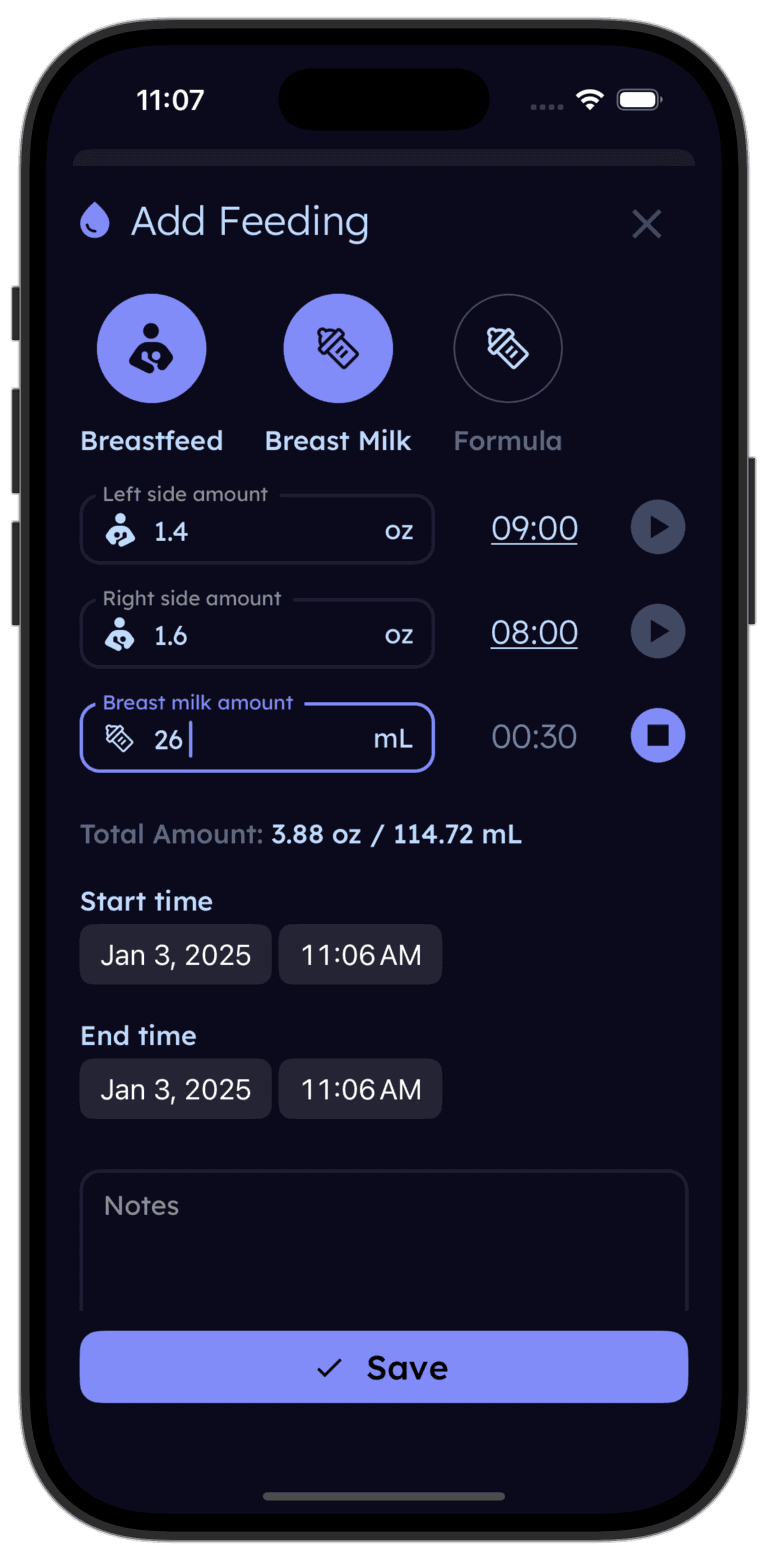
tinylog feeding tracker showing newborn feeding log with frequency data

In the first week, your pediatrician will ask: how many feeds? How many wet diapers? Having the answer ready makes those early visits so much less stressful.

tinylog lets you log feeds and diapers in seconds — even one-handed, even at 3 AM. Bring actual data to your weight check instead of trying to remember.

Download on the App StoreGet It On Google Play

Latch and Positioning: Getting Started

A good latch is the single most important factor in the first week. A deep latch — where baby takes a large mouthful of breast, not just the nipple — means more efficient milk transfer, less nipple pain, and better supply stimulation.

Signs of a good latch: baby's mouth is wide open (like a yawn), lips are flanged outward (not tucked in), you see more areola above baby's top lip than below, their chin is pressed into your breast, and you hear rhythmic swallowing. It might feel like a strong tug, but it shouldn't feel like sharp, pinching pain.

If your latch isn't working, don't push through pain. Break the seal (slide your finger into the corner of baby's mouth), take a breath, and try again. Some babies need many attempts before they get it. That's normal. If latch is consistently painful or baby doesn't seem to be transferring milk, an IBCLC can observe a feed and help you troubleshoot — and the earlier you get this help, the better.

For a detailed deep-dive on latch technique, see our breastfeeding latch guide. For different holds and positions, see breastfeeding positions.

When to Get Help Right Away

  • Baby is too sleepy to wake for feeds and hasn't eaten in 4+ hours
  • No wet diapers in 12 hours
  • Meconium stools still present after day 4-5 (should be transitioning to yellow)
  • Weight loss exceeding 10% of birth weight
  • Painful cracking, bleeding, or blistering of nipples that isn't improving
  • Baby's skin or eyes look yellow (jaundice — needs evaluation)
  • You have a fever above 100.4°F or notice red, hot, painful areas on your breast

Don't wait to see if these resolve on their own. Call your pediatrician, your OB/midwife, or an IBCLC. Early intervention makes a huge difference.

Surviving Week One

Skin-to-skin is your secret weapon

Skin-to-skin contact regulates baby's temperature, heart rate, and blood sugar, and it stimulates your milk production. In the first few days, do as much of it as you can. Strip baby down to a diaper, place them on your bare chest, and cover with a blanket. This is not just bonding — it's biological infrastructure.

Day 3 is the worst day — plan for it

Day 3 is when your milk comes in, your hormones crash, you're sleep deprived, and your baby is cluster feeding. It is genuinely one of the hardest days of early parenthood. Know this in advance. Ask your partner or support person to take over everything except feeding on this day.

Wake a sleepy baby to feed

In the first week, if your baby hasn't eaten in 3 hours during the day or 4 hours at night, wake them. Newborns sometimes sleep through hunger cues, especially if they're jaundiced or had a difficult birth. Undress them, change their diaper, or put them skin-to-skin to rouse them.

You cannot overfeed a breastfed newborn

There is no such thing as nursing too much in the first week. Every feed is building your milk supply. Feed on demand, every time baby cues. If they want to nurse 15 times in 24 hours, that's biology working as intended.

Get help early, not later

If breastfeeding hurts beyond initial tenderness, if you're not seeing enough wet diapers, or if something just feels wrong — call a lactation consultant (IBCLC) now, not next week. Most latch and positioning issues are fixable with hands-on help, and the sooner you get it, the easier the fix.

What the Evidence Actually Says

There's a lot of misinformation about the first week of breastfeeding. Here's what the research supports:

"Your baby should nurse for 20 minutes per side." Not quite. The AAP recommends feeding until baby is satisfied, not for a set time. Some babies are efficient and drain a breast in 10 minutes. Others take 30. Session length is less important than whether baby is swallowing actively and seems satisfied afterward. (AAP, 2022)

"If you need to supplement in the first days, breastfeeding is over." False. The Academy of Breastfeeding Medicine's Protocol #3 outlines specific medical indications for early supplementation and emphasizes that appropriate supplementation supports — not undermines — continued breastfeeding. If your baby needs formula in the first days for medical reasons, it does not mean breastfeeding has failed.

"Your baby lost too much weight — you don't have enough milk." Normal weight loss in the first few days is up to 7-10%. This is expected. Babies are born with extra fluid specifically for this purpose. The concern point is when loss exceeds 10% or baby hasn't started gaining by day 5. (Nommsen-Rivers et al., 2008)

"Colostrum isn't enough — baby needs more." Colostrum is specifically designed for the first days. Your baby's stomach is tiny, and colostrum is calorie-dense and rich in immune factors. The small volumes are matched to the small stomach. (Kent et al., 2006)

When to Get Help and What Kind

IBCLC (International Board Certified Lactation Consultant) — the gold standard for breastfeeding support. If latch hurts, baby isn't gaining, or you just need someone to watch a feed and tell you what they see, this is who you want. Many hospitals have them on staff, and you can request a visit before discharge. They also do home and telehealth visits.

CLC (Certified Lactation Counselor) — trained peer support. Good for encouragement, basic positioning help, and answering common questions. Many pediatric offices have CLCs on staff.

Pediatrician — for weight checks, jaundice evaluation, and any medical concerns about your baby's health or feeding. Most pediatricians want to see newborns within 1-3 days of hospital discharge.

Your OB/GYN or midwife — for your health. If you have a fever, breast pain beyond normal tenderness, or signs of infection, this is your call.

Get help early. The difference between a fixable day-3 latch issue and a week-2 supply crisis often comes down to timing.

If pain continues beyond the first few days or is getting worse rather than better, our painful breastfeeding guide covers every common cause and when each one needs professional help.


Related Guides

Sources

  • American Academy of Pediatrics (AAP). (2022). Breastfeeding and the Use of Human Milk. Pediatrics, 150(1).
  • Academy of Breastfeeding Medicine. (2017). ABM Clinical Protocol #3: Supplementary Feedings in the Healthy Term Breastfed Neonate. Breastfeeding Medicine, 12(4).
  • Kent, J. C., et al. (2006). Volume and frequency of breastfeedings and fat content of breast milk throughout the day. Pediatrics, 117(3).
  • Nommsen-Rivers, L. A., et al. (2008). Delayed onset of lactogenesis among first-time mothers is related to maternal obesity and factors associated with ineffective breastfeeding. American Journal of Clinical Nutrition, 92(3).
  • World Health Organization. (2023). Breastfeeding recommendations.
  • Dewey, K. G., et al. (2003). Risk factors for suboptimal infant breastfeeding behavior, delayed onset of lactation, and excess neonatal weight loss. Pediatrics, 112(3).

Medical Disclaimer

This guide is for informational purposes only and is not a substitute for professional medical advice. If you're experiencing breastfeeding difficulties, consider consulting an IBCLC (International Board Certified Lactation Consultant) or your pediatrician.

Get this day-by-day guide in your inbox.
We'll send you this reference so you can check it at 3 AM when you can't remember what day it is, let alone what's normal.
Log every feed from day one — future you will thank you.
Download tinylog free — track feeds and diapers and bring real data to your pediatrician visit.
Download on the App StoreGet It On Google Play