


GUIDE

First 48 Hours with a Newborn

They hand you a baby and send you home. No manual. Here's what to actually expect.

The first 48 hours are a blur of feeding, diaper changes, and wondering if everything is normal. Spoiler: it probably is.

Track everything in the app

Feeds, diapers, sleep, all in one place

They Just Send You Home With a Baby

This is the part no one fully prepares you for. You go through pregnancy, labor, delivery, and then someone hands you a baby, puts you in a wheelchair, and waves goodbye from the hospital entrance. No instruction manual. No test to pass. Just you, your partner, and a tiny human who depends on you for everything.

The first 48 hours at home are a blur. You are physically recovering, emotionally processing, sleep-deprived, and learning to care for a newborn simultaneously. It is the most intense, beautiful, terrifying, and rewarding experience, often all within the same hour.

This guide covers what to actually expect during those first 48 hours, so you can spend less time Googling at 3 AM and more time figuring things out together.

What Your Baby Is Doing

Your newborn's job in the first 48 hours is simple: eat, sleep, poop, repeat. But the reality of that cycle is more chaotic than any book prepares you for.

Babies sleep a lot, around 16-17 hours a day, but never in stretches longer than 1-3 hours. They eat 8-12 times a day, which means feeding roughly every 2-3 hours around the clock. And they communicate exclusively by crying, which in the beginning all sounds the same.

Newborns are also surprisingly noisy sleepers. The grunting, squeaking, snorting, and random sounds can be alarming the first time you hear them. This is normal. Babies cycle through active sleep frequently, and their tiny nasal passages make all sorts of sounds. You will spend a lot of time staring at your baby's chest to make sure they are breathing. That is also normal.

What to Expect From Your Baby

  • Sleeps 16-17 hours a day, but in short 1-3 hour stretches, not in a row
  • Eats 8-12 times per day (every 2-3 hours, sometimes more)
  • Has 1-2 wet diapers on day 1, increasing to 6+ by day 4-5
  • May lose up to 7-10% of birth weight. This is normal and expected
  • Makes grunting, squeaking, and snorting noises while sleeping
  • Communicates almost entirely through crying. Hunger, discomfort, overstimulation
  • Can see about 8-12 inches (the distance to your face during feeding)
  • May have irregular breathing patterns during sleep. Brief pauses are normal

All of this is normal newborn behavior. If you are unsure about anything, call your pediatrician. That is what they are there for.

What You Are Feeling

The emotional experience of the first 48 hours is intense. You might feel an overwhelming rush of love, followed immediately by panic that you have no idea what you are doing. You might cry, a lot, and not know why. You might feel disconnected from your partner, even though you are going through this together.

If you gave birth, your hormones are in freefall. Estrogen and progesterone, which were at sky-high levels during pregnancy, plummet after delivery. This hormonal crash, combined with sleep deprivation and the reality of keeping a tiny human alive, creates the perfect storm for emotional upheaval. Our postpartum recovery guide covers the full physical and emotional timeline in detail.

The "baby blues", including tearfulness, mood swings, irritability, and anxiety, affect up to 80% of new mothers. They typically peak around day 3-5 and resolve within two weeks. Partners can also experience significant emotional shifts. None of this means you are failing. It means you are human.

What Parents Commonly Feel

  • Overwhelmed. 'I can't believe they just sent us home with a baby'
  • Sleep-deprived. Newborns do not sleep when you want them to
  • Anxious. Every sound, movement, and pause in breathing feels alarming
  • Emotional. Crying, mood swings, and feeling raw are all normal
  • Hungry. You will forget to eat if you do not plan ahead
  • Proud and terrified at the same time. Also normal
  • Disconnected from your partner. You are both running on fumes and figuring it out

All of this is normal. You are not failing. You are adjusting to the biggest change of your life on no sleep.

7 Survival Tips for the First 48 Hours

These are the things experienced parents wish someone had told them before they brought their baby home. None of them are complicated. All of them make a real difference.

Newborn Survival Playbook

Accept that there is no manual

You will feel wildly unprepared. Every new parent does. The hospital sends you home and you figure it out together. That feeling of 'I can't believe they just let us leave with a baby' is universal.

Know that newborns are noisy sleepers

Grunting, squeaking, snorting, and random noises while sleeping are completely normal. Newborns spend a lot of time in active sleep (REM), and their tiny airways make all sorts of sounds. It will scare you at first, but it is almost always fine.

Let yourself cry

Hormonal shifts, sleep deprivation, and the sheer weight of what just happened can make you emotional. Crying is normal, for both parents. The baby blues affect up to 80% of mothers. If sadness persists beyond two weeks, talk to your provider.

Prepare easy meals in advance

You will not have time or energy to cook. Stock up on frozen meals, takeout menus, and easy snacks before the baby arrives. Keep food you can eat one-handed near your feeding station. Accept every meal a friend or family member offers to bring.

Don't tiptoe around the baby

Run the vacuum, keep the TV at normal volume, have conversations at regular volume. Babies who grow up with normal household noise learn to sleep through it. If you create a silent environment, your baby will need silence to sleep, and that is a much harder problem to fix later.

Understand cluster feeding

Cluster feeding, when your baby wants to eat constantly for hours at a time, is normal, especially in the evenings. It can feel like it will never end, but it does. Cluster feeding helps establish milk supply and is your baby's way of signaling to your body to produce more milk.

Track everything from the start

Your brain will not retain information well on zero sleep. Use an app to track feedings, diapers, and sleep from day one. When your pediatrician asks how many wet diapers your baby had yesterday, you will be glad you tracked it instead of trying to remember through the fog.
Feeding in the First 48 Hours

Whether you are breastfeeding or formula feeding, the first 48 hours involve a lot of feeding. Newborns have tiny stomachs, about the size of a cherry on day 1, and need to eat frequently.

If you are breastfeeding, your body is producing colostrum: a thick, yellowish, nutrient-dense liquid that comes in small amounts but is exactly what your baby needs. Your mature milk typically comes in around day 2-5. Our breastfeeding first week guide has a day-by-day breakdown of what to expect.

Cluster feeding, when your baby wants to eat almost nonstop for several hours, often starts in the first 48 hours. It can feel overwhelming and make you question whether your baby is getting enough. In almost all cases, cluster feeding is normal and temporary. It is your baby's way of telling your body to ramp up milk production.

If you are formula feeding, newborns typically take 1-2 oz per feeding in the first few days. Our newborn feeding chart breaks down exact amounts by age. Feed on demand, when your baby shows hunger cues like rooting, lip-smacking, or putting fists to their mouth.

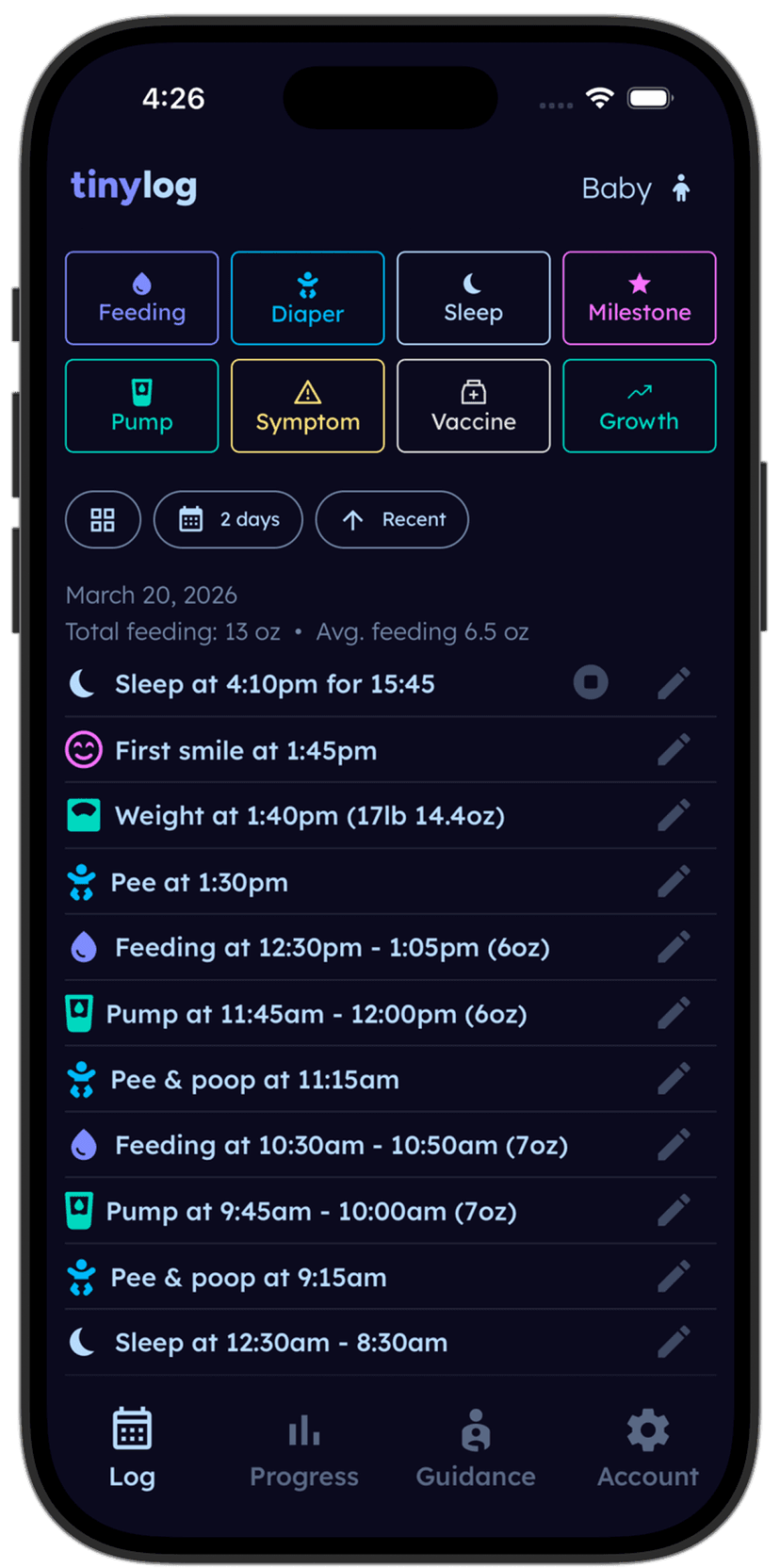
Tinylog activity log showing feedings, diapers, and sleep tracked throughout the day

Track every feeding and diaper from day one.

You won't remember which side you nursed on last or how many wet diapers there were today. The app will.

Download on the App StoreGet It On Google Play

Sleep (Yours and Theirs)

Newborns do not know the difference between day and night. They will sleep in short bursts around the clock, and their schedule will not align with yours. This is not a problem to solve in the first 48 hours. It is just the reality.

The advice to "sleep when the baby sleeps" is both the most annoying and the most important thing you will hear. You will be tempted to use nap time to clean, eat, shower, or scroll your phone. Resist when you can. Sleep deprivation compounds quickly, and even a 20-minute nap makes a measurable difference in how you feel and function.

Take shifts with your partner if possible. One person sleeps while the other handles the baby. Even a 3-4 hour uninterrupted stretch of sleep can feel transformative in those first days. See our newborn sleep schedule guide for what to expect week by week.

Diapers: What to Expect

Diaper changes are a constant in the first 48 hours. Expect your newborn to have 1-2 wet diapers on day 1, gradually increasing to 6 or more by day 4-5 as your milk comes in or they take more formula.

Your baby's first bowel movements will be meconium, a thick, dark, tar-like substance. This is normal and clears within the first 2-3 days, transitioning to softer, seedy, yellowish stools (for breastfed babies) or tan, more formed stools (for formula-fed babies). Our baby poop color chart covers what each color means.

Tracking diapers from the beginning matters. Wet and dirty diaper counts are one of the primary ways your pediatrician gauges whether your baby is eating enough. When they ask at the first checkup, you will want an actual number, not a guess.

When to Call the Doctor

Most of what happens in the first 48 hours is normal. But some things warrant a call to your pediatrician, and one thing is always an emergency.

Call Your Pediatrician If...

  • Fever of 100.4°F (38°C) or higher in baby. This is always urgent in a newborn
  • Baby is too sleepy to eat or cannot be woken for feedings
  • Fewer wet diapers than expected (at least 1-2 on day 1, increasing daily)
  • Yellowing of the skin or eyes (jaundice) that is worsening
  • Baby is not latching or refusing to eat entirely
  • Umbilical cord stump has redness, swelling, or foul-smelling discharge
  • You are having thoughts of harming yourself or your baby. Call immediately

When in doubt, call. Your pediatrician's office has a nurse line for a reason. No question is too small in the first 48 hours.

The Bottom Line

The first 48 hours with a newborn are messy, exhausting, emotional, and wonderful. Sometimes all at once. You will not have it figured out by hour 48. Nobody does. The goal is not perfection. The goal is to keep your baby fed, safe, and loved, and to take care of yourself in the process.

Everything feels huge right now because it is. But you will find your rhythm. It will not happen in the first 48 hours, and that is completely fine.

Related Guides

This guide is for informational purposes only and is not a substitute for professional medical advice. Always consult your pediatrician or healthcare provider with any questions about your newborn's health.

Want this guide in your inbox?
We'll send you this reference for quick access, because you will not remember anything we just told you.
Your brain will be mush. Let the app remember for you.
Tinylog tracks feeds, diapers, and sleep so you don't have to hold it all in your head.
Download on the App StoreGet It On Google Play