
Chest-to-chest counts
Lying on your chest while you're reclined counts as tummy time, especially for newborns. It's inclined, so it's easier than the floor, and the skin-to-skin contact is a bonus. This is often the easiest way to start.
GUIDE
Published on
Back time is for safe sleep. Tummy time is for building strength. Your baby needs both — back to sleep, tummy to play — and the balance shifts as they grow and gain head control.
The 'Back to Sleep' campaign saved lives, but it also created a generation of babies who need intentional tummy time to build the muscles they used to develop naturally.
Log activities and watch progress
“Tummy time is an early chance for interaction and play with your baby, which is a really crucial bonding activity.”
 Dr. Matthew Badgett, MD, Pediatrician, Cleveland Clinic
In 1994, the "Back to Sleep" campaign changed how parents put babies to bed. It was one of the most successful public health campaigns in history — SIDS deaths dropped by more than 50%. The recommendation is clear and unchanged: babies should always be placed on their backs to sleep.
But the campaign had an unintended side effect. With babies spending so much time on their backs — for sleep, in car seats, in bouncers, in swings — they were getting less time in positions that build the muscles they need for motor development. Rates of positional plagiocephaly (flat head spots) increased. And some babies were slower to develop head control, rolling, and crawling.
That's where tummy time comes in. It's not optional or nice-to-have — it's an essential part of your baby's physical development that compensates for all the necessary back time during sleep. The AAP recommends supervised tummy time starting from day one.
| Aspect | Tummy Time | Back Time |
|---|---|---|
| Primary purpose | Builds neck, shoulder, arm, and core strength | Safe sleep position; reduces SIDS risk by over 50% |
| When to use | During supervised awake time, multiple times per day | For all sleep; also during supervised play with varied positions |
| Developmental benefit | Prepares for rolling, crawling, sitting; prevents flat spots | Allows visual exploration, reaching, kicking; develops leg strength |
| Daily target (3-4 months) | Work up to 60+ minutes total per day, spread across sessions | All sleep time; remaining awake time with position variety |
| Baby's typical reaction | Many babies fuss initially — it's physically demanding for them | Most babies are comfortable and content on their backs |
| Risk if overdone | Minimal risk if supervised — baby will let you know when they're done | Extended unsupervised back time in one position can contribute to flat spots |
| Starts when | Day 1 — on parent's chest counts as tummy time | Day 1 — the recommended sleep position from birth |
The WHO recommends at least 30 minutes of tummy time per day for infants, building to more as they grow.
If your baby consistently refuses tummy time despite gradual introduction, mention it to your pediatrician to rule out discomfort or reflux.
The back sleep recommendation applies until your baby can roll both ways independently, typically around 4-6 months.
Limiting time in 'containers' (car seats, swings, bouncers) to necessary periods helps offset excessive back-positioned time.
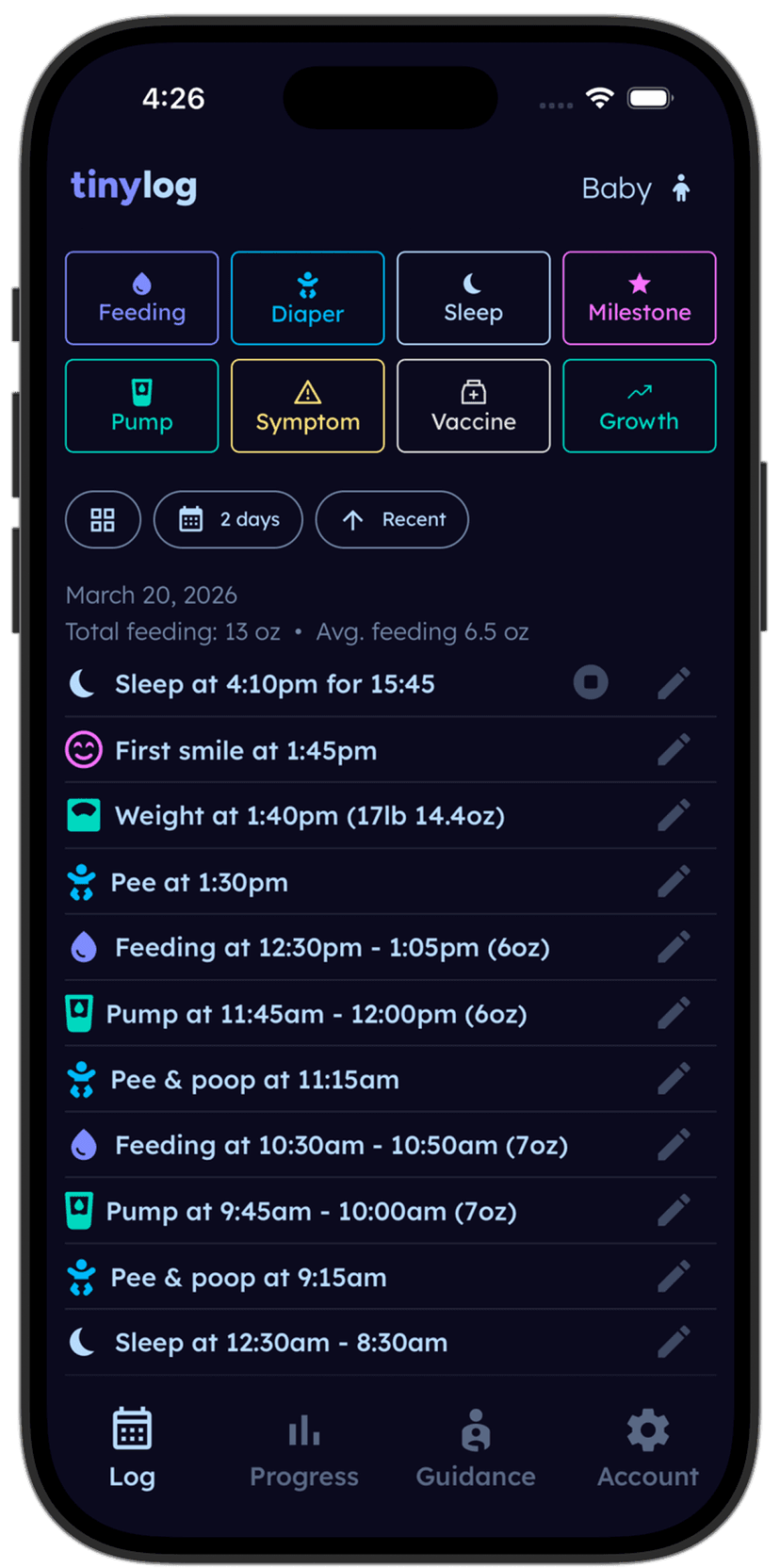
Log tummy time sessions in Tinylog — even the short ones. Small sessions throughout the day add up, and seeing the total helps you know your baby is getting enough practice.


The targets increase as your baby gains strength. Newborns can start with 1-2 minutes at a time, several times a day — on your chest is perfectly fine. By 2 months, aim for 10-20 minutes total across the day. By 3-4 months, work toward 60 minutes total per day, broken into as many sessions as needed.
These are cumulative targets, not single-session goals. A baby who does eight 5-minute sessions gets 40 minutes of tummy time. That's more effective — and more pleasant for everyone — than forcing one long session. By 5-6 months, many babies enjoy tummy time because they've developed the strength to hold their head up, look around, and reach for toys.
Once your baby starts rolling on their own (typically 4-6 months), they'll naturally get into and out of the prone position during play. At that point, formal tummy time becomes less necessary because they're building those muscles throughout their normal activity.
Modern baby gear — car seats, bouncers, swings, rockers — keeps babies on their backs in a semi-reclined position. Each one is fine in moderation, but collectively they can mean a baby spends their entire day in a back-positioned container, only to be placed on their back again for sleep.
The AAP and physical therapists recommend limiting total container time and prioritizing floor time — both tummy and back — during awake hours. When your baby is awake, the floor (or your chest) is the best place for them to develop both gross and fine motor skills. Vary their position every 15-20 minutes between tummy, back, and side-lying to give all muscle groups a chance to work.
Lying on your chest while you're reclined counts as tummy time, especially for newborns. It's inclined, so it's easier than the floor, and the skin-to-skin contact is a bonus. This is often the easiest way to start.
Five 3-minute sessions are better than one 15-minute session that ends in tears. Spread tummy time throughout the day — after diaper changes, between feeds, whenever baby is alert and content.
Your baby shouldn't spend all their awake time in any single position. Rotate between tummy time, back play, side-lying (supervised), being held upright, and babywearing. Variety is the best approach for well-rounded development.
This guide is for informational purposes only and is not a substitute for professional medical advice. Consult your pediatrician for guidance specific to your baby.