
Frequent feeding
Eating every 1-2 hours does NOT mean low supply. Breast milk digests in about 90 minutes, and frequent feeding is how breastfed babies regulate supply. This is normal biology, not a red flag.
GUIDE
Published on ·Updated on
Wet diapers, weight gain, and a generally content baby between feeds — those three things tell you more than any amount of pumping or weighing.
This is the single most common worry in breastfeeding. You can't see ounces going in, so your brain fills the gap with anxiety. Here's how to replace the anxiety with data.
Log breast, bottle and solids
Here's the fundamental anxiety of breastfeeding: you can't see how much milk your baby is getting. A bottle has markings. A breast does not. And into that gap between what you know and what you can see, your sleep-deprived brain will pour every worst-case scenario it can find.
But here's the thing — you don't actually need to see the ounces. You need to see the output. Wet diapers, stools, and weight gain tell you what went in by showing you what comes out. This is how lactation consultants and pediatricians assess intake, and it's more reliable than trying to measure breast milk volume directly.
If your baby is producing enough wet diapers, gaining weight at checkups, and generally seems content between feeds, they are getting enough milk. Full stop. Even if they eat frequently. Even if your breasts feel soft. Even if your pump only gets 2 ounces.
| Age | Wet Diapers | Stools | Weight Gain | Feed Frequency | Notes |
|---|---|---|---|---|---|
| Week 1 | Building: 1 on day 1, 2 on day 2... 6+ by day 5 | Transitioning from meconium to yellow | May lose up to 7-10% of birth weight | 8-12+ per 24 hours | This is the calibration phase. Frequent feeding drives milk production. |
| Weeks 2-4 | 6+ per day | 3-4+ yellow, seedy per day | Gaining 5-7 oz per week; back to birth weight by day 10-14 | 8-12 per 24 hours | If baby is back to birth weight by 2 weeks, you're on track. |
| Months 1-3 | 6+ per day | Variable — some babies go daily, some go days between | 5-7 oz per week | 7-10 per 24 hours | Feeds get shorter as baby gets more efficient. Less time nursing ≠ less milk. |
| Months 3-6 | 6+ per day | Wide variation in frequency is normal | 3-5 oz per week (growth rate slows naturally) | 6-8 per 24 hours | Supply is regulated. Breasts may feel soft even when full. Baby feeds faster. |
| Months 6-12 | 4-6+ per day (solids add to output) | Changing with solid food introduction | Growth rate continues to slow (normal) | 4-6 per 24 hours plus solids | Breast milk remains primary nutrition until 12 months even as solids increase. |
If most of these describe your baby, they're getting enough. Even on cluster feeding days. Even when your breasts feel soft.
These are the most common reasons parents worry they don't have enough milk — and none of them are reliable indicators of supply.
Eating every 1-2 hours does NOT mean low supply. Breast milk digests in about 90 minutes, and frequent feeding is how breastfed babies regulate supply. This is normal biology, not a red flag.
Some babies comfort suck, some have a high suck need, and some are going through a growth spurt. A baby who acts hungry 30 minutes after a full feed isn't necessarily underfed — they might be cluster feeding or seeking comfort.
Your pump is not your baby. Babies are more efficient than pumps — significantly so. A pump might get 2 oz where your baby gets 4. Never use pump output to judge supply. If you need a real measurement, ask for a weighted feed.
Soft breasts don't mean empty breasts. Once your supply regulates (around 6-12 weeks), your breasts may stop feeling full even when they're producing plenty. This is supply regulation, not supply loss.
Babies fuss for many reasons beyond hunger: overstimulation, gas, tiredness, wanting to be held, being a baby. If diapers and weight are on track, fussiness alone doesn't indicate insufficient milk.
Breastfed babies eat more frequently and may take smaller volumes per feed than formula-fed babies. They also have different growth patterns — WHO breastfed baby growth charts show different curves than older charts based on formula-fed norms. Compare to the right standard.
For more on the difference between perceived and actual low supply, see our low milk supply guide.
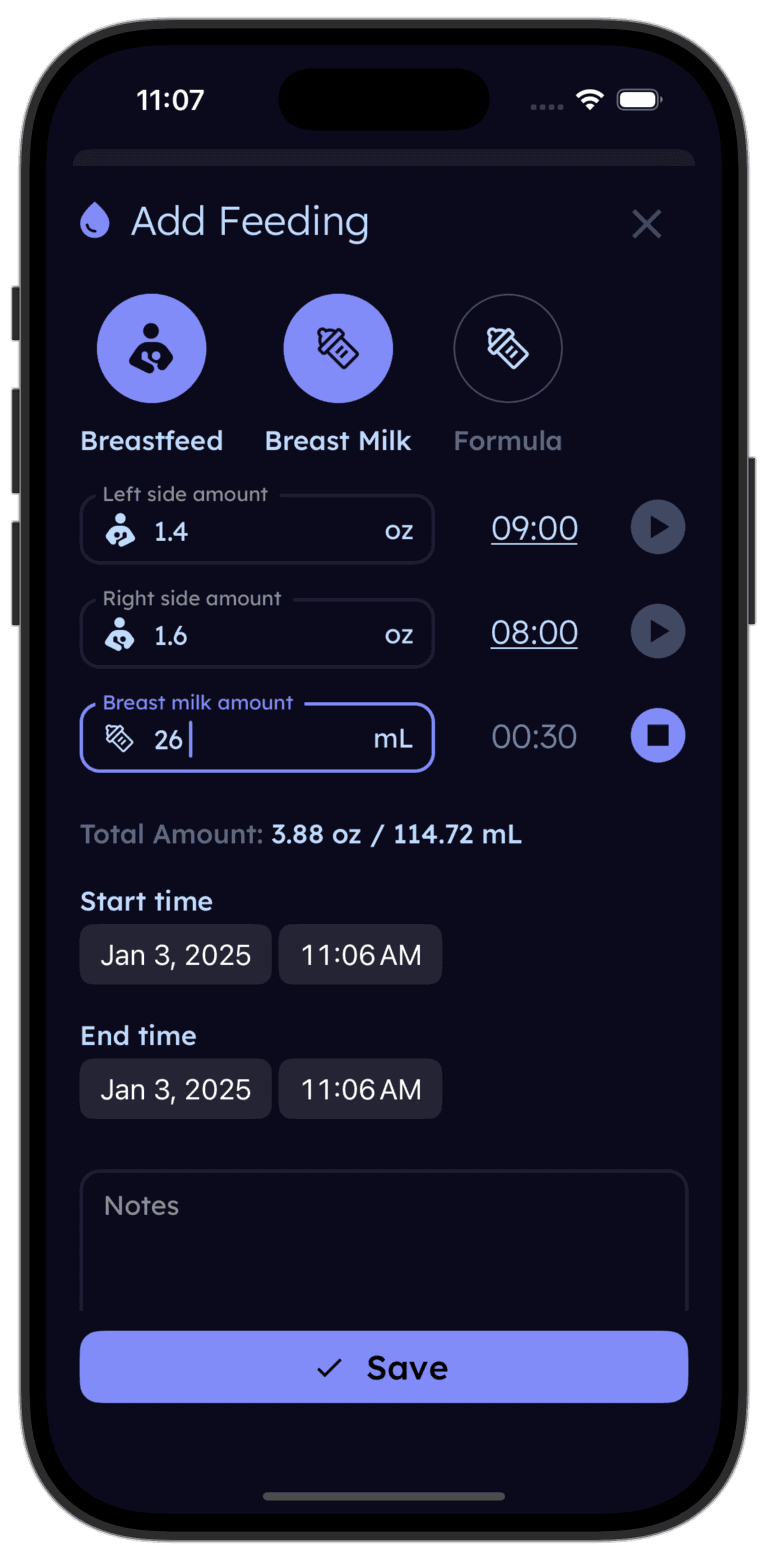
Tinylog lets you log feeds and diapers in seconds and chart weight over time. Bring actual data to your pediatrician or lactation consultant instead of trying to remember.


One of these in isolation may not be alarming — several together warrant a call to your pediatrician. Better to check and be reassured than to wait and worry.
If you truly need to know how much milk your baby transfers during a feed, ask your IBCLC about a weighted feed. Here's how it works: baby is weighed on a sensitive scale before nursing, then weighed again immediately after (same diaper, same clothes). The difference is the amount of milk consumed.
This is significantly more accurate than pump output because baby is actually doing the feeding. A weighted feed gives you real transfer data for that specific session. Your IBCLC can then extrapolate daily intake based on how many feeds your baby takes.
Weighted feeds are especially useful when weight gain is borderline, when you're investigating a suspected tongue tie, or when you just need a data point to relieve anxiety. One number can sometimes do more for your peace of mind than weeks of worrying.
"Breastfed babies should eat every 3-4 hours like formula-fed babies." No. Breast milk is digested in about 90 minutes — faster than formula. The AAP recommends feeding breastfed babies on demand, which typically means every 1.5-3 hours in the early months. Stretching feeds to match formula schedules can actually reduce milk supply and baby's intake.
"If baby isn't on the 50th percentile, they're not getting enough." Growth percentiles are not grades. A baby on the 15th percentile who follows their curve is growing perfectly. What matters is that baby stays on or near their own curve, not that they're at any particular percentile. The WHO growth standards, which are based on breastfed babies, should be used for breastfed infants.
"Your milk gets thinner and less nutritious over time." False. The composition of breast milk changes over the course of lactation, but it remains nutritionally adequate. Fat content actually increases within a feed (foremilk to hindmilk) and across the day. Mature milk at 12 months still provides significant nutrition and immune benefits. (Ballard & Morrow, 2013)
"Supplementing with formula after nursing means baby wasn't getting enough." Not necessarily. Some parents supplement for non-supply reasons: convenience, shared feeding, work schedules. And for babies with genuine intake concerns, supplementing is a medical intervention — not evidence that breastfeeding failed. The two aren't mutually exclusive.
See your pediatrician if: weight gain is below expected (less than 5 oz per week in the first 3 months), baby has fewer wet diapers than expected, or you see signs of dehydration. Pediatricians can do weighted measurements and evaluate whether intake is adequate.
See an IBCLC if: you want a weighted feed, you're worried about milk transfer, or your baby seems to nurse but never seems satisfied. IBCLCs can observe a full feed, check latch and transfer, and give you a concrete action plan.
See your pediatrician AND an IBCLC if: both supply and weight gain are concerns. These professionals complement each other — the pediatrician monitors baby's health, the IBCLC optimizes breastfeeding.
For general feeding intake benchmarks (including formula), see our is my baby eating enough guide.
Low Milk Supply — Real causes, real solutions, and when it is actually fine
Is My Baby Eating Enough? — Signs to watch for at every age
How Much Should a Newborn Eat? — Feeding chart by age
This guide is for informational purposes only and is not a substitute for professional medical advice. If you're experiencing breastfeeding difficulties, consider consulting an IBCLC (International Board Certified Lactation Consultant) or your pediatrician.