GUIDE

When Baby Only Sleeps on You

Contact sleep is biologically normal — your baby isn't manipulating you, they're following millions of years of survival instinct. And no, you're not creating a bad habit.

Here's why it happens, when it matters, and gentle ways to transition if you want to.

First Things First: You're Not Doing Anything Wrong

If you're reading this while pinned under a sleeping baby, one arm going numb, desperately Googling whether you've ruined your child's sleep forever — take a breath. You haven't.

Your baby sleeping on you is one of the most normal, biologically expected things a baby can do. They're not manipulating you. They haven't learned a "bad habit." They're doing exactly what babies have done for hundreds of thousands of years — staying close to their caregiver to stay alive.

The fact that your baby sleeps well on you and terribly in the crib isn't a sign that something is wrong. It's a sign that your baby's nervous system is working exactly as designed. And it does get easier — on its own timeline, at its own pace.

This guide will explain why contact sleep happens, help you do it safely, and give you gentle strategies for transitioning to independent sleep if and when you're ready. No pressure, no judgment, no timelines you have to meet.

Why Your Baby Wants to Sleep on You

It's easy to think of contact sleep as a quirk or a problem to solve. But when you understand the biology, it makes perfect sense.

Your heartbeat and breathing are a sleep machine

Your baby spent months listening to your heartbeat and feeling the rhythm of your breathing. Those sounds and vibrations are deeply familiar. When they sleep on your chest, they're getting the same sensory input that surrounded them in the womb — rhythmic, predictable, calming.

Warmth regulation

Newborns are not great at regulating their own body temperature. Your body does it for them automatically through skin contact. When they're placed on a cool, flat surface alone, they lose that thermal regulation and their body has to work harder — which can wake them up.

The Moro reflex

That dramatic startle reflex — arms flinging out, eyes popping open — is the Moro reflex, and it's strongest from birth to about 4 months. It triggers most often when a baby feels unsupported or senses a sudden change in position (like, say, being lowered into a crib). On your chest, they feel contained and secure, so the reflex rarely fires.

Movement

You breathe, you shift, you sway slightly without thinking about it. That gentle movement is exactly what your baby's vestibular system craves. A still crib offers none of that. The motion of your body keeps them in deeper sleep.

Survival instinct — literally

For most of human history, a baby separated from a caregiver was a baby in danger. The drive to stay close during sleep isn't a preference — it's hardwired. Your baby isn't being difficult when they cry the moment you put them down. They're responding to thousands of years of evolutionary programming that says 'alone means unsafe.'

None of this means your baby can never sleep independently. It just means that right now — especially in the first few months — their preference for sleeping on you is rational, biological, and temporary. Understanding the way baby sleep cycles work can also help explain why the transition to flat, still surfaces is harder than it seems like it should be.

Is Contact Sleep a Problem?

Honestly? That depends entirely on you.

Contact sleep is not a problem if: you enjoy it, your schedule allows it, you're managing your own rest, your baby is sleeping well, and you feel okay. Plenty of families contact nap for months — sometimes the entire first year — and everyone thrives. There is zero evidence that holding your baby while they sleep causes any developmental or behavioral harm. None.

Contact sleep becomes a problem if: you're in physical pain, you can't eat or take care of yourself, you're so tired you're falling asleep in unsafe positions, your mental health is suffering, or you simply don't want to do it anymore. All of those are valid reasons to make a change. You don't need to be in crisis to decide you want something different.

The distinction isn't "contact sleep is good" or "contact sleep is bad." It's: "Is this working for my family right now?" If the answer is yes, keep going. If the answer is no, there are gentle ways to shift — and we'll get to those.

Safe Contact Sleep Practices

  • Stay awake while your baby sleeps on you — this is the most important rule
  • Sit upright or slightly reclined, never fully lying down on a sofa or recliner
  • Keep your baby's face visible and airway clear at all times — chin off chest, nose and mouth uncovered
  • Never contact sleep on a couch, armchair, or recliner — these are the highest-risk surfaces for infant suffocation
  • If you feel yourself getting drowsy, move your baby to their safe sleep space immediately
  • If you keep falling asleep with your baby, prepare a firm, flat surface following safe bedsharing guidelines rather than risking falling asleep in a chair
  • Remove loose blankets, scarves, or anything near your baby's face
  • Don't contact sleep if you've consumed alcohol, sedating medications, or if you're extremely sleep-deprived and likely to fall asleep

The AAP identifies sofas and recliners as the highest-risk surfaces for sleep-related infant deaths. If you're going to contact sleep, a firm chair while sitting upright and fully awake is the safest option. If you keep falling asleep accidentally, it's safer to set up a planned, intentional safe sleep surface than to fight against biology in an armchair.

When You're Ready to Transition

If you've decided you'd like your baby to start sleeping more independently — great. If you haven't — also great. Skip this section entirely and come back to it whenever you want, if you ever want.

For those who are ready, here are strategies that work gently. None of these require crying it out, and all of them assume you're going at your baby's pace.

Start with one nap, not all of them

Pick a single nap — ideally the first nap of the day, when sleep pressure is highest — and try it in the crib. Keep all other naps as contact naps. You're not going cold turkey. You're running a small experiment, once a day, with very low stakes.

Wait for deep sleep before the transfer

When your baby falls asleep on you, wait at least 10 to 20 minutes before attempting the crib transfer. Watch for signs of deep sleep: limp limbs, slow and regular breathing, no eye movement under the lids. If you move them during light sleep, the transfer will almost certainly fail.

Warm the crib surface first

Place a heating pad or warm water bottle on the crib mattress for a few minutes before the transfer, then remove it completely before laying your baby down. Going from your warm body to a cold sheet is one of the most common reasons babies wake immediately on transfer. The temperature change alone can trigger arousal.

Try a firm swaddle for babies under 4 months

A snug swaddle mimics the contained feeling of being held and suppresses the Moro reflex — the startle that jolts babies awake during transfers. Stop swaddling once your baby shows any signs of rolling. For older babies, a sleep sack gives a cozy, enclosed feeling without the restraint.

Go butt-first on the transfer

Instead of lowering your baby headfirst, lower their bottom to the mattress first, keep your hands on their chest for a moment, then slowly slide your hands out. This keeps the sensation of pressure on their chest for as long as possible, mimicking the feeling of being held.

White noise and darkness are your transfer allies

Have the white noise already running and the room already dark before you attempt the transfer. These environmental cues help maintain the sleep state. If your baby starts to stir during the transfer, a gentle shush or a hand on their chest can sometimes settle them back without picking them up.

Expect some failed transfers — that's normal

The first week of trying crib naps will probably involve a lot of 10-minute naps and re-do contact naps. That's fine. You're building a new association gradually. Even a short crib nap counts as practice. If a transfer fails, contact nap it is — no guilt, no setback.

For more on wake windows, nap schedules, and age-appropriate sleep strategies, the baby sleep playbook covers everything from newborn through 12 months. And if your baby is also fighting sleep in general — not just preferring contact — our guide on why babies fight sleep can help you figure out what else might be going on.


Age-by-Age Expectations

One of the most stressful parts of contact sleep is not knowing whether it's "normal" for your baby's age. Here's a reality check by age — and remember, these are general patterns, not deadlines.

0–6 weeks

Contact sleep is the norm. Most newborns strongly prefer sleeping on a caregiver. This is completely typical and expected. Don't fight it. Set up a comfortable contact nap station with water, snacks, phone charger, and remote within reach. Accept the help people offer.

6–12 weeks

Still very normal. Some babies may start tolerating short stretches in a bassinet, especially at night when sleep drive is strongest. You can try one crib nap a day if you want to — but there's zero pressure. Many babies this age still need contact sleep for all naps.

3–4 months

The Moro reflex is fading, which makes crib sleep easier. Some babies naturally start accepting the crib; others still strongly prefer being held. If you want to start gentle transitions, this is a reasonable time. Swaddling helps if they're not rolling yet. But if contact sleep still works for you, keep going.

5–6 months

Most babies are developmentally capable of sleeping independently for at least some naps. Contact sleep preference may decrease on its own. A good time for gradual crib transitions if you haven't started. The startle reflex is gone and sleep cycles are maturing. But again — only if you want to.

7–12 months

Most babies are sleeping independently for at least nighttime sleep. Some still prefer contact naps, which is fine if it works for your family. If contact sleep is causing problems (back pain, you can't function, it's affecting your mental health), gentle sleep changes are very appropriate here.

If your baby is going through the 4-month sleep regression, contact sleep often intensifies temporarily as their sleep cycles reorganize. That's normal and doesn't undo any progress you've made.

What No One Tells You

There's nothing to 'fix' if it's working for you

The internet will tell you contact sleep is a problem you need to solve. It's not — unless it's a problem for you. If you love holding your sleeping baby, if your schedule allows it, if you're managing fine — there is nothing wrong with continuing. The only person who gets to decide if contact sleep is a problem is you.

Contact naps are often longer

You're not imagining it. Research confirms that babies held during sleep tend to sleep longer and more soundly. Your body provides warmth, motion, and sensory regulation that helps them connect sleep cycles. A 2-hour contact nap versus a 30-minute crib nap isn't a sign of a problem — it's biology doing exactly what it's designed to do.

This phase actually ends

It doesn't feel like it right now, but the intensity of contact sleep need does decrease. By 6 months, many babies who seemed physically incapable of sleeping without being held are napping in their crib with minimal fuss. It happens gradually, sometimes without you even trying. Development is doing most of the work.

Your needs matter too

Saying 'I need to put my baby down sometimes' isn't selfish. It's honest. You need to eat, shower, use the bathroom, move your body, and occasionally exist as a person who isn't a mattress. If contact sleep is working beautifully, great. If it's running you into the ground, that's valid and worth addressing — not because there's something wrong with your baby, but because you deserve to function.

tinylog sleep tracker showing nap duration comparison over time

Compare contact naps vs. crib naps and see what's actually working.

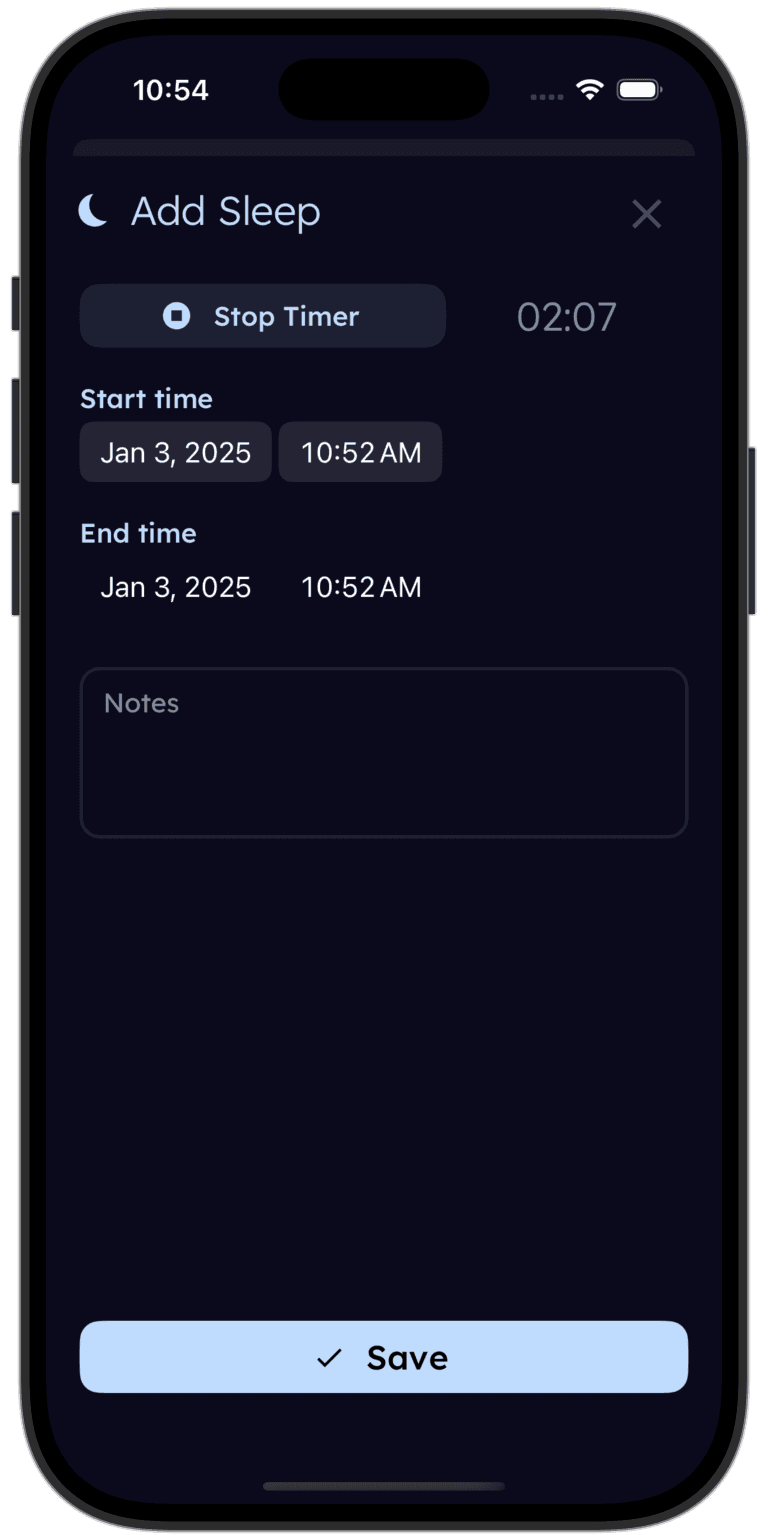
Log naps in a couple of taps — tinylog tracks where and how long your baby sleeps so you can spot the pattern over time. See if those crib naps are getting longer, without relying on your sleep-deprived memory.

Download on the App StoreGet It On Google Play

When to Talk to Your Pediatrician

  • Your baby cannot sleep at all — not even on you — and seems constantly uncomfortable or in pain
  • They arch their back, scream, or seem distressed during or after feeds, which may suggest reflux
  • You notice breathing irregularities, pauses, or unusual sounds during sleep in any position
  • Your baby is not gaining weight appropriately
  • The sleep situation is significantly affecting your mental health — anxiety, depression, feeling unable to cope
  • Your baby is older than 6 months and the contact sleep need seems to be intensifying rather than gradually improving

You never need a 'good enough' reason to call your pediatrician. 'I'm worried' is always sufficient. That's what they're there for.

Related Guides

Sources

  • American Academy of Pediatrics (AAP). (2022). Sleep-Related Infant Deaths: Updated 2022 Recommendations for Reducing Infant Deaths in the Sleep Environment. Pediatrics, 150(1).
  • Baby Sleep Information Source (BASIS), Durham University. Normal Infant Sleep Development. https://www.basisonline.org.uk
  • Feldman, R., Rosenthal, Z., & Eidelman, A. I. (2014). Maternal-Preterm Skin-to-Skin Contact Enhances Child Physiologic Organization and Cognitive Control Across the First 10 Years of Life. Biological Psychiatry, 75(1), 56–64.
  • Ludington-Hoe, S. M. (2011). Thirty Years of Kangaroo Mother Care Science and Practice. Neonatal Network, 30(5), 357–362.
  • Galland, B. C., Taylor, B. J., Elder, D. E., & Herbison, P. (2012). Normal sleep patterns in infants and children: A systematic review of observational studies. Sleep Medicine Reviews, 16(3), 213–222.
  • Zero to Three. Helping Your Baby Sleep. https://www.zerotothree.org

Medical Disclaimer

This guide is for informational purposes only and is not a substitute for professional medical advice. If you have concerns about your baby's sleep, safety, or health, please consult your pediatrician.

Want this guide in your inbox?
We'll send you this guide so you have it ready for the next contact nap.
Track nap lengths to see what's working.
Download tinylog free — compare contact naps vs. crib naps and see the trend over time.
Download on the App StoreGet It On Google Play