
Try a different nipple
This is the single most common fix for formula refusal in young babies. Nipple shape, material (silicone vs. latex), and flow rate all matter. Some babies are very particular. Buy a few different options and experiment.
GUIDE
Published on ·Updated on
Formula refusal usually has a fixable cause. The reason depends a lot on your baby's age.
A newborn refusing a bottle is a different problem than a 6-month-old pushing it away. Here's how to figure out what's going on and what to try — broken down by age.
Free 2-min quiz. Matched to your baby, plus tracking to confirm it works.
“All infant formulas must meet requirements that ensure optimal nutrition for babies. If your baby's formula is sold in the U.S., it has the nutrients your baby needs.”
 Dr. Matthew Badgett, MD, Pediatrician, Cleveland Clinic
A baby refusing formula is stressful. Your instinct to worry is completely understandable — feeding your baby is your primary job right now, and when they won't eat, it feels urgent.
Here's the reassuring part: most formula refusal is temporary, has a fixable cause, and does not mean your baby is in danger. Babies are surprisingly good at self-regulating their intake. A single refused feed — or even a day of lighter eating — is rarely a medical concern if your baby is otherwise healthy, alert, and making wet diapers.
That said, there are patterns that do warrant attention. Let's break it down by age.
| Age | Reason | What You'll Notice | What to Try |
|---|---|---|---|
| 0-4 weeks | Nipple flow too fast or too slow | Gulping, choking, or getting frustrated and pulling away; or falling asleep quickly without eating much | Try a different nipple flow rate. Newborns usually need a slow-flow (size 0 or 1) nipple. If baby is working very hard and getting tired, try the next size up. |
| 0-4 weeks | Formula temperature | Turns head away, fusses when bottle touches lips, but shows hunger cues | Many newborns prefer formula warmed to body temperature (98.6 degrees F). Test on your inner wrist. Some babies are fine with room temp — experiment. |
| 0-4 weeks | Tongue tie or lip tie | Clicking sounds while feeding, milk leaking from sides of mouth, poor latch on nipple, very long feeds with little intake | Ask your pediatrician to check for oral restrictions. A lactation consultant can also evaluate latch and suck. |
| 0-4 weeks | Reflux or discomfort | Arching back during feeds, crying after a few sips, excessive spitting up, seeming hungry but refusing to eat | Try smaller, more frequent feeds. Hold baby upright during and for 20-30 minutes after feeding. Talk to your pediatrician about reflux. |
| 1-3 months | Flow rate needs updating | Baby seems frustrated with the bottle, takes much longer to finish feeds, fusses mid-feed | As babies grow, they may need to move from size 1 to size 2 nipples. If feeds consistently take more than 30 minutes, try a faster flow. |
| 1-3 months | Overstimulation | Feeds well when sleepy or in a quiet room, refuses when there's activity around | Feed in a dimmer, quieter environment. Reduce eye contact and talking during feeds if baby keeps popping off to look at you. |
| 3-6 months | Distraction phase | Constantly pulling off the bottle to look around, eating very little during daytime feeds, eating more at night | Feed in a dark, quiet room. Offer bottle at the start of nap routine when baby is drowsy. Accept that daytime feeds may be shorter — many babies compensate overnight. |
| 3-6 months | Teething pain | Drooling more, chewing on everything, fussy at the start of feeds, may eat better with a cold nipple | Offer a cold teether before feeds. Massage gums gently. Some parents find that slightly cooling the formula helps. Pain relief per your pediatrician's guidance. |
| 3-6 months | Formula change | Refusal started right after switching brands or types | Give it a few days — some babies need time to adjust to a new taste. If refusal persists for a week, talk to your pediatrician about alternatives. |
| 6-9 months | Solids are filling them up | Eating less formula but eating well at solid meals, still gaining weight, happy and active | Completely normal. Offer formula before solid meals to maintain milk intake. Total formula will naturally decrease as solids increase. |
| 6-9 months | Illness | Fever, congestion, ear pulling, general fussiness, reduced appetite across all food types | Offer smaller amounts more frequently. If baby has a stuffy nose, use saline drops before feeding — babies can't breathe and eat at the same time. Call your ped if fever is high or refusal lasts 24+ hours. |
| 9-12 months | Strong food preferences emerging | More interested in table food than the bottle, may take less formula at meals but still drinks at wake-up and bedtime | Normal developmental shift. Keep offering formula at key times (morning, before naps, bedtime). Total daily formula will decrease as the first birthday approaches. |
| 9-12 months | Cup transition readiness | Plays with the bottle instead of drinking, bites the nipple, seems bored with bottle feeding | Try offering formula in a straw cup or open cup. Some babies are ready to transition from bottles earlier than others. |
Before you switch formulas, call the doctor, or spiral — try these.
This is the single most common fix for formula refusal in young babies. Nipple shape, material (silicone vs. latex), and flow rate all matter. Some babies are very particular. Buy a few different options and experiment.
Warm formula to body temperature by running the bottle under warm water or using a bottle warmer. If your baby has been breastfed, they're used to warm milk — cold formula might be the issue.
Hold baby more upright (about 45 degrees), keep the bottle horizontal, and let baby control the pace. Fast flow can overwhelm some babies, causing them to refuse the bottle as a self-protection mechanism.
Offer the bottle at the start of a nap or bedtime routine, when baby is calm and sleepy. Many babies who refuse during active awake time will drink readily when drowsy.
Feed in a quiet, dimly lit room. Face baby away from visual stimulation. This is especially effective for the 3-6 month distraction phase.
If you're the breastfeeding parent, baby may refuse a bottle from you because they can smell your milk. Have a partner or caregiver offer the bottle while you're in another room.
Make sure you're following the correct water-to-powder ratio. Over-concentrated formula tastes different and can cause stomach discomfort. Under-concentrated formula may not be satisfying.
Check for fever, stuffy nose, ear infection symptoms (pulling at ears, crying when laid flat), and mouth sores (hand, foot, and mouth disease is common and makes sucking painful).
This is the thing that calms most parents down once they see it: your baby's total daily intake matters far more than any individual feed. A baby who refuses the 2 PM bottle but eats extra at 5 PM, bedtime, and overnight is still getting enough.
The problem is that individual feeds feel very visible and emotional in the moment, while daily totals are abstract. You remember the feed where your baby screamed and pushed the bottle away. You don't automatically add up the other five feeds that went fine.
This is where tracking helps. When you can look at actual numbers for the day — or the week — you can see whether refusal is actually affecting total intake or whether your baby is simply redistributing when they eat. If you're logging feeds in Tinylog, check the daily totals before you worry. More often than not, the math is fine.
For guidelines on how much formula your baby should be drinking at each age, see our formula amounts by age guide.
If you're seeing these signs, your baby is managing their intake — even if individual feeds look inconsistent. The overall pattern matters more than any single meal.
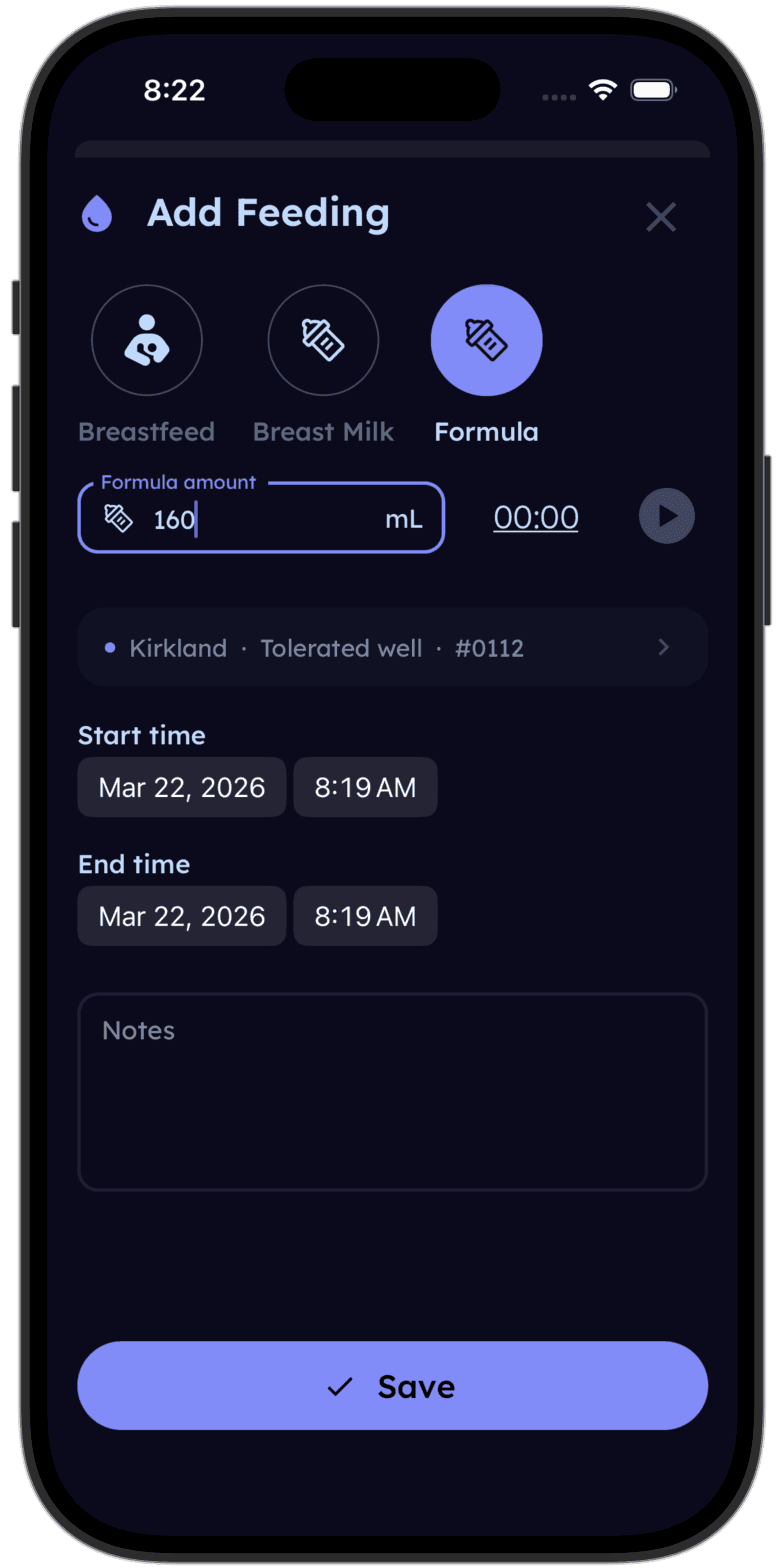
Log every feed and see the daily total at a glance. Most babies who refuse daytime bottles make it up overnight or at other feeds — and you can't know that without the numbers. Before you worry, check if the math adds up.


Trust your instincts. If something feels wrong, call your doctor. Having a feed log to share — even for just a few days — helps them assess the situation faster.
Beyond the urgent warning signs above, schedule a conversation with your pediatrician if:
A feeding log — even just a few days of data — changes the conversation with your pediatrician entirely. Instead of "my baby isn't eating well," you can say "my baby took 18 oz yesterday instead of the usual 26 oz, and has refused 3 of the last 5 daytime feeds." That specificity helps them figure out whether this is a pattern that needs attention or a normal stretch of lighter eating. If you're logging in Tinylog, bring the daily totals from the last week — that's exactly what they need.
For more context on age-appropriate feeding amounts, check out our baby feeding chart.
Formula aversion — where a baby has developed a negative association with bottle feeding — is different from typical refusal. It usually develops after a period of forced or pressured feeding, medical interventions involving the mouth or throat (like NG tube placement), or prolonged reflux that made feeding painful.
Signs of a true feeding aversion include: baby becomes distressed at the sight of the bottle, arches and turns away before the nipple even touches their lips, may only accept feeds while fully asleep, and the pattern persists for weeks.
If you suspect a feeding aversion, talk to your pediatrician. They may refer you to a feeding therapist or occupational therapist who specializes in infant feeding. This is a treatable condition, but the approach is different from standard formula refusal — it requires patience and a very low-pressure feeding strategy.
Switching Formulas — How to do it safely
How Much Formula by Age — A guide by age and weight
This guide is for informational purposes only and is not a substitute for professional medical advice. If you have concerns about your baby's feeding or health, please consult your pediatrician.